1&2 Timothy Bible Study

1 & 2 Timothy: Lesson 8

Previous Lessons: 123456, 7


Last week, we finished up the book of 1 Timothy. Today, we’re doing our preliminary background work on the book of 2 Timothy before diving into the text. You might want to review lesson 1 (link above) and compare the background information on 1 Timothy to the background information on 2 Timothy. How are they similar? How are they different?


Introduction to 2 Timothy

Before we begin studying a book of the Bible, it’s very important that we understand some things about that book. We need to know…

Who the author was and anything we might be able to find out about him or his background.

Who the audience of the book is: Jews or Gentiles? Old Testament Israelites or New Testament Christians? This will help us understand the author’s purpose and approach to what he’s writing.

What kind of biblical literature we’re looking at. We approach books of history differently than books of wisdom, books of wisdom differently than books of prophecy, etc.

What the purpose of the book is. Was it written to encourage? Rebuke? Warn?

What the historical backdrop is for the book. Is Israel at war? At peace? In exile? Under a bad king? Good king? Understanding the historical events surrounding a piece of writing help us understand what was written and why it was written.

When the book was written. Where does the book fall on the timeline of biblical history? This is especially important for Old Testament books which are not always arranged in chronological order.

So this week, before we start studying the actual text of the book of 2 Timothy, we need to lay the foundation to understanding the book by finding the answers to these questions.

Read the following overviews of the book of 2 Timothy, taking notes on anything that might aid your understanding of the book, and answer the questions below:

Bible Introductions: 2 Timothy at Grace to You

Overview of the Book of 2 Timothy at Reformed Answers

Book of 2 Timothy at Got Questions

1. Who wrote the book of 2 Timothy? How do we know this?

2. Approximately when was 2 Timothy written? What is the geographical setting of the book of 2 Timothy? Here are some maps (scroll down to “2 Timothy”) that may be helpful as you study through the book of 2 Timothy.

3. Who is the original, intended audience of the book of 2 Timothy? Describe the historical setting (historic events, politics, sociology of the time, etc.) of 2 Timothy.

4. Which genre of biblical literature is the book of 2 Timothy: law, history, wisdom, poetry, narrative, epistles, or prophecy/apocalyptic? What does this tell us about the approach we should take when studying this book versus our approach to books of other genres?

5. What is the theme or purpose of the book of 2 Timothy?

6. What are some of the major topics of instruction in the book of 2 Timothy? How do these topics relate to the theme of 2 Timothy?

7. What are some ways 2 Timothy points to and connects to Jesus?

8. What else did you learn about 2 Timothy or the setting of this book that might help you understand the text of the book better?

Take some time in prayer this week to begin preparing your heart to study 2 Timothy. What are some ways your pastor and church could be encouraged by the instruction of 2 Timothy? What might you learn that could make you a healthier church member? Do you have any areas that need improvement when it comes to the way you serve God or your brothers and sisters in Christ? Ask God to grow you in those areas as we continue to study 1 & 2 Timothy: The Structure and Spirit of the Church.
1&2 Timothy Bible Study

1 & 2 Timothy: Lesson 7

Previous Lessons: 1, 2, 3, 4, 5, 6

Read 1 Timothy 6

Questions to Consider

1. Examine verses 1-2, putting yourself in the sandals of a first century house servant who is a Christian. Explain God’s instruction that you’re to obey in each of these verses. What are the reasons God gives for these instructions in each verse? (Hint: after “so that” (1), after “since” (2)).

We often talk about how Ephesians 5 explains that the wife portrays to the world how the church is to relate to Christ, and how the husband portrays how Christ relates to the church. Explain what the Christian servant, by obeying the instructions in verses 1-2, portrays to the world about how a Christian relates to her master, Christ. How can these principles apply to the Christian employee’s behavior and attitude toward her boss in today’s world?

2. Read verses 3-10 from a “helicopter view” (big picture, main ideas). What are the two main concepts this passage deals with in 3-5a and 5b-10? How does this passage connect false doctrine and greed?

3. Carefully read verse 3. In the church today, many will say that as long as someone agrees to the most fundamental doctrines of soteriology (the things you must believe at the most basic level in order to be saved), that person should not be labeled a false teacher (even if they persist in teaching other unbiblical things despite correction, ex: homosexuality is OK, women preachers are OK, etc.). Does verse 3 seem to agree with that idea? Explain the terms “sound words of our Lord Jesus Christ,” and “teaching that accords with godliness.” Compare and contrast “different doctrine” with “different gospel” in Galatians 1:6-10. Are there different “levels” of unbiblical teaching?

4. How does 4a describe the false teacher? What is the fruit of teaching false doctrine? (4b-5) Compare this fruit to the fruit of false teachers described in Matthew 7:15-20. What kind of fruit does doctrinally sound teaching produce? Compare the fruit of false teaching with the fruit of doctrinally sound teaching. Matthew 7:20 says we will recognize false teachers by the fruit their ministry produces. You are the fruit of the pastors and teachers you sit under. If someone were examining your life, would she conclude that you sit under false teachers or doctrinally sound teachers?

5. Carefully examine verses 6-10. What do these verses teach us about contentment? How is godliness with contentment a great gain? How do greed and coveting rob us? How can we find our contentment and satisfaction in Christ?

6. Ephesians 4:21-32 explains the concept of “putting off” the old self and “putting on” the new self. We “put off,” or stop doing, something that is sinful (ex: lying, 4:25a), and “put on,” or proactively seek ways to do, the opposite, biblical thing (ex: proactively tell the truth 4:25b). Examine verses 11-21 in light of the Ephesians passage. What does “these things” in verse 11 refer to (the two major concepts in question #2)?

Make a list of the ways verses 11-16 and 20-21 instruct us to “put off” false doctrine and “put on” sound doctrine. Notice the imperatives (flee, pursue, fight, etc.) Paul uses. How does this wording convey the idea that these instructions are commands that require intentional action on our part?

Make a list of the ways verses 17-19 instruct us to “put off” greed and coveting and “put on” giving, generosity, and contentment in Christ, again noting the imperatives.

How can corporately putting off greed and false teaching, and putting on contentment and sound doctrine benefit and protect the structure and spirit of the local church?

7. Two of our recurring motifs in the book of 1 Timothy are back, and kind of overlap in verses 13-16. Can you identify these two motifs (Hint: If your memory needs jogging, see lesson 6, question 7 and lesson 5, question 9) and explain their significance? How are they similar or different to the previous instances of these motifs?


Homework

As we’ve studied 1 Timothy, one of the themes we’ve seen is the hierarchical structure of authority in the church (and even in the world), where each of us fits in that hierarchy, and how we’re to submit to those in authority over us. Can you think of other biblical passages that deal with these themes? Why do you think God made authority one of the major themes of this book and of the Bible?


Suggested Memory Verse

1&2 Timothy Bible Study

1 & 2 Timothy: Lesson 6

Previous Lessons: 1, 2, 3, 4, 5

Read 1 Timothy 5

Questions to Consider

If you have completed the Imperishable Beauty study, you may wish to look over your notes from lessons 10, 13, and 15, since we examined part of today’s passage (1 Timothy 5) in those lessons.

1. Notice the section heading at the beginning of this chapter and be reminded of the purpose and audience of this epistle. Who is the individual Paul is primarily addressing? What is his position in the church? What do these instructions pertain to?

2. How does God instruct Timothy (and every pastor) to treat the older/younger men and older/younger women he shepherds? (1-2) How do these instructions, if followed, benefit and protect the pastor, the church at large, and individual church members? Give a practical example of how a pastor could treat an older man, a younger man, an older woman, and a younger woman the way this passage instructs.

What does this passage not mean? For example – what if an older man is living in open sin? Does verse 1 mean the pastor should not confront him about that? What if a pastor is single and he and a woman five years his junior desire to get married? Does verse 2b prohibit that? Is there anything else this passage does not mean? Explain your answers with applicable Scripture.

3. Examine verses 3-16. What is the two word phrase used in both verse 3 and verse 16, that “bookends” this passage? Make a list of the things that qualify a woman as “truly” a “widow”. (4-16a) Now, go back over your list and highlight the character traits and activities that a godly woman will be exemplifying or practicing, and the ungodly traits and activities she will avoid, even before she becomes a widow. How can you continue to, or begin to, exemplify or practice each of these godly traits and activities and avoid the ungodly ones?

Compare the list of personal requirements and character qualifications of those who are “truly widows” (3-16) with the list of personal requirements and character qualifications for pastors and deacons in 3:1-13. What are the similarities and differences? How does this speak to the necessity of these men and women leading by setting a godly example in their character and practices for the rest of the church, and the rest of the church following their example? Explain how the role of leading by example is a vital role of leadership women must carry out in the church. How can women and men in the church learn from a godly woman who sets a good example?

What are the examples God gives of things women should be busying themselves with (14,16) in order not to fall into sin and set a bad example (11-13,15)?

4. Note how many times Paul speaks of the family’s duty to care for their widowed family members in 3-16. What are the various responsibilities of the family that he mentions? How are godly women particularly well suited to this kind of ministry? (16) What is the role of the pastor (7,9,11) and the church (16b) in this passage?

5. In 1 Timothy 2, (lesson 3, link above) God explained the two ways women may not minister in the church. What are those two ways? In 5:3-16, God lists many ways women can and must minister in the church. Make a list of each of those ways, and give a practical example of how a woman could carry out each of those ways in the church today (ex: What might “washing the feet of the saints” look like in the church today?) while still being obedient to God’s instructions for women in chapter 2.

6. Examine verses 17-20. Explain the church’s responsibilities regarding godly elders who righteously carry out their duties (17-18) as well as the church’s responsibilities regarding elders who persist in sin (19-20). (Use your cross-references.) Compare the instructions in verses 19-20 to the current idea in some corners of evangelicalism of “touch not My anointed“. How would you refute this false teaching from verses 19-20?

7. Explain the meaning of the charge God gives in verse 21, and the gravity and weightiness it conveys to pastors. Make a mental note of this, as this kind of charge will come up again in 1&2 Timothy.

8. After the weighty charge of verse 21, do the rapid fire instructions in verses 22-25 seem like a “P.S.” (and a P.P.S., a P.P.P.S, etc.) to a letter? Explain each instruction and why it was important to Paul and to the Holy Spirit to make sure it was included.


Homework

Think about a recent, sinful, evangelical “current event” (or an incident from your own church) you’re familiar with. For example: the egalitarian movement, a pastor falling into sin and having to step down, sexual abuse in the church, pastors spiritually abusing (intimidation, anger, threats, manipulation, etc.) their church members or congregation, false doctrine in the church, etc.

How could obedience to one or more of God’s instructions to pastors and to the church (from today’s lesson or previous lessons) have partially or completely prevented this incident?


Suggested Memory Verse

1&2 Timothy Bible Study

1 & 2 Timothy: Lesson 5

Previous Lessons: 1, 2, 3, 4

Read 1 Timothy 4

Questions to Consider

1. Study verses 1-5. In what ways does this passage contrast truth with falsehood? List the individual words in these verses that convey the idea of falsehood or dishonesty. List the words that convey the idea of truthfulness. Who is the origin of all falsehood and deception? Compare “deceitful spirits” and “demons” (1) with John 8:44. Who is the origin of truth? Compare the statements about truth in 2b-5 with John 14:6, 17:17.

Recalling that 1 Timothy is a letter breathed out by the Holy Spirit to a pastor about the church, explain why it is important to God, to pastors, and to the church body that the church be a place of truth rather than a place of deception, false teaching, and lies.

2. Examine verse 1. What does it mean that “some will depart from the faith“? Does this mean that some people whom Christ has genuinely saved will lose their salvation?

3. Look closely at the way false doctrine and false teaching are described in verses 1-2. Is Paul wrongly using a “harsh tone” or being “unloving” toward false teachers as some Christians might accuse him of today? (Again, Who breathed out these Scriptures?)

4. Compare 4-5 with 2:9. Is there anything inherently sinful about braided hair, gold, pearls, or an expensive garment – these objects themselves, and/or owning/wearing them? Explain the primacy of the attitude of our hearts when it comes to these objects, marriage, and food (3). What does verse 5 mean when it says that these things are made holy “by the word of God and prayer”? How does this apply to your “relationship” with the things you own, wear, or participate in?

5. What is Paul instructing Timothy to do when he says, “If you put these things before the brothers,” (6)?

6. Examine 6-16. In chapter 3, the Holy Spirit gives a list of character qualifications for pastors – what they are to be. In 4:6-16 the Holy Spirit gives a list of instructions for pastors – what they are to __. Work your way through these verses and make a list of the things the Holy Spirit wants pastors to do. Circle or highlight any of these instructions and principles that do not apply to the laity (Christians who are not pastors). If pastors are supposed to “set the Believers an example” (12) what does that tell us about the need for us to follow the instructions in 6-16 that apply to both pastors and non-pastors? How does 2:11-15 apply to the way women are to follow these instructions? Is there any way in which the qualifications for pastors and deacons in chapter 3 should inform the way in which men follow these instructions? (For example: compare 3:2’s “able to teach” with 4:11’s “teach these things”. If a man is not “able to teach”, should he be in a teaching role in the church?)

7. What metaphor does Paul employ in 6-10 to describe training for godliness? How is spiritual training like physical training? How are they different?

8. Look closely at verse 9. We see this same phraseology four times in 1-2 Timothy. What does this statement mean, and why do you think Paul says it so often?

9. Compare the way Paul again inserts the gospel smack dab into the middle of his instructions to Timothy (10) to the way he has already done this in chapters 1, 2, and 3. How does this motif help us to see that everything we do in the church and in our own lives should revolve around and point back to the gospel?


Homework

Can you think of any churches, denominations, religions, cults, or movements today that “forbid marriage and require abstinence from foods” (3) for its leaders and/or members? Do some research, find out what is forbidden for whom, and examine the major points of the organization’s doctrine (ex: the nature of God, how people can be made right with God, etc.). Does it match up with biblical doctrine?


Suggested Memory Verse


1&2 Timothy Bible Study

1 & 2 Timothy: Lesson 4

Previous Lessons: 1, 2, 3

Read 1 Timothy 3

Questions to Consider

Question 1 is drawn from lesson 14 of my Imperishable Beauty study of biblical womanhood. If you have completed that study, you may wish to review your notes from lesson 14.

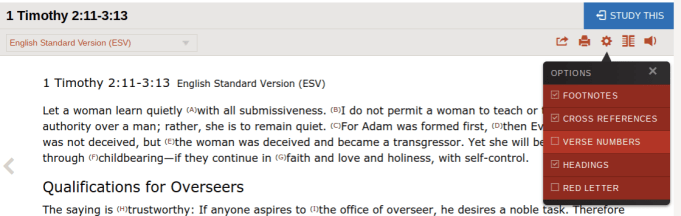
1. Recall that when the Bible was written, there were no chapter and verse numbers. (Those were added much later.) First Timothy would have read like one long, continuous letter or e-mail. So let’s reconnect the end of chapter 2 to the beginning of chapter 3. Click here, then click on the “options” icon and uncheck the box next to “verse numbers”.

Now read the passage, noting the flow of thought and how the end of chapter 2 is interconnected with chapter 3. What is the main idea of this passage? How does this passage demonstrate that God views both men and women as having important roles to play in the life of the church in Timothy’s day and now? Is the role of men or the role of women discussed first in this passage? How could the phrase “ladies first,” the idea of chivalry, and the biblical concept of servanthood describe this passage? Describe how men biblically filling out their role of leadership is actually serving the women (and other men) of the church.

(OK, now click the verse numbers back on and return to 1 Timothy 3 – link above.)

2. What is an overseer? Name two terms we more commonly use today for the office of overseer. What is a deacon? Read Acts 6:1-6. What was (and is today) the main duty of the pastor/elder versus the main duty of the deacon?

3. Make two 4-column charts, one for pastors/elders, one for deacons. In the first column of each chart, list each qualification for the office. In the second column, explain what that qualification means. (For example: What does it mean to be “sober-minded” or “double-tongued”? In the third column, explain why this qualification is important in the character of the man and/or in carrying out the duties of the office. In the fourth column, place a check mark if this is a requirement for both pastor/elder and deacon. Which of the qualifications are common to both offices? Which are different? Explain the reasons for the commonalities and differences in qualifications. How is it beneficial to the church for men in these offices to have these qualifications?

4. Describe how verses 14-16 could serve as the key verses or a summary statement for the books of 1&2 Timothy. Closely examine the two parts of verse 15. Which is the “what to do” part, and which is the “why we’re to do it” part? If 15 tells us the “what” and the “why,” what does 16 tell us?

5. As you’ve read through Old Testament books, have you ever noticed how many times God reminds His people of who He is and what He has done when He’s speaking with them? Refresh your memory, and compare this OT way of God with the NT way we’ve seen God remind His people in 1 Timothy of who Jesus is, and that every “what,” “how,” and “why,” of His instructions always points back to the “Who” of Jesus.


Homework

1. If you’d like to study more about the differences between God’s role for women in the church and men in the church, check out these articles:
Rock Your Role FAQs
Jill in the Pulpit
Deaconesses and Female Deacons

2. Do some research on how your church selects men for the position of pastor, elder, and deacon. Are the qualifications in 1 Timothy 3 (and Titus 1) the highest priority in the selection process? Are there other qualifications (seminary degree, age, etc.) your church requires for these offices? Are these extra qualifications biblical and wise, or unbiblical?


Suggested Memory Verse