Homosexuality, Salvation

God Loves Gays

god loves gays

Last week, as I was mindlessly flipping through Facebook, this picture caught my eye. It was attached to a news article about the Supreme Court’s hearing on same sex “marriage”. I was already at my saturation point with the reporting on the day’s events, but this picture just reached out and grabbed my heart.

“God loves gays,” the young man’s sign says. Rarely, perhaps never, has a statement been so beautifully true and so painfully false all at the same time.

For one will scarcely die for a righteous person—though perhaps for a good person one would dare even to die— but God shows his love for us in that while we were still sinners, Christ died for us.
Romans 5:7-8

It’s true. God does love gays. He doesn’t love them because He sees what they might someday become after leaving the lifestyle behind. He doesn’t love them because they’re great “fixer upper” projects. He doesn’t love them because He feels sorry for them. He just loves them. Right where they are. Not after they get cleaned up. Now.


 God shows his love for us in that while we were still sinners, Christ died for us.


Have you ever really thought about the implications of that statement?

God loves the homosexual man while he is sodomizing his partner.

God loves the gang banger while he is pulling the trigger of his gun.

God loves the prostitute while she is servicing her client.

God loves the child molester while he is violating that precious little one.

God loves the atheist soldier in a godless country while he is torturing Christians.

In the deepest, blackest night of our sin, God loves each and every one of us. Only a profoundly, unfathomably good and kind God could, or would, do such a thing.

But the story doesn’t end there.

You see, as unbelievable as it is that God could love someone so drenched in evil, He takes things a step further. God’s love motivated Him to act.


while we were still sinners, Christ died for us.


Rescue. Redemption. Salvation. However you want to put it, God personally came down and sacrificed Himself so that even the most wretched sinner would have a way out. No more enslavement to evil. No more being pawns of the devil in his never-ending quest for revenge against the King. No more separation from God, now, or in eternity.

God drove a cross-shaped stake into the ground at Calvary and said, “No more.”

God does love gays. And murderers. And child rapists. And hookers. And even prideful, rebellious, good little Sunday School girls like me. But not like this young man’s sign implies. He thinks God shows love by approving of his homosexuality. But an all-powerful God who would say He loves sinners and yet leave them to rot in their sin without lifting a finger to help them isn’t loving. Isn’t all-powerful. Isn’t God.

God does love you, my young friend. You simply have no idea how much.

Wednesday's Word

Wednesday’s Word ~ Joshua 24

josh 24 15Joshua 24

Joshua gathered all the tribes of Israel to Shechem and summoned the elders, the heads, the judges, and the officers of Israel. And they presented themselves before God. And Joshua said to all the people, “Thus says the Lord, the God of Israel, ‘Long ago, your fathers lived beyond the Euphrates, Terah, the father of Abraham and of Nahor; and they served other gods. Then I took your father Abraham from beyond the River and led him through all the land of Canaan, and made his offspring many. I gave him Isaac. And to Isaac I gave Jacob and Esau. And I gave Esau the hill country of Seir to possess, but Jacob and his children went down to Egypt. And I sent Moses and Aaron, and I plagued Egypt with what I did in the midst of it, and afterward I brought you out.

“‘Then I brought your fathers out of Egypt, and you came to the sea. And the Egyptians pursued your fathers with chariots and horsemen to the Red Sea. And when they cried to the Lord, he put darkness between you and the Egyptians and made the sea come upon them and cover them; and your eyes saw what I did in Egypt. And you lived in the wilderness a long time. Then I brought you to the land of the Amorites, who lived on the other side of the Jordan. They fought with you, and I gave them into your hand, and you took possession of their land, and I destroyed them before you. Then Balak the son of Zippor, king of Moab, arose and fought against Israel. And he sent and invited Balaam the son of Beor to curse you, 10 but I would not listen to Balaam. Indeed, he blessed you. So I delivered you out of his hand. 11 And you went over the Jordan and came to Jericho, and the leaders of Jericho fought against you, and also the Amorites, the Perizzites, the Canaanites, the Hittites, the Girgashites, the Hivites, and the Jebusites. And I gave them into your hand. 12 And I sent the hornet before you, which drove them out before you, the two kings of the Amorites; it was not by your sword or by your bow. 13 I gave you a land on which you had not labored and cities that you had not built, and you dwell in them. You eat the fruit of vineyards and olive orchards that you did not plant.’

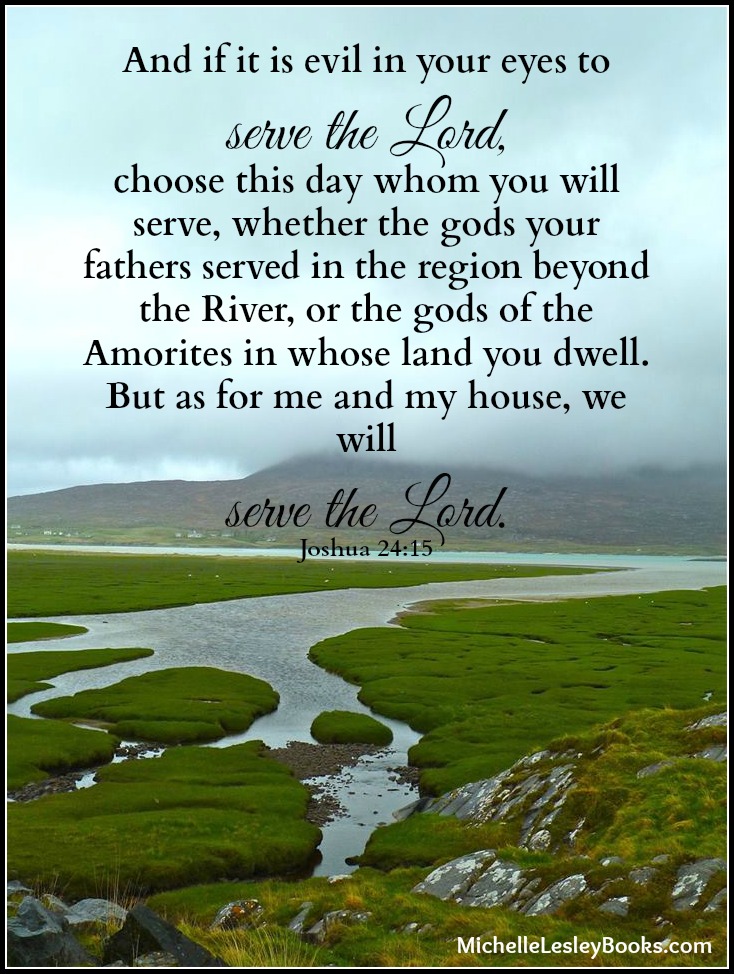
14 “Now therefore fear the Lord and serve him in sincerity and in faithfulness. Put away the gods that your fathers served beyond the River and in Egypt, and serve the Lord. 15 And if it is evil in your eyes to serve the Lord, choose this day whom you will serve, whether the gods your fathers served in the region beyond the River, or the gods of the Amorites in whose land you dwell. But as for me and my house, we will serve the Lord.”

16 Then the people answered, “Far be it from us that we should forsake the Lord to serve other gods,17 for it is the Lord our God who brought us and our fathers up from the land of Egypt, out of the house of slavery, and who did those great signs in our sight and preserved us in all the way that we went, and among all the peoples through whom we passed. 18 And the Lord drove out before us all the peoples, the Amorites who lived in the land. Therefore we also will serve the Lord, for he is our God.”

19 But Joshua said to the people, “You are not able to serve the Lord, for he is a holy God. He is a jealous God; he will not forgive your transgressions or your sins. 20 If you forsake the Lord and serve foreign gods, then he will turn and do you harm and consume you, after having done you good.” 21 And the people said to Joshua, “No, but we will serve the Lord.” 22 Then Joshua said to the people, “You are witnesses against yourselves that you have chosen the Lord, to serve him.” And they said, “We are witnesses.” 23 He said, “Then put away the foreign gods that are among you, and incline your heart to the Lord, the God of Israel.” 24 And the people said to Joshua, “The Lord our God we will serve, and his voice we will obey.” 25 So Joshua made a covenant with the people that day, and put in place statutes and rules for them at Shechem. 26 And Joshua wrote these words in the Book of the Law of God. And he took a large stone and set it up there under the terebinth that was by the sanctuary of the Lord. 27 And Joshua said to all the people, “Behold, this stone shall be a witness against us, for it has heard all the words of the Lord that he spoke to us. Therefore it shall be a witness against you, lest you deal falsely with your God.” 28 So Joshua sent the people away, every man to his inheritance.

29 After these things Joshua the son of Nun, the servant of the Lord, died, being 110 years old. 30 And they buried him in his own inheritance at Timnath-serah, which is in the hill country of Ephraim, north of the mountain of Gaash.

31 Israel served the Lord all the days of Joshua, and all the days of the elders who outlived Joshua and had known all the work that the Lord did for Israel.

32 As for the bones of Joseph, which the people of Israel brought up from Egypt, they buried them at Shechem, in the piece of land that Jacob bought from the sons of Hamor the father of Shechem for a hundred pieces of money. It became an inheritance of the descendants of Joseph.

33 And Eleazar the son of Aaron died, and they buried him at Gibeah, the town of Phinehas his son, which had been given him in the hill country of Ephraim.


The Holy Bible, English Standard Version Copyright © 2001 by Crossway Bibles, a division of Good News Publishers.


Questions to Consider:

1. Verse 1 lists the groups of people God was speaking to in this chapter. Who are they? What place do they occupy in Israelite society?

2. In the Old Testament, we often see passages in which God (or one of His prophets) is reciting Israel’s history. Why, in general, would God do this, and why, in particular does He recite Israel’s history in this chapter? (14, 28)

3. In verses 14-18, what ultimatum does Joshua put to the people, and what is their response?

4. Why, after telling the people to choose between serving God and serving foreign gods, did Joshua tell them they would not be able to serve God? What did he mean when he said God would not forgive them? (19-20)

5. What was the purpose of the stone Joshua set up? (26-27) Which ordinances of the church today can serve a similar function for Christians?

Church

Axiom Questions, I’ll Tell You No Lies

axiomsWhy do churches do church the way churches do church?

Ever thought about that? Moreover, have you ever thought about why churches take for granted that they have to do certain things or do things a certain way? Is there an unspoken assumption at your church that you have to have a sermon outline in the bulletin (or for that matter, that you have to have a bulletin), that Vacation Bible School is a non-negotiable event, or that the deacons absolutely must wear ties when serving the Lord’s Supper? Has it gone on for so long that now “it goes without saying”?

Don’t get me wrong- sermon outlines and bulletins can be very helpful, VBS is a great outreach, and I’m in favor of more men wearing ties to church, period. And I’m not talking about irrefutable biblical truths, either, such as, “faith in Christ is the only way of salvation,” or “God created the world,” or “women are not to instruct or hold authority over men in the church.” What I’m trying to get at here is that there are lots of church practices, preferences, and philosophies that we take as axiomatic. We never question them. We just assume they’re true. We act on them as though they’re immutable laws of physics or something. And every once in a while, somebody notices this and wants to change things up.

When it’s an axiom that’s been around for a few decades, the people who hold to that particular ideal are often chided (sometimes deservedly, sometimes not) by those who are pressing for changes. They’re called “inflexible” or “enslaved to tradition.” They’re labled as the “We’ve never done it that way before,” or “We’ve always done it this way,” people.

But have we ever stopped to think that, in many cases, the changes people seek to make today are the outmoded preferences of tomorrow? Often, we’re not making the church better or more biblical, we’re just adding a new premise here or trading one axiom for another there. Like rearranging deck chairs on a cruise ship. Or the Titanic.

Let’s take a look at some of those new axioms that have materialized over the last couple of decades and are now assumed to be a “given” when it comes to ecclesiology.

1. Pastors need to “cast vision,” and churches need a vision/mission statement.
No, they don’t. Christ is the head of the church, the CEO, if you will. Therefore, He is the only one whose place it is to have a vision for the church and to set a mission statement for it. And He has already done that for us. It was one of the last items on His agenda before leaving earth. It’s called the Great Commission:

And Jesus came and said to them, “All authority in heaven and on earth has been given to me. Go therefore and make disciples of all nations, baptizing them in the name of the Father and of the Son and of the Holy Spirit, teaching them to observe all that I have commanded you. And behold, I am with you always, to the end of the age.” Matthew 28:18-20

2. Churches have to be attractional.
Should you invite people to church? Absolutely. Should you be kind and welcoming to visitors? Of course. But that’s not what “attractional” means these days. Attractional means assimilating church into the culture so that lost people will think it’s a cool and groovy place and will flock through the door in droves. That’s why you see pastors coming out onto a stage and giving a Tonight Show-esque monologue while dressed like a teenager at a concert, churches playing music that sounds like what you hear on the radio (sometimes music that is on the radio) accompanied by bands that mimic whichever artist is popular at the moment, no choirs, no pews, no crosses, no pulpits, no hymnals, but a Starbucks in the lobby. Everything a sinner is used to in his daily life. Everything that will make him perfectly comfortable.

Where is this model of doing church found in the Bible? If you answered, “nowhere,” you’d be correct. The church, by definition, is made up of believers. Christ Himself is what is attractional to people who have genuinely been born again. And when we meet together, we have one purpose: to worship and grow in Him. The Bible never tells the church to make itself look like the world to bring lost people into the church. Christ tells us, believers, the church, to go out and make disciples, to go out into the highways and byways and urge the lost to trust Christ so that His house might be filled…with believers.

3. Church should be fun.
Nope, not going to find that one in the Bible either. Worshiping Christ should bring us the deepest joy we can fathom, but that’s not the same thing as rock concert, bouncy house, stand up comedian, outlandish props and gimmicks, music video back up dancers, cash and prizes giveaway, “fun”. Church should be joyful, welcoming, warm, and pleasant. It should also be reverent, solemn, and, often, serious. Worshiping Christ, handling and learning His word, partaking of communion and baptism– these are not frivolous things, and the climate of the church should reflect that.

4. When it comes to the size of a local church, bigger is not only better, but more spiritual.
I see articles from denominational leaders and church growth gurus all the time that start with the presupposition that if your church isn’t constantly growing until you’ve reached thousands in attendance and have to go multi-site, you need to get on that problem, pronto. Or that if your attendance numbers are “stuck” around the 200 or 300 mark, it’s a crisis that needs to be addressed. Pastor, you need to do something about that. It’s assumed that you want to do something about that.

Says who? Says people who have made a lot of money selling church growth materials and want to make more, that’s who. The fact of the matter is, mega churches are the exception, not the rule. The average size of a church in the U.S. is 186 people, and 94% of church goers attend a church of under 500 members.

There are many perfectly legitimate and biblical reasons why a local church might be small. Smaller churches foster intimacy in fellowship, accountability in discipleship, and make it easier for pastors to shepherd individuals and small groups. Certainly, a church should welcome any newcomers wishing to join and should seek to minister to the surrounding community, but if zeal for the gospel is in place, there is no shame in being a small church.

5. Our worship music has to be contemporary.
Why? No, really. Why does it have to be pop-contemorary style? Because we’ll lose or fail to attract young people? First of all, there are plenty of young people who, believe it or not, like hymns and traditional worship music. Why aren’t we concerned about alienating them? What about the older people who like hymns? What about the young people who like country music, or classical music, or rap, or screamo, or death metal, or opera? How come we don’t cater to any of their musical preferences (assuming that’s the basis on which you choose the genre of worship music) during the worship hour?

Up until the early ’80’s or so, when you went to church, you expected to sing hymns out of a hymnal. There’s nothing wrong with adding new songs here and there to the church’s repertoire, but there is something wrong with trying to replicate what’s going on in the world in order to entice lost people into the church. When people go to a funeral they expect to hear funeral music. When they go to a fais do do they expect to hear Cajun music. And have you seen how incensed people get when somebody tries to put a fresh spin on the National Anthem? It’s perfectly all right for church music to sound churchy. We don’t need to apologize for that.

6. Leaving a church (or deciding not to join one) because you don’t like contemporary worship music is selfish, petty, and reeks of spiritual immaturity.
Really? I thought you just said we had to use contemporary music to get young people to join and keep them from leaving. Are they selfish, petty, and spiritually immature for having their music preference catered to? Why don’t they have to suck it up and sing hymns? Would you go to a church that used only a genre of music you hate, like rap or opera? Does that make you selfish, petty, and spiritually immature?

It’s time we stopped shaming people for wanting to leave a church that has changed to a genre of music or a worship style that they hate. There will be times in every church when a particular song (or maybe even several) is sung that you don’t like. That’s normal no matter which genre your church uses. But music is a huge part of our worship services, and if, even after making an effort to embrace the music, you are so distracted by the genre that you’re incapable of focus on Christ, you need to go to a church- a doctrinally sound one, mind you – where you can worship.

We make a lot of assumptions about the way we should do church. Maybe it’s time to start questioning some of them.

What are some other church axioms you’ve noticed?

Wednesday's Word

Wednesday’s Word ~ 2 Corinthians 4

2 cor 4 6


2 Corinthians 4

Therefore, having this ministry by the mercy of God, we do not lose heart. But we have renounced disgraceful, underhanded ways. We refuse to practice cunning or to tamper with God’s word, but by the open statement of the truth we would commend ourselves to everyone’s conscience in the sight of God. And even if our gospel is veiled, it is veiled to those who are perishing. In their case the god of this world has blinded the minds of the unbelievers, to keep them from seeing the light of the gospel of the glory of Christ, who is the image of God. For what we proclaim is not ourselves, but Jesus Christ as Lord, with ourselves as your servants for Jesus’ sake. For God, who said, “Let light shine out of darkness,” has shone in our hearts to give the light of the knowledge of the glory of God in the face of Jesus Christ.

But we have this treasure in jars of clay, to show that the surpassing power belongs to God and not to us. We are afflicted in every way, but not crushed; perplexed, but not driven to despair; persecuted, but not forsaken; struck down, but not destroyed; 10 always carrying in the body the death of Jesus, so that the life of Jesus may also be manifested in our bodies. 11 For we who live are always being given over to death for Jesus’ sake, so that the life of Jesus also may be manifested in our mortal flesh. 12 So death is at work in us, but life in you.

13 Since we have the same spirit of faith according to what has been written, “I believed, and so I spoke,” we also believe, and so we also speak, 14 knowing that he who raised the Lord Jesus will raise us also with Jesus and bring us with you into his presence. 15 For it is all for your sake, so that as grace extends to more and more people it may increase thanksgiving, to the glory of God.

16 So we do not lose heart. Though our outer self is wasting away, our inner self is being renewed day by day. 17 For this light momentary affliction is preparing for us an eternal weight of glory beyond all comparison, 18 as we look not to the things that are seen but to the things that are unseen. For the things that are seen are transient, but the things that are unseen are eternal.


The Holy Bible, English Standard Version Copyright © 2001 by Crossway Bibles, a division of Good News Publishers.


Questions to Consider:

1. Identify the antecedents of the pronouns in this chapter. Who is “we“? Who is “they”? (3)

2. What does it mean that the gospel is “veiled”? To whom is it veiled and why? (3-4) How could God save these people if the gospel is veiled?

3. What are the two instances or events of light shining in darkness which Paul is comparing in verse 6?

4. In verse 7, what is the “treasure”? What are the “jars of clay”?

5. What does Paul say is the purpose (15) of the persecution and suffering he mentions in verses 8-9? Why do they “not lose heart”? (16-18)

Throwback Thursday, Types and Shadows

Throwback Thursday ~ In the Shadow of the Son

Originally published March 6, 2013shadow son

Once, there was a father who sent his beloved son on a journey far away from home. The son was to seek out the father’s other children who had been separated from the father for quite some time. Quite willingly, the son went.

But when the son arrived at his destination, he found that his brothers had strayed away from where they were supposed to be, seeking greener pastures. So the son went after them and found them. He met them right where they were.

His brothers saw their father’s favored son coming for them. They hated him and everything he said and stood for because they knew he was to be in authority over them. It had been foretold. They conspired to kill him and bury him in a pit. Then, the prophecy of his authority over them would not come true.

The brothers stripped him of his robe and drenched it in the blood of an animal they had sacrificed for this purpose. They stripped him of his dignity, his favored status, and, if possible, his father’s love and approval. It was an attempted coup to knock the prince off his throne.

When they were finished, they threw him into a pit that had never held another man’s body. They sat down to eat, returning to life as usual.

But it wasn’t enough. Revenge is a meal that never satiates.

The brothers determined to turn the favored son over to a rough pack of wealthy heathens. They wouldn’t dirty their hands to kill him. Their brother’s life would rest in the hands of foreigners who had no part in their family line. And so the son’s fate was sealed.

By oppression and judgment he was taken away;
and as for his generation, who considered
that he was cut off out of the land of the living,
stricken for the transgression of my people?
And they made his grave with the wicked
and with a rich man in his death,
although he had done no violence,
and there was no deceit in his mouth.
Isaiah 53:8-9

His closest brother sold him out for pieces of silver, for the price of a slave. Life, as he knew it, was over.

Later, another brother would peer into the pit to see what had become of him. “He is gone!” the brother discovered to his great distress and sadness. Little did he know that the favored son had risen up out of the pit. He would rise in power to deliver the very brothers who had hated him and plotted his death, as well as myriads of others who didn’t even know him.

Who was this favored son? He is the One who has taken away our reproach and added us as sons and daughters into God’s family. He is Joseph, the forefather. He is Jesus, the Son.

Based on Genesis 37.