This article was last updated on April 29. Today’s (May 5) updates include:
May:
- The ineptitude or sabotage (it’s unclear which) of Baptist Press’ interview with Tom Ascol
- The video of the SBC presidential candidate forum
I’m still collecting proposed resolutions for SBC 2022. I invite anyone submitting a resolution to send it to me for inclusion in this article. (More under “April”)

The 2021 annual meeting of the Southern Baptist Convention opened the eyes of a lot of Southern Baptists to the sin and corruption infecting our cooperative of churches.
The foremost question on the minds of many doctrinally sound and discerning Southern Baptist pastors and church members is whether or not the SBC is too corrupt to be saved. “Should we shake the dust off our feet and leave the SBC, or should we stay in and fight for fidelity to Scripture?”
If you and your church are choosing to stay in and fight, it is crucial that you be well-informed enough on the issues and the candidates to vote biblically when you attend the 2022 annual meeting in Anaheim. And that also means you’re going to need to know your Bible well enough to vote biblically on those issues.
Because what really hurt doctrinally sound Southern Baptists at the 2021 meeting (and previous years’ meetings) was not just those who were consciously pushing an unbiblical, liberal agenda, it was also the messengers who were ignorant of the issues and the candidates, and just voted according to whatever sounded good on the surface, or just blindly trusted whoever was on stage at the moment.
Representing your church (and millions of other Southern Baptists) as a messenger at the annual meeting is a grave responsibility and it should be treated as such. You’ve got to get informed. Your church and pastor have to get informed. The other churches in your association, and your associational leadership have to get informed.
That’s where this article comes in.
I know it’s hard to keep up with the issues when you’ve got a life you’re trying to live and responsibilities you’re trying to take care of. I want to try to make staying informed a little easier for you, your church, and your association, so please share this around.
This article (initially published in the summer of 2021 and subsequently updated) is a timeline of significant events in the SBC at the national level starting with the 2021 annual meeting and moving forward from there. I’ve tried to keep things brief, so you may need to take what you see here and do some more digging on your own if you want an in depth look at a particular issue.
I’ve also posted a few “Points of Order,” things that aren’t really a current event, but more along the lines of SBC polity or information you might need.
If you think I’ve left out something significant (I’m trying not to get bogged down in too much minutiae), please leave a comment and a link, if possible.
Acronyms you need to know:
- SBC: Southern Baptist Convention
- BFM: Baptist Faith and Message
- IMB: International Mission Board
- NAMB: North American Mission Board
- EC: Executive Committee
- GCR: Great Commission Resurgance
- ACP: Attorney-Client Privilege
- SATF: Sexual Abuse Task Force
- SWBTS: Southwestern Baptist Theological Seminary
- SEBTS: Southeastern Baptist Theological Seminary
- CRT: Critical Race Theory
The 2021 Annual Meeting
For a recap of the major decisions and happenings of the 2021 annual meeting, please read my article: SBC21: Aftermath, Thoughts, and Where Do We Go From Here? There are lots of informative links at the end of the article in the “Additional Resources” section.
June 2021
Point of Order: Financial Contributions
If you’re staying in the SBC, you might be concerned about your offerings being sent to the Cooperative Program to fund SBC entities which are operating unbiblically. This is a dilemma for doctrinally sound churches and individuals, because, until fairly recently, making a financial contribution to the SBC at the national level was a requirement for being “in friendly cooperation with the SBC.”
So how do we stay in the SBC to fight ungodliness by sending messengers to the annual meeting, yet maintain our financial contribution without funding ungodliness? [Now former – see “October” below] Executive Committee member Rod Martin explains:
I have been repeatedly asked how the formula works that determines how many messengers an SBC church may send to the Annual Meeting. Here’s the deal:
- Under the recent constitutional amendment, every church now gets two messengers whether they give or not. Previously you had to give a minimum amount to get any messengers at all.
- The previous maximum number of messengers was 10. That number is now 12.
- You can get one additional messenger (up to the maximum) for every percentage point of additional giving out of undesignated receipts. That’s fair for every church: if you’re giving 5%, you get five more messengers. If you’re giving 10%, you get ten more messengers. The dollar amount doesn’t come into play.
- That said, and I very much disagree with this, you can also get one additional messenger (up to the maximum) for each $6,000 in giving. That means megachurches can have 12 messengers by giving next to nothing as a percentage of their budgets. I think that was a big mistake. But the vast majority of SBC churches are small, so they greatly outnumber those churches, and also, the 12 messenger cap greatly limits the power of those giant churches on the floor.
- The “giving” I just described can be through the Cooperative Program, but no longer has to be: it can be to any convention entity. So let’s say you wanted to give all of it to Lottie Moon, or give all of it through IMB but designated for certain specific missionaries: you could do that and get all ten additional messengers. There are many other possibilities as well.
I think this change to our system (which was part of GCR) was a giant mistake, as was GCR generally. However, while I know some people disagree, I don’t think it actually disadvantages smaller churches in practice, and it definitely creates a lot of flexibility for churches to give creatively while also maintaining their maximum possible messenger representation.
You can read the official version of this in the SBC Constitution, Article III.
xxxxx
Trinitarian Heresy on Litton’s Church Website
On June 16, the second day of the 2021 annual meeting, a messenger mentioned in a question from the floor that the “What We Believe” page of the church Ed Litton pastors (Redemption Church in Saraland, Alabama) contained a heretical view of the Trinity called partialism.

Quietly, and almost immediately, the heretical wording was deleted from the website, as you can see in the “before and after” screenshots above.
It’s not just that the wording was heretical. Redemption Church’s statement of faith – the core of its identity as a church – was changed without a vote by the church body. Indeed, without even notifying or consulting the church body. How would that go over at your church?
To date, neither Litton nor Redemption Church has offered any official explanation regarding why a multi-SBC seminary degreed pastor would lead his church to codify a heretical statement of faith in the first place, nor how that statement of faith was able to be altered without input or permission from the church, nor why it took outside publicity to spur the change.
Unofficially, the explanation some claim Litton has given is that the original heretical wording was some sort of typographical error by the person who typed it into the website. (I want to stress that this is hearsay.)
HERESY? SBC President Ed Litton’s church holds potentially heretical view of Trinity at Capstone Report
A check reveals a change – which deserves an answer at One News Now
The Plagiarism Fiasco
About a week after the convention ended, starting during the week of June 20:
A side by side video surfaced of Ed Litton (Jan. 2020) and J.D. Greear (Jan. 2019) preaching the same (Greear’s) sermon on Romans 1.
The sermon was Greear’s infamous “The Bible whispers about sexual sin” sermon, so there was not only the plagiarism aspect, but, just as when Greear originally preached it, there was outrage over the bad theology contained in the sermon itself.
Greear and Litton each issued statements explaining, justifying, and excusing the plagiarism.
Litton removed 143 sermons from his church’s website and YouTube, leading most to surmise that these sermons probably also contained plagiarism, due to his explanation of his “sermon by committee” paradigm explained in his statement.
The secular news media began reporting on all of this.
Justin Peters posted a very thorough video biblically explaining and providing documentation for all of this:
Greear and Litton: Plagiarism and Sin in the SBC | Justin Peters | June 28, 2021
Almost immediately, three more side by side sermon comparison videos of Litton and Greear surfaced showing even further plagiarism by Litton. Romans 8 sermon Romans 13 sermon* Romans 14 sermon* (The Justin Peters video above includes the Romans 1 sermon side by side video.)
*I am citing Reformation Charlotte for the purpose of these videos only. It is not a site I endorse.
Somewhat simultaneously, some of Litton’s scrubbed sermon videos begin reappearing on his church’s website and YouTube, and both he (in an interview with the Washington Times) and the leadership of his church (in a statement obtained by Baptist Press) issued statements about why the videos had been removed in the first place. The reasons given by Litton and his church leadership did not match.
For another timeline of these events with additional links, click here.
Further examples of Litton’s sermon plagiarism, some instances going back years, continue to surface.
The Ed Litton Sermon Plagiarism Scandal by Gabriel Hughes
Point of Order: Removing a sitting SBC President
With all the outcry against current SBC president, Ed Litton, and calls for his resignation, you might be surprised to learn that there is no mechanism in place for removing a sitting SBC president. For the office of president to be vacated, he has to resign, die, or be incapacitated.
The only official governing statement about replacing a sitting SBC president is this sentence from Article V of the SBC Constitution:
“In case of death or disability of the president, the vice presidents shall automatically succeed to the office of president in the order of their election.“
Maybe plagiarism and heresy don’t seem like that big of a deal to you. What’s going to happen when a sitting president commits adultery, steals SBC funds, comes out of the closet as a homosexual or transgender, or is discovered to be a child molester, and refuses to resign?
xxxxx
July 2021
EC SATF Named
Prior to the 2021 convention, allegations were made that the Executive Committee mishandled some charges of sexual abuse by SBC pastors / at SBC churches, which the EC vehemently denied. At the convention, a motion was made that President Ed Litton appoint a task force to investigate these allegations. That task force was named on July 9:
Litton names task force to oversee third-party review of SBC Executive Committee at Baptist Press
The purpose of the task force is to objectively examine whether the EC handled these charges of sexual abuse fairly and appropriately with regard to recommending whether or not the church should be disfellowshiped from the SBC.
You’ll notice many of the members and advisors work or volunteer in the field of victim advocacy. While it is good to have people with experience on the task force, that has to be balanced with their ability to be objective if this is to truly be an independent review.
For example, Rachael Denhollander has been a polarizing figure in victim advocacy because she has a reputation for never having met an accusation of abuse she didn’t believe, or “having an ax to grind” when it comes to allegations of abuse. If anything, she has a reputation for being biased in favor of alleged victims and unable to objectively assess when false charges have been levied.
When someone (such as some of the members of this task force) has made victim advocacy his career or life’s mission, that person is heavily invested in one side of the issue. It raises the question, “How objective can some of these task force members/advisors be?”.
You can read about the SATF’s progress and work at Task Force Updates.
Litton’s Lies
(Week ending July 10, 2021)
I’m sorry, but there’s just no polite way to say this, and sometimes you have to call a spade a spade. Ed Litton has been caught in two obvious, public lies about the plagiarism fiasco and his wife co-preaching with him.
Kathy’s Co-Preaching:
This is an issue that came up prior to the 2021 convention so it is not included in this article, but I referred to it in this pre-convention article regarding Ed Litton’s wife Kathy:
This man who wants to be at the helm of your entire denomination, violates Scripture by allowing Kathy to “co-preach” the Sunday sermon at their Southern Baptist church here, and here, and several more sermons can be found at their church’s website.
If you try to click on the links above you’ll notice two of them yield no results. That’s because once Ed Litton was publicly taken to task for allowing his wife to preach, he deleted the sermon videos, which is covering up sin, rather than biblically repenting of it.
When first questioned about allowing his wife to preach, Litton explained that this was because it was a sermon series on marriage and family and he wanted Kathy to provide her perspective. (Scripture doesn’t allow for this, but some accepted this justification.)
It has now been discovered that Litton had Kathy co-preach at least one other sermon series in 2013 which had nothing to do with marriage and family.
Litton co-preached with wife far more extensively than previously known at Capstone Report
(If you’re unclear about why this is a violation of Scripture, please click here, here, and here to read up.)
Plagiarism (see “June” above):
In a news interview with his local CBS affiliate, Litton clearly says the allegations of plagiarism came from “unnamed sources”.
This is patently untrue. Many SBC pastors and others have publicly sounded the alarm about the plagiarism issue, and all the ones I’m aware of have used their real names.
Ed Litton is an unrepentant liar and this interview proves it at Capstone Report
September 2021
SWBTS/Greenway Provide Cover
for Litton’s Non-Repentance
On September 14, during SWBTS’ chapel service, seminary president Adam Greenway interviewed Ed Litton on a variety of topics, first – and most notably – the plagiarism scandal (3:50). Once again, Litton finessed instead of repenting.
You can tell where Greenway stands as he prefaces his question to Litton by disparagingly referring to the “snark” he received from “anonymous social media accounts” when he announced that Litton had been invited. (“Anonymous”? What I saw when I commented on his Twitter announcement was, I’d estimate, well over 90% non-anonymous, concerned, yet frustrated Southern Baptists wanting the plagiarism issue addressed, and for Litton to resign.)
And, of course, you’ll notice that Litton doesn’t repent over this sin, and even characterizes those who exposed his sin as meaning evil against him in the Genesis 50:20 sense. (More here.)
A Conversation with Ed Litton – #SWBTSChapel | September 14, 2021
October 2021
EC Waives ACP
“In a 44-31 vote Tuesday, Oct. 5, the Southern Baptist Convention Executive Committee (SBC EC) opted to waive attorney-client privilege in connection with a third-party investigation of itself [see “July” above]. Ahead of the special called meeting, six committee members resigned, and Chairman Rolland Slade noted during the meeting an expectation that other resignations may soon follow with the passage of the widely-debated waiver of attorney-client privilege.” – SBC Executive Committee votes to waive attorney-client privilege in sexual abuse investigation at Conservative Baptist Network
Waiving ACP was not necessary in order for Guidepost Solutions (the firm retained by the SATF to investigate allegations of mishandling of abuse cases by the EC) or the SATF to investigate allegations of the EC’s mishandling of abuse cases. It put the SBC in jeopardy of losing its legal representation and insurance coverage, and left individual EC members vulnerable to lawsuits (thus, the aforementioned resignations). And since any compensation paid to abuse victims would have been covered by the insurance policy, it was a very foolish decision indeed.
Multiple EC Resignations
As a result of the EC voting to waive ACP, fourteen committee members resigned effective in late September and October – including President Ronnie Floyd and Rod Martin – due to personal legal vulnerability and frustration.
More Southern Baptist Convention Executive Committee members resign — new leadership announced at The Christian Post
SBC Executive Committee breaks deadlock to waive privilege, loses 10% of board at The Baptist Paper
On October 11, Guenther, Jordan & Price, the Nashville firm which had provided legal representation for the SBC since 1966, terminated its relationship with the Southern Baptist Convention
“The Executive Committee’s board of directors, by a majority vote, has acted to prospectively and preemptively waive the Executive Committee’s attorney-client privilege without knowing the communications affected by the waiver and without knowing the effect it will have on the Executive Committee, the Convention, and those who have served as members or employees of the Executive Committee…For these reasons, we believe our commitment to a certain standard of professional conduct leaves us no
choice but to advise you that we are withdrawing from our role as general counsel to the Southern Baptist Convention and the Executive Committee of the Southern Baptist Convention.“
Guenther, Jordan & Price resignation letter
SBC legal team resigns after vote to waive attorney-client privilege in sex abuse investigation at The Christian Post
On October 28, the EC trustees met and retained Bradley Legal to provide legal services on an interim basis. (See “February” below for more information on Bradley Legal.)
November 2021
A Discussion of the Issues
On November 19, the Conservative Baptist Network hosted a panel discussion centering on problematic issues in the SBC. Led by SBC First Vice President, Dr. Lee Brand, participants included (L-R: Randy Adams, Tom Ascol, Russell Fuller, Rod Martin, and Allen Nelson)
UnMerritted Praise
On November 22, James Merritt – multi-seminary degreed pastor of Cross Point church (SBC) in Duluth, Georgia, former SBC president, chair of the 2021 Resolutions Committee, former chair of the EC, former president of the SBC Pastors’ Conference, visiting professor at SEBTS, etc. – posted this tweet regarding his son Jonathan’s sermon at his (Jonathan’s) “church” the day before. Jonathan is openly homosexual, and his “church” is homosexuality affirming, egalitarian, and universalist, among other anti-biblical beliefs:

Obviously, it should go without saying (especially to someone as biblically knowledgeable as a pastor, former SBC president, and SBC seminary professor should be) that a practicing homosexual is not saved and has, therefore, rejected the gospel. How could any sermon he preached be “faithful to the gospel”?
STATEMENT: Promoting homosexual preachers is not loving, biblical, or Baptist at Conservative Baptist Network
Naturally, his appalling statement received pushback from biblically faithful Christians, and James Merritt once again showed his baser nature by lashing out at those taking him to task.
James Merritt defends gay son’s preaching by attacking Trump supporters at Capstone Report
Homosexuality, Universalism, The Gospel, and the SBC | Justin Peters | November 28, 2021
A Gospel Without Merit by Gabriel Hughes
Likely facing pressure behind the scenes, James Merritt resigned his position as visiting professor at SEBTS (but not his pastorate). For this, he was practically lauded as a hero by SEBTS president Danny Akin…
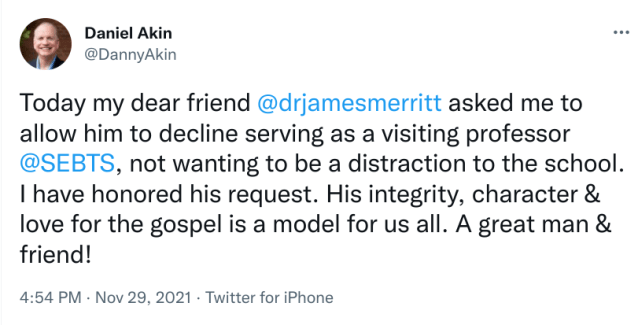
…and by Vance Pittman, president of Send Network (NAMB’s church planting division):
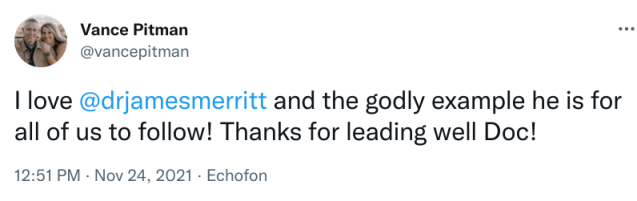
Send Network, SEBTS, and Salvation by Merritt by Allen Nelson
December 2021
BinderGate
Someone gave reporter Liam Adams of the Tennesseean James Merritt’s binder from his tenure as 2021 Resolutions Committee chair. The binder contained private emails between Tom Ascol and James Merritt as well as other confidential Resolutions Committee communications and information, some of which was used in an article Adams wrote.

Bindergate: An Appeal for Honesty and Integrity in the SBC by Tom Ascol
February 2022
Is the SBC Moving Toward Affirming Homosexuality?
In this video, Justin Peters examines four incidents in recent SBC history that seem to demonstrate a gradual progression toward affirming homosexuality. Two of the incidents took place at First Baptist Church Orlando, pastored by David Uth (president of the 2020 Pastors’ Conference who was roundly criticized for inviting false teachers and a female “pastor” as speakers), one incident involved James Merritt, and another involved former SBC President J.D. Greear.
FBC Orlando’s Shocking Capitulation | Justin Peters | February 15, 2022
A Pride Full Firm
Following a tweet by pastor and EC member Adam Wyatt singing the praises of new interim legal team Bradley Legal, questions began to be raised about the many ties the firm has to the homosexual and woke agendas. From sponsoring Nashville Pride to a glowing report on Bradley’s “inclusivity” from the Human Rights Campaign, Bradley is proud of its “diversity”.
A Different Kind of Nashville Statement: New SBC Lawyers Full of Gay Pride at Servants and Heralds
Coming to Terms
On February 28, in the middle of a self-aggrandizing video noting his past and anticipated accomplishments, and breaking with decades of tradition, Ed Litton briefly announced he would not seek or accept a second term as president of the Southern Baptist Convention.
Dr. Ed Litton addresses the SBC | Redemption Church | February 28, 2022
Ed Litton says he won’t seek reelection as SBC president, prompts mixed reactions at The Christian Post
Point of Order: The SBC President’s Term of Office
“The officers shall be elected annually and shall hold office until their successors are elected and qualified. The term of office for the president is limited to two (2) years, and a president shall not be eligible for re-election until as much as one (1) year has elapsed from the time a successor is named.” The Constitution of the Southern Baptist Convention, Article V, Point 2
In plain English: There is an election for SBC president (and other officers) every year at the SBC annual meeting, which means we could elect a new president every single year. However, the SBC Constitution allows the president to serve two consecutive one-year terms, and, in recent history, most SBC presidents and messengers have taken the Constitution up on that offer. The last single-term president was Adrian Rogers, who (though later elected to two consecutive terms in the mid-1980’s) served from 1979 to 1980, 43 years ago.
xxxxx
March 2022
Willy Run?
March 1, one day after Ed Litton announced he would not seek re-election for a second term as SBC president (see “February” above), Willy Rice, pastor of Calvary Church in Clearwater, Florida, announced that he would be nominated for SBC president at the annual meeting in June. (See “April” below)
Fla. Pastor Willy Rice to be nominated for SBC president, says ‘faith family’ is all he’s ever known at The Christian Post
Calvary follows the multi-site model with three locations in Florida. They also have an “online campus” which they seem to equate with the three physical locations. Though there’s nothing wrong with a church live streaming its worship service, leading people to believe that watching a video of a worship service is equal to being a faithful member of a local church and physically gathering with that church body for worship and fellowship is an unbiblical ecclesiology. The Greek word for “church” in the New Testament is ἐκκλησία, or ekklesia. It literally means a gathering or assembly. No gathering, no church. The Bible commands and assumes that we physically gather as the church.
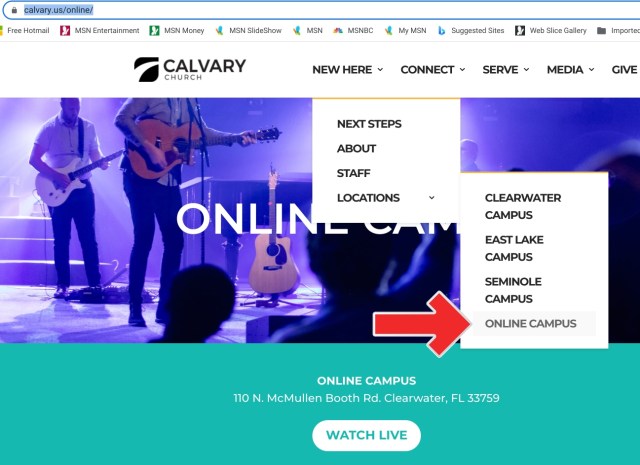
Calvary will be hosting the LifeWay Women Live Simulcast which features Jackie Hill Perry, Jen Wilkin, Jada Edwards, Jennifer Rothschild, Kelly Minter, and others.
Willy’s wife, Cheryl, is apparently a fan of Beth Moore, Priscilla Shirer, and Lysa TerKeurst. (Click here for more info.)
Willy Rice on the January 6 Capitol protest, race, and social justice:
Willy Rice Nominated for SBC President | Conversations That Matter | March 4, 2022
Two Good Men to Right the Ship
On March 22, it was announced that Tom Ascol – pastor of Grace Baptist Church in Cape Coral, Florida, and president of Founders Ministries – would be nominated for SBC president, and Voddie Baucham – author, sought after conference speaker, and currently dean of theology at African Christian University in Zambia – for president of the Pastors’ Conference.
Both men have an outstanding record of fidelity to Scripture, biblical ecclesiology, Christian ethics, and sound doctrine. Both have spoken unashamedly against sexual sin, false teachers, Critical Race Theory and racialism, egalitarianism, and the social justice movement. Both are dedicated to the bold proclamation of the mercy and grace of God in the biblical gospel rather than the watered down gospel of seeker sensitive easy believism.
There could be no two better men than these to begin the hard task of turning the SBC back to faithfully believing and obeying God’s Word. If at all possible, my Southern Baptist sisters, I urge you to talk to your pastor about representing your church as a messenger at the SBC annual meeting in Anaheim in June (along with as many other messengers as your church qualifies for) and vote for Tom and Voddie.
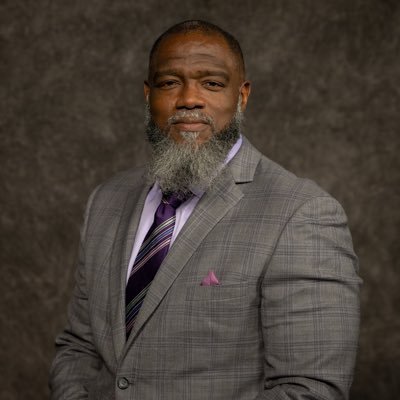
Statement from Southern Baptists Nominating Tom Ascol and Voddie Baucham
Southern Baptists Nominate Tom Ascol, Voddie Baucham To Leadership To Combat Woke Drift In Largest Protestant Denomination at The Daily Wire
Why I Am Willing to Be Nominated for SBC President by Tom Ascol
Change the Direction – With SBC Presidential Nominee, Tom Ascol at A Word Fitly Spoken
TS&TT: The Nomination of Tom Ascol for SBC President And The Need To #ChangeTheDirection | Founders Ministries | March 22, 2022
TS&TT: Voddie Baucham | SBC Pastors Conference Presidency and How We #ChangeTheDirection | Founders Ministries | March 29, 2022
The Missionary Candidate
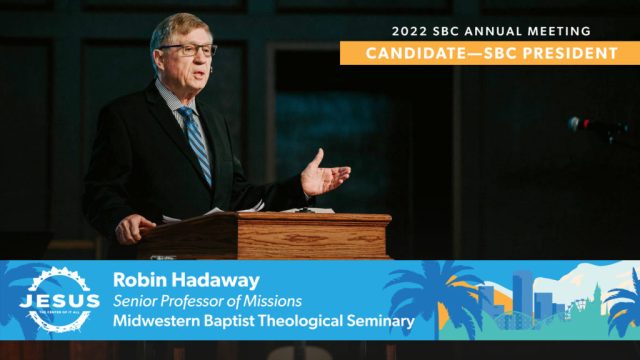
On March 23, a third candidate for the SBC presidency was announced. Former IMB missionary, Robin Hadaway. Hadaway served for many years as a missionary in Africa and South America. Following his time on the mission field he spent twenty years at Midwestern Baptist Theological seminary as a professor of missions and in several different administrative positions. He has also served in various offices and capacities in the Southern Baptist Convention.
Former missionary Robin Hadaway to be nominated for SBC president at Baptist Press
Blackmailing the Bucks
In late March (spilling over into April), a situation began to unfold in which Tom Buck (and his wife, Jennifer), pastor of First Baptist Church, Lindale, Texas, who has battled valiantly against corruption in the SBC, was maligned, lied to, and threatened with blackmail. The situation involved not insignificant figures in SBC life, including SEBTS professor Karen Swallow Prior, SEBTS President Danny Akin, former 2022 SBC presidential nominee Willy Rice, and others.
This is the same type of “dirty tricks” move from the liberal contingent of the SBC we’ve come to expect over the last few years in the weeks immediately preceding the annual meeting, as they attempt to sully the reputations of those on the biblical side of the aisle in an attempt to influence, or even derail, the SBC presidential election.
The story is both heart wrenching and enraging, and provides insight into just how evil and corrupt the SBC has become at the highest levels. The story is somewhat lengthy and involved, and the timeline intricate, but I urge you to peruse the following pertinent documentation:
A Story of Restorative Grace by Jennifer Buck
A Statement Regarding Tom and Jennifer Buck by the elders of First Baptist Church, Lindale, Texas (BNG article referred to but not linked)
The Essential Facts and Concise Timeline of the SEBTS Coverup against Tom and Jennifer Buck: Questions We Should Be Asking at Servants and Heralds
Tom and Jennifer Buck’s Story | Tom Buck | April 22, 2022
April 2022
Willy Run? Apparently Not.
On April 1, potential SBC presidential nominee, Willy Rice (see “March” above) announced that it was about to be made public that a deacon in his church had committed “sexual sin” in his past – prior to his salvation – “that could also be described as abusive” but which did not involve criminal charges. The deacon was removed from his position. (I would like to point out, for clarity, that the 2021 resolution Rice quotes from near the end of the video says that anyone who has committed sexual abuse is permanently disqualified from the office of pastor. The man in question was a deacon, not a pastor.)
Willy Rice blames political rivals for Deacongate at Capstone Report
On April 6 – likely under pressure from “progressive” SBC leadership because he was the progressive candidate, and abuse is a major plank in the progressive platform – Rice announced he was withdrawing his name as a candidate for SBC President.
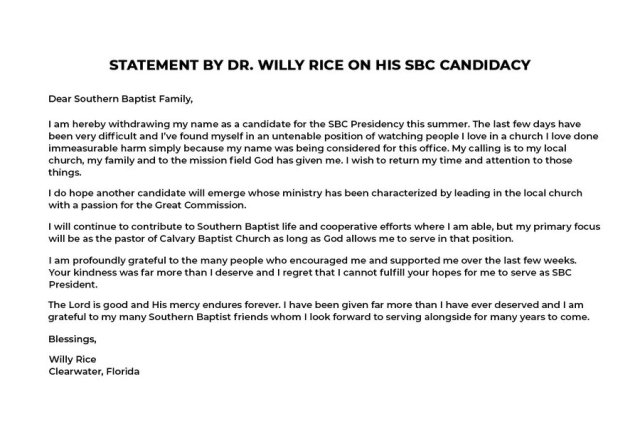
Willy Rice drops out of SBC Presidential race after Deacongate at Capstone Report
The “Progressive” Candidate
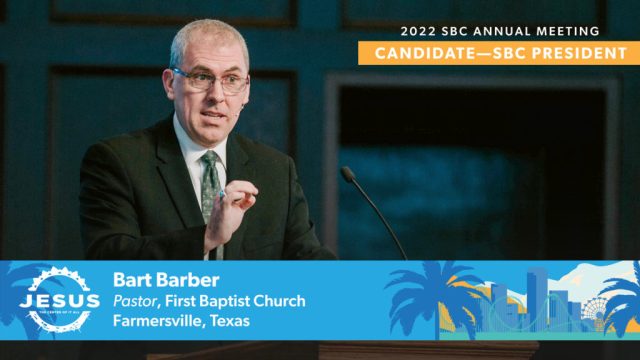
Texas pastor Bart Barber announced as candidate for SBC president at Baptist Press
On April 7, it was announced that pastor Bart Barber would be nominated for president of the SBC. Barber was appointed by current SBC president Ed Litton (see above) as chair of the Resolutions Committee, and will serve in that capacity at the 2022 annual meeting.
Though he may not consider himself progressive, Barber is the candidate most progressives will likely end up voting for, simply because a) he has greater name recognition than Robin Hadaway, and b) they want the least conservative candidate possible to win.
You can read about Barber’s positions on various issues at Bart Barber FAQs on his church’s website. You may find the following sections to be informative:
- Critical Race Theory– in which Barber says it is problematic there is no agreed upon definition of CRT, yet conducts a Twitter poll (which any marginal statistician could tell you is hardly reliable) about this undefined concept of CRT, and uses those results to conclude that CRT is “far from being an urgent issue to address in your church or in the Southern Baptist Convention.”
(Barber also served on the 2021 resolutions committee which quashed a resolution condemning CRT as incompatible with the BFM signed by 1300+ Southern Baptists. Tom Ascol, on the other hand, at that same meeting, made a motion to rescind 2019’s Resolution 9. Read more here.)
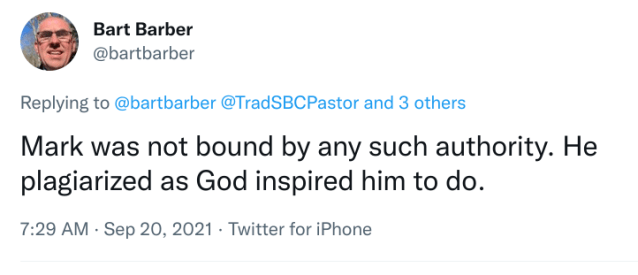
- Plagiarism– in which Barber asserts that, since the authors of Scripture, young pastors, and those newly converted on the mission field may not have access to advanced theological training, the internet, commentaries, methods of attribution, etc., and, thus, may repeat things they’ve been told by others with no attribution, this excuses someone like Ed Litton – who does have all of those advantages and should know better – from plagiarism. How does Ed telling JD Greear’s personal life experiences as though they were his own fit into that paradigm? It’s not readily clear.
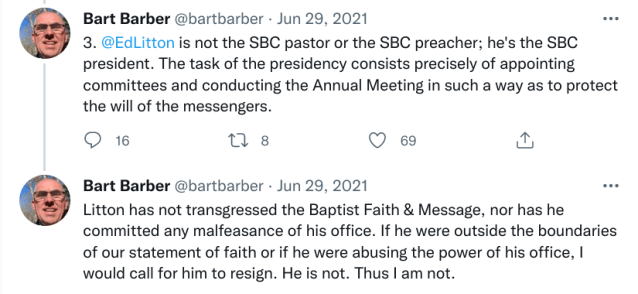
You can read the rest of Barber’s defense of Litton – as well as his opposition to the CBN (Conservative Baptist Network) here. Tom Ascol was, at that same time, vocally decrying Litton’s sin of plagiarism.
On the author of the gospel of Mark (see the remainder of the thread for context):
On a few other notes…
Though the content of his interactions with her are benign, Barber seems to have a friendly Twitter relationship with false teacher Beth Moore (here, here).
Barber has allowed the women’s ministry of his church to schedule a “Bible” study using a book by false teacher Priscilla Shirer:

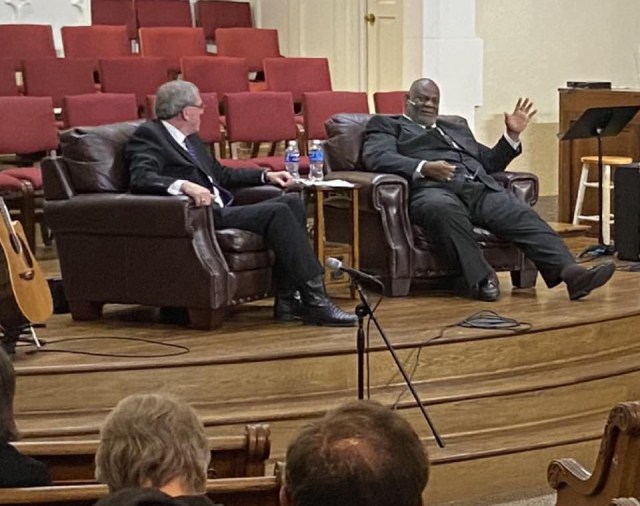
In 2020, Barber invited Dwight McKissic to be a guest on his podcast, and recorded the episode in the sanctuary of his church. McKissic is an SBC “pastor” (he is biblically disqualified) who plays the race card in nearly every conversation, is a rabid egalitarian, and defends false teachers such as Beth Moore (McKissic suggested that she should be nominated as president of the SBC a few years ago) whenever he gets a chance.
It’s an Issue with the Network: The Platform and Anaheim 2022 by Allen Nelson
This Year’s Resolutions
On April 15, the resolutions portal opened for submitting a resolution to the 2022 Resolutions Committee. The 2022 resolution submission window closes May 30.
Resolutions are essentially position statements messengers may have the opportunity to vote on at the Convention. (Parliamentary procedure or committee action may preclude a vote.) I would love to publish the text of, or information regarding as many resolutions as possible so messengers can take the time to read, inform themselves, and especially pray about how they should vote that they may not have once at the convention site.
If you know someone who will be submitting a resolution at the Convention and would like to have it published here, please comment below or contact me as soon as possible.
Resolutions
This is the original text that will be submitted to the Committee on Resolutions. Please bear in mind, the Committee on Resolutions has the authority to “reword” these resolutions in any way they choose and then present the edited version to the Convention for a vote. (This was a major issue with Resolution 9 on CRT in 2019. The Committee “reworded” the original resolution so much that the edited version ended up saying basically the opposite of the original version.) The Committee also has the authority to decline to present a resolution for a vote. When you arrive at the Convention, please carefully read the versions of the resolutions you are given before voting on them, since they may have been altered.
Resolution on the Sacredness of the Southern Baptist Pulpit submitted by Pastor Allen Nelson, Perryville Second Baptist Church, Perryville, AR
Resolution on Beholding the Majesty of God submitted by Pastor Allen Nelson, Perryville Second Baptist Church, Perryville, AR
Point of Order: Resolutions
A resolution has traditionally been defined as an expression of opinion or concern, as compared to a motion, which calls for action. A resolution is not used to direct an entity of the Southern Baptist Convention to specific action other than to communicate the opinion or concern expressed. Resolutions are passed during the annual Convention meeting. Resources in Resolutions at SBC.net
As I mentioned above, a resolution is akin to a position statement on anything from abortion to a war in another country to National Ice Cream Day if you like. Individual Southern Baptist church members write up resolutions and submit them to the Committee on Resolutions within the allotted time frame. The Committee on Resolutions processes each resolution. Most, they will decline to present for a vote. Some, they will tweak, re-word, edit, beef up, or water down, before presenting. Some, they will present as is. Sometimes, when several similar resolutions are submitted, they will write a new resolution, combining the ideas they like from each, and present a resolution from the committee for a vote. Messengers then have the opportunity to vote in agreement or disagreement with each resolution the Committee on Resolutions presents.
Resolutions are non-binding. This means neither you nor your church nor any other Southern Baptist individual or church has to abide by any resolution. Resolutions serve mainly to make a public statement: This is what the majority of Southern Baptists believe about this issue this year.
Each year, no later than 75 days prior to the SBC Annual Meeting, the SBC president, in conference with the vice presidents, appoints a Committee on Resolutions whose task is to consider and recommend appropriate resolutions to the messengers attending the annual meeting….Only members in good standing of churches entitled to send messengers to the next annual meeting of the Southern Baptist Convention may submit resolutions.
For more information on how to submit a resolution to the committee click here: Submit a Resolution
xxxxx
Change of Venue
On April 28, the Executive Committee voted to move the 2023 SBC annual meeting from Charlotte, North Carolina (the site approved by messengers in 2016), to New Orleans, Louisiana. Due to increased attendance over the past few years, it was anticipated that the Charlotte venue would be too small.
SATF Cost
Also on April 28, with regard to the Sexual Abuse Task Force:
EC members were informed that since Oct. 1, a total of $1,661,530 has been paid toward Guidepost Solutions [the independent investigating agency] and $17,478 toward Task Force travel and meetings.
In September, the EC voted to allocate up to $1.6 million toward the work by Guidepost Solutions. In February, they voted to increase the funds allocated to $2 million for the investigation or the “coverage of any other direct expenses without further approval.”
SBC Executive Committee approves 2023 Annual Meeting move, provides financial update at Baptist Press
May 2022
Baptist Press’ Tomfoolery
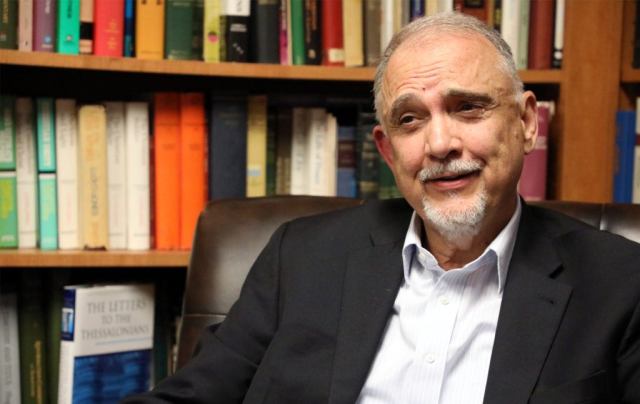
“Baptist Press recently released an interview that Jonathan Howe and Brandon Porter conducted with me…on April 5. Both they and I recorded the interview. They did so indicating that they would edit out the “ums,” “uhs,” and “wells,” etc. from the transcript in order to make the article flow well without losing the contextually understood meaning of my words.
In the interview that they posted, however…my responses were largely left unedited except for the exclusion of certain things I said…There are other misquotes throughout the article…in the interest of openness and transparency, I am making available the full audio below. In it you can hear a more complete and accurate version of the how the questions were phrased as well as my exact answers.”
Tom Ascol in What I Really Said in the Baptist Press Interview (with audio)
You can read and compare the Baptist Press article here.
Candidate Forum
Tom Ascol, Bart Barber, and Robin Hadaway participated in a panel discussion on issues facing the SBC at First Baptist Church, Keller, Texas, on May 4. The discussion was moderated by Joe Wooddell and Tony Richmond—both of FBC Keller.
SATF Report and Recommendations
Guidestone Solutions, the firm hired by the SATF to investigate the EC for mishandling cases of abuse is to submit its report to the SATF 30 days prior to the SBC annual meeting in Anaheim (June 14-15, 2022). The report is to be made public one week after receipt, along with the SATF’s recommendations on any action the SBC should take as a result of the report.