It’s not often you get to hear a great sermon out of Leviticus, so I wanted to share this one with you, preached by my friend Laramie Minga, Pastor of Worship and Discipleship at Woodlawn Baptist Church, Baton Rouge, Louisiana.
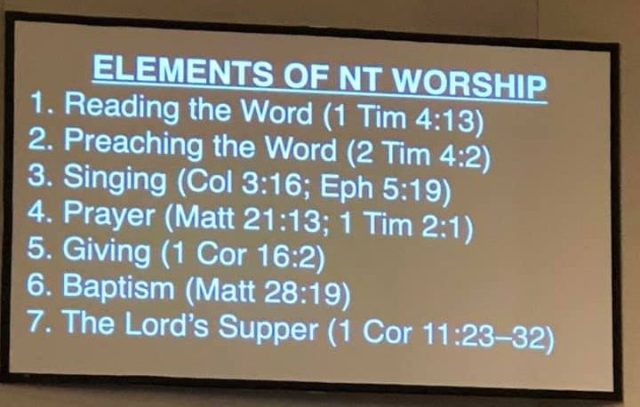
If you’re a new Christian or maybe you’re just coming out of an unbiblical “church” and you’re not quite sure what biblical worship in a doctrinally sound church is supposed to look like, this sermon will help. And even if you are in a solid church with biblical worship, Laramie’s sermon will be an encouragement to you. The worship pastor at your own church might even enjoy giving it a listen.
I recently had the pleasure of chatting with Rose Spiller and Christine Paxon of Proverbs 9:10 Ministries on their delightfully named No Trash, Just Truth podcast – “taking out the trash of false teaching and replacing it with biblical truth”.
Listen in (or watch and listen above) as we chat about the Old Testament, Andy Stanley, Bible study, evangelism, a balanced view of the role of women, and more!
Check out the Proverbs 9:10 website, and find all their social media links so you can give them a follow. Also, be sure to subscribe to the Proverbs 9:10 YouTube channel so you’ll never miss an episode of No Trash, Just Truth, or add it to your queue on your favorite podcast platform.
Articles / resources mentioned or touched on in the episode:
Got a podcast of your own or have a podcasting friend who needs a guest? Need a speaker for a women’s conference or church event? Click the “Speaking Engagements” tab in the blue menu bar at the top of this page, drop me an e-mail, and let’s chat!
1. Briefly review the “middle parts” (ex: merciful, poor in spirit) of the Beatitudes, the “salt and light” passage, and the “heart of the law” passage in Matthew 5:1-12, 13-16, 14-20. Now read 6:19-34 in light of those passages.
What is the main theme of both 19-24 and 25-34? Is there one verse that could serve as a theme verse for the entire passage? Which one, and why?
2. In the Beatitudes, Jesus lists the traits that define Christian character. In much of the rest of the Sermon on the Mount He fleshes out what many of these character traits look like when walked out in “real life”. Which of the traits (the “middle parts” – there could be several) listed in the Beatitudes is Jesus expanding on in 19-34? How does 6:33 echo 5:6?
How could anxiety-driven greed bland your saltiness? (5:13-16) How can contentment and trusting in God to provide make you saltier and brighter?
3. Review from our previous lessons (links above) the idea that the Sermon on the Mount is to the New Testament / new covenant what the Ten Commandments were to the Old Testament / old covenant.
Though they are not specifically mentioned in the Ten Commandments, which of the Ten Commandments could be connected to worry, anxiety, and storing up earthly treasures?
Despite having dropped the “You have heard it said…but I say to you…” framing of His teaching in chapter 6, how is Jesus still shifting the people’s focus from outward obedience to the letter of the law to zeroing in on the attitude of their hearts and the spirit of the law? How should treasuring Christ above all else and trusting His care for us be at the heart of our obedience to God’s laws?
4. Are verses 19-24 specifically and/or exclusively talking about money? How does this passage apply to treasuring riches? What are some ways it could apply to treasuring things other than money?
Think back to the spring of 2020 and the beginning of COVID when everyone was stockpiling and hoarding toilet paper. What does this passage have to say to that situation (or others you can think of) about treasuring our own strength and provision over God’s? How can worry and anxiety (25-34) drive us to trust in our own provision over trusting God to provide?
What is the connection between your treasure and your heart? (21) Why do our hearts follow our treasure?
5. Verses 19-21 and 24 focus on not loving money and not putting your heart into your treasure. How do verses 22–23 connect those two passages? What would a healthy eye and a bad eye be in this context? Is this a form of “lusting” after treasure? Pessimism versus optimism? Connect 22–23 to 5:29. Where is your focus?
6. Think about verse 24 in literal terms of serving God in a position of church ministry or in a business that deals in Christian products. Can you think of a real life example in which an individual, a ministry, or a Christian business attempted to serve God and money at the same time? Which one won out, God or money? If God, what hard decisions or sacrifices had to be made in order to keep Him first and rightly handle and obey His Word? How did God bless that obedience to Him? If money won out, how did the person, ministry, or business eventually succumb to false doctrine or sin?
7. Where is the line between being prepared and trusting God in today’s passage? Is verse 34 saying we shouldn’t plan ahead or work diligently? Compare 19-34 to these passages. How should we balance hard work with trusting God to provide, and how does the posture of our heart figure in to that equation?
8. How many times does Jesus say, “Do not be anxious,“ in 25-34? Can we consider this a command? Is there a difference between terms “anxious,” or “worry,” in this passage and “fret,” or having a fearful / troubled heart in other passages? Think of all the biblical passages you know of that deal with fear, worry, anxiety, or fretting. Why does God have to deal with us about this so often in Scripture?
Which two items does Jesus tell His hearers not to worry about in 25-34? How would you classify these items (ex: needs vs. wants, luxuries vs. basic necessities, etc.)? How would you classify the things you most often worry about, compared to the basic necessities of food and clothing? If God promises to take care of our most fundamental needs, what does that tell us about His ability to take care of other, less “life or death” matters?
How are worry and anxiety indicators of “little faith“? (30) How does worrying fundamentally state, “God, I don’t trust you to do what you’ve promised. I’ve got to handle this myself.“? What might the consequences be when we fail to trust God and worry about a situation so much that we take matters into our own hands? In several places, the Bible speaks of “waiting patiently on the Lord”. How can waiting on the Lord tempt us to be anxious but also build our trust in Him?
9. How does trusting God to provide for us separate us from pagans? (32) How does today’s passage speak to hoarding – both hoarding out of greed, and hoarding out of fear?
Homework
Compare Philippians 4:4-7 to today’s passage. If you struggle with anxiety, try memorizing this passage and praying through it every time you feel anxious this week.
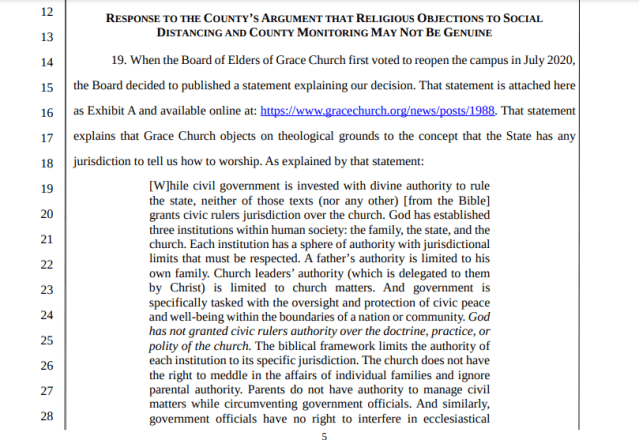
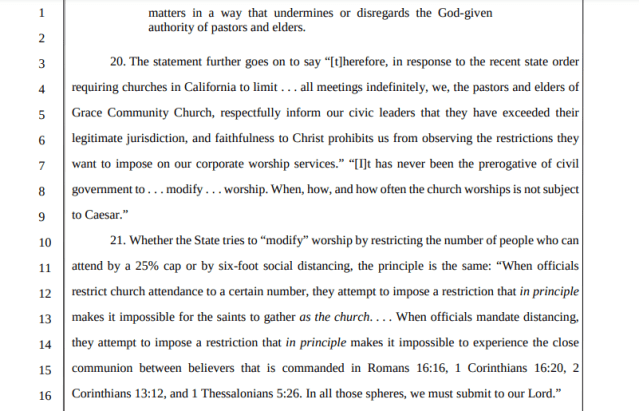
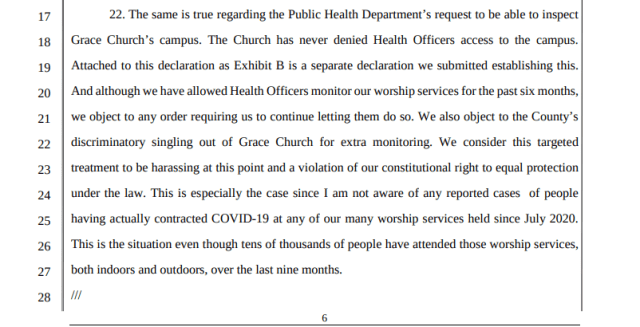
Grace Community Church has filed a motion against Los Angeles County in their ongoing legal response to the county’s harassment regarding COVID regulations. In support of GCC’s motion, John MacArthur has filed a rebuttal declaration against Julie Roys’ slanderous and false accusations of a cover up of COVID cases.
Or in simpler terms (as I understand it – I’m not a lawyer1):
Los Angeles County files an injunction against GCC for refusing to follow unbiblical COVID regulations
GCC defends itself
Los Angeles County finds Julie Roys’ blog article2 and tries to use it as evidence against GCC
GCC and John MacArthur respond, essentially, “Judge, we request that you not allow the Roys blog article as evidence because it is factually untrue, and here’s why.”
All of that is really neither here nor there, because it’s the content of the document, rather than the procedural aspect of it, that I thought was edifying and wanted to pass on to you.
A court document? Edifying?
Yeah, actually.
In items #2-9 of the document (found in its entirety here), Dr. MacArthur sets the record straight on Roys’ false accusations, but of far greater interest are items #10-22. This is a study in the church rightly relating to, and biblically correcting the civil magistrate.
Consider, as you read these sections, the way GCC and Dr. MacArthur are bearing witness to the court of the Lord Jesus Christ and His holy Word. They are reminding the governing authorities of their place as servants of God, not pretenders to His throne.
Read through the points that are being made. Look up and study all of the Scriptures that are mentioned. Think critically. Make biblical application to your own beliefs and to your local church.
1If you’re a lawyer, I’m open to correction on the nature of the document. :0)
2I’m purposely not linking the Roys blog article. False accusations should not earn blog and social media traffic, and it’s not really the point of this post anyway.