Christian women, Complementarianism, Mailbag

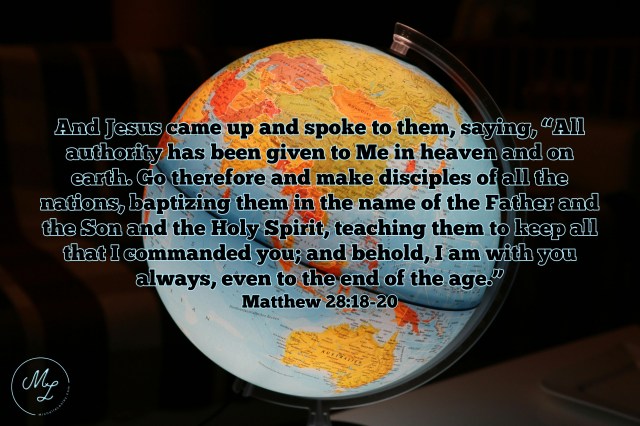
The Mailbag: Is it biblical for women to carry out The Great Commission?

Originally published June 18, 2018

Last week, I received some questions from a Facebook follower regarding my article Basic Training: The Great Commission. I thought they were very insightful and that other readers might have the same questions, so I’m sharing and expanding on my answers to her here. (I’ve edited/condensed the reader’s questions and comments {in bold type} for the sake of brevity.)

Given my understanding of what Jesus is commanding, and comparing it with other examples in the New Testament, it’s not for women to do the Great Commission. Our role is not to make disciples, teach, or baptize, but to keep the home, edify other women believers, etc. The Great Commission is for men, not women, to do because…

1. The Great Commission requires teaching and baptizing.

2. Jesus was speaking the Great Commission to His disciples, who were all male.

3. We don’t see any specific New Testament examples of women sharing the gospel with the lost through their own witness or example.

4. Because we don’t see any specific New Testament examples of women sharing the gospel or any explicit commands for women to share the gospel, it violates the regulative principle for women to share the gospel with the lost.

This reader’s questions really got me thinking and digging. I love questions that make me think hard and dig into Scripture and theology for answers!

First, let me briefly address the points of this issue that are not in dispute. As I understand her, the reader is in full agreement with Titus 2:3-5 and the example of Lois and Eunice. She agrees with the biblical principles of women training their own children in the gospel and discipling Christian women (already saved) inside the church. Her questions have mainly to do with sharing the gospel with the lost outside the church – evangelism.

Next, before we dive into the reader’s questions themselves, it is very important to distinguish between two types of Scripture:

Broadly speaking, there are two main types of Scripture: descriptive and prescriptive. Descriptive passages describe something that happened: Noah built an ark. Esther became queen. Paul got shipwrecked. These passages simply tell us what happened to somebody. Prescriptive passages are commands or statements to obey. Don’t lie. Share the gospel. Forgive others.

If we wanted to know how to have a godly marriage, for example, we would look at passages like Ephesians 5:22-33, 1 Corinthians 7, and Exodus 20:14,17. These are all passages that clearly tell us what to do and what not to do in order to have a godly marriage.

What we would not do is look at David’s and Solomon’s lives and conclude that polygamy is God’s design for marriage. We would not read about Hosea and assume that God wants Christian men to marry prostitutes. We would not read the story of the woman at the well and think that being married five times and then shacking up with number six is OK with Jesus.

Descriptive passages may support, but never trump, the clear instruction of prescriptive passages.¹

Now, let’s see if we can come to some biblical conclusions on her questions:

1. The Great Commission requires teaching and baptizing.

Teaching:
Often, when we’re looking at women’s roles in the church and being obedient to 1 Timothy 2:12, people conflate evangelism with teaching. Teaching Scripture to saved people inside the church gathering is not the same thing as sharing the gospel with lost people outside the church gathering. They are two separate, distinct things. First Timothy 2:12 (and other prohibitive passages) only prohibits the former, not the latter. The Great Commission, and the New Testament overall, commands the latter.

Teaching Scripture to saved people inside the church gathering is not the same thing as sharing the gospel with lost people outside the church gathering. They are two separate, distinct things.

As Christian women we want to be sure we keep these two things straight and carry out The Great Commission in the way God has prescribed for women to carry it out. May we share the gospel with a lost man or woman “as we are going”? Yes. If that person is a man, once he is saved is it biblically appropriate for a woman to teach and disciple him? No. If he is saved, he is supposed to be joined to a local church. Once inside the church body, he is to be taught Scripture and discipled by men.

As Christian women we want to be sure we keep teaching and evangelism straight and carry out The Great Commission in the way God has prescribed for *women* to carry it out.

Here are some resources which may be of further help:

Rock Your Role: Jill in the Pulpit

Rock Your Role FAQs (see #11 for using wisdom on sharing the gospel with men)

Basic Training: 7 Reasons Church is Not Optional and Non-Negotiable for Christians

Women Preaching the Gospel? at A Word Fitly Spoken (This is sort of the opposite {and unbiblical} argument: “Because the Bible says ‘preach the gospel’ -meaning, we’re to evangelize- that means women can preach in church, too!”. I thought you might find it interesting.)

Baptism:
When it comes to teaching inside the church, we have clear, prescriptive passages that specifically tell us what women are not to do. With evangelism, we also have clear commands in The Great Commission, and elsewhere, that disciples of Christ are to share the gospel.

But when it comes to baptism, we don’t have a clear “this or that person should or should not perform baptisms” passage, so we need to look at the principles and precedents surrounding baptism.

The people specifically named as personally performing baptisms in the New Testament were John the Baptist (who baptized Jesus), the twelve apostles, Philip the Evangelist, Paul and/or Silas, and Paul. All of these were men, and all held pastoral or pastoral/elder-type formal leadership positions in the embryonic or infancy stages of the church. All of them were commissioned, ordained, or set apart to their positions by God, Jesus, or the church. We do not see any New Testament instances of random church members – male or female – performing baptisms, only those in positions of church leadership.

Additionally, baptism is a formal, official, consecrated ordinance of the church, not a casual, personal, relational activity between individuals, friends, or loved ones. It should no more be administered by any church member who wants to do it than the Lord’s Supper should be. Both ordinances should be administered by an ordained pastor or elder of the church. That leaves out women as well as most men. Does the responsibility of pastors to baptize mean that men who aren’t pastors shouldn’t carry out the Great Commission? Of course not. We – men and women – share the gospel with someone, and if that person gets saved, part of our responsibility is to do what we can to get him plugged in to a local church where a pastor can baptize him. We don’t have to baptize him ourselves in order to be fulfilling The Great Commission.

Basic Training: Baptism

2. Jesus was speaking the Great Commission to His disciples, who were all male.
Yes, they were all male. They were all apostles, too. But first and foremost, they were all disciples – followers of Christ – just as Christians are today. Our identity in Christ – who we are, spiritually – trumps what we are, physically (male or female), and what we do (different roles and behaviors) as a result of who and what we are. Galatians 3:28 tells us:

There is neither Jew nor Greek, there is neither slave nor free, there is no male and female, for you are all one in Christ Jesus.

In Christ, there is only one type of being: Christian. There is only one kind of spiritual DNA. There’s no XX and XY. There’s just X. Ontologically, Christians are all the same kind of spiritual being.

The Great Commission is based on who the disciples, and we, are – followers of Christ – just as many of the other things that Jesus taught His disciples were. For example, when the disciples said, “Lord, teach us to pray,” and Jesus responded with the Lord’s Prayer, did Jesus mean that only the Twelve, or only men should use it as their model in prayer? When Jesus washed the disciples’ feet, did He mean that only the disciples or only men should serve one another in humility? When Peter asked Jesus how many times he had to forgive, did “seventy times seven” apply only to Peter, only to the disciples, or only to men? Of course not. Christ’s instructions to His followers apply to all who follow Him. It is in the way in which we carry these instructions out that Christ differentiates and delegates divergent and discrete responsibilities to men, women, and church leadership.

As disciples, we are to carry out The Great Commission. As Christian women, we carry it out in a different way from men and pastors.

As disciples, we are to carry out The Great Commission. As Christian women, we carry it out in a *different way* from men and pastors.

3. We don’t see any specific New Testament examples of women sharing the gospel with the lost through their own witness or example.
We don’t see any specific verses that say something along the lines of “Miriam shared the gospel with Simon, and he got saved,” that’s true. But how about these…

✢The woman at the well in John 4: “So the woman left her water jar and went away into town and said to the people, ‘Come, see a man who told me all that I ever did. Can this be the Christ?’ They went out of the town and were coming to him.” (28-30)

✢The widow (and townswomen) of Nain in Luke 7: “Fear seized them all, and they glorified God, saying, ‘A great prophet has arisen among us!’ and ‘God has visited his people!’ And this report about him spread through the whole of Judea and all the surrounding country.” (16-17)

✢The friends of Tabitha in Acts 9: ” And he gave her his hand and raised her up. Then, calling the saints and widows, he presented her alive. And it became known throughout all Joppa, and many believed in the Lord.” (41-42)

✢Lydia in Acts 16: “The Lord opened her heart to pay attention to what was said by Paul. And after she was baptized, and her household as well…” (14-15)

1 Corinthians 7:12-16: “If any woman has a husband who is an unbeliever, and he consents to live with her, she should not divorce him. For the unbelieving husband is made holy because of his wife…For how do you know, wife, whether you will save your husband?”

1 Peter 3:1-6: “Likewise, wives, be subject to your own husbands, so that even if some do not obey the word, they may be won without a word by the conduct of their wives.”

The first four examples imply that various women, to one degree or another, were pointing people to Jesus. But, again, these are descriptive passages. They lend a bit of support to the idea of women sharing the gospel with others, but we build doctrine on prescriptive passages like The Great Commission. The last two examples are prescriptive passages instructing women in sharing the gospel with their lost husbands. These passages are supportive of women sharing the gospel.

4. Because we don’t see any specific New Testament examples of women sharing the gospel or any explicit commands for women to share the gospel, it violates the regulative principle for women to share the gospel with the lost.
Well, as I mentioned above, we do see descriptive passages that at least hint at women sharing the gospel, and we also see prescriptive passages that explicitly instruct women in sharing the gospel with their lost husbands. But The Great Commission and other passages that are general commands to all followers of Christ to share the gospel are the strong and emphatic passages we draw doctrine from, not the more tangential passages. So even if the regulative principle did apply to evangelism, it would be supported by Scripture.

But the regulative principle doesn’t apply to evangelism as the full terminology – the regulative principle of worship – helps us to understand. The regulative principle applies to the corporate worship service, not evangelism, not marriage, not finances, not employment, not parenting, nor any other biblical issue. Just corporate worship.

Are women to carry out The Great Commission? Yes. We are to carry it out in the way Christ has prescribed for godly Christian women.

Are women to carry out The Great Commission? Yes. We are to carry it out in the way Christ has prescribed for godly Christian women.


¹Rock Your Role: Oh No She Di-int! Priscilla Didn’t Preach, Deborah Didn’t Dominate, and Esther Wasn’t an Egalitarian

If you have a question about: a Bible passage, an aspect of theology, a current issue in Christianity, or how to biblically handle a family, life, or church situation, comment below (I’ll hold all questions in queue {unpublished} for a future edition of The Mailbag) or send me an e-mail or private message. If your question is chosen for publication, your anonymity will be protected.


Mailbag

The Mailbag: Potpourri (Women giving eulogies… Highlighting my Bible?… Sharing resources with men… Leading a tract ministry)

Welcome to another “potpourri” edition of The Mailbag, where I give short(er) answers to several questions rather than a long answer to one question.

I like to take the opportunity in these potpourri editions to let new readers know about my comments/e-mail/messages policy. I’m not able to respond individually to most e-mails and messages, so here are some helpful hints for getting your questions answered more quickly. Remember, the search bar (at the very bottom of each page) can be a helpful tool!

Or maybe I answered your question already? Check out my article The Mailbag: Top 10 FAQs to see if your question has been answered and to get some helpful resources.


My father passed away recently, and I’ve been asked by my family to give one of several eulogies. I am saved, and I’d be very eager to share the gospel, as most of my beloved relatives & extended family are not. However, I will decline, and not go against God’s Word, if this would be an example of “teaching” both men & women. Thank you so much.

My deepest condolences on the loss of your father.

No, giving a eulogy is not a violation of Scripture for women. What God prohibits you from doing is pastoring, preaching, teaching men the Scriptures, and exercising authority over men in the context of the gathering of the church body.

A funeral is not the gathering of the church body (especially when, as you indicated, most of the people attending are lost), and a eulogy doesn’t correlate to a sermon, it correlates more closely to giving a short personal testimony. You’ll be talking about your dad, not instructing or exhorting people from the Scriptures.

Was your dad a Believer? If so, one way to share the gospel during your eulogy that might make you more comfortable would be to word the gospel in terms of your dad’s testimony. (i.e. “In 1973, Dad hit rock bottom and came to realize he was a sinner. He cussed like a sailor, he wasn’t leading his family to know the Lord, he was a liar … but then he picked up the Bible Grandma had given him so many years ago and started reading. As he read, he came across Scriptures like X, Y, and Z [read Scriptures like Romans 3:23, etc. here] ….I’m so glad Dad trusted in the death, burial, and resurrection of Christ to save him, and I know he’d want you to trust Christ, too.”)

If your dad wasn’t a Believer, was there something in his life that lent itself to you becoming a Believer? If so, you could word the gospel in terms of your own testimony. (i.e. “…Dad had messed up. Again. But that led me to think about all the times in my life when I had messed up. I had sinned so many times against a holy God…. [insert the gospel via your testimony here] … and even though Dad wasn’t perfect, I’m so thankful for the way God used his life to help me understand that I needed Christ.)

What you might want to do is meet with your pastor for some counsel on this. He has undoubtedly performed a lot of funerals, both for saved people and unsaved people, and I’m sure he can give you better guidance than I can.

Additional Resources

Rock Your Role: Jill in the Pulpit

Rock Your Role FAQs

Rock Your Role series


You’re the first person I thought of to ask how to highlight Bible verses using specific colors. Do you have a system for this skill that you can share? I’m 61 and have never had a church that taught it.

Well, I’m honored that you thought of me! I’m almost 54 and I’ve never been in a church that taught it either. I think it’s really just an individual thing that you develop a method for on your own rather than something the church teaches.

I wish I could help you come up with a system, but I don’t use highlighters in my Bible. I did when I was younger, but I ended up highlighting so many verses it just became pointless.

(I have no idea what @faithcomedy is. I’m not recommending it, just leaving it on the pic for a photo credit.)

My husband gave me a MacArthur Study Bible for Christmas! It’s a precious gift, so I want to use it wisely.

Your husband is a keeper! I hope you gave him plenty of hugs and kisses. The MacArthur Study Bible is one of the best study Bibles out there.

I also want to learn how to study my Bible without a formal study, so I thought I would start with a few of your studies before going solo. I believe systematically highlighting what I learn will help me focus better and provide order to my efforts. Brain fog and focus are current challenges for me, so keeping things simple works best.

I hope you’ll enjoy whichever of my studies you decide to use. Studying straight from the text of Scripture is the wisest possible use of that new Bible.

My advice would be to ask your friends at church how they highlight. You can also Google something like “how to highlight my Bible”. I’m sure you’ll get lots of results. Just sift through them carefully, use what works for you, and throw out the rest.

My daily structure was shattered last year, but God used it to get my attention. Now, I’m working on re-establishing self-discipline to restore the structure as God directs me. Thank you for your time in considering my thoughts. Your assistance is greatly respected and appreciated.

You are more than welcome. I’m so encouraged to hear how God is working in your heart and life. It is my pleasure to serve you in Christ.


You write to women. I love the things you write but are they appropriate to share with men? Is it my place to share with men? I’m not talking about my husband, I have a man who is the right age to be my son, I am 62, and he randomly sends me things from teachers you have helped me learn to veer away from… but my friend has much more of an attitude of something you wrote somewhere about chewing the meat,spitting out the bones… I can’t remember exactly how you said it. Anyway he feels like sharing anything is better than sharing nothing. I am wondering if forwarding him your article is a good idea or if there is a strong male pastor who writes about discernment? I hate to send videos of John MacArthur although I’ve watched him and it’s so good. But I’m not sure if sending an hour long video is something that would capture his attention enough. He is of course accusing me of being a Pharisee😔

Thank you so much for your kind words. Hon, let me start off by saying this- if this disrespectful dude is young enough to be your son and he feels comfortable calling someone he should view as a mother figure a Pharisee, he’s not your friend. You may have some sort of relationship with him, but it’s not a friendship, at least not on his part. A younger man treating an older woman that way ought to be ashamed of himself.

While it’s admirable that you’re trying to help him, it sounds like you’ve already tried to, and he’s thrown it back in your face. Scripturally, you are under no obligation to keep going back indefinitely for what he’s dishing out. Even God the Father, Jesus, and their admonitions in Scripture don’t teach us to keep indefinitely pursuing people who have rejected biblical truth:

  • Think about Old Testament Israel. God pursued them, disciplined them, sent them prophets, performed miracles – the whole works – and He bore with them in their idolatry and disobedience for hundreds of years. But not forever. He eventually sent them into exile.
  • Remember the story of Jesus and the rich young ruler? Did Jesus chase him down and keep trying to convince him once he rejected biblical teaching from Jesus Himself? No. He let him go. What about the father of the prodigal son? Dad lets that rebel leave. (You can probably think of many more examples.)
  • Matthew 7:6: Do not give dogs what is holy, and do not throw your pearls before pigs, lest they trample them underfoot and turn to attack you.
  • Mark 6:11: And if any place will not receive you and they will not listen to you, when you leave [this phrase assumes they will leave], shake off the dust that is on your feet as a testimony against them.

Now, all of that being said, you’ll want to spend some time in prayer for wisdom about how much longer you should hang in there with him on this topic. It is perfectly permissible for you to say, at some point, “It seems like we are at an impasse about these teachers and it is causing contention. If you’d ever like to discuss how you can stop following these false teachers and follow some sound teachers instead, my door is always open. But until then, let’s talk about other things instead.”. Keep praying for him. This is a heart issue, not an evidence issue. God has to open his eyes to the truth before he’ll be able to see it.

In the meantime, yes, it is OK to send him my articles, but if you’re looking for a man’s discernment materials instead, you can’t go wrong with Chris Rosebrough. Check out his YouTube channel and the archives of his podcast, Fighting for the Faith.


I don’t want this question to appear on the forum, if that’s all right. Like the name and details….

This was the preface to a question a reader posed in a comment here on the blog. I certainly understand wanting to remain anonymous, but I can’t answer blog comments that way. I’m not able to. If you leave a blog comment and I publish and respond to it, your name, avatar, and comment are going to be visible to the public in the comments section of the article you commented on. And I can’t respond to your comment without publishing it. I’m sorry, that’s just the way WordPress works.


A church I previously attended is interested in funding a ministry idea I have to mail or email gospel tracts to anyone for free. They are encouraging me to lead the ministry and I don’t see how I qualify biblically being an unmarried woman. I told them I read in the Bible a Christian woman is allowed to share the gospel but a Christian man qualified as bishop or deacon should lead the ministry. They said I shouldn’t worry about being a woman leading the ministry. I could use your guidance and prayers about what I should do.

Should I work on the ministry plan and administrate the ministry? I would still find qualifying Christian men to lead the ministry through a Board of Directors/Advisors. Thanks in advance for your thoughts on this.

What a fantastic ministry! I’m so glad you thought of this, and I hope it will be a blessing to many.

If your conscience prevents you from heading up this ministry, then don’t sin against your conscience by heading up this ministry.

That said, you do want to be sure your conscience is biblically informed before you base a decision on it.

The biblical prohibition is against women pastoring, preaching, teaching the Bible to men, or exercising unbiblical authority over men in the gathering of the church body. I’m guessing your hesitation is based on the “authority” aspect of that passage.

On the surface, with the limited information I have, it doesn’t sound like ordering and mailing tracts, the administrative sorts of tasks that go along with that (i.e. buying stamps, taking the mailers to the post office, etc.) and organizing those who volunteer to help, would be an authority issue. I mean, how much supervision does a man need to stick a tract into an envelope, seal it, stamp it, and address it? Are you truly “exercising authority” by sending him a list of email addresses to send e-tracts to?

However, there may be some other aspects of the situation I’m not aware of that would make authority an issue. Assuming your current church is doctrinally sound, I would suggest you set up an appointment with your pastor, lay everything out for him, and ask for his counsel and advice.


If you have a question about: a Bible passage, an aspect of theology, a current issue in Christianity, or how to biblically handle a family, life, or church situation, comment below (I’ll hold all questions in queue {unpublished} for a future edition of The Mailbag) or send me an e-mail or private message. If your question is chosen for publication, your anonymity will be protected.

Christian women, Complementarianism, Mailbag

The Mailbag: Is it biblical for women to carry out The Great Commission?

Last week, I received some questions from a Facebook follower regarding my article Basic Training: The Great Commission. I thought they were very insightful and that other readers might have the same questions, so I’m sharing and expanding on my answers to her here. (I’ve edited/condensed the reader’s questions and comments {in bold type} for the sake of brevity.)

Given my understanding of what Jesus is commanding, and comparing it with other examples in the New Testament, it’s not for women to do the Great Commission. Our role is not to make disciples, teach, or baptize, but to keep the home, edify other women believers, etc. The Great Commission is for men, not women, to do because…

1. The Great Commission requires teaching and baptizing.

2. Jesus was speaking the Great Commission to His disciples, who were all male.

3. We don’t see any specific New Testament examples of women sharing the gospel with the lost through their own witness or example.

4. Because we don’t see any specific New Testament examples of women sharing the gospel or any explicit commands for women to share the gospel, it violates the regulative principle for women to share the gospel with the lost.

This reader’s questions really got me thinking and digging. I love questions that make me think hard and dig into Scripture and theology for answers!

First, let me briefly address the points of this issue that are not in dispute. As I understand her, the reader is in full agreement with Titus 2:3-5 and the example of Lois and Eunice. She agrees with the biblical principles of women training their own children in the gospel and discipling Christian women (already saved) inside the church. Her questions have mainly to do with sharing the gospel with the lost outside the church – evangelism.

Next, before we dive into the reader’s questions themselves, it is very important to distinguish between two types of Scripture:

Broadly speaking, there are two main types of Scripture: descriptive and prescriptive. Descriptive passages describe something that happened: Noah built an ark. Esther became queen. Paul got shipwrecked. These passages simply tell us what happened to somebody. Prescriptive passages are commands or statements to obey. Don’t lie. Share the gospel. Forgive others.

If we wanted to know how to have a godly marriage, for example, we would look at passages like Ephesians 5:22-33, 1 Corinthians 7, and Exodus 20:14,17. These are all passages that clearly tell us what to do and what not to do in order to have a godly marriage.

What we would not do is look at David’s and Solomon’s lives and conclude that polygamy is God’s design for marriage. We would not read about Hosea and assume that God wants Christian men to marry prostitutes. We would not read the story of the woman at the well and think that being married five times and then shacking up with number six is OK with Jesus.

Descriptive passages may support, but never trump, the clear instruction of prescriptive passages.¹

Now, let’s see if we can come to some biblical conclusions on her questions:

1. The Great Commission requires teaching and baptizing.

Teaching:
Often, when we’re looking at women’s roles in the church and being obedient to 1 Timothy 2:12, people conflate evangelism with teaching. Teaching Scripture to saved people inside the church gathering is not the same thing as sharing the gospel with lost people outside the church gathering. They are two separate, distinct things. First Timothy 2:12 (and other prohibitive passages) only prohibits the former, not the latter. The Great Commission, and the New Testament overall, commands the latter.

Teaching Scripture to saved people inside the church gathering is not the same thing as sharing the gospel with lost people outside the church gathering. They are two separate, distinct things.

As Christian women we want to be sure we keep these two things straight and carry out The Great Commission in the way God has prescribed for women to carry it out. May we share the gospel with a lost man or woman “as we are going”? Yes. If that person is a man, once he is saved is it biblically appropriate for a woman to teach and disciple him? No. If he is saved, he is supposed to be joined to a local church. Once inside the church body, he is to be taught Scripture and discipled by men.

As Christian women we want to be sure we keep teaching and evangelism straight and carry out The Great Commission in the way God has prescribed for *women* to carry it out.

Here are some resources which may be of further help:

Rock Your Role: Jill in the Pulpit

Rock Your Role FAQs (see #11 for using wisdom on sharing the gospel with men)

Basic Training: 7 Reasons Church is Not Optional and Non-Negotiable for Christians

Women Preaching the Gospel? at A Word Fitly Spoken (This is sort of the opposite {and unbiblical} argument: “Because the Bible says ‘preach the gospel’ -meaning, we’re to evangelize- that means women can preach in church, too!”. I thought you might find it interesting.)

Baptism:
When it comes to teaching inside the church, we have clear, prescriptive passages that specifically tell us what women are not to do. With evangelism, we also have clear commands in The Great Commission, and elsewhere, that disciples of Christ are to share the gospel.

But when it comes to baptism, we don’t have a clear “this or that person should or should not perform baptisms” passage, so we need to look at the principles and precedents surrounding baptism.

The people specifically named as personally performing baptisms in the New Testament were John the Baptist (who baptized Jesus), the twelve apostles, Philip the Evangelist, Paul and/or Silas, and Paul. All of these were men, and all held pastoral or pastoral/elder-type formal leadership positions in the embryonic or infancy stages of the church. All of them were commissioned, ordained, or set apart to their positions by God, Jesus, or the church. We do not see any New Testament instances of random church members – male or female – performing baptisms, only those in positions of church leadership.

Additionally, baptism is a formal, official, consecrated ordinance of the church, not a casual, personal, relational activity between individuals, friends, or loved ones. It should no more be administered by any church member who wants to do it than the Lord’s Supper should be. Both ordinances should be administered by an ordained pastor or elder of the church. That leaves out women as well as most men. Does the responsibility of pastors to baptize mean that men who aren’t pastors shouldn’t carry out the Great Commission? Of course not. We – men and women – share the gospel with someone, and if that person gets saved, part of our responsibility is to do what we can to get him plugged in to a local church where a pastor can baptize him. We don’t have to baptize him ourselves in order to be fulfilling The Great Commission.

Basic Training: Baptism

2. Jesus was speaking the Great Commission to His disciples, who were all male.
Yes, they were all male. They were all apostles, too. But first and foremost, they were all disciples – followers of Christ – just as Christians are today. Our identity in Christ – who we are, spiritually – trumps what we are, physically (male or female), and what we do (different roles and behaviors) as a result of who and what we are. Galatians 3:28 tells us:

There is neither Jew nor Greek, there is neither slave nor free, there is no male and female, for you are all one in Christ Jesus.

In Christ, there is only one type of being: Christian. There is only one kind of spiritual DNA. There’s no XX and XY. There’s just X. Ontologically, Christians are all the same kind of spiritual being.

The Great Commission is based on who the disciples, and we, are – followers of Christ – just as many of the other things that Jesus taught His disciples were. For example, when the disciples said, “Lord, teach us to pray,” and Jesus responded with the Lord’s Prayer, did Jesus mean that only the Twelve, or only men should use it as their model in prayer? When Jesus washed the disciples’ feet, did He mean that only the disciples or only men should serve one another in humility? When Peter asked Jesus how many times he had to forgive, did “seventy times seven” apply only to Peter, only to the disciples, or only to men? Of course not. Christ’s instructions to His followers apply to all who follow Him. It is in the way in which we carry these instructions out that Christ differentiates and delegates divergent and discrete responsibilities to men, women, and church leadership.

As disciples, we are to carry out The Great Commission. As Christian women, we carry it out in a different way from men and pastors.

As disciples, we are to carry out The Great Commission. As Christian women, we carry it out in a *different way* from men and pastors.

3. We don’t see any specific New Testament examples of women sharing the gospel with the lost through their own witness or example.
We don’t see any specific verses that say something along the lines of “Miriam shared the gospel with Simon, and he got saved,” that’s true. But how about these…

✢The woman at the well in John 4: “So the woman left her water jar and went away into town and said to the people, ‘Come, see a man who told me all that I ever did. Can this be the Christ?’ They went out of the town and were coming to him.” (28-30)

✢The widow (and townswomen) of Nain in Luke 7: “Fear seized them all, and they glorified God, saying, ‘A great prophet has arisen among us!’ and ‘God has visited his people!’ And this report about him spread through the whole of Judea and all the surrounding country.” (16-17)

✢The friends of Tabitha in Acts 9: ” And he gave her his hand and raised her up. Then, calling the saints and widows, he presented her alive. And it became known throughout all Joppa, and many believed in the Lord.” (41-42)

✢Lydia in Acts 16: “The Lord opened her heart to pay attention to what was said by Paul. And after she was baptized, and her household as well…” (14-15)

1 Corinthians 7:12-16: “If any woman has a husband who is an unbeliever, and he consents to live with her, she should not divorce him. For the unbelieving husband is made holy because of his wife…For how do you know, wife, whether you will save your husband?”

1 Peter 3:1-6: “Likewise, wives, be subject to your own husbands, so that even if some do not obey the word, they may be won without a word by the conduct of their wives.”

The first four examples imply that various women, to one degree or another, were pointing people to Jesus. But, again, these are descriptive passages. They lend a bit of support to the idea of women sharing the gospel with others, but we build doctrine on prescriptive passages like The Great Commission. The last two examples are prescriptive passages instructing women in sharing the gospel with their lost husbands. These passages are supportive of women sharing the gospel.

4. Because we don’t see any specific New Testament examples of women sharing the gospel or any explicit commands for women to share the gospel, it violates the regulative principle for women to share the gospel with the lost.
Well, as I mentioned above, we do see descriptive passages that at least hint at women sharing the gospel, and we also see prescriptive passages that explicitly instruct women in sharing the gospel with their lost husbands. But The Great Commission and other passages that are general commands to all followers of Christ to share the gospel are the strong and emphatic passages we draw doctrine from, not the more tangential passages. So even if the regulative principle did apply to evangelism, it would be supported by Scripture.

But the regulative principle doesn’t apply to evangelism as the full terminology – the regulative principle of worship – helps us to understand. The regulative principle applies to the corporate worship service, not evangelism, not marriage, not finances, not employment, not parenting, nor any other biblical issue. Just corporate worship.

Are women to carry out The Great Commission? Yes. We are to carry it out in the way Christ has prescribed for godly Christian women.

Are women to carry out The Great Commission? Yes. We are to carry it out in the way Christ has prescribed for godly Christian women.


¹Rock Your Role: Oh No She Di-int! Priscilla Didn’t Preach, Deborah Didn’t Dominate, and Esther Wasn’t an Egalitarian

If you have a question about: a Bible passage, an aspect of theology, a current issue in Christianity, or how to biblically handle a family, life, or church situation, comment below (I’ll hold all questions in queue {unpublished} for a future edition of The Mailbag) or send me an e-mail or private message. If your question is chosen for publication, your anonymity will be protected.