1&2 Timothy Bible Study

1 & 2 Timothy: Lesson 5

Previous Lessons: 1, 2, 3, 4

Read 1 Timothy 4

Questions to Consider

1. Study verses 1-5. In what ways does this passage contrast truth with falsehood? List the individual words in these verses that convey the idea of falsehood or dishonesty. List the words that convey the idea of truthfulness. Who is the origin of all falsehood and deception? Compare “deceitful spirits” and “demons” (1) with John 8:44. Who is the origin of truth? Compare the statements about truth in 2b-5 with John 14:6, 17:17.

Recalling that 1 Timothy is a letter breathed out by the Holy Spirit to a pastor about the church, explain why it is important to God, to pastors, and to the church body that the church be a place of truth rather than a place of deception, false teaching, and lies.

2. Examine verse 1. What does it mean that “some will depart from the faith“? Does this mean that some people whom Christ has genuinely saved will lose their salvation?

3. Look closely at the way false doctrine and false teaching are described in verses 1-2. Is Paul wrongly using a “harsh tone” or being “unloving” toward false teachers as some Christians might accuse him of today? (Again, Who breathed out these Scriptures?)

4. Compare 4-5 with 2:9. Is there anything inherently sinful about braided hair, gold, pearls, or an expensive garment – these objects themselves, and/or owning/wearing them? Explain the primacy of the attitude of our hearts when it comes to these objects, marriage, and food (3). What does verse 5 mean when it says that these things are made holy “by the word of God and prayer”? How does this apply to your “relationship” with the things you own, wear, or participate in?

5. What is Paul instructing Timothy to do when he says, “If you put these things before the brothers,” (6)?

6. Examine 6-16. In chapter 3, the Holy Spirit gives a list of character qualifications for pastors – what they are to be. In 4:6-16 the Holy Spirit gives a list of instructions for pastors – what they are to __. Work your way through these verses and make a list of the things the Holy Spirit wants pastors to do. Circle or highlight any of these instructions and principles that do not apply to the laity (Christians who are not pastors). If pastors are supposed to “set the Believers an example” (12) what does that tell us about the need for us to follow the instructions in 6-16 that apply to both pastors and non-pastors? How does 2:11-15 apply to the way women are to follow these instructions? Is there any way in which the qualifications for pastors and deacons in chapter 3 should inform the way in which men follow these instructions? (For example: compare 3:2’s “able to teach” with 4:11’s “teach these things”. If a man is not “able to teach”, should he be in a teaching role in the church?)

7. What metaphor does Paul employ in 6-10 to describe training for godliness? How is spiritual training like physical training? How are they different?

8. Look closely at verse 9. We see this same phraseology four times in 1-2 Timothy. What does this statement mean, and why do you think Paul says it so often?

9. Compare the way Paul again inserts the gospel smack dab into the middle of his instructions to Timothy (10) to the way he has already done this in chapters 1, 2, and 3. How does this motif help us to see that everything we do in the church and in our own lives should revolve around and point back to the gospel?


Homework

Can you think of any churches, denominations, religions, cults, or movements today that “forbid marriage and require abstinence from foods” (3) for its leaders and/or members? Do some research, find out what is forbidden for whom, and examine the major points of the organization’s doctrine (ex: the nature of God, how people can be made right with God, etc.). Does it match up with biblical doctrine?


Suggested Memory Verse
 

1&2 Timothy Bible Study

1 & 2 Timothy: Lesson 4

Previous Lessons: 1, 2, 3

Read 1 Timothy 3

Questions to Consider

Question 1 is drawn from lesson 14 of my Imperishable Beauty study of biblical womanhood. If you have completed that study, you may wish to review your notes from lesson 14.

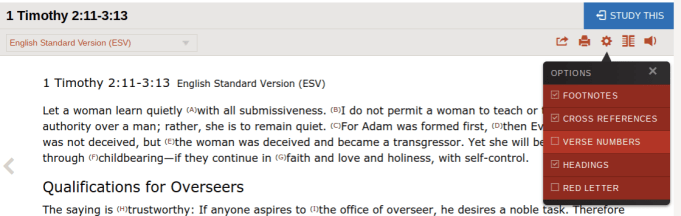
1. Recall that when the Bible was written, there were no chapter and verse numbers. (Those were added much later.) First Timothy would have read like one long, continuous letter or e-mail. So let’s reconnect the end of chapter 2 to the beginning of chapter 3. Click here, then click on the “options” icon and uncheck the box next to “verse numbers”.

Now read the passage, noting the flow of thought and how the end of chapter 2 is interconnected with chapter 3. What is the main idea of this passage? How does this passage demonstrate that God views both men and women as having important roles to play in the life of the church in Timothy’s day and now? Is the role of men or the role of women discussed first in this passage? How could the phrase “ladies first,” the idea of chivalry, and the biblical concept of servanthood describe this passage? Describe how men biblically filling out their role of leadership is actually serving the women (and other men) of the church.

(OK, now click the verse numbers back on and return to 1 Timothy 3 – link above.)

2. What is an overseer? Name two terms we more commonly use today for the office of overseer. What is a deacon? Read Acts 6:1-6. What was (and is today) the main duty of the pastor/elder versus the main duty of the deacon?

3. Make two 4-column charts, one for pastors/elders, one for deacons. In the first column of each chart, list each qualification for the office. In the second column, explain what that qualification means. (For example: What does it mean to be “sober-minded” or “double-tongued”? In the third column, explain why this qualification is important in the character of the man and/or in carrying out the duties of the office. In the fourth column, place a check mark if this is a requirement for both pastor/elder and deacon. Which of the qualifications are common to both offices? Which are different? Explain the reasons for the commonalities and differences in qualifications. How is it beneficial to the church for men in these offices to have these qualifications?

4. Describe how verses 14-16 could serve as the key verses or a summary statement for the books of 1&2 Timothy. Closely examine the two parts of verse 15. Which is the “what to do” part, and which is the “why we’re to do it” part? If 15 tells us the “what” and the “why,” what does 16 tell us?

5. As you’ve read through Old Testament books, have you ever noticed how many times God reminds His people of who He is and what He has done when He’s speaking with them? Refresh your memory, and compare this OT way of God with the NT way we’ve seen God remind His people in 1 Timothy of who Jesus is, and that every “what,” “how,” and “why,” of His instructions always points back to the “Who” of Jesus.


Homework

1. If you’d like to study more about the differences between God’s role for women in the church and men in the church, check out these articles:
Rock Your Role FAQs
Jill in the Pulpit
Deaconesses and Female Deacons

2. Do some research on how your church selects men for the position of pastor, elder, and deacon. Are the qualifications in 1 Timothy 3 (and Titus 1) the highest priority in the selection process? Are there other qualifications (seminary degree, age, etc.) your church requires for these offices? Are these extra qualifications biblical and wise, or unbiblical?


Suggested Memory Verse

1&2 Timothy Bible Study

1 & 2 Timothy: Lesson 3

Previous Lessons: 1, 2

Read 1 Timothy 2

Questions to Consider

1. Briefly review the theme or purpose of the book of 1 Timothy from lesson 1 (link above). Who is the ultimate Author of this book? Are the ideas and instructions in this book God’s ideas and instructions, or something Paul came up with on his own? Who was the original audience of this book?

2. You may be familiar with the little hermeneutical rule of thumb, “Whenever you see therefore in a verse, you need to find out what it’s there for.” “First of all, then,…” at the beginning of verse 1 serves the same purpose as “therefore” (in fact, some translations render that phrase as “therefore” instead of “first of all, then”). God, through Paul, is saying, “Because of all that stuff I told you in chapter 1, do what I’m about to tell you to do in chapter 2.” Review 1 Timothy 1 and/or lesson 2 (link above). What are the main issues addressed in chapter 1?

3. Make a “bullet point” list of each instruction given to Timothy and the church in chapter 2. Now make the connection between the two chapters – how can the church’s obedience to the instructions in chapter 2 fix the issues brought out in chapter 1?

4. Which group of verses is the focal point, or main idea, of chapter 2?

  • 1-3
  • 4-7
  • 8-10
  • 11-15

Read each of these groupings of verses and describe how each of them revolves around the idea that God desires to save people (4). Notice how the words, “I desire then” (8) and “likewise also” (9) point back to the focal passage. Why did God put the gospel smack dab in the middle of these instructions about how the congregation is to behave?

5. Why does Paul again cite his qualifications and credentials? (7)

6. Why does God want His church to pray for others, including kings and leaders? (1-2) What is the immediate desired outcome of this kind of prayer? (2) What is the long-term desired outcome of this kind of prayer? (3-4) Think about the political and cultural context surrounding the church at Ephesus. How could the church at Ephesus and the church today leading “a peaceful and quiet life, godly and dignified in every way” (2) lead to people getting saved (3-4)?

7. Does verse 8 mean that only men should pray when the church is gathered together? (Use your footnotes)

Questions 8-12 are drawn from lessons 15 and 14 (respectively) of my Imperishable Beauty study of biblical womanhood. If you have completed that study, you may wish to review your notes from those lessons.

8. Examine verses 9-10. Describe how women are not to adorn themselves and how they are to adorn themselves. Are things like braids, jewelry, and clothes intrinsically sinful, or is Paul giving cultural examples to illustrate a theological point he’s making? What is that point? What is it about the bent of women’s hearts that would cause God to give this instruction to women in the context of the home and the church, but not to give this instruction to men at all? How does it benefit the church for us to “wear”, or portray, godliness by adorning ourselves modestly and with good works?

9. Study verses 11-15. What is the first word of verse 11? Think about women’s social status and value in Paul and Timothy’s culture, and in many cultures since that time, even today. Why does the Holy Spirit instruct pastors to “let” women learn? What does this teach us about the responsibility God places on us as women to learn His Word? Would you categorize verse 11 as a “do this” or “don’t do this” verse?

10. Examine verse 12. Is this mainly a “do this” or “don’t do this” verse? What two things does the Holy Spirit say women are not to do in the gathering of the church body? What does He say women are to do? Think about God’s nature and character. Does He ever give instructions arbitrarily or just to spoil our fun? Why does God give us commands and instructions, generally speaking? Are the instructions in verse 12 good for women and for the church?

11. Take a look at 13-14. God kindly gives not one, but two reasons for His instructions in verses 11-12. What are those two reasons? How do they fall in line with God’s design for male headship and leadership across biblical history in the hierarchical structures He has set up?

12. Verse 15 can be a little cryptic to us today because we equate the word “saved” with salvation. Does verse 15 mean that women gain salvation by having children? How do we know it doesn’t? The NASB helpfully, and more accurately, renders this word as “preserved.” We don’t feel it much today, but think about the stigma women (particularly Jewish women) carried at the time this was written simply because they were daughters of Eve. Paradise was lost and the curse of sin entered the world because of a woman, many men thought, and they viewed and treated women accordingly. Yet who was chosen to bring the Messiah into the world? And following in her footsteps, a major way godly women can “save” or “preserve” the reputation, esteem, and value of womankind is to “continue in” what 3 godly character traits? (15) Because if they continue in those three godly character traits, they will be raising up a godly seed to the Lord (even if the children they bear aren’t perfect like Mary’s child was.) :0)


Homework

If you’d like to study more about modesty (9-10), check out these articles:
Imperishable Beauty: Lesson 15- A Beautiful Portrayal of Biblical Womanhood in the Church
The Mailbag: Potpourri (Calvinism, Baptism, Modesty…)

If you’d like to study more about the role of women in the church (11-15), check out these articles:
Imperishable Beauty: Lesson 14- A Beautiful Position in the Church
Jill in the Pulpit (1 Timothy 2:11-12)
Order in His Courts: Silencing Women? (1 Corinthians 14:33b-35)


Suggested Memory Verse

1&2 Timothy Bible Study

1 & 2 Timothy: Lesson 2

Previous Lessons: 1

Read 1 Timothy 1

Questions to Consider

1. Briefly review the housekeeping/helpful hints section and “Introduction to 1 Timothy” section from lesson 1 (link above).

2. Why did the Holy Spirit inspire Paul to list his credentials and explain his relationship to Timothy in verses 1-2? Why would this have been important to Paul and Timothy, to the members of Timothy’s church, to anyone else at that time who happened to read this letter, and to readers of 1 Timothy today? Where was Timothy’s church located? (3)

3. What is the very first issue Paul tackles regarding Timothy’s church? (3-11) What does this tell you about the urgency of this issue then, and now?

Today, with regard to false teachers, Christians will often say things like, “You shouldn’t say anything negative about that person, you should just pray for her,” or “You should just teach the truth of the Bible and people will figure out for themselves who the false teachers are.” Is this what the Holy Spirit, via Paul, instructs Timothy to do? (3-4) How is Timothy instructed to address the false teachers? (3-4) Why is it urgent that Timothy (and pastors today) deal with false doctrine and not allow it in his church? (4b, 7)

What is supposed to be the motive and goal of pastors, teachers, and church members when it comes to living the Christian life and serving the church? (5) When teachers “swerve from these,” what does that swerving lead to? (6-7)

Compare verse 19 to verses 5-6, noting the similarities. Who were Hymenaeus and Alexander? (use your cross references) How does Paul say he handled these false teachers? (20) Why did he do this? (20) Compare Paul’s handling of unrepentant false teachers in the church to Matthew 18:15-20, Jesus’ instruction of how to handle unrepentant sinners in the church (18:17b). Why is it necessary to remove unrepentant sinners and false teachers from the church and to regard them as non-Christians (“hand over to Satan”, “let him be to you as a Gentile and a tax collector”)? (20b, 4b) What is the goal of a Christian regarding anyone who is not a Christian? Are these actions toward false teachers in keeping with the motive and aim Paul expressed in verse 5?

4. Examine the words “genealogies” (4), “teachers of the law” (7), and the discussion about the law in verses 8-9. Now, draw from what you may already know about the false teaching of the Judaizers in the early church. What do you think is the general topic the false teaching Paul addresses in chapter 1 has to do with?

5. What does it mean to “use the law lawfully” (8)? (9) Who are the “just”? (9) Who are “the lawless and disobedient…the ungodly and sinners” (9a)? (9b-10) Which is the correct (lawful) group to “lay the law down for” (9a)? (9b-10)

If 8-11 describe the lawful use of the law – who it should be laid down for – what can you conclude about the false teachers’ use of the law? Who were they laying it down for? Why is this false teaching? (10b-11)

6. What is “sound doctrine” (10b)? (11) Why is it important that all pastors and teachers preach and teach sound doctrine?

7. Read 12-17. What are some adjectives you would use to describe Paul’s character and his view of himself? What is Paul’s view of his position in relationship to Christ? How does Paul see what Christ has done in his life as an example for others? (16) Pray through these verses asking God to develop in you the same view of yourself and your position before God that Paul had.

8. We’re going to see the word “charge” several times in 1 & 2 Timothy. How many times does this word appear in chapter 1? What does the word “charge” mean in verse 3? In verses 5 & 18?


Homework

Believe it or not, there are still false teachers out there today teaching that Christians must obey Old Testament civil and ceremonial laws. Do some research on the Hebrew Roots Movement to learn more, and if you come across a good resource about it, please comment below and share.


Suggested Memory Verse

Biblical Womanhood Bible Study

Imperishable Beauty: Lesson 17- The Most Beautiful Girl in the World…er…Bible- Finale

Previous Lessons: 1, 2, 3, 4, 5, 6, 7, 8, 9, 10, 11, 12, 13, 14, 15, 16

Read These Selected Scriptures

It’s been a beautiful 17 weeks studying biblical womanhood with you! Today, we’re bringing things to a close as we reflect on all we’ve learned. Links to all previous lessons are located above.

Questions to Consider

1. We started this study by looking at the Proverbs 31 woman (lessons 2-3), often considered the icon of biblical womanhood. In subsequent lessons, we tried to answer the question, “If the Proverbs 31 woman really is the ideal to attain to, how do we get there from here?”. And we’re finishing up today by looking back again at the Proverbs 31 woman. Is she really the quintessential picture of biblical womanhood? How do all the other Scriptures we’ve studied flesh out the ideal described in Proverbs 31?

2. What does verse 10 mean? Consider verse 10 in light of lessons 4-6. How does the fact that you were uniquely created by God (4), that your identity is found in Christ (5), and that you are a vital member of the Body of Christ (6), provide a foundation to build on for becoming the rare, excellent, godly woman?

3. Examine verses 11-12 in light of lesson 11. What are some of the ways you can be obedient to Scripture that will enable you to do your husband good and not harm, benefit him, and enable his heart to trust in you?

4. Consider verse 17 in light of lessons 7-9. How do knowing and loving God’s Word (7), obeying God’s Word (8), and sharing the gospel (9), dress you with strength and make your arms strong?

5. What is the general motif of verses 17, 22, 25? Compare these verses to the concept of “adorning” we studied in lesson 15. With what “clothing” should a godly woman “dress” or adorn herself?

6. Examine verse 26 in light of lessons 13-16. How can we open our mouths with wisdom and teach kindly through our position in the church (14), our portrayal of biblical womanhood in the church (15), and our proclamation of God’s Word (16) in the church? What are the unique opportunities single women (13) have to teach and model wisdom and kindness in the church?

7. Examine verses 27-28 in light of lessons 10-13. How can we diligently look well to the ways of our households and families as daughters (10), wives (11), mothers (12), and single women (13)?

8. In what specific areas has God grown you in biblical womanhood during the course of this study? What would you say was your most important takeaway from this study?


Homework

Go back over the questions in the “Expectations and Presuppositions” section of lesson 1. Have any of your answers changed? How or why? Did you get out of this study what you were hoping to get out of this study (#6)? Explain.


Suggested Memory Verse

Give her of the fruit of her hands, and let her works praise her in the gates.
Proverbs 31:31