Obedience, Sanctification

40 Things to Give Up for Lent

Although, as a Louisiana girl, I’ve had a decades long love affair with king cake, and I totally support the increased availability of fish entrées at local restaurants and getting a few days off school or work, I’m not a big fan of Mardi Gras and Lent.

The intrinsic philosophy behind Mardi Gras – a day of revelry, indulgence, and debauchery to get it all out of your system before you have to start “being good” for Lent – is patently unbiblical.

The practice of Lent often is, as well. Lent is the forty day period, beginning with Ash Wednesday and ending with Easter Sunday, observed by Catholics and some Protestants. Originally, it was simply a time of fasting, prayer, and worship in anticipation of Easter, and for Christians who continue to observe it this way, it can be a valuable and meaningful time of respite and renewal with the Lord.

For many, however, Lent – particularly the aspect of giving something up for Lent in an act of self-denial – is nothing more than an empty religious ritual, or worse, works righteousness. Giving something up for Lent because, “I’m Catholic and that’s what good Catholics do,” or to atone for your sins, or to curry favor with God, or to flaunt your self-righteousness flies in the face of grace alone, faith alone, Christ alone biblical Christianity.

If you give something up for Lent, why do you do so? If it’s for one of the aforementioned unbiblical reasons (or others), or even if you don’t observe Lent at all, I’d like to challenge us all to give up the things below for Lent:

1. Give up Lent for Lent.

2. Give up attending any church that requires the observance of Lent in a sacramental way and find a doctrinally sound one.

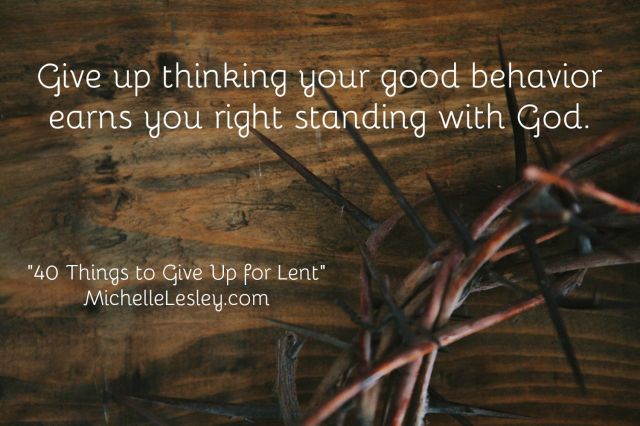
3. Give up thinking your good behavior earns you right standing with God.

4. Give up the idea that there’s any such thing as truly good behavior.

5. Give up thinking your good deeds could ever outweigh your sins.

6. Give up willfully indulging in sin as long as you “make up for it” later.

7. Give up the notion that penance or self-denial can pay for your sins.

8. Give up thinking that penance or self-denial curries favor with God.

9. Give up the idea that repentance and obedience belong to a certain season on the calendar. We are to walk in repentance every day.

10. Give up the concept that Christmas and Easter are Christian “high holy days.” We celebrate Christ’s incarnation and resurrection every Sunday, and should prepare ourselves all during the week. Every Sunday is a high holy day for the Christian.

11. Give up rote participation in church rituals. Search the Scriptures and see if they’re biblical first.

12. Give up thinking God concerns Himself strictly with your external behavior rather than the condition of your heart.

13. Give up “sounding a trumpet before you” with humblebrags on social media and in real life about giving things up for Lent, fasting, giving offerings, or any other good works you might do. You just lost your reward, baby.

14. Give up approaching church attendance as punching the time clock for God. The Christian’s entire life, our very beings, belong to Christ, not just a couple of hours on Sunday.

15. Give up the delusion that you’re basically a good person. You’re not.

16. Give up biblical ignorance and become a good student of God’s word.

17. Give up forsaking the assembly and become a faithful, serving member of your local church.

18. Give up thinking that everyone and everything that calls itself “Christian” actually is.

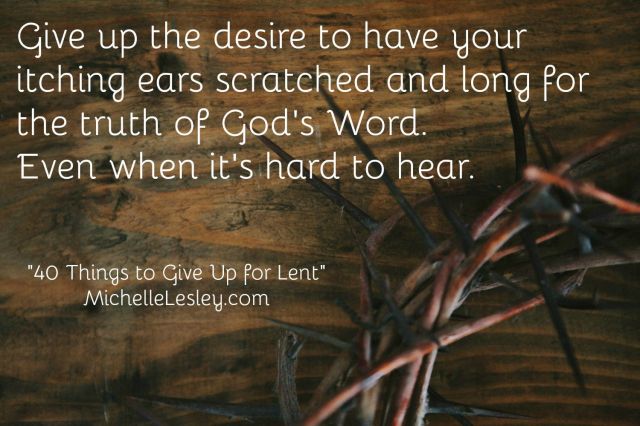
19. Give up the desire to have your itching ears scratched and long for the truth of God’s word. Even when it’s hard to hear.

20. Give up neglecting the daily study of God’s word.

21. Give up rejecting parts of the Bible you don’t agree with. We don’t sit in judgment over Scripture. Scripture sits in judgment over us.

22. Give up neglecting your prayer life.

23. Give up making excuses for failing to memorize Scripture. You can do it!

24. Give up being a non-serving member of your church.

25. Give up being a non-giving member of your church.

26. Give up thinking you’re hearing God speak to you. If you want to hear God speak to you, open your Bible and study it. God has spoken in His word and many are largely ignoring what He has already said.

27. Give up following false teachers and be a good Berean.

28. Give up being afraid to share the gospel and just do it.

29. Give up thinking you can please God apart from faith in Christ.

30. Give up basing your doctrine and beliefs on your own (or anyone else’s) opinions, experiences, and feelings, and base them on correctly handled Scripture instead.

31. Give up following your wicked and deceitful heart, take up your cross daily, and follow Christ.

32. Give up thinking you have to do big things for God in order for Him to be pleased with you and “aspire to live quietly, and to mind your own affairs, and to work with your hands.”

33. Give up worrying and trust God.

34. Give up neglecting to fear God’s wrath if you don’t know Christ.

35. Give up fearing God’s wrath if you do know Christ.

36. Give up the idea that “God is love” means God is a pushover who won’t judge you.

37. Give up thinking you’ve been so bad that God could never forgive you.

38. Give up thinking you’re so good that you don’t need God to forgive you.

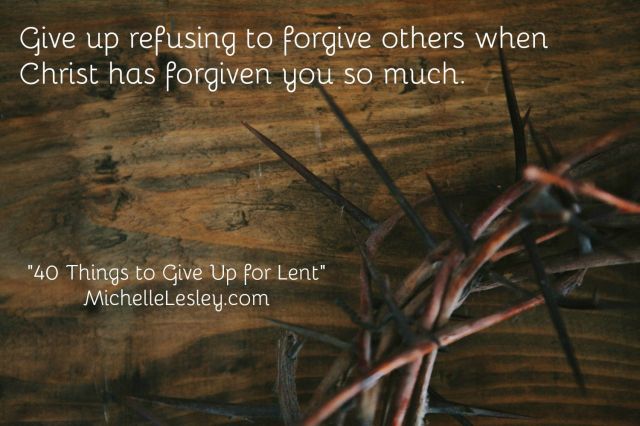
39. Give up refusing to forgive others when Christ has forgiven you so much.

40. Give up everything and be saved by grace alone, through faith alone, in Christ alone, and walk in His ways, all the days of your life, to the glory of God alone.

Sin, Throwback Thursday

Throwback Thursday ~ When Animals Attack

Originally published December 15, 2010animals-attack

Dear Mom and Dad-

Thank you for not getting me a pet monkey when I was a kid, even though I begged and begged for one.

Love,
Michelle

Lately, and I’m not sure why, I have become fascinated with a television show on the Animal Planet channel called Fatal Attractions. It’s all about people who keep dangerous exotic animals as pets. Usually, the pet owner ends up dead by the end of the show, hence the title. It’s not a program for the faint of heart.

People keep the strangest animals – venomous snakes, giant lizards, bears, and, yes, even apes – despite the fact that they are known to be dangerous. Now, if you grew up in the ’70s and ’80s like I did, you might remember that there was a spate of movies and TV shows at some point back then – B.J. and the Bear, Cannonball Run II, etc. – that featured cute little chimpanzees and their human companions. So, you might be thinking what I was thinking the other day when an episode of Fatal Attractions focusing on pet chimpanzees came on: “How could those adorable little animals be dangerous?”. They wear hats and overalls, give hugs and kisses, and even communicate in a rudimentary way. My parents told me the reason I couldn’t have one was that they carried germs and that they would stink up the house.

Well, apparently, chimps are much more sinister than smelly. Even when people have taken them in as babies and raised them as their own children, many chimps, upon reaching adolescence, have turned violent and attacked their owners or others.

Moreover, the way they attack is particularly gruesome. Snakes will bite whichever of your body parts is closest. Bears flail their paws around indiscriminately, mauling whatever is in their pathway. Chimpanzees, however, attack systematically. They focus specifically on severing small appendages (ears, eyes, nose, lips, fingers, toes, and genitals) first, before moving on to a more “macro” assault on their victims.

Interestingly, most of the story lines on Fatal Attractions follow the same pattern. The pet owner is somewhat reclusive and secretive about owning the animal – in many cases, because the species is illegal to own or has been illegally obtained. Some owners have even refrained from calling 911 when attacked out of fear that the animal will be confiscated.

Additionally, the fatal attack usually comes after months or years of much smaller assaults. A nip here, a show of aggression there. Those closest to the pet owner warn him repeatedly that the animal is dangerous, but he refuses to listen, thinking that the small attacks will be the extent of the animal’s aggression. He believes he has control over the animal and that the animal respects, loves, and trusts him enough not to hurt him.

And, on this show, he always turns out to be wrong.

When it comes to sin, are we any different than these pet owners? First Peter 5:8 says:

Be of sober spirit, be on the alert. Your adversary, the devil, prowls around like a roaring lion, seeking someone to devour.

At first, sin looks more like a cute, cuddly lion cub. It’s small. It seems harmless enough. We have control over the situation. And besides, who could resist a little nuzzle with something so adorable?

We keep the cub a secret because we know we’re not supposed to have it, or maybe because others just wouldn’t understand how it’s really OK to keep it, despite all the evidence to the contrary.

Time goes by. The cub gets bigger. It’s not so cute anymore, but we still love it and can’t let it go. We ignore the warnings that lions are dangerous. It begins to show signs of aggression from time to time, but we still think we’re in control. And then, eventually, comes the final attack.

The extent of the damage depends on one thing, and one thing only – whether or not we have a saving relationship with Jesus Christ.

Just like the victims who refused to call 911 out of fear that their animals would be confiscated, a person who has never turned away from his sin and cried out to Jesus to be saved from it will die a horrible death. His physical death may look peaceful, but it’s in the afterlife of Hell that Satan will devour him for eternity.

The person who is saved won’t die that eternal death in hell, but he will bear the scars of his sin in this life. Maybe he’ll just lose a finger; maybe he’ll be horribly mutilated. His ministry might be destroyed, or maybe his marriage, his business, his reputation, or a friendship.

You see, on the episode of Fatal Attractions dealing with chimps, the victim didn’t die. The chimp tore off his nose, lips, ears, and fingers, and gouged out one of his eyes, in addition to doing other damage. The man is still alive, but he will be horribly disfigured for the rest of his life. He can still function and have a purposeful life, but he will never be able to get back what he lost.

And so it is when we cuddle up with sin and it eventually turns on us. When we repent, God is faithful and just to forgive us and cleanse us, but the scars remain for the rest of our lives. He can certainly still use us, but we can never get back what we’ve lost.

What to do?

But resist [Satan], firm in your faith, 1 Peter 5:9a

Submit therefore to God. Resist the devil and he will flee from you.
James 4:7

Now flee from youthful lusts and pursue righteousness, faith, love and peace, with those who call on the Lord from a pure heart. 2 Timothy 2:22

Run. Run for your life.

Mailbag

The Mailbag: My “Christian” Family Member Bears Rotten Fruit

mailbag


I have a family member, *Fran, who claims to be a Christian, but follows several major false teachers, drinks, habitually lies, is very proud, boastful, and manipulative. She has been shown that these teachers are false but chooses to follow them anyway.

Should I treat her as though she were a sister in Christ by going to her and rebuking her and going through the “disciplinary” steps in hopes of reconciliation? Or should I go about it as if she weren’t a sister in Christ?  I have been praying for her and for wisdom for myself to handle this in a God honoring way.
(*Name changed)

It’s always difficult to watch a loved one choose sin over Christ and false doctrine over sound doctrine. Praying for Fran and for God’s wisdom and guidance are the first and best step.

You’ve asked about “going through the ‘disciplinary’ steps in hopes of reconciliation.” I believe what you’re referring to here is the process described in Matthew 18:15-17:

If your brother sins against you, go and tell him his fault, between you and him alone. If he listens to you, you have gained your brother. But if he does not listen, take one or two others along with you, that every charge may be established by the evidence of two or three witnesses. If he refuses to listen to them, tell it to the church. And if he refuses to listen even to the church, let him be to you as a Gentile and a tax collector.
This is the basic outline Christ has given us for disciplining sin in the local church. One thing to notice about that last step is that if the person sinning does not listen to the church, the church is to excommunicate (remove, or disfellowship) him from membership and regard him as someone who is lost and in need of the gospel. This brings us to the question of whether Fran is a member of your church or another church. A church obviously can’t excommunicate someone who isn’t a member of that church. This helps us to see that each local body is responsible for disciplining its own members.

If Fran is a member of your church, then, yes, the steps in the Matthew 18 passage should be applied. The wisest course of action, especially if you’ve never done something like this before, is to seek the counsel of your pastor or an elder as to the best way to approach Fran and handle the meeting. Set aside some one on one time to talk to Fran, and be sure you listen to her as well. Part of that one on one meeting is for you– to make sure you are correctly assessing the situation, not, for example, reacting to a rumor you heard, a misunderstanding of an incident, etc. Lovingly and humbly point her to the Scriptures she has transgressed. Pray with her if she is willing.

After that initial meeting, give her some time to consider what you’ve said and to respond to the Holy Spirit’s work in her heart. Check back in with her at a later date and find out if she has repented. If not, prayerfully gather two or three others Fran likes and respects and repeat the process. If she still doesn’t repent, take those two or three people, meet with your pastor or the appropriate elder, and seek his guidance on the next step to take.

You didn’t specify in your e-mail, but it sounded as though Fran is not a member of your church. In this case, you really don’t have any ecclesiological redress (i.e. excommunication) to back you up. What you have is a family member who appears to be a false convert because she is bearing the fruit of someone who is unsaved rather than the fruit of someone who is saved.

I would again encourage you to meet with your pastor, an elder, or a godly, older, spiritually mature woman at your church for counsel as to the best way to proceed. It might be possible to carry out the first two steps of the process simply as an act of love and concern, considering what steps you would take in your personal relationship with Fran if she refuses to repent. First Corinthians 5:9-13 is a good passage to study as you consider this situation:

I wrote to you in my letter not to associate with sexually immoral people— not at all meaning the sexually immoral of this world, or the greedy and swindlers, or idolaters, since then you would need to go out of the world. But now I am writing to you not to associate with anyone who bears the name of brother if he is guilty of sexual immorality or greed, or is an idolater, reviler, drunkard, or swindler—not even to eat with such a one. For what have I to do with judging outsiders? Is it not those inside the church whom you are to judge? God judges those outside. “Purge the evil person from among you.”

This passage is also written to the church body regarding church discipline, but we can glean from it, as well as from the Matthew 18 passage, that there is to be some noticeable degree of separation between Christians and individuals who call themselves Christians yet unrepentantly persist in sin.

As you mentioned, the whole point of lovingly confronting someone you care for about her sin is to – for the good of her own soul – point her back to Christ so that she may first be reconciled with Him through repentance and forgiveness, and then be reconciled with her church family and others. Two good Scriptures to remember and take to heart when we have no other choice but to approach a sinning sister are:

And as you wish that others would do to you, do so to them. Luke 6:31

For with the judgment you pronounce you will be judged, and with the measure you use it will be measured to you. Matthew 7:2

It can be difficult, painful, and embarrassing to hear someone tell you you’re in sin. Put yourself in that sister’s shoes. Treat her as kindly and mercifully as you would want someone to treat you. We never confront another in her sin with the motive of shaming, punishing, seeking revenge, or proving her wrong and ourselves right. That is not the gospel. It is not how Christ treats us when we sin. If she repents when you approach her, forgive and rejoice with her in the good work Christ has done in her heart.

Additional Resources:

What is Excommunication in the Bible? at Got Questions

What does the Bible say about church discipline? at Got Questions

A Church Discipline Primer at 9 Marks

In Order that You May Know at Grace to You


If you have a question about: a well known Christian author/leader, a Bible passage, an aspect of theology, a current issue in Christianity, or how to biblically handle a family, life, or church situation, comment below (I’ll hold all questions in queue {unpublished} for a future edition of The Mailbag) or send me an e-mail or private message. If your question is chosen for publication, your anonymity will be protected.

Sin, Throwback Thursday

Throwback Thursday ~ 9 Things that Are Still Sins Whether We Agree or Not

Originally published June 19, 20159 still sins


I do it all the time, Mother, and I’ve decided something-
it’s not a sin.

I heard this line several years ago on a popular sitcom, spoken by an adult daughter to her Christian mother about a behavior the Bible unambiguously calls a sin. I mean, it’s right smack dab in the middle of the Big 10; “thou shalt not” and everything.

It’s one thing to say, “I know it’s a sin, but I don’t care. I’m going to do it anyway,” but how depraved is the world when they think they – in God’s place – are the ones who get to define what sin is? And what’s even worse is that the church has begun to adopt this audacious depravity as well, whether approving of sin by fiat or by simply ignoring God’s word and letting sin slide without rebuke.

When it comes to what’s a sin and what’s not, God made up His mind a long time ago. And He’s not changing it, regardless of what you or I or Joe Politician or Jane Celebrity might think. Maybe we all need a remedial course in hamartiology, so let’s start with the basics. These things are all still sins whether the world and the church agree with God or not:

1. Homosexuality

Let’s just get it out of the way right up front. I don’t care how many celebrity “pastors” and “Christian” authors twist God’s word to say otherwise, or how many people declare themselves to be (unrepentant, practicing) “gay Christians,” or how many homosexuals declare that God made them that way, God’s word is clear: homosexual lust and behavior are sins.

2. Abortion

Abortion is the taking of an innocent human life. We don’t murder people because they’re small or sick or inconvenient or will hinder our sucess. God didn’t say, “You shall not murder, except when…” He said, “You shall not murder.” Period.

3. Extra-Marital (Heterosexual) Sex

Adultery, fornication, whatever form it might take, if you’re not legally married to the person you’re engaging in sexual activity – up to and including actual intercourse – with, you’re sinning.

4. Cohabitation

See #3. And don’t try to whitewash it by saying you’re living together but not sleeping together. A) The Bible says we’re to flee temptation, not move in with it, and B) we’re supposed to avoid every form of evil, even the appearance of it. If you call yourself a Christian and you’re shacking up, you’re living in sin (that’s why they call it “living in sin”). Repent and move out or marry up.

5. Divorce

Yep, still a sin, except in two cases: unfaithfulness or an unsaved spouse leaving a saved spouse. In those two cases the spouse who was wronged is not sinning and is free to marry again.

6. Swearing

The air is saturated with it. Foul language coming from our TVs, music, movies, social media, and the people we’re around all day. But expletives have no place in the vocabulary of a Christian. Is your potty mouth on Saturday the same one you praise God with on Sunday?

7. Taking God’s Name in Vain

It’s gotten to the point where we think so little of casually punctuating our sentences with, “Oh my G-d,”  or using the name of Jesus as an exclamation that pastors are even doing so from the pulpit these days. God’s name is high and holy and should be spoken only reverently and worshipfully. How can we look people in the eye and call them to repentance and faith in a Person whose name we use as a cuss word?

8. Gluttony

We have almost completely amputated gluttony from the spiritual realm by cordoning it off as merely a physical or medical issue. We’ve renamed it “overeating,” but that doesn’t change the fact that it’s a sin. God created good food for us to enjoy, but just as with all the other good gifts He gives us, He expects us to exercise Spirit-enabled self control when we receive it.

9. Female Usurpation

God makes it abundantly clear in His word that women are not to instruct men in the Scriptures or hold authority over them in the church. Women sin when they pastor churches, preach sermons in church, teach men in Sunday School classes, and hold other positions of authority over men in the church. Men, however, bear the primarily responsibility for this when they sin by failing to rebuke usurping women, or when women feel they have no other choice but to take on male responsibilities in the church because men are shirking their own duties before God.


We don’t get to decide what sin is. That’s God’s job. And all of us – whether we’ve committed one of these nine sins or not – are guilty of sinning against Him. That’s the bad news.

But, in Christianity, we never give the bad news without following it up with the good news. And, oh what wonderfully good news it is: forgiveness. Jesus paid for our sin at Calvary so that if we will only turn from it and trust Him, He will forgive us for all nine of these sins and countless others.

If we confess our sins, he is faithful and just to forgive us our sins and to cleanse us from all unrighteousness.
1 John 1:9

Faith, Salvation

Making a U-turn on the Road to Emmaus

That very day two of them were going to a village named Emmaus, about seven miles from Jerusalem, 14 and they were talking with each other about all these things that had happened. 15 While they were talking and discussing together, Jesus himself drew near and went with them. 16 But their eyes were kept from recognizing him. 17 And he said to them, “What is this conversation that you are holding with each other as you walk?” And they stood still, looking sad. 18 Then one of them, named Cleopas, answered him, “Are you the only visitor to Jerusalem who does not know the things that have happened there in these days?” 19 And he said to them, “What things?” And they said to him, “Concerning Jesus of Nazareth, a man who was a prophet mighty in deed and word before God and all the people, 20 and how our chief priests and rulers delivered him up to be condemned to death, and crucified him. 21 But we had hoped that he was the one to redeem Israel. Yes, and besides all this, it is now the third day since these things happened. 22 Moreover, some women of our company amazed us. They were at the tomb early in the morning, 23 and when they did not find his body, they came back saying that they had even seen a vision of angels, who said that he was alive. 24 Some of those who were with us went to the tomb and found it just as the women had said, but him they did not see.” 25 And he said to them, “O foolish ones, and slow of heart to believe all that the prophets have spoken! 26 Was it not necessary that the Christ should suffer these things and enter into his glory?” 27 And beginning with Moses and all the Prophets, he interpreted to them in all the Scriptures the things concerning himself.

28 So they drew near to the village to which they were going. He acted as if he were going farther, 29 but they urged him strongly, saying, “Stay with us, for it is toward evening and the day is now far spent.” So he went in to stay with them. 30 When he was at table with them, he took the bread and blessed and broke it and gave it to them. 31 And their eyes were opened, and they recognized him. And he vanished from their sight. 32 They said to each other, “Did not our hearts burn within us while he talked to us on the road, while he opened to us the Scriptures?” 33 And they rose that same hour and returned to Jerusalem. And they found the eleven and those who were with them gathered together, 34 saying, “The Lord has risen indeed, and has appeared to Simon!” 35 Then they told what had happened on the road, and how he was known to them in the breaking of the bread.
Luke 24:13-35

It had been a long, confusing, emotional couple of days. Eventful? The word could hardly capture all that had taken place. As they made their way from Jerusalem to Emmaus, Cleopas and his friend rehearsed the trials, the scourging, the crucifixion, and the reports of the empty tomb, trying to make sense of it all.

As they made their way from Jerusalem to Emmaus, Cleopas and his friend rehearsed the trials, the scourging, the crucifixion, and the reports of the empty tomb, trying to make sense of it all.

How could this have happened? It just didn’t add up. Everything their beloved Jesus had done, taught, and said fairly screamed, “This is it! This is the Messiah!” Jesus was the one they had been waiting for. The one who would throw off the iron-heeled boot of Roman oppression, take the throne of His father, David, and reestablish Israel as a sovereign nation, restoring her former glory.

But…a crucifixion? His body missing? It didn’t fit the narrative they’d been weaned on. Maybe Jesus wasn’t the Messiah after all. Their hopes for the future, so recently a roaring flame, waned at the cross and dwindled to an ember at the tomb.

Their hopes for the future, so recently a roaring flame, waned at the cross and dwindled to an ember at the tomb.

Try to put yourself in the sandals of Cleopas and his companion. Every day of your life has been lived shivering in the shadow of the evil Roman empire. Unclean Gentiles, pagans, haters of God and His people, who ruled with impunity and maintained pax romana by any means necessary. Crosses laden with the corpses of criminals and insurrectionists lined the road leading into town, lest there be any question as to the fate of those who dared rebel. There was no real right of redress. No true due process. And since Rome ruled the known world, virtually no way of escape.

“Someday,” Jewish boys and girls learned for hundreds of years at their mother’s knee, “Someday God’s promised Messiah will come and deliver us. This will all be over. We’ll be free.”

This was the Christ – the Messiah, or “anointed one” – most of God’s people hoped in. A Christ who would save them from earthly suffering. A Christ who would set things right and make their temporal circumstances better. No thought to their need for atonement. No concerns about eternity. Never mind the Bread of Life, just give us bread.

And Cleopas and his fellow disciple had found him. Maybe they were afraid to believe it at first. Could Jesus really be the one? But as they followed him for days, or months, or years, they began to believe. Finally, He was here. Finally, things would turn around for them. Everything was going great.

Until.

And just like that, in a matter of a few days, all hope was lost.

They stood still, looking sad.

Was it because Jesus had, in reality, failed to fulfill His mission? No. It was because they had poured every drop of their faith into a false Christ. A christ of their own imagination and design. An unbiblical christ who had been passed down to them over the years by false or misinformed teachers.

And, to this day, people are still placing their faith in that same false christ of their own imagination, promulgated by false or misinformed teachers. A christ who will solve all their earthly problems. A christ who will heal their diseases, fix their broken relationships, grant them power, imbue them with influence, and shower them with wealth.

To this day, people are still placing their faith in that same false christ of their own imagination, promulgated by false or misinformed teachers.

Sure, their hope in this christ will burn brightly for a while, but just like that, in a matter of a few moments, hours, or days, that hope can be extinguished forever. A car accident. A house fire. An affair. A child gone prodigal. Wasn’t Christ supposed to make my life better?

But – thanks be to God – that’s not the end of the story. There’s a true Christ. The true Christ of Scripture. The Christ that Jesus showed the two disciples from Moses and the Prophets on the road to Emmaus. The Christ that God reveals to us today in the New Testament. The Christ that all of Scripture points to – not as a life enhancement genie – but as the spotless Lamb of God who came to take away the sin of the world.

This is the Christ in whom we find the hope of sin forgiven. The peace of being made right with God. The joy of knowing He will never leave us nor forsake us.

Are you foolish and slow of heart to believe all that the Bible says about Christ, or does your heart burn within you as the true Christ of Scripture reveals Himself to you in God’s word?

A false christ promises hope, but brings only despair and discouragement when hard times come and his promises go unfulfilled. But all the promises of God find their fulfillment in the Christ of Scripture. He will never fail you nor disappoint you.

A false christ promises hope, but brings only despair when hard times come and his promises go unfulfilled. But all the promises of God find their fulfillment in the Christ of Scripture. He will never fail you nor disappoint you.

The road to Emmaus is a two-way street. Cleopas and his friend started their journey going the wrong direction, but they repented of their unbelief, turned around, and walked the other way. If you’ve been following a false christ, you can repent and trust the true Christ of Scripture today. He’s only a you-turn away.

If you’ve been following a false christ, you can repent and trust the true Christ of Scripture today. He’s only a you-turn away.