Easter, Holidays (Other)

The Daily Wonder of Easter

Originally published April 1, 2014

“What should I preach about on Easter Sunday? Help me out, here.”

That’s the gist of a tweet I saw recently from a pastor. It caught me quite off guard, and it must have had the same effect on many others who punctuated their excellent advice –“preach the death, burial, and resurrection of Christ for our sins”- with lots of “duh’s” and other indications that this should be a no-brainer for a Christian pastor.

Traditionally, the prevailing line of thought about Easter (and Christmas) services has always been, “This is one of the two times a year that a lot of lost people go to church. It might be our only chance to reach some of them. Let’s make sure we give them the gospel.” Maybe after so many years of that, some pastors feel that their church members have heard it all before and they need to move on to something else in order to keep people’s attention. Sometimes, as a pastor, it’s tough to know just what to do to best reach people for Christ.

But, see, the thing is, Christians never move past our need for hearing the gospel again and again. Young or old. Newly saved or seasoned saint.

We need the gospel.

Christians never move past our need for hearing the gospel again and again. Young or old. Newly saved or seasoned saint. We need the gospel.

We need it because we forget. We forget that we are great sinners in need of a great Savior. We forget to slow down and pour out our gratitude and worship for the sacrifice of our beautiful Savior. We forget to bask in our wonder, our amazement, at His glorious and triumphant resurrection.

As Christians, every day our sin sick souls need to bow at the cross and be washed afresh in the precious, atoning blood of Christ. What can wash away my sin? Nothing –nothing– but the blood of Jesus.

Every day our sin sick souls need to bow at the cross and be washed afresh in the precious, atoning blood of Christ. What can wash away my sin? Nothing -nothing- but the blood of Jesus.

Daily, we must approach the tomb, see the massive stone rolled away and shout with joy over its emptiness. Hallelujah! Death has lost its victory and the grave has been denied! The very reason we worship on Sunday instead of Saturday is the celebration of an empty tomb. Every Sunday is Easter Sunday.

Remember, and rejoice!

Wednesday's Word

Wednesday’s Word ~ Nehemiah 8

neh 8 6

Nehemiah 8

And all the people gathered as one man into the square before the Water Gate. And they told Ezra the scribe to bring the Book of the Law of Moses that the Lord had commanded Israel. So Ezra the priest brought the Law before the assembly, both men and women and all who could understand what they heard, on the first day of the seventh month. And he read from it facing the square before the Water Gate from early morning until midday, in the presence of the men and the women and those who could understand. And the ears of all the people were attentive to the Book of the Law. And Ezra the scribe stood on a wooden platform that they had made for the purpose. And beside him stood Mattithiah, Shema, Anaiah, Uriah, Hilkiah, and Maaseiah on his right hand, and Pedaiah, Mishael, Malchijah, Hashum, Hashbaddanah, Zechariah, and Meshullam on his left hand. And Ezra opened the book in the sight of all the people, for he was above all the people, and as he opened it all the people stood. And Ezra blessed the Lord, the great God, and all the people answered, “Amen, Amen,” lifting up their hands. And they bowed their heads and worshiped the Lord with their faces to the ground. Also Jeshua, Bani, Sherebiah, Jamin, Akkub, Shabbethai, Hodiah, Maaseiah, Kelita, Azariah, Jozabad, Hanan, Pelaiah, the Levites, helped the people to understand the Law, while the people remained in their places. They read from the book, from the Law of God, clearly, and they gave the sense, so that the people understood the reading.

And Nehemiah, who was the governor, and Ezra the priest and scribe, and the Levites who taught the people said to all the people, “This day is holy to the Lord your God; do not mourn or weep.” For all the people wept as they heard the words of the Law. 10 Then he said to them, “Go your way. Eat the fat and drink sweet wine and send portions to anyone who has nothing ready, for this day is holy to our Lord. And do not be grieved, for the joy of the Lord is your strength.” 11 So the Levites calmed all the people, saying, “Be quiet, for this day is holy; do not be grieved.” 12 And all the people went their way to eat and drink and to send portions and to make great rejoicing, because they had understood the words that were declared to them.

13 On the second day the heads of fathers’ houses of all the people, with the priests and the Levites, came together to Ezra the scribe in order to study the words of the Law. 14 And they found it written in the Law that the Lord had commanded by Moses that the people of Israel should dwell in booths during the feast of the seventh month, 15 and that they should proclaim it and publish it in all their towns and in Jerusalem, “Go out to the hills and bring branches of olive, wild olive, myrtle, palm, and other leafy trees to make booths, as it is written.” 16 So the people went out and brought them and made booths for themselves, each on his roof, and in their courts and in the courts of the house of God, and in the square at the Water Gate and in the square at the Gate of Ephraim. 17 And all the assembly of those who had returned from the captivity made booths and lived in the booths, for from the days of Jeshua the son of Nun to that day the people of Israel had not done so. And there was very great rejoicing. 18 And day by day, from the first day to the last day, he read from the Book of the Law of God. They kept the feast seven days, and on the eighth day there was a solemn assembly, according to the rule.


The Holy Bible, English Standard Version Copyright © 2001 by Crossway Bibles, a publishing ministry of Good News Publishers.


Questions to Consider:

1. What were some of the events that led up to Nehemiah 8? Why would this “worship service” have been especially meaningful for the people?

2. Which phrase in verse 2, repeated in verse 3, show us God’s desire for all people to hear and understand His word? How does this phrase hint at the love God has for women and children?

3. Read verses 2-8 and describe the scene in your own words or make a sketch of what it might have looked like. Which elements of this worship service are similar to the elements of the services at your church today? Why are these elements important? Why do you think they have lasted until the present time?

4. Why were the people weeping (9)? Why were they told not to weep (10-11)? Were the spiritual leaders ignoring the people’s desire to repent? What was the Feast of Booths (14)? How was the recent return from exile (17) similar to the original event the Feast of Booths commemorated?

5. Two key words in this chapter are “understand” and “rejoice/joy.” How many times do you see these words mentioned? What does God want us to learn from this chapter about understanding His word and taking joy in His word and in obedience to it?


Easter

Throwback Thursday ~ The Daily Wonder of Easter

Yesterday was my one year anniversary of being a contributing writer at Satisfaction Through Christ. This article was originally published at STC on April 1, 2014.

“What should I preach about on Easter Sunday? Help me out, here.”

That’s the gist of a tweet I saw recently from a pastor. It caught me quite off guard, and it must have had the same effect on many others who punctuated their excellent advice –“preach the death, burial, and resurrection of Christ for our sins”- with lots of “duh’s” and other indications that this should be a no-brainer for a Christian pastor.

Traditionally, the prevailing line of thought about Easter (and Christmas) services has always been, “This is one of the two times a year that a lot of lost people go to church. It might be our only chance to reach some of them. Let’s make sure we give them the gospel.” Maybe after so many years of that, some pastors feel that their church members have heard it all before and they need to move on to something else in order to keep people’s attention. Sometimes, as a pastor, it’s tough to know just what to do to best reach people for Christ.

559197_439100116151470_344850853_n-300x225

But, see, the thing is, Christians never move past our need for hearing the gospel again and again. Young or old. Newly saved or seasoned saint.

We need the gospel.

We need it because we forget. We forget that we are great sinners in need of a great Savior. We forget to slow down and pour out our gratitude and worship for the sacrifice of our beautiful Savior. We forget to bask in our wonder, our amazement, at His glorious and triumphant resurrection.

As Christians, every day our sin sick souls need to bow at the cross and be washed afresh in the precious, atoning blood of Christ. What can wash away my sin? Nothing –nothing– but the blood of Jesus. Daily, we must approach the tomb, see the massive stone rolled away and shout with joy over its emptiness. Hallelujah! Death has lost its victory and the grave has been denied! The very reason we worship on Sunday instead of Saturday is the celebration of an empty tomb. Every Sunday is Easter Sunday.

Remember, and rejoice!

Wednesday's Word

Wednesday’s Word ~ Romans 5

ro 5 8


Romans 5

Therefore, since we have been justified by faith, we have peace with God through our Lord Jesus Christ. Through him we have also obtained access by faith into this grace in which we stand, and we rejoice in hope of the glory of God. Not only that, but we rejoice in our sufferings, knowing that suffering produces endurance, and endurance produces character, and character produces hope, and hope does not put us to shame, because God’s love has been poured into our hearts through the Holy Spirit who has been given to us.

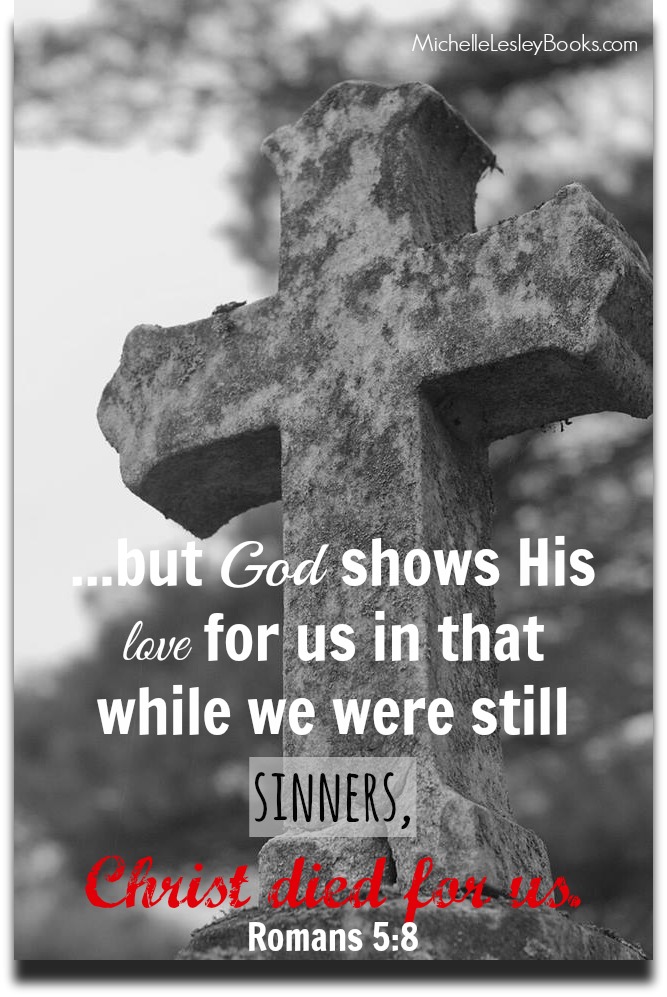
For while we were still weak, at the right time Christ died for the ungodly. For one will scarcely die for a righteous person—though perhaps for a good person one would dare even to die— but God shows his love for us in that while we were still sinners, Christ died for us. Since, therefore, we have now been justified by his blood, much more shall we be saved by him from the wrath of God. 10 For if while we were enemies we were reconciled to God by the death of his Son, much more, now that we are reconciled, shall we be saved by his life. 11 More than that, we also rejoice in God through our Lord Jesus Christ, through whom we have now received reconciliation.

12 Therefore, just as sin came into the world through one man, and death through sin, and so death spread to all men because all sinned— 13 for sin indeed was in the world before the law was given, but sin is not counted where there is no law. 14 Yet death reigned from Adam to Moses, even over those whose sinning was not like the transgression of Adam, who was a type of the one who was to come.

15 But the free gift is not like the trespass. For if many died through one man’s trespass, much more have the grace of God and the free gift by the grace of that one man Jesus Christ abounded for many.16 And the free gift is not like the result of that one man’s sin. For the judgment following one trespass brought condemnation, but the free gift following many trespasses brought justification. 17 For if, because of one man’s trespass, death reigned through that one man, much more will those who receive the abundance of grace and the free gift of righteousness reign in life through the one man Jesus Christ.

18 Therefore, as one trespass led to condemnation for all men, so one act of righteousness leads to justification and life for all men. 19 For as by the one man’s disobedience the many were made sinners, so by the one man’s obedience the many will be made righteous. 20 Now the law came in to increase the trespass, but where sin increased, grace abounded all the more, 21 so that, as sin reigned in death, grace also might reign through righteousness leading to eternal life through Jesus Christ our Lord.


The Holy Bible, English Standard Version Copyright © 2001 by Crossway Bibles, a division of Good News Publishers.


Questions to Consider:

1. To whom is Paul speaking in this chapter? Christians? Non-Christians?

2. According to verses 3-5, for what reasons should we rejoice in times of suffering?

3. What kind of people did Christ die for? (6-8) What do these verses say to the person who thinks she has to get her life cleaned up before coming to Christ? Would you be willing to die for a good person? What about someone who has sinned against you as much as you have sinned against Christ?

4. Verse 12 says that sin entered into the world through one man. Who was that one man, and how did he cause sin to enter the world?

5. This chapter talks a lot about justification and reconciliation. Re-read the verses that mention these words. What does it mean to be justified before God? What does it mean to be reconciled to God? Whose actions justify and reconcile us, and what were those actions?

New Testament, Salvation, Suffering, Sunday School

3 Reasons to Rejoice ~ Sunday School Lesson ~ 12-14-14

Rejoice

These are my notes from my ladies’ Sunday School class this morning. I’ll be posting the notes from my class here each week. Click here for last week’s lesson.

Through the Bible in 2014 ~ Week 50 ~ Dec. 7-13
Acts 20-26, Romans
3 Reasons to Rejoice

Background

Paul wrote the epistle of Romans to the church at Rome while he was still in Corinth, around A.D. 56. His main purpose in writing was to instruct the Roman believers in basic Christian doctrine, beliefs, and practices, since neither Paul nor the other apostles had yet been able to instruct them in person.

Rome was a dangerous place for Christians at that time. There was persecution of the sort that, today, we can only have nightmares about. But even in the midst of that horrific situation, those who were in Christ had good reasons for hope and rejoicing. Paul shares three of them in Romans 5:1-11 to comfort and encourage the Roman church.

Romans 5:1-11

Reason to Rejoice #1: Our Standing (1-2)

What is our standing before God before we’re saved? We stand guilty in our sin before God. There is no way out of that sin, and no way out of its eternal consequences. There is complete uncertainty about what will happen to us after we die. For the lost, there’s no hope that, no matter how bad things get in this life, God will set all things right in Heaven. Without Christ, the best we can say about our eternity is, “I guess,” “I hope,” or “Maybe.”

Verses 1-2 remind us that because we have been justified (legally exonerated of our crimes against God) by faith in Christ, our standing has been changed. Because of Christ’s sacrifice for our sin, we now stand before God as righteous, not as guilty. And because of that standing which we now experience dimly here on earth, we have the hope of one day standing before God in all of His glory– not ashamed and cowering before Him, but loved, welcomed, and accepted. We have that certain hope, and we rejoice in it.

Reason to Rejoice #2: Our Suffering (3-5, Hebrews 12:2)

Every one of us has suffered or will suffer. Even the richest, most powerful, most popular, most famous person you can think of suffers. In this life, the question is never, “Will I suffer?” but “Will I suffer with Christ or without Him?”

I have a friend who’s a physical therapist. Physical therapy can be excruciating, but one thing my friend helps her patients to focus on is that the pain they experience is not pointless. It is “pain with a purpose.” That pain means that one day that patient will be past the injury and able to walk better. There’s a reason for it. It’s the same way with suffering.

The reason God allows lost people to suffer is to cause them to cry out to Him for salvation. Paul explains, in verses 3-5, the reason God allows saved people to suffer: it grows and matures us in Christ.

We need endurance. Most of us have many years ahead of us to live for Christ. Coming through suffering builds the endurance we need to depend on God’s strength, keep on keeping on, and finish our lives out as faithful servants who refused to give up on following Christ, no matter how hard it got.

The Greek word translated “character” here means “proof.” When gold is refined in fire, all of the impurities burn away and what comes out is the proof of what was there all along: pure gold. When we endure passing through the fire of suffering, what comes out on the other side is the proof that the “pure gold” of Christ in us is what survives the flame. And the world desperately needs to see that proof -through our endurance of suffering- that Christ is their only hope. Not only that, but that very same proof that Christ carries us through suffering gives us hope that He will continue to carry us through suffering until He carries us Home. Just as Jesus endured the cross for the joy set before Him (Heb.) we endure suffering for the joy of what’s waiting on the other side– another hope to rejoice in.

Reason to Rejoice #3: Our Salvation (6-11)

There are so many reasons to rejoice in our salvation, but I’ll limit myself to the ones Paul outlines here.

6-8- We don’t have to clean ourselves up before coming to Christ. (Mark 2:17, Romans 3:10)
In fact, we can’t. It’s not possible. Jesus Himself said, “I came not to call the righteous, but sinners.” (and, by the way, “None is righteous, no, not one;” so that’s all of us). Before we ever drew breath, before we ever thought about getting our lives in order before we could come to Him, while we were enjoying our sin and shaking our fists at God, that’s when Christ died for us. That’s why even the worst sinner can have the hope that Christ will save him, because God’s desire to save us doesn’t hinge on who we are or what we’ve done. It hinges on Him and His love for us in spite of our sin.

9We no longer have to fear God’s wrath. (Romans 8:1)

There is therefore now no condemnation for those who are in Christ Jesus.

None. Zero. Zip. Unsaved people should rightly fear God’s wrath being poured out on them for their sin. That fear should drive them to run to the loving arms of the merciful Savior who stands ready to welcome and forgive them. But Believers can rejoice in the fact that Christ has already absorbed God’s wrath –all of it– towards us when He endured the cross.

10-11We are reconciled to God.
Have you ever had a big fight with your husband, your sister, your best friend, or someone else you’re really close to? Think for just a moment about how you feel during the hours or days before you and that person make things right with each other. You feel separated from that person- disconnected -maybe like there’s a huge wall between you. You don’t feel bonded with that person. You don’t feel at peace. You wake up every day feeling like something is off kilter. But then think of the peace, and joy, and reconnection you feel when you and that person make up, forgive, and move ahead in your relationship.

That’s what it’s like to be reconciled (brought back and reunited with) to God through faith in Christ. We’re no longer separated from God. That disconnect is gone. We’re not enemies with Him anymore! We can rest in Him, enjoy Him, be at peace with Him, and be in harmony with Him. “God and sinners reconciled!” Rejoice!

When I first started putting this lesson together, I thought, “Hmm…Romans 5 is a great passage, but it isn’t very Christmasy.” But if you think about it, the rejoicing in Romans 5 is the very reason we rejoice in the birth of Christ. He was born so that, through Him, we could stand before God as righteous. He was born to shine the light of the gospel -and give us hope- through our suffering. He was born to reconcile man to God. Those are reasons to rejoice at Christmas and every other day!