Basic Training, Obedience

Basic Training: Obedience: 8 Ways To Stop Making Excuses and Start Obeying Scripture

For more in the Basic Training series, click here.
So whoever knows the right thing to do and fails to do it, for him it is sin. James 4:17

Excuses, excuses.

We’ve all got them. We’ve all used them.

“The dog ate my homework.”

“I was going to, but…”

“I’d like to, but I can’t, because…”

Sometimes there are legitimate reasons we can’t take part in certain earthly activities. Time conflicts: If a birthday party and a wedding are scheduled for the same date and time, you obviously can’t be in two places at once. Financial constraints: Maybe you’d really like to attend that conference, but there’s no money in the budget. Prioritized responsibilities and loyalties- you’d like to travel as much as you did when you were single, but now that you have a family, taking care of them comes first.
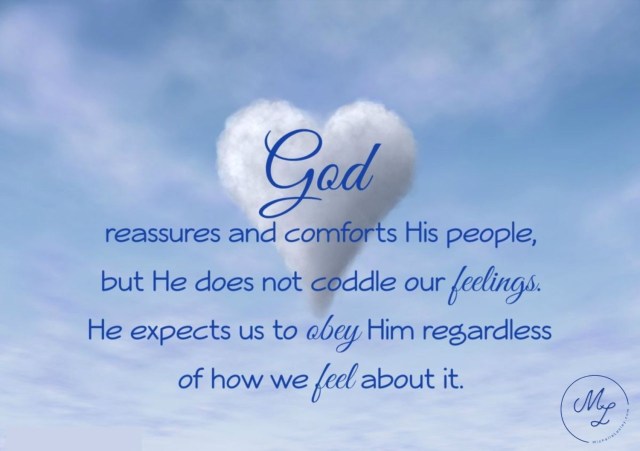
Those arenโ€™t really excuses, though, theyโ€™re reasons – totally understandable ones – that you canโ€™t do something. But weโ€™re so much in the habit of explaining why we canโ€™t do something in the day to day logistical realm that it never occurs to us that this isnโ€™t right when it comes to the things of God. When Godโ€™s Word tells us to do something, we are to obey it, not make excuses about why we canโ€™t.

When Godโ€™s Word tells us to do something, we are to obey it, not make excuses about why we canโ€™t.

Most Christians seem to grasp this concept when it comes to one of the โ€œbigโ€ commands. Take abortion, for example. We know that abortion is a sin regardless of the circumstances, even when those circumstances are huge and scary. We reach out to pregnant women with the gospel and with practical help so that they wonโ€™t commit that sin. We love the homosexual who wants to come to Christ but is being pulled the other direction by her lifestyle, living arrangements, and loved ones, by compassionately providing for her needs while holding firm to the biblical gospel that says she must turn from her sin in repentance if she wants to be saved.

But when it comes to the โ€œlittleโ€ commands like…

…submitting to your husband

…being a faithful, active member of a local church

…refraining from teaching men or holding authority over them in the church

…refusing to be anxious about anything

…lots of those same Christians (including me) who are so clear that abortion and homosexuality are sins requiring repentance regardless of the circumstances, have at the ready, all kinds of excuses and reasons and circumstances to offer up as to why we canโ€™t obey Godโ€™s word.

โ€œI just donโ€™t think my husbandโ€™s decision is the right way to go.โ€

โ€œA church hurt me in the past, so Iโ€™m done with church.โ€

โ€œNone of the men in my church will step up and lead, so I have to.โ€

โ€œIโ€™m in a really bad situation. I canโ€™t help it if Iโ€™m constantly stressing about it.โ€

Uh uh. No excuse for disobedience that we can come up with is going to wash with God. There is never any acceptable reason or excuse to say, โ€œI canโ€™t,โ€ when it comes to a command of Scripture. God expects us to be obedient. So how can we move from excuses to obedience?

There is never any acceptable reason or excuse to say, โ€œI canโ€™t,โ€ when it comes to a command of Scripture. God expects us to be obedient.

1. Understand that obedience to Scripture is not โ€œlegalismโ€ or being a โ€œPhariseeโ€

As much as pop evangelicalism would like us to believe it, obedience to Scripture is not legalism, nor is someone acting like a Pharisee if sheโ€™s teaching that all Christians should obey Scripture. Legalism is when you think obeying Godโ€™s commands will save you, make up for your sin, or somehow make you right with God through your own fleshly efforts. Pharisee-ism is making up your own bibley-sounding laws – usually ones that are related to Scripture, but more restrictive than Scripture – and insisting that others adhere to them or theyโ€™re not saved, not as good of a Christian as you are, etc. Thatโ€™s not what weโ€™re talking about here. Weโ€™re talking about rightly handling Godโ€™s Word in context, understanding what His commands to Christians actually are, and joyfully submitting to them in obedience.

As much as pop evangelicalism would like us to believe it, obedience to Scripture is not legalism.

2. Embrace what Scripture says about obedience:

So whoever knows the right thing to do and fails to do it, for him it is sin. James 4:17

Teaching them to observe all that I have commanded you. Matthew 28:20a

So you also, when you have done all that you were commanded, say, โ€œWe are unworthy servants; we have only done what was our duty.โ€ Luke 17:10

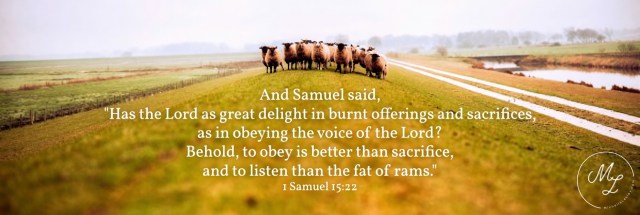
And Samuel said, โ€œHas the Lord as great delight in burnt offerings and sacrifices, as in obeying the voice of the Lord? Behold, to obey is better than sacrifice, and to listen than the fat of rams. For rebellion is as the sin of divination, and presumption is as iniquity and idolatry.โ€ 1 Samuel 15:22-23a

If you love me, you will keep my commandments. John 14:15

And by this we know that we have come to know him, if we keep his commandments. Whoever says, โ€œI know him,โ€ but does not keep his commandments is a liar, and the truth is not in him, but whoever keeps his word, in him truly the love of God is perfected. By this we may know that we are in him: whoever says he abides in him ought to walk in the same way in which he walked. 1 John 2:3-5

For this is the love of God, that we keep his commandments. And his commandments are not burdensome. 1 John 5:3

Scripture says that Christians seek to obey Godโ€™s Word, and when we donโ€™t, weโ€™re sinning.

3. Know that there are no commands of Scripture followed by asterisks
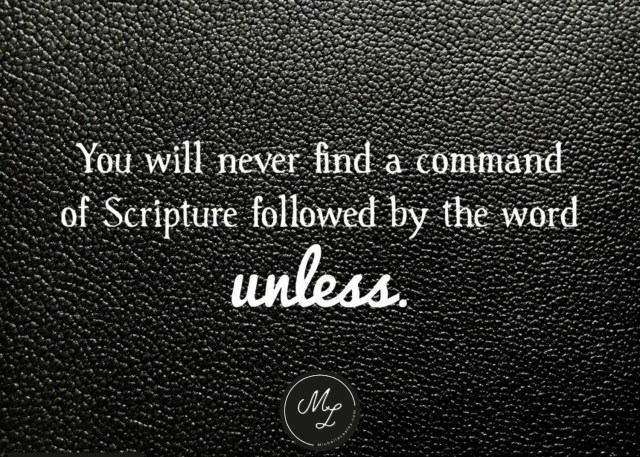
โ€œYou shall not murder…unlessโ€ฆโ€ โ€œDo not worry…except in circumstances X, Y, or Z, then itโ€™s acceptable.โ€ โ€œIf no men will step up and teach that co-ed Sunday School class, itโ€™s OK if a woman teaches it.โ€ Nope. You will not find a command of Scripture that contains exceptions or caveats. When God says โ€œdoโ€ or โ€œdonโ€™tโ€, He means it. He means it for you. He means it for everybody. He means it if itโ€™s difficult or inconvenient. He means it regardless of your circumstances.

When God says โ€œdoโ€ or โ€œdonโ€™tโ€, He means it. He means it for you. He means it for everybody. He means it if itโ€™s difficult or inconvenient. He means it regardless of your circumstances.

4. Realize that God is sovereign over your circumstances

God controls everything in this universe. Nothing happens anywhere that He hasnโ€™t either allowed or caused. Translation: youโ€™re in the circumstances youโ€™re in because God either put you there or allowed you to be there. Everybody has some sort of situation in her life that makes obedience to Scripture difficult or inconvenient. Do you think God intends for everyone to use those circumstances that He sovereignly decided to allow or put into their lives as an excuse to disobey Him? Adam and Eve tried that. Did God accept their excuses? Isnโ€™t blaming your disobedience to Scripture on the circumstances youโ€™re in just another way of saying itโ€™s Godโ€™s fault youโ€™re being disobedient? That if God had just created you differently or put you in a different set of circumstances, youโ€™d obey, but since He didnโ€™t, you have no choice but to disobey?

Isnโ€™t blaming your disobedience to Scripture on the circumstances God sovereignly put you in just another way of saying itโ€™s Godโ€™s fault youโ€™re being disobedient?

When we really want to do something, we find a way or die trying. Be honest- have you checked out every single church you can get to and explored every available resource and option for finding a church before giving up and saying you canโ€™t attend church? Have you actually tried submitting to your husband even when you think heโ€™s making a boneheaded decision? Is anybody at your church going to die if all of the women refuse to teach men and that co-ed class is disbanded? Are you so willing to obey Christ that youโ€™ll do whatever you have to do in order to find a way to obey Him?

Are you so willing to obey Christ that youโ€™ll do whatever you have to do in order to find a way to obey Him?

6. Consider that this might be a test

Remember taking pop quizzes when you were in school? Unless you were a child genius, you probably donโ€™t look back on them fondly. They were unpleasant. Hard. Sometimes scary because so much was riding on them. Maybe you were like a lot of students who could easily answer questions on the subject matter while studying, but went blank during the quiz because of the fear and pressure.
The testing of our faith can be a lot like those pop quizzes. We know the test is coming, but weโ€™re never quite sure when. Weโ€™re supposed to be studying the Textbook and asking the Teacher for help every day so weโ€™ll be prepared. But when the test comes, we have to take it. Thereโ€™s no opting out and saying, โ€œIf this test werenโ€™t happening Iโ€™d be able to obey easily.โ€ Of course you would! Itโ€™s easy to obey God when itโ€™s convenient and everythingโ€™s going your way, but obeying when itโ€™s difficult or inconvenient pushes you. Stretches you. It reinforces what youโ€™ve learned, reaffirms your commitment to Christ, and refreshes your trust in God. Donโ€™t give up in the middle of the test. Hang on to Christ, hang in there, andโ€ฆ

Count it all joy, my brothers, when you meet trials of various kinds, for you know that the testing of your faith produces steadfastness. And let steadfastness have its full effect, that you may be perfect and complete, lacking in nothing. James 1:2-4

Obeying God when itโ€™s difficult or inconvenient reinforces what youโ€™ve learned, reaffirms your commitment to Christ, and refreshes your trust in God.

7. Look to Christ as your example

Christians are supposed to โ€œwalk in the same way He walkedโ€ (1 John 2:5b). Christ is the perfect example of someone who determined to obey God regardless of His circumstances. Just look at everything He went through. Donโ€™t you think He was awfully hungry after fasting for 40 days in the wilderness? Wouldnโ€™t it have been extraordinarily easy to strike down every Pharisee who got on His nerves? Couldnโ€™t He have decided the cross was just too much and that redeeming mankind wasnโ€™t worth the trouble?

Consider him who endured from sinners such hostility against himself, so that you may not grow weary or fainthearted. In your struggle against sin you have not yet resisted to the point of shedding your blood. Hebrews 12:3-4

Jesus gave up His body – His life – in order to obey God. Are we willing to give up whatever it costs us to walk in the same way He walked?

8. Remember that God has promised to help you

What an amazing God we serve who doesnโ€™t just give us a bunch of rules to follow and leaves us to figure it out on our own! The Holy Spirit is right there, indwelling His people, always ready to help, guide, strengthen, and comfort. First Corinthians 10:13 says:

No temptation has overtaken you that is not common to man. God is faithful, and he will not let you be tempted beyond your ability, but with the temptation he will also provide the way of escape, that you may be able to endure it.

God isnโ€™t going to put you into a situation in which you have no choice but to disobey Him. Jesus proved that with His own life. Have you asked God to provide you with a way to obey Him? The Bible tells us that when we pray for things in accordance with Godโ€™s will, He will give those things to us. It is definitely in Godโ€™s will for you to resist temptation and obey Him, so it is His delight to answer when you ask Him for a way to do that.
Ladies, obedience to Christ is not optional. We don’t get to pick and choose which of God’s commands to Christians we want to obey and which ones are OK to let slide. He expects us to follow after Christ, who obeyed to His last breath, His last drop of blood. And He promises to help us, even when obeying Him is hard. Let’s stop making excuses and start looking for ways to submit to, and obey, God’s Word.

God expects us to follow after Christ, who obeyed to His last breath, His last drop of blood. And He promises to help us, even when obeying Him is hard. Letโ€™s stop making excuses and start looking for ways to obey Godโ€™s Word.

Obedience, Sanctification

When God Says No

When I was sixteen years old, I was convinced God was calling me to be the next Sandi Patty…I wanted God to use me- to put me on a stage every night in front of thousands of people so I could sing to them about Him…Somehow, it never occurred to me to care what God thought about all this or what He might want to do in my life. If I thought about it at all, I just assumed He was on board with my plans. Like, how could He not be, right?

(Excerpted from my article Used by God)

There’s much ado about dreaming big dreams for God in modern evangelicalism. Think of the biggest thing you want to do for God and then “step out on faith” and make it happen. Sometimes we’re even told God is offended if our dreams aren’t big enough. It means we don’t have enough faith. It means we don’t believe God – or love Him – enough.

Or does it?

Sometimes pop evangelicalism even tells us God is offended if our dreams aren’t big enough. It means we don’t have enough faith. It means we don’t believe God – or love Him – enough…Or does it?

If you study through the books of 1 and 2 Samuel, you’re going to get to know Saul and David pretty well. And as you observe and compare their words, their behavior, and their interactions with God, a major theme that jumps out is obedience to God’s Word versus doing what’s right in your own eyes.

Saul was an “I did it my way,” kind of guy. Time and again, he looked out for number one. Tried to build up his own kingdom. Did what he thought was best.

In 1 Samuel 15, God told Saul to utterly destroy the Amalekites. Everything. Every living creature and all their stuff. All means all.

But Saul had big dreams. So, he destroyed all the worthless stuff and all the people, but he saved the king and all the valuables. He disobeyed God’s clear word in favor of what he wanted to do.

Hereโ€™s the interesting part, though. When Samuel showed up and said, โ€œWhy did you disobey the Lord?โ€ Saul said, not once, but twice, โ€œI did obey the Lord.โ€

Why? Because Saul was going to offer some of those sheep he spared in a grand and showy sacrifice to the Lord. He was going to โ€œdo great things for Godโ€ and, in his mind, that was far better and more glorious than simple obedience to Godโ€™s explicit command.

Saul was going to โ€œdo great things for Godโ€ and, in his mind, that was far better and more glorious than simple obedience to Godโ€™s explicit command.

By contrast, God says David was “a man after My heart, who will do all My will.” David sought the Lord and obeyed His words.

But David had a dream, too. He loved God deeply and wanted to do something big to honor Him.

โ€œSee now, I dwell in a house of cedar,” David said, “but the ark of God dwells in a tent.โ€ David wanted to build a grand and glorious house for God.

It was a good dream. A dream that stemmed from godly motives. A dream that was, in reality, part of God’s plan.

But God said, “No.” Because it wasn’t God’s plan for David.

Sometimes there are things we want to do for God in life or in ministry because our hearts are fairly bursting with love for Him. Nothing small or insignificant will suffice – we want to do great things for Him because He has done so many great things for us.

Sometimes there are things we want to do for God in life or in ministry because our hearts are fairly bursting with love for Him… That *heart* is what is most precious to God, not whatever it is you can dream up to do for Him.

Can I just tell you – that heart is what is most precious to God, not whatever it is you can dream up to do for Him. Every parent who’s ever received a clay ashtray or a bedraggled dandelion from her five year old knows this. We love the heart of our child who wants to show her love for us, even if the gift itself isn’t quite right.

And just like you would have to tell your five year old no if she wanted to demonstrate her love for you by having the family skip church on Sunday so she could cook you a four course brunch, God sometimes has to say no to the things we want to do for Him because those things – even though motivated by love for Him – conflict with His Word, are out of sync with His timing, or aren’t His specific plan for us, personally.

God sometimes has to say no to the things we want to do for Him because those things – even though motivated by love for Him – conflict with His Word, are out of sync with His timing, or aren’t His specific plan for us, personally.

It might be your heart’s deepest desire to serve God as the perfect Proverbs 31 wife…and Godย says no by declining to provide you with a husband. Maybe it’s always been your dream to raise a house full of children in the nurture and admonition of the Lord…and God says no by preventing you from bearing or adopting children. “I’ve always loved to tell people about Jesus,” you think, “Surely He’s calling me to be a pastor.”…and God says no in His Word because that’s not His plan for Christian women.

God said no to David, too. It wasn’t the right time. It didn’t fit with what God was trying to accomplish in Israel at that moment. And David wasn’t the right man for the job. God had other things He wanted David to do.

How did David respond when God said no? Did he push forward with his own plans and build the temple anyway? Spend the rest of his life sulking or angry at God? Turn away from God all together?

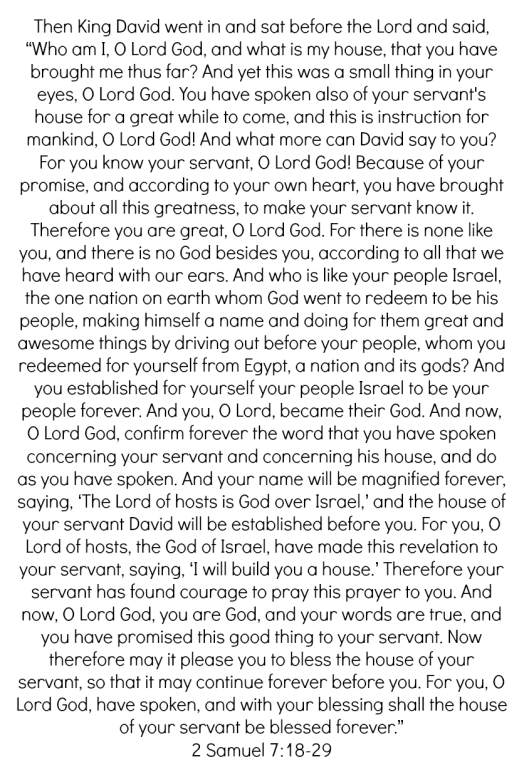
No. David responded with humility that God would use him in any way, joy over God’s love and blessings, and thanksgiving for God’s plans and promises.

That’s what a heart that truly loves God does. It obeys Him. It finds joy in any task He might bring our way. It is thankful and humbled that God takes any notice of us whatsoever and lavishes His grace and mercy upon us by allowing us to do what He wants us to do.

The heart that *truly* loves God obeys Him.

God didn’t allow David to build the temple. God didn’t allow me to become a top Christian recording artist. Maybe there’s something God isn’t allowing you to do. Will you joyfully obey Him in the things He does have planned for you? Will you be thankful and humbled that He desires to use you as part of His good plans and purposes even if those plans and purposes don’t match your own?

Maybe there’s something God isn’t allowing you to do. Will you joyfully obey Him in the things He *does* have planned for you?

May we all follow David’s example – and the Greater David’s example – by saying, meaning, and living out, “Not my will but Thy will be done,” even when God says no.


Additional Resources:

How do I move on after God says โ€œnoโ€?

The Ten (10 Commandments Bible Study)

The Ten: Lesson 13

Previous Lessons: 1, 2, 3, 4, 5, 6, 7, 8, 9, 10, 11, 12

Exodus 20:18-20

Now when all the people saw the thunder and the flashes of lightning and the sound of the trumpet and the mountain smoking, the people were afraid and trembled, and they stood far off 19 and said to Moses, โ€œYou speak to us, and we will listen; but do not let God speak to us, lest we die.โ€ 20 Moses said to the people, โ€œDo not fear, for God has come to test you, that the fear of him may be before you, that you may not sin.โ€

Exodus 24:3-8

Moses came and told the people all the words of the Lord and all the rules. And all the people answered with one voice and said, โ€œAll the words that the Lord has spoken we will do.โ€ And Moses wrote down all the words of the Lord. He rose early in the morning and built an altar at the foot of the mountain, and twelve pillars, according to the twelve tribes of Israel. And he sent young men of the people of Israel, who offered burnt offerings and sacrificed peace offerings of oxen to the Lord. And Moses took half of the blood and put it in basins, and half of the blood he threw against the altar. Then he took the Book of the Covenant and read it in the hearing of the people. And they said, โ€œAll that the Lord has spoken we will do, and we will be obedient.โ€ And Moses took the blood and threw it on the people and said, โ€œBehold the blood of the covenant that the Lord has made with you in accordance with all these words.โ€


Romans 3:19-20

Now we know that whatever the law says it speaks to those who are under the law, so that every mouth may be stopped, and the whole world may be held accountable to God. 20 For by works of the law no human being will be justified in his sight, since through the law comes knowledge of sin.

Romans 7:1-12

Or do you not know, brothersโ€”for I am speaking to those who know the lawโ€”that the law is binding on a person only as long as he lives? For a married woman is bound by law to her husband while he lives, but if her husband dies she is released from the law of marriage. Accordingly, she will be called an adulteress if she lives with another man while her husband is alive. But if her husband dies, she is free from that law, and if she marries another man she is not an adulteress.

Likewise, my brothers, you also have died to the law through the body of Christ, so that you may belong to another, to him who has been raised from the dead, in order that we may bear fruit for God.For while we were living in the flesh, our sinful passions, aroused by the law, were at work in our members to bear fruit for death. But now we are released from the law, having died to that which held us captive, so that we serve in the new way of the Spirit and not in the old way of the written code.

What then shall we say? That the law is sin? By no means! Yet if it had not been for the law, I would not have known sin. For I would not have known what it is to covet if the law had not said, โ€œYou shall not covet.โ€ But sin, seizing an opportunity through the commandment, produced in me all kinds of covetousness. For apart from the law, sin lies dead. I was once alive apart from the law, but when the commandment came, sin came alive and I died. 10 The very commandment that promised life proved to be death to me. 11 For sin, seizing an opportunity through the commandment, deceived me and through it killed me. 12 So the law is holy, and the commandment is holy and righteous and good.

Galatians 3:23-26

Now before faith came, we were held captive under the law, imprisoned until the coming faith would be revealed. 24 So then, the law was our guardian until Christ came, in order that we might be justified by faith. 25 But now that faith has come, we are no longer under a guardian, 26 for in Christ Jesus you are all sons of God, through faith.


Romans 13:8-10

Owe no one anything, except to love each other, for the one who loves another has fulfilled the law.For the commandments, โ€œYou shall not commit adultery, You shall not murder, You shall not steal, You shall not covet,โ€ and any other commandment, are summed up in this word: โ€œYou shall love your neighbor as yourself.โ€ 10 Love does no wrong to a neighbor; therefore love is the fulfilling of the law.

1 John 5:2-3

By this we know that we love the children of God, when we love God and obey his commandments. For this is the love of God, that we keep his commandments. And his commandments are not burdensome.


The Holy Bible, English Standard Version. ESVยฎ Permanent Text Editionยฎ (2016). Copyright ยฉ 2001 by Crossway Bibles, a publishing ministry of Good News Publishers.


Questions to Consider:

1. In Exodus 20:18-19, how did the Israelites react to God’s appearance to Moses? What was Moses’ response to them? (20) What did Moses say would be two results of God testing the people? (20) How many times does the word “fear” appear in verse 20? What is the difference in meaning between the first “fear” and the second one?

2. Briefly skim Exodus 20:21-23:33. In addition to the Ten Commandments, what are some of the other laws, or categories of laws, God gave Moses? In the Exodus 24 passage above, what was the people’s response to hearing all of these laws? (3) Describe the sequence of events taking place in Exodus 24:3-8. Why did the people respond twice? (3,7) Was there any difference between these two responses? Compare the people’s response in this passage with their response in Exodus 19:5-8. What events transpired between the response in chapter 19 and the response in chapter 24?

3. In Exodus 24:6,8, why did Moses sprinkle the altar and the people with blood? How did this formalize Israel’s agreement to the Mosaic covenant? How does the Mosaic covenant point ahead to the new covenant in Christ? Are Christians still bound by the Mosaic covenant?

4. In what ways did the giving of the law and Israel’s agreement to the Mosaic covenant help officially establish Israel as a nation and set Israel apart from the surrounding pagan nations?

5. Examine the Romans 3 and 7 passages. What does it mean that the law makes us “accountable” to God? (3:19) Why can’t we be made righteous in God’s eyes by simply striving to keep His laws? (3:20) Read Romans 3:20 and 7:7-8 together. What do these verses tell us about the connection between knowing the law and sin?

6. Explain the analogy of dying to works of the law that Paul is trying to convey in Romans 7:1-6. Compare verse 6 to Galatians 3:23-26. What does Galatians say was the purpose of the law, and what is our obligation to it now? What does the latter part of verse 6 – “we serve in the new way of the Spirit and not in the old way of the written code” – mean? Does this mean we no longer have to obey God’s moral laws such as the ones in the 10 Commandments? (12)

7. Study the Romans 13 and 1 John 5 passages. What is the theme of these two passages? What does Paul mean when he says, “the one who loves another has fulfilled the law”? (13:8) Who are the two parties we demonstrate love for when we keep God’s commands? How does loving God and keeping His commands automatically translate into loving others? (5:2) How does loving God and our neighbors, thus keeping God’s commands, demonstrate to others that we belong to Christ?


Homework:

This week, view your sin or obedience through the lenses of love. Examine the sins you commit. How do they demonstrate your failure to love God and love your neighbor? Examine instances of your obedience to God’s commandments and think about how they demonstrate your love for Him and for your neighbor. As you pray, ask God to increase your love for Him. Increased love leads to increased obedience.

Wednesday's Word

Wednesday’s Word ~ Daniel 3

daniel 3 17 18

Daniel 3

King Nebuchadnezzar made an image of gold, whose height was sixty cubits and its breadth six cubits. He set it up on the plain of Dura, in the province of Babylon. 2ย Then King Nebuchadnezzar sent to gather the satraps, the prefects, and the governors, the counselors, the treasurers, the justices, the magistrates, and all the officials of the provinces to come to the dedication of the image that King Nebuchadnezzar had set up.3ย Then the satraps, the prefects, and the governors, the counselors, the treasurers, the justices, the magistrates, and all the officials of the provinces gathered for the dedication of the image that King Nebuchadnezzar had set up. And they stood before the image that Nebuchadnezzar had set up. 4ย And the herald proclaimed aloud, โ€œYou are commanded, O peoples, nations, and languages, 5ย that when you hear thesound of the horn, pipe, lyre, trigon, harp, bagpipe, and every kind of music, you are to fall down and worship the golden image that King Nebuchadnezzar has set up. 6ย And whoever does not fall down and worship shall immediately be cast into a burning fiery furnace.โ€ 7ย Therefore, as soon as all the peoples heard the sound of the horn, pipe, lyre, trigon, harp, bagpipe, and every kind of music, all the peoples, nations, and languages fell down and worshiped the golden image that King Nebuchadnezzar had set up.

8ย Therefore at that time certain Chaldeans came forward and maliciously accused the Jews. 9ย They declared to King Nebuchadnezzar, โ€œO king, live forever! 10ย You, O king, have made a decree, that every man who hears the sound of the horn, pipe, lyre, trigon, harp, bagpipe, and every kind of music, shall fall down and worship the golden image. 11ย And whoever does not fall down and worship shall be cast into a burning fiery furnace.12ย There are certain Jews whom you have appointed over the affairs of the province of Babylon: Shadrach, Meshach, and Abednego. These men, O king, pay no attention to you; they do not serve your gods or worship the golden image that you have set up.โ€

13ย Then Nebuchadnezzar in furious rage commanded that Shadrach, Meshach, and Abednego be brought. So they brought these men before the king. 14ย Nebuchadnezzar answered and said to them, โ€œIs it true, O Shadrach, Meshach, and Abednego, that you do not serve my gods or worship the golden image that I have set up? 15ย Now if you are ready when you hear the sound of the horn, pipe, lyre, trigon, harp, bagpipe, and every kind of music, to fall down and worship the image that I have made, well and good. But if you do not worship, you shall immediately be cast into a burning fiery furnace. And who is the god who will deliver you out of my hands?โ€

16ย Shadrach, Meshach, and Abednego answered and said to the king, โ€œO Nebuchadnezzar, we have no need to answer you in this matter. 17ย If this be so, our God whom we serve is able to deliver us from the burning fiery furnace, and he will deliver us out of your hand, O king. 18ย But if not, be it known to you, O king, that we will not serve your gods or worship the golden image that you have set up.โ€

19ย Then Nebuchadnezzar was filled with fury, and the expression of his face was changed against Shadrach, Meshach, and Abednego. He ordered the furnace heated seven times more than it was usually heated. 20ย And he ordered some of the mighty men of his army to bind Shadrach, Meshach, and Abednego, and to cast them into the burning fiery furnace. 21ย Then these men were bound in their cloaks, their tunics, their hats, and their other garments, and they were thrown into the burning fiery furnace. 22ย Because the king’s order was urgent and the furnace overheated, the flame of the fire killed those men who took up Shadrach, Meshach, and Abednego. 23ย And these three men, Shadrach, Meshach, and Abednego, fell bound into the burning fiery furnace.

24ย Then King Nebuchadnezzar was astonished and rose up in haste. He declared to his counselors, โ€œDid we not cast three men bound into the fire?โ€ They answered and said to the king, โ€œTrue, O king.โ€ 25ย He answered and said, โ€œBut I see four men unbound, walking in the midst of the fire, and they are not hurt; and the appearance of the fourth is like a son of the gods.โ€

26ย Then Nebuchadnezzar came near to the door of the burning fiery furnace; he declared, โ€œShadrach, Meshach, and Abednego, servants of the Most High God, come out, and come here!โ€ Then Shadrach, Meshach, and Abednego came out from the fire. 27ย And the satraps, the prefects, the governors, and the king’s counselors gathered together and saw that the fire had not had any power over the bodies of those men. The hair of their heads was not singed, their cloaks were not harmed, and no smell of fire had come upon them.28ย Nebuchadnezzar answered and said, โ€œBlessed be the God of Shadrach, Meshach, and Abednego, who has sent his angel and delivered his servants, who trusted in him, and set aside the king’s command, and yielded up their bodies rather than serve and worship any god except their own God. 29ย Therefore I make a decree: Any people, nation, or language that speaks anything against the God of Shadrach, Meshach, and Abednego shall be torn limb from limb, and their houses laid in ruins, for there is no other god who is able to rescue in this way.โ€ 30ย Then the king promoted Shadrach, Meshach, and Abednego in the province of Babylon.


The Holy Bible, English Standard Version Copyright ยฉย 2001 by Crossway Bibles, a publishing ministry of Good News Publishers.


Questions to Consider:

1. What is the historical setting of the book of Daniel? Which nationality and religion were the Shadrach, Meshach, and Abednego? Nebuchadnezzar?ย Why do verses 2-3 list out all the specific government officials? What does this tell us about Nebuchadnezzar’s power, influence, and the reach of his edicts? Why might he have built the image and commanded everyone to worship it? (5-7, 12-15)

2. Read Romans 13:1-3. How does Shadrach, Meshach, and Abednego’s defiance of the king compare to God’s command to obey governmental authority? Were they obeying God by refusing to worship the image or disobeying Him by refusing to submit to the king? (Hint) Can you think of any situations in the world today that might force us to disobey the government in order to obey God?

3.ย Was Shadrach, Meshach, and Abednego’s obedience to God conditional (we’ll obey if God gives us the outcome we want) or unconditional (we’ll obey regardless of the outcome)? (16-18) Do you think they were scared? Are there any situations in your life in which you’re obeying God conditionally?

4. How did Shadrach, Meshach, and Abednego’s unconditional obedience to God and willingness to die for their faith impact Nebuchadnezzar? (26, 28) The officials? (27) What actions did Nebuchadnezzar take as a result? (29-30) How did these actions affect Shadrach, Meshach, and Abednego? The exiled Jews? The people of Babylon? How might your faithfulness to Christ impact those around you?

5. What do we learn about the nature and character of God from this story? Would it call God’s character into question if He hadn’t rescued Shadrach, Meshach, and Abednego?

Here’s a more detailed study I wrote on Daniel 3.