Idolatry, Sunday School, Worship

Worship Gone Wrong, Worship Gone Right ~ Sunday School Lesson ~ 2-16-14

sunday school

These are my notes from my ladies’ Sunday School class this morning. I’ll be posting the notes from my class here each week. Click here for last week’s lesson.

Through the Bible in 2014 ~ Week 7 ~ Feb. 9-15
Exodus 30-Leviticus 10
Worship Gone Wrong ~ Worship Gone Right

Think about the last time you were invited over to someone’s house for dinner or a visit. Even if it was your closest friend’s house, did you go into her kitchen and start rearranging her cabinets so the dishes would be the way you like them? Refold her towels into thirds instead of halves? Insist on fried chicken when she had planned baked? Would you like it if your closest friend came to your house and started doing things like that?

What’s your favorite flower? Mine is pink roses, and my husband knows this very well. Would it have been loving for my husband to give me a cactus for Valentine’s Day—even though he knows I can’t stand them –because that’s the plant he likes best?

We all have a certain way we like things done at our own homes for certain reasons. We have all been given gifts that make us feel loved and cherished (and some gifts that haven’t). God is no different. When we come into His house to worship Him, we abide by His “house rules” out of love and respect for Him. We are to offer Him the worship He desires, not because it makes us happy or comfortable, but because that’s what makes Him “feel loved.”

This week’s reading was all about worship. Worship done the right way – God’s way, and worship done the wrong way – man’s way.

Worship Gone Wrong: Man’s Way (Exodus 32)

32:1-2: Worship goes wrong when we take our focus off God.
Moses didn’t bring them out of Egypt, God did. But the people’s focus was only on the temporal and tangible. They hounded Aaron to give them a god they could see and worship their own way rather than an invisible God whose ways were holy and different from theirs. They were not thinking about what God wanted but what they wanted.

32:2-14: Worship goes wrong when the pastor is more interested in pleasing the people (or himself) than pleasing God.
Rather than leading the people and holding up God’s standard for them, Aaron gave in to their base desires. Contrast this with Moses who was more interested in God’s glory, His name being honored among the heathens, and His covenant promises, than Moses’ own self interest of being made a “great nation”.

32:4-6: Worship goes wrong when we paste God’s name on man made rituals.
Notice that they essentially called the golden calf “God” and claimed that worshiping it was actually worshiping God. This was not a situation in which they were inventing a new god to worship.

32:15-19: Worship goes wrong when we break God’s law (Exodus 19-20:21).
The people had heard from the very mouth of God himself, “You shall have no other gods before me. You shall not make for yourself a carved image, or any likeness of anything that is in heaven above, or that is in the earth beneath, or that is in the water under the earth. You shall not bow down to them or serve them…” Those are the first and second Commandments! They knew God’s Law and intentionally broke it. Our worship is unacceptable to God (indeed, it isn’t worship at all) when we do it while knowingly disobeying Him. (Naked church, homosexuality affirming “churches”, female pastors.)

32:25: Worship goes wrong when we give unbelievers the opportunity to mock God.
When the people “break loose” from doing things biblically with the pastor leading the way (as in the New Apostolic Reformation movement, for example), the world rightly mocks them. As a result, many unbelievers understandably take the position, “If that’s what Christianity is, I don’t want any part of it.” This is to our shame. (This is different, however, from being mocked for upholding biblical standards, such as standing against abortion or homosexuality.)

32:26-28: Worship goes wrong when people refuse to repent of their sin (Matthew 18:15-17, 1 Corinthians 5:11-13).
The three thousand men who refused to repent of their idol worship were the problem here, not the Levites. They were given every opportunity to repent and refused. This compounded their sin by forcing their brothers into a horrific situation of having to kill them.

Today, when church members refuse to repent of their sin, God has instructed us to put them outside the fellowship (after due process). This is painful for all involved, and puts brothers and sisters who are trying to faithfully follow God’s word in the awful position of having to confront and discipline people they may dearly love. It often causes a deep wound that necessarily hinders worship.


Worship Gone Right: God’s Way

God cares about the smallest details of how we approach Him in worship. (Exodus 30, 39)
He’s not an “anything goes” God. We see this in the detailed instructions about the construction of the ark, the tabernacle, and all its accessories, right down to the recipe for the anointing oil (30) and the little pomegranates on the hems of the priestly garments (39). (We’ll also see His instructions about worship to the church in the New Testament.) If God cares this much about the little details of worship, what are some things in our worship services and other church activities that we need to think about as to whether or not they’re pleasing to God?

God takes worship seriously, and so should His people (Exodus 32, Leviticus 10, Acts 5:1-11, 1 Corinthians 11:29-30).
The results of the golden calf incident (32), the strange fire incident (10), as well as situations in the New Testament show us that the way we worship and conduct activities in the church is no trivial matter to God. When He gives instructions about worship, He means what He says. It is just as wrong for us in the New Testament church to disregard God’s instructions about the Lord’s supper, giving offerings, qualifications for pastors/teachers, etc., as it was for Nadab and Abihu to offer “strange fire” before the Lord.

This doesn’t mean we can’t experience and express joy during worship—God wants us to! But there are also times to weep over our sin, listen intently to God’s word, and pray fervently. What are some things that show that a church/church members take worship seriously?

The men who lead God’s people have a grave responsibility to lead biblically, and God’s people have the responsibility to follow them biblically. (Exodus 32, Leviticus 10, 2 Timothy 4:1-5)
Pastors are to be faithful to God and His requirements for worship regardless of what the people clamor for. When pastors give in to the sinful desires of their people, they both endorse and give their people the opportunity to sin. So long as the pastor is standing by Scripture, we are to follow his leadership and support him.

The results of worship gone right (Leviticus 9:22-24)
When worship is done biblically, the pastor is in right relationship with God. He’s in the right position spiritually to be a blessing to God’s people. God blesses the people, they see His glory, He is pleased with their worship, His presence is with them, and it generates more worship.

Sanctification, Sin, Sunday School

Obedience: Adam, Eve, Cain, and Babel vs. Abel, Enoch, Noah, and Job ~ Sunday School Lesson ~ 1-5-14

sunday school

These are my notes from my ladies’ Sunday School class this morning. I’ll be posting the notes from my class here each week. Click here for last week’s lesson.

This week, we started a new study. We will be reading through the entire Bible in 2014 using “Back to the Bible’s” chronological reading plan (reading Biblical events in the order in which they actually happened). Each Sunday’s lesson will cover a story(s)/event(s) contained in the previous week’s (Sun. – Sat.) reading.

Through the Bible in 2014 ~ Week 1 ~ Jan. 1-4
Genesis 1-11, Job 1-5
Obedience: Adam, Eve, Cain, and Babel vs. Abel, Enoch, Noah, and Job


What is obedience? (Deuteronomy 15:5) Obedience is simply doing what God commands. Bringing our lives/behavior/hearts in line with what God tells us to do.

Why are we to obey God? (John 14:15, 21, 23-24, 1 John 5:3) We do NOT obey God’s commands in order to get to Heaven or to balance out our sin. Our obedience shows that we are already saved because it springs from the love and gratitude in our hearts to Christ for saving us from our sin.

What can we learn about disobedience from…

Adam & Eve:
Flee from, don’t flirt with, temptation. (Genesis 3:1-5) Eve didn’t flee temptation, she stood around, had a conversation with it, and let it convince her.

Your disobedience doesn’t just affect you. (Genesis 3:6-24) Eve’s sin caused Adam to sin, which caused the whole world to sin for every successive generation. Your sin can have far reaching effects.

Cain:
Sin snowballs. (Genesis 4:1-16) First Cain disobeyed God’s parameters (not stated in Genesis) for offerings. The root sin of this was rejection of God’s authority. God didn’t have the right to tell Cain what to do, he’d do it his own way.

This led to anger (not grief, shame, or repentance at his disobedience—anger) at God for rejecting his offering. His anger was rooted in the sin of mischaracterizing God as unfair or wrong. Anger led to murder, then murder led to lying to God to cover it up.

God graciously warns us about disobedience. (Genesis 4:7) He’s such a good God, that just as He warned Cain of the consequences of disobedience, and that he needed to avoid temptation, God gives us a Bible full of examples of the dire consequences of disobedience, culminating in the death of Christ to pay the penalty for sin.

Babel:
We must obey God even if it’s hard, we don’t want to, or it doesn’t make sense to us. (Genesis 9:1,7; 11:1-9) After the flood, God told Noah’s family to spread out and fill the earth. 11:4- They wanted the exact opposite. They were supposed to bring glory to God’s name, but they wanted glory for themselves.

God is sovereign and will have His way despite our disobedience. (Genesis 11:8-9) Nothing, including our disobedience takes God by surprise or thwarts His plans.

What can we learn about obedience from…

Abel:
Obedience isn’t always a grand gesture. Obedience in the “small” things is just as important to God. (Genesis 4:1-16) If it weren’t for Cain’s disobedience, we probably wouldn’t know about Abel’s obedience. How many times that weren’t recorded had he obediently offered a sacrifice? Abel’s obedience is the true hero of this story, yet he’s little more than a bit player. He simply and quietly obeys God, and God “has regard” for his offering.

Faith in Christ and love for Him are what motivate obedience that is pleasing to God. (Hebrews 11:4) Not fear of punishment, not grudging legalism.

Enoch:
Obedience is to be a day by day, continual practice. (Genesis 5:22-24) “I’ll obey when I feel like it, when it’s convenient, etc.,” is totally foreign to God’s definition of obedience. In some stories we see special “big” acts of obedience, but in Enoch’s life we see a steady, daily walk with God. That is the type of story most Christians will live out.

God rewards obedience. (Genesis 5:24, Hebrews 11:5) Possibly materially, definitely spiritually.

Noah:
God requires our obedience even if everyone around us disobeys. (Genesis 6:5-8) Noah (and his family) was the only one on EARTH obeying God. Had he chosen a life of rebellion like the others, he would have died like the others.

The world will often respond negatively to our obedience. (Genesis 6:5, John 15:18) “…every intention of the thoughts of his heart was only evil continually.” That’s not a heart that loves and embraces the things of God. John 15:18: “If the world hates you, know that it has hated me [Jesus] before it hated you.” Just as the world hates God, so, when we display His truths in our lives, they will also hate us.

Job:
Obedience and faithfulness does not guarantee health, wealth, or smooth sailing. (Job 1:8-19) Job was the most blameless and upright guy on earth, according to God, and for God’s own purposes, not to punish Job for disobedience, He took away all the good things in his life.

We obey God even in the most difficult circumstances (Job 1:20-22) Even in times of extreme difficulty, we worship, we obey, we don’t charge God with wrong. Because God doesn’t owe us material goodies or positive circumstances as payment we earn with our obedience, neither can we “quit our job” of being obedient when tough times come. God may be trying to bless us with something even more valuable: knowing Him more closely, feeling His comfort, maturing, leading someone to Christ, taking us home to Heaven, etc.

We are only servants, called to obey a kind and loving Master (Luke 17:7-10; Matthew 25:23)

Money, Sanctification

To Tithe or Not to Tithe…

tithetithe_challenge….that is the question. But should it be? And is it really as simple as that? Yes. And no. On the “simple answer” side, there are two things to keep in mind:

First, Christians today are not required to keep any of the civil or ceremonial laws of Old Testament Israel. If you disagree, I hope you’ve got a parapet around the perimeter of your roof  and that when you harvest your wheat you’re sure to leave the gleanings on the ground. (Christians are, however, called to obey God’s moral laws –many of which are initially laid down in the Old Testament– not in order to earn or keep our salvation, but because we love our Savior and want to flee as far away from sin as possible.)

If you’re interested in the whys and wherefores of the reasons Christians are not required to keep the law of the tithe, there downloadare a number of great articles out there to help you understand. Check out this one, this one, and this one  for starters.

Second, the words “tithing” and “giving” are not synonymous. The New Testament is rife with admonitions to Christians to give, and examples of Christians giving (many of which went far beyond the amount that would have been required by tithing laws) to meet the needs of the church.

So, tithing- no. Giving- yes.

But there’s another aspect of this question, a bigger picture, that doesn’t fit neatly into a “yes or no” category. It’s the heart of the matter. The matter of our hearts.

There are those who will read the articles I’ve linked to above, and, despite solid biblical teaching on why Christians are not required to keep the law of the tithe, will balk at the idea. I know this because that’s exactly what I did when I was first introduced to this teaching. Most of the churches I’ve attended have taught that tithing is a requirement for Christians. It wasn’t a question of “should we or shouldn’t we,” it was the parsing of “gross or net”. Tithing was just assumed. And when you hear something that goes against what you’ve been taught in church all your life, you just naturally resist it. (As well you should. Many of the “new teachings” and “fresh approaches” you’ll encounter out there are nothing but centuries old heresies with a shiny new coat of paint on them.) But sometimes somthing we’ve been taught in church all our lives is wrong. Once you put your Berean spectacles on and thoroughly examine the Scriptures, do you still bristle at the idea of throwing out the requirement to tithe? Why?

Because it’s easier to write a check on autopilot than to take the time to examine our hearts.

Raise your hand if you remember offering envelopes in Sunday School. When I was a little girl, we filled out an offering envelope every Sunday in Sunday School whether we were giving an offering or not. There were little check boxes on the front of the envelope that said things like “Bible brought,” “Attending worship,” “Bible read daily,” etc. It was the way the teachers counted attendance and organized statistics. 

As fallen creatures, we are bent towards keeping one of those offering envelopes in the back of our minds. “Read my Bible today.” Check. “Prayed.” Check. “Wrote out my tithe check.” Check. And our spiritual lives never go deeper than a check on a checklist.

Remind you of anybody? The Pharisees, perhaps? Ouch.

Time and again, Jesus told them that their relationship with God wasn’t about surface behaviors, but a heart to heart –my heart to God’s heart—communion and intimacy with their Creator and Redeemer.

And I don’t know about you, but my fallen, broken, old nature resists that like the devil. Why? Because it’s messy and dirty. There’s no clear cut, singular, magic “right answer”. It requires a lot of time and effort and trial and error. It can get frustrating and discouraging. It’s inefficient.

tithingIt’s so much easier to just check off a few boxes, be done with it, and be on my way.

But that bent of our hearts is exactly the opposite of what God wants. He doesn’t want to receive our remuneration; He wants to consume our hearts.

“You have heard it said…” Jesus said to the Pharisees, quoting the law, “but I say to you…” it goes much deeper than that.

It’s not enough to keep from murdering somebody. What are the selfish motives in your heart that made you angry with your brother in the first place?

It’s not enough to refrain from the act of adultery. What’s going on in your heart that you’re even looking at that woman?

It’s not enough just to dutifully fulfill the requirement of the law. I want you to have a heart that is so dead to self and alive to Christ that it goes the extra mile joyfully.

Woe to you, scribes and Pharisees, hypocrites! For you tithe mint and dill and cumin, and have neglected the weightier matters of the law: justice and mercy and faithfulness. These you ought to have done, without neglecting the others. You blind guides, straining out a gnat and swallowing a camel!

Woe to you, scribes and Pharisees, hypocrites! For you clean the outside of the cup and the plate, but inside they are full of greed and self-indulgence. You blind Pharisee! First clean the inside of the cup and the plate, that the outside also may be clean.
Matthew 23:23-26

How’s that cup and plate looking? What’s going on in our hearts that we’re not already –simply as a result of being a new creature in Christ—giving of what we have whenever we see a need? It didn’t occur to the early church to quibble over percentages and gross vs. net. Their brothers and sisters were in need, and they dipped into the coffers of the treasure of their heartstheir love for Christ and the brethrenand met those needs.

Maybe we’re just not as acutely aware of the need today. Well get aware, and rejoice in your opportunity to give!

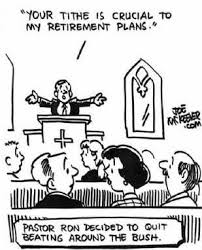
Your pastor and your worship leader and, depending on the dynamics and circumstances of your church, other church staffimages members, need to be able to support their families above the poverty level.

There are people in your church who have lost their jobs, and despite their best efforts, haven’t been able to find new ones. They need your help.

There are pregnant teenagers all over your city who don’t want to abort their babies but don’t see any other options. What can your offering do to help them?

There are people groups all over the globe who have never seen a Bible or heard the name of Jesus. How can we best steward our money to get the gospel to them?

People are dying and spending eternity in hell. Starving to death. Being abused. Living on the streets. Risking their lives to get their hands on a Bible. Trying to put food on the table as they labor to bring you God’s word. The check you put in the offering plate every Sunday can help them.

Forget the percentages and requirements of the law. How can a follower of Christ look upon those needs and ask, “Where’s my calculator?”

Where’s your heart?