New Testament, Sunday School

1 John: A Read-Through ~ Sunday School Lesson ~ 12-28-14

UPDATE to this post:
Due to sudden and unforeseen circumstances beyond my control, I will not be teaching/blogging the “Jacob” study after all. I’m sorry for any inconvenience this may have caused.

1 John

These are my notes from my ladies’ Sunday School class this morning. I’ll be posting the notes from my class here each week. Click here for last week’s lesson.

Through the Bible in 2014 ~ Week 52 ~ Dec. 21-28
Hebrews, 2 Timothy, 2 Peter, Jude, 1, 2 & 3 John, Revelation 1-5
1 John

Wednesday will mark the end of our “Through the Bible in 2014” readings and lessons. It’s been a great study, and I hope you have learned from it and enjoyed it as much as I have. So, because next Sunday will be the first Sunday of the new year, on the 4th we will start a new curriculum.

For the next few months, we will be using my book, Jacob: Journaling the Journey, to study the life of Jacob in the book of Genesis. If you’re familiar with the book, you know that it is divided into 77 short lessons. It begins with Scripture, followed by expository teaching, followed by questions for the reader to consider as she journals what she has learned from the lesson. In class, I anticipate that we will cover about 2-3 lessons per week, using the quesions at the end of each lesson for discussion.

If you physically attend my Sunday school class, there is no need for you to purchase the book since we will be verbally covering nearly everything in it. However, you may purchase it if you’d like to study ahead. If you would like a copy but cannot afford one, let me know, and I’ll make sure you get one.

If you do not physically attend my class but like to follow my Sunday school lessons here on the blog, you will need to purchase a copy of the book (click on the “books” tab at the top of this page- the e-book version is on sale dirt cheap right now!), and study it on your own. Generally speaking, we will be following the “3 lessons per week” schedule found at the beginning of the book. I will not be posting the text of the lesson since it can be found in the book. Each week’s Sunday school lesson post will be more like an on line discussion/Q&A session for that week’s lessons from the book. I welcome your comments, questions, and input.

Today, we’re going to be reading through the book of 1 John, and pausing to discuss comments and questions from the class as they arise. We will start at chapter 1 and see how far we can get before the bell rings. It is chock full of good stuff, so I encourage you to read 1 John in its entirety when you are at leisure to read and savor it slowly.

One verse I want to make sure we get to is 5:13, because it is here that John explains to us his purpose in writing this epistle:

I write these things to you who believe in the name of the Son of God that you may know that you have eternal life.

First John is not written to lost people for the purpose of sharing the gospel with them. First John is written to Believers to assure them of their salvation and eternal life. We have all had moments when we wondered if we were really saved or not. The book of 1 John gives us a sort of measuring stick to compare our walk with Christ to. We will particularly see this in the first couple of chapters.

As you read through the book of 1 John, what jumps out at you? What questions arise as you read?
Comment below and let’s chat.

Wednesday's Word

Wednesday’s Word ~ Luke 12

luke

Luke 12:

In the meantime, when so many thousands of the people had gathered together that they were trampling one another, he began to say to his disciples first, “Beware of the leaven of the Pharisees, which is hypocrisy. Nothing is covered up that will not be revealed, or hidden that will not be known. Therefore whatever you have said in the dark shall be heard in the light, and what you have whispered in private rooms shall be proclaimed on the housetops.

“I tell you, my friends, do not fear those who kill the body, and after that have nothing more that they can do. But I will warn you whom to fear: fear him who, after he has killed, has authority to cast into hell. Yes, I tell you, fear him! Are not five sparrows sold for two pennies? And not one of them is forgotten before God. Why, even the hairs of your head are all numbered. Fear not; you are of more value than many sparrows.

“And I tell you, everyone who acknowledges me before men, the Son of Man also will acknowledge before the angels of God, but the one who denies me before men will be denied before the angels of God. 10 And everyone who speaks a word against the Son of Man will be forgiven, but the one who blasphemes against the Holy Spirit will not be forgiven. 11 And when they bring you before the synagogues and the rulers and the authorities, do not be anxious about how you should defend yourself or what you should say, 12 for the Holy Spirit will teach you in that very hour what you ought to say.”

13 Someone in the crowd said to him, “Teacher, tell my brother to divide the inheritance with me.” 14 But he said to him, “Man, who made me a judge or arbitrator over you?” 15 And he said to them, “Take care, and be on your guard against all covetousness, for one’s life does not consist in the abundance of his possessions.” 16 And he told them a parable, saying, “The land of a rich man produced plentifully, 17 and he thought to himself, ‘What shall I do, for I have nowhere to store my crops?’ 18 And he said, ‘I will do this: I will tear down my barns and build larger ones, and there I will store all my grain and my goods. 19 And I will say to my soul, “Soul, you have ample goods laid up for many years; relax, eat, drink, be merry.”’ 20 But God said to him, ‘Fool! This night your soul is required of you, and the things you have prepared, whose will they be?’ 21 So is the one who lays up treasure for himself and is not rich toward God.”

22 And he said to his disciples, “Therefore I tell you, do not be anxious about your life, what you will eat, nor about your body, what you will put on. 23 For life is more than food, and the body more than clothing. 24 Consider the ravens: they neither sow nor reap, they have neither storehouse nor barn, and yet God feeds them. Of how much more value are you than the birds! 25 And which of you by being anxious can add a single hour to his span of life? 26 If then you are not able to do as small a thing as that, why are you anxious about the rest? 27 Consider the lilies, how they grow: they neither toil nor spin, yet I tell you, even Solomon in all his glory was not arrayed like one of these. 28 But if God so clothes the grass, which is alive in the field today, and tomorrow is thrown into the oven, how much more will he clothe you, O you of little faith! 29 And do not seek what you are to eat and what you are to drink, nor be worried. 30 For all the nations of the world seek after these things, and your Father knows that you need them. 31 Instead, seek his kingdom, and these things will be added to you.

32 “Fear not, little flock, for it is your Father’s good pleasure to give you the kingdom. 33 Sell your possessions, and give to the needy. Provide yourselves with moneybags that do not grow old, with a treasure in the heavens that does not fail, where no thief approaches and no moth destroys. 34 For where your treasure is, there will your heart be also.

35 “Stay dressed for action and keep your lamps burning, 36 and be like men who are waiting for their master to come home from the wedding feast, so that they may open the door to him at once when he comes and knocks. 37 Blessed are those servants whom the master finds awake when he comes. Truly, I say to you, he will dress himself for service and have them recline at table, and he will come and serve them. 38 If he comes in the second watch, or in the third, and finds them awake, blessed are those servants! 39 But know this, that if the master of the house had known at what hour the thief was coming, he would not have left his house to be broken into. 40 You also must be ready, for the Son of Man is coming at an hour you do not expect.”

41 Peter said, “Lord, are you telling this parable for us or for all?” 42 And the Lord said, “Who then is the faithful and wise manager, whom his master will set over his household, to give them their portion of food at the proper time? 43 Blessed is that servant whom his master will find so doing when he comes. 44 Truly, I say to you, he will set him over all his possessions. 45 But if that servant says to himself, ‘My master is delayed in coming,’ and begins to beat the male and female servants, and to eat and drink and get drunk, 46 the master of that servant will come on a day when he does not expect him and at an hour he does not know, and will cut him in pieces and put him with the unfaithful. 47 And that servant who knew his master’s will but did not get ready or act according to his will, will receive a severe beating. 48 But the one who did not know, and did what deserved a beating, will receive a light beating. Everyone to whom much was given, of him much will be required, and from him to whom they entrusted much, they will demand the more.

49 “I came to cast fire on the earth, and would that it were already kindled! 50 I have a baptism to be baptized with, and how great is my distress until it is accomplished! 51 Do you think that I have come to give peace on earth? No, I tell you, but rather division. 52 For from now on in one house there will be five divided, three against two and two against three. 53 They will be divided, father against son and son against father, mother against daughter and daughter against mother, mother-in-law against her daughter-in-law and daughter-in-law against mother-in-law.”

54 He also said to the crowds, “When you see a cloud rising in the west, you say at once, ‘A shower is coming.’ And so it happens. 55 And when you see the south wind blowing, you say, ‘There will be scorching heat,’ and it happens. 56 You hypocrites! You know how to interpret the appearance of earth and sky, but why do you not know how to interpret the present time?

57 “And why do you not judge for yourselves what is right? 58 As you go with your accuser before the magistrate, make an effort to settle with him on the way, lest he drag you to the judge, and the judge hand you over to the officer, and the officer put you in prison. 59 I tell you, you will never get out until you have paid the very last penny.”


The Holy Bible, English Standard Version Copyright © 2001 by Crossway Bibles, a division of Good News Publishers


Questions to Consider

1. What is the purpose of the book of Luke? Which genre(s) of biblical literature (prophecy, epistle, narrative, wisdom, etc.) is the book of Luke? What is the historical backdrop for this book?

2. What is the main theme of verses 1-12? What are the practical and theological reasons it’s important for us to fear God, keep Him first, and let the chips fall where they may? How might verses 31 and 34 serve as theme verses for this chapter?

3. How do 13-21 and 22-34 flesh out the theme (from #2) of this chapter? In what ways do coveting (13-21) and worry/anxiety (22-34) both demonstrate a lack of trust in God and a failure to fear God and keep Him first? How can we cultivate trusting in God and keeping Him first?

4. If 13-21 and 22-34 center around earthly, day to day circumstances, what is 35-59 mainly centered around (40)? How does trusting God and keeping Him first help us not only with day to day matters but also spiritual and eternal matters?

5. In what ways do 35-48, 49-53, 54-56, and 57-59 teach us to be ready for the spiritual warfare of these last days and for the Lord’s return?


New Testament, Sunday School

The Believin’ Bereans and the Thessalonian Thugs ~ Sunday School Lesson ~ 11-30-14

bereans

These are my notes from my ladies’ Sunday School class this morning. I’ll be posting the notes from my class here each week. Click here for last week’s lesson.

Through the Bible in 2014 ~ Week 48 ~ Nov. 23-29
Acts 15-19, Galatians, 1&2 Thessalonians, 1Corinthians 1-4
The Believin’ Bereans and the Thessalonian Thugs

A large part of Acts is devoted to describing how Paul traveled around Asia and Europe preaching and planting churches. Today, we’re going to look at two places he went, Thessalonica and Berea, and their two very different responses to the gospel.

Acts 17:1-9- Thessalonica

Jews vs. Gentiles (1-2, Romans 1:16)
In the days of the early church, one of the apostles was known primarily as the apostle to the Jews, and one as the apostle to the Gentiles. Do you remember which was which? Peter preached mainly to the Jews, and Paul preached mainly to the Gentiles. But as we can see, there was some overlap for both of them.

When Paul arrived at a town with a synagogue (a local “mini-temple” in towns distant from Jerusalem) he started his preaching gig there– to the Jews. This mirrors what we studied back in October, when Jesus sent the disciples out to preach. First, the messiah was God’s promise to and through the Jews, so it was only right to give them “first dibs” on the gospel. Second, this was a period of rapid growth for the church, and converted Jews, with their background in the Old Testament could become competent teachers and preachers much more quickly than Gentiles who had no biblical training at all. Paul emphasizes this concept later in Romans 1:16:

For I am not ashamed of the gospel, for it is the power of God for salvation to everyone who believes, to the Jew first and also to the Greek.

The Substance of the Sermon (2-3)
In verses 2-3, what does Paul draw from to convince the people that Jesus is the Savior? Does he tell them about his phenomenal personal salvation experience on the road to Damascus? No. He “reasoned with them from the Scriptures.” (2) This is something that’s extremely important for us to grasp and remember as we share the gospel with others today.

The gospel isn’t true and necessary because we personally experience life change from it. The gospel is true and necessary because God says it is.

People can experience life change from Weight Watchers, or a near death experience, or Mormonism, or Buddhism. But the life change they experience doesn’t save them and doesn’t prove that these things are true. This is why, when we evangelize, Scripture should take center stage and personal experiences of how Christ has changed our lives should play a supporting role.

The Mixed Response (4-9)
The encouraging news of this passage is that some of the people Paul preached to heard the gospel and believed it. Sometimes, we are reluctant to share the gospel with people because we’re afraid they will reject it (or us), but we should always keep verse 4 in mind– what if they actually believe it?

The remaining five verses, however, describe the opposite response to the gospel. Now, keep in mind, Paul is preaching to Jews…in the synagogue…from their own Scriptures. These are “church people,” if you will. If anybody should have received with joy what Paul was saying, it was this audience. Instead, they rejected the plain teaching of Scripture and basically ran Paul and Silas out of town on a rail.

Though we don’t usually experience rejection to this extreme today, it is a good reminder to us that there are still unbelievers in the church who will reject the plain teaching of Scripture. And, if there are enough like-minded unbelievers in a particular church or denomination, they will run off pastors, teachers, and denominational leaders who stand firmly on Scripture, and will codify rebellion against Scripture into their core beliefs and policies. This is why we have “churches” today that have homosexual bishops, female pastors, accept evolution, etc. Faithful, active church membership does not automatically guarantee that a person is saved.

Acts 17:10-15- Berea

Second Verse, Same as the First (10)
Sometimes, God closes a door and opens a window. Sometimes He slams the door and throws us through the window. Regardless of His method, we end up in the yard with a new place to share the gospel, and that’s exactly what happened to Paul and Silas.

Again, they started out by preaching the gospel in the synagogue.

An Enthusiastic and Responsible Response (11-12)
It’s easy to see why Paul said that the Jews of Berea were more noble than those of Thessalonica. He had three reasons:

1. “They received the word with all eagerness.”
These Jews loved God’s word and were hungry for it. Hearing Scripture taught wasn’t a burden or a duty for them, it was a joy.

2. They were “examining the Scriptures daily to see if these things were so.”
These Jews had the godly wisdom to know that, if what Paul was preaching was truly from God, Scripture would back it up. They did not just gullibly take every thing Paul said at face value. They did their homework and dug into the Scriptures to make sure Paul wasn’t pulling a fast one on them.

In our day and age of so many false teachers permeating the media, it is imperative that we follow the example of the Bereans. Don’t listen to that TV preacher just because what he says sounds good to the ear. Don’t assume that Bible study you’re considering buying is true to Scripture just because it’s on the shelf at a Christian bookstore. Be a good Berean. Do the homework– it’s never been easier! Google the pastor or author and find out if he/she has a track record of proclaiming sound doctrine. Compare what you’re hearing or reading to Scripture (in context), and see if what you’re being taught is really what God’s word says.

3. “Many of them therefore believed” (Mark 1:14)
There’s nothing more noble than hearing the gospel and believing it. That’s exactly what Jesus said to do in Mark 1:14: “repent and believe in the gospel.”

The Rest of the Story (13-15)
I wanted to end the lesson with verse 12, because I’m a “happily ever after” kind of gal. But this is the Bible, not a Disney movie, and the reality is that wherever the gospel flourishes, Satan will be hot on its heels to attack.

The unbelieving Jews who had caused such a ruckus in Thessalonica heard what was going on in Berea, and they didn’t like it. So, they traipsed roughly 50 miles down the road (a trip which probably took 2+ days) and started causing the same kind of trouble in Berea. We can expect the same kind of results today. When we preach the gospel, we will often face opposition.


When we share the gospel, we can be encouraged and spurred on by the fact that sometimes people will believe it. At the same time, we must be prepared for the opposition Paul and Silas, and even Jesus faced. But, like them, we will eventually get our happy ending. Jesus promised:

Blessed are you when others revile you and persecute you and utter all kinds of evil against you falsely on my account. Rejoice and be glad, for your reward is great in heaven, for so they persecuted the prophets who were before you.
Matthew 5:11-12

Wednesday's Word

Wednesday’s Word ~ 2 Timothy 2

For further study on the books of 1-2 Timothy, try my study 1 & 2 Timothy: The Structure and Spirit of the Church, from which this lesson is excerpted.

2tim

2 Timothy 2

You then, my child, be strengthened by the grace that is in Christ Jesus, 2 and what you have heard from me in the presence of many witnesses entrust to faithful men, who will be able to teach others also. 3 Share in suffering as a good soldier of Christ Jesus. 4 No soldier gets entangled in civilian pursuits, since his aim is to please the one who enlisted him. 5 An athlete is not crowned unless he competes according to the rules. 6 It is the hard-working farmer who ought to have the first share of the crops. 7 Think over what I say, for the Lord will give you understanding in everything.

8 Remember Jesus Christ, risen from the dead, the offspring of David, as preached in my gospel, 9 for which I am suffering, bound with chains as a criminal. But the word of God is not bound! 10 Therefore I endure everything for the sake of the elect, that they also may obtain the salvation that is in Christ Jesus with eternal glory. 11 The saying is trustworthy, for:

If we have died with him, we will also live with him;
12 if we endure, we will also reign with him;
if we deny him, he also will deny us;
13 if we are faithless, he remains faithful—

for he cannot deny himself.

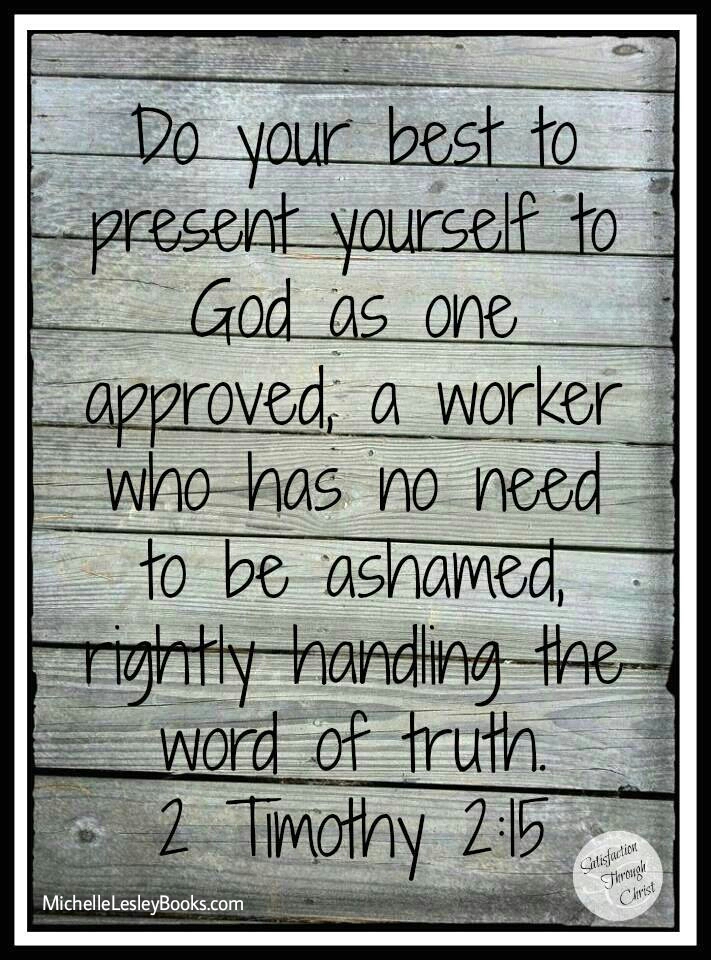
14 Remind them of these things, and charge them before God not to quarrel about words, which does no good, but only ruins the hearers. 15 Do your best to present yourself to God as one approved, a worker who has no need to be ashamed, rightly handling the word of truth. 16 But avoid irreverent babble, for it will lead people into more and more ungodliness, 17 and their talk will spread like gangrene. Among them are Hymenaeus and Philetus, 18 who have swerved from the truth, saying that the resurrection has already happened. They are upsetting the faith of some. 19 But God’s firm foundation stands, bearing this seal: “The Lord knows those who are his,” and, “Let everyone who names the name of the Lord depart from iniquity.”

20 Now in a great house there are not only vessels of gold and silver but also of wood and clay, some for honorable use, some for dishonorable. 21 Therefore, if anyone cleanses himself from what is dishonorable, he will be a vessel for honorable use, set apart as holy, useful to the master of the house, ready for every good work.

22 So flee youthful passions and pursue righteousness, faith, love, and peace, along with those who call on the Lord from a pure heart. 23 Have nothing to do with foolish, ignorant controversies; you know that they breed quarrels. 24 And the Lord’s servant must not be quarrelsome but kind to everyone, able to teach, patiently enduring evil, 25 correcting his opponents with gentleness. God may perhaps grant them repentance leading to a knowledge of the truth, 26 and they may come to their senses and escape from the snare of the devil, after being captured by him to do his will.


The Holy Bible, English Standard Version Copyright © 2001 by Crossway Bibles, a division of Good News Publishers.


Questions to Consider

1. What is the purpose of the book of 2 Timothy? Which genre(s) of biblical literature (prophecy, epistle, narrative, wisdom, etc.) is the book of 2 Timothy? What is the historical backdrop for this book?

2. How do the themes of suffering for the gospel, not being ashamed of the gospel, and guarding the deposit from chapter 1 relate to what Paul is about to tell Timothy? Trace the line of entrusting the deposit of the gospel, beginning with Christ entrusting it to PaulTo whom did Paul entrust it? To whom is Timothy to entrust it? (2)

3. Examine each of the times a form of the word “quarrel” is used in 14-26. (14,23,24) Does this mean that disagreement, controversy, and confrontation are always to be avoided in the church regardless of the issue? What is the difference between these types of controversies and quarrels and the necessary factions Paul describes in 1 Corinthians? Is rebuking false teachers taking part in “quarrels about words” and “foolish, ignorant controversies” or being “quarrelsome”?

4. Examine verses 15-19. List the things in verses 16-18 that can bring chaos and disorder to the church. Explain the instructions and precepts in verses 15 and 19. Notice how these instructions and precepts bring stability and unity to the church, and how these two verses “bookend” or contain the chaos in verses 16-18. What does this tell you about the church, and you as an individual, walking in obedience to God?

5. Who is “the Lord’s servant” in verse 24? How could you walk out the instructions in 24-25a as a mother, leader, Bible teacher, while evangelizing, or while defending the faith? Verses 25b-26 tell us why pastors, teachers, and, yes, even a mom or a woman sharing the gospel should exhibit these characteristics. What is that reason?

Wednesday's Word

Wednesday’s Word ~ Acts 1

10624842_773638779349560_23824209767270553_n

Acts 1

In the first book, O Theophilus, I have dealt with all that Jesus began to do and teach, 2 until the day when he was taken up, after he had given commands through the Holy Spirit to the apostles whom he had chosen. 3 He presented himself alive to them after his suffering by many proofs, appearing to them during forty days and speaking about the kingdom of God.

4 And while staying with them he ordered them not to depart from Jerusalem, but to wait for the promise of the Father, which, he said, “you heard from me; 5 for John baptized with water, but you will be baptized with the Holy Spirit not many days from now.”

6 So when they had come together, they asked him, “Lord, will you at this time restore the kingdom to Israel?” 7 He said to them, “It is not for you to know times or seasons that the Father has fixed by his own authority. 8 But you will receive power when the Holy Spirit has come upon you, and you will be my witnesses in Jerusalem and in all Judea and Samaria, and to the end of the earth.” 9 And when he had said these things, as they were looking on, he was lifted up, and a cloud took him out of their sight. 10 And while they were gazing into heaven as he went, behold, two men stood by them in white robes, 11 and said, “Men of Galilee, why do you stand looking into heaven? This Jesus, who was taken up from you into heaven, will come in the same way as you saw him go into heaven.”

12 Then they returned to Jerusalem from the mount called Olivet, which is near Jerusalem, a Sabbath day’s journey away. 13 And when they had entered, they went up to the upper room, where they were staying, Peter and John and James and Andrew, Philip and Thomas, Bartholomew and Matthew, James the son of Alphaeus and Simon the Zealot and Judas the son of James. 14 All these with one accord were devoting themselves to prayer, together with the women and Mary the mother of Jesus, and his brothers.

15 In those days Peter stood up among the brothers (the company of persons was in all about 120) and said, 16 “Brothers, the Scripture had to be fulfilled, which the Holy Spirit spoke beforehand by the mouth of David concerning Judas, who became a guide to those who arrested Jesus. 17 For he was numbered among us and was allotted his share in this ministry.” 18 (Now this man acquired a field with the reward of his wickedness, and falling headlong he burst open in the middle and all his bowels gushed out. 19 And it became known to all the inhabitants of Jerusalem, so that the field was called in their own language Akeldama, that is, Field of Blood.) 20 “For it is written in the Book of Psalms,

“‘May his camp become desolate,
and let there be no one to dwell in it’;

and

“‘Let another take his office.’

21 So one of the men who have accompanied us during all the time that the Lord Jesus went in and out among us, 22 beginning from the baptism of John until the day when he was taken up from us—one of these men must become with us a witness to his resurrection.” 23 And they put forward two, Joseph called Barsabbas, who was also called Justus, and Matthias. 24 And they prayed and said, “You, Lord, who know the hearts of all, show which one of these two you have chosen 25 to take the place in this ministry and apostleship from which Judas turned aside to go to his own place.” 26 And they cast lots for them, and the lot fell on Matthias, and he was numbered with the eleven apostles.


The Holy Bible, English Standard Version Copyright © 2001 by Crossway Bibles, a division of Good News Publisher


Questions to Consider

1. What is the purpose of the book of Acts? Which genre(s) of biblical literature (prophecy, epistle, narrative, wisdom, etc.) is the book of Acts? What is the historical backdrop for this book?

2. What is the “first book” referred to in verse 1? Who is the author of both books? How do these two books fit together? How does the book of Acts, especially chapter 1, show us the transitional period between Jesus’ earthly ministry and the church era?

3. Why did the apostles ask Jesus the question in verse 6? (Hint: Use your cross-references.) Why were they expecting the Messiah to build an earthly kingdom? What was Jesus building instead? (7-8). When will Jesus build His earthly Kingdom? (6-7,11)

4. How do verses 12-14 demonstrate the apostles’ obedience to Jesus’ command in verse 4? To Jesus’ admonition in Matthew 26:41? Why do you think the main activity they were engaged in was prayer? Jesus is about to set up His church through this little group. Explain why it was crucial for the church to be born out of a) obedience to the word of Christ, and b) prayer. Why are these still crucial for the church, and Christian individuals, today?

5. Explain how Peter and the apostles followed Scripture as they went about replacing Judas with Matthias. (15-26) Were they following Old Testament or New Testament Scripture? Why is it important, when making decisions in the church today (or as individuals), to search the Scriptures and find out how they apply to the situation? Why don’t we still cast lots (26) to make decisions in the church, or as individuals, today?