Evangelism, Gospel, Homosexuality, Salvation, Sin

Cancer: A Love Story

cancer love story

Cancer.

The dreadfulness of the word hung heavy in the air between Jana and her friend Denise.

“The doctor says it’s terminal,” Denise choked, “I’m so confused. I don’t know what to do.”

Jana’s heart broke as she envisioned the difficult emotional road ahead for Denise and watched the tears streaming down her face.

“I’d do anything to take that pain away,” thought Jana. “Anything.

For days after they parted, Jana’s thoughts were consumed with how she could help Denise accept and feel better about her condition. By the weekend, when they met for coffee, Jana was ready.

“Denise,” she began, “I’ve been giving it a lot of thought, and I think I know why you’re so uncomfortable with having cancer.”

“Oh? Why?” asked Denise.

“Well, first of all, you shouldn’t be fighting against the idea of having cancer. It’s a completely natural biological event. In fact, you were probably born genetically predisposed to cancer. It’s part of who you are. Accept it and embrace it as something that makes you unique and wonderful!”

Denise seemed skeptical, but Jana plunged ahead.Girlfriends Enjoy A Conversation

“You’re also worried about what other people will think of you. Maybe they’ll think you’re weak and try to help you with things that you’d rather do for yourself.”

“But maybe I’ll need some help,” Denise suggested quietly.

“Nonsense!” Jana retorted, “Having cancer doesn’t make you different from anybody else. It’s exactly the same as not having cancer. What we need to do is show that to the world. Maybe we should have a rally for cancer equality!”

“Jana, that’s great and all,” Denise whispered somberly, “but I’m going to die. That makes all the stuff you’re talking about seem a lot less important.”
Jana seems like a very loving and kind person, but does the “help” she was offering Denise seem…well…helpful?

What if I told you that during this entire scenario, Jana personally knew a doctor who had a proven cure for Denise’s type of cancer, and was giving it away, yet Jana never told Denise? How loving and kind does Jana seem now?

Now read back through this story and substitute homosexuality for cancer.

We live in a culture that tells Christians that we are to “love” our homosexual friends and loved ones by embracing homosexuality as good and natural. We even hear people who claim to be Christians saying this. But is this how the Bible defines love? Is this how Jesus loved people?

In this is love, not that we have loved God but that he loved us and sent his Son to be the propitiation for our sins. Beloved, if God so loved us, we also ought to love one another.
1 John 4:10-11

Think back over the encounters Jesus had with people, from the woman at the well, to Zaccheus, to Nicodemus, to the woman caught in adultery, to the rich young ruler, to anybody else Jesus ever interacted with.

Did Jesus ever “love” someone by telling him it was OK to stay in his sin?

No, He didn’t.

Jesus loved sinners by calling them to repentance, forgiveness, and a new life in Christ.

Why? Because it isn’t love to help the slave to embrace his chains. It’s love to set him free.

Christ loved us by going to the cross and becoming the propitiation –satisfying God’s wrath—for our sins. He laid down His life for our freedom.

And, Christian, if God so loved us, we also ought to love one another. We must lay down our opinions, our politics, our ideas of what we’d like the Bible to say, maybe even our actual lives, in order to help people know freedom in Christ. We have the cure for their spiritual cancer—the gospel—and it is not “love” to knowingly misdiagnose them or keep that cure from them.

Greater love has no one than this, that one lay down his life for his friends.
John 15:13

blurry-sky-cross
But as important as it is to rescue the perishing, there’s an even greater issue at stake here for those of us who claim the name of Christ.

For our sin, our Savior endured wrongful conviction, ridicule, mockery, and bullying.

For our sin, our Savior was slapped, punched, spit on, had His beard yanked out, and thorns and brambles mashed into His skull.

For our sin, our Savior had the skin flayed off His back, buttocks, and legs, whipped nearly to death until He was a bloody mess.

For our sin, our Savior, beaten, bloody, and broken of body, hoisted a heavy, splintery cross onto His shoulders and carried it through town and up the hill to His execution.

One nail.

Two nails.

Three nails.

For your sin. For my sin. For our neighbors’ sin.

How dare you, or I, or anyone spit in the face of our bleeding, dying Savior by saying that the sin that put Him on the cross is OK?

How dare we?

How can any of us claim to love Christ while celebrating the nails, the spear, the crown of thorns?

By this we may know that we are in him: whoever says he abides in him ought to walk in the same way in which he walked.
1 John 2:5b-6

Jesus walked the way of leading people to repentance from sin and to the beauty, the freedom of a glorious new life through faith in Himself. Will we, who say we abide in Him, love Jesus and our homosexual neighbor enough to walk in the same way in which He walked?

Mostloving

Bible, Types and Shadows

In the Shadow of the Son

shadow son

Once, there was a father who sent his beloved son on a journey far away from home. The son was to seek out the father’s other children who had been separated from the father for quite some time. Quite willingly, the son went.

But when the son arrived at his destination, he found that his brothers had strayed away from where they were supposed to be, seeking greener pastures. So the son went after them and found them. He met them right where they were.

His brothers saw their father’s favored son coming for them. They hated him and everything he said and stood for because they knew he was to be in authority over them. It had been foretold. They conspired to kill him and bury him in a pit. Then, the prophecy of his authority over them would not come true.

The brothers stripped him of his robe and drenched it in the blood of an animal they had sacrificed for this purpose. They stripped him of his dignity, his favored status, and, if possible, his father’s love and approval. It was an attempted coup to knock the prince off his throne.

When they were finished, they threw him into a pit that had never held another man’s body. They sat down to eat, returning to life as usual.

But it wasn’t enough. Revenge is a meal that never satiates.

The brothers determined to turn the favored son over to a rough pack of wealthy heathens. They wouldn’t dirty their hands to kill him. Their brother’s life would rest in the hands of foreigners who had no part in their family line. And so the son’s fate was sealed.

By oppression and judgment he was taken away;
and as for his generation, who considered
that he was cut off out of the land of the living,
stricken for the transgression of my people?
And they made his grave with the wicked
and with a rich man in his death,
although he had done no violence,
and there was no deceit in his mouth.
Isaiah 53:8-9

His closest brother sold him out for pieces of silver, for the price of a slave. Life, as he knew it, was over.

Later, another brother would peer into the pit to see what had become of him. “He is gone!” the brother discovered to his great distress and sadness. Little did he know that the favored son had risen up out of the pit. He would rise in power to deliver the very brothers who had hated him and plotted his death, as well as myriads of others who didn’t even know him.

Who was this favored son? He is the One who has taken away our reproach and added us as sons and daughters into God’s family. He is Joseph, the forefather. He is Jesus, the Son.

Based on Genesis 37.

Evangelism, Faith, Forgiveness, Gospel, Salvation, Sin

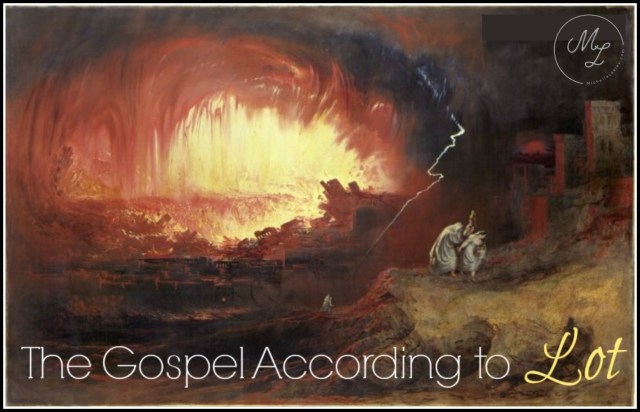
The Gospel According to Lot

Then the men said to Lot, “Have you anyone else here? Sons-in-law, sons, daughters, or anyone you have in the city, bring them out of the place. For we are about to destroy this place, because the outcry against its people has become great before the Lord, and the Lord has sent us to destroy it.” So Lot went out and said to his sons-in-law, who were to marry his daughters, “Up! Get out of this place, for the Lord is about to destroy the city.” But he seemed to his sons-in-law to be jesting.
Genesis 19:12-14

The story of the destruction of Sodom and Gomorrah would make an epic movie. You’ve got your good guys: Abraham, Lot, and the angels. Your bad guys: everybody else in town. Violence, dramatic tension, a narrow escape, major pyrotechnics, and the good guys take the day. Epic, I tell you.

But that’s just what’s happening on the surface.

If you look closely, you can see the light of the gospel casting a shadow over Sodom. A shadow that’s the size and shape of a cross.

The city of Sodom was so wicked that God personally came down to deal with it. Judgment was coming. There was hell to pay—quite literally.

God revealed His plan of destruction to Lot, His only follower in Sodom. But God didn’t stop there. Did Lot have anyone in town that needed to be rescued from the coming devastation? Hurry! Go get them and urge them to flee!

“My sons-in-law!” thought Lot. Perhaps he raced out the back door, slipped carefully past any of the blinded mob left on his front porch, and scurried surreptitiously through town to avoid other hostile neighbors. Arriving at the respective homes of the two men betrothed to his daughters, he must have pleaded with them to drop everything and come with him. It was the only way they could be saved.

But they wouldn’t go with him. They didn’t believe him.

hp-crossshadow

The next morning, judgment came. And that handful of people—righteous Lot, and those who believed with him that God would save them if they left everything behind and followed Him—were the only ones spared.

Is that shadow becoming clearer?

This world is a frightfully wicked place. And, one day, God is going to come down personally to deal with it. Judgment is coming. It will be swift, it will be terrible, and it will be final. God has revealed this to us in His word. He has also revealed to us, His followers, the plan of escape: Jesus.

But God doesn’t stop there. Do we have friends and loved ones who need to be rescued from the very real and eternal hellfire and brimstone that await them if they stay in the Sodom of their sin?

Jesus tells us to “go out and…compel them to come in” (Luke 14:23), and that they “must be born again” (John 3:7).

This isn’t some kind of “God loves you and has a wonderful plan for your life” game we’re playing here. It’s urgent, a matter of life and death.

Eternal life. Eternal death.

And God’s way is the only way out.

God didn’t offer Lot’s sons-in-law the option of having their cake and eating it, too, by remaining in Sodom and being saved from His wrath. And it doesn’t work that way for us either. We don’t get to have Jesus and continue to rebel against Him by remaining in our sin.

Just as Lot’s sons-in-law could not survive God’s judgment any other way than fleeing the sin of Sodom and following God’s escape route, there is only one way we may escape. We must flee from our sin and into the forgiving arms of our crucified and risen Savior.

This is the gospel with which we must compel them. It is the only gospel that saves.

“If sinners will be damned, at least let them leap to hell over our bodies. And if they will perish, let them perish with our arms around their knees, imploring them to stay. If hell must be filled, at least let it be filled in the teeth of our exertions, and let not one go there unwarned and unprayed for. – C.H. Spurgeon.

Faith, Prayer, Tragedy

How Now Shall We Pray?

525896_10152328212315442_1287922350_nLast week, an unspeakable tragedy happened. We all wish there were something we could do to fix things and make things better for those who lost loved ones in Connecticut.

Well, there is something we can do. We can pray for them.

If you’re like me, your initial reaction is probably a feeling of, “That’s not enough. I need to do more.” Yes, it will be kind and compassionate to donate to the various funds that will be established, or to send a note of condolence. And if God moves you to do so, you absolutely should show His love in these ways. The families need to receive comfort and encouragement from God’s people, showing them God’s love.

But, if you think about it -especially if you’ve lost a loved one- you know that no act of kindness from a human being can bring the healing of the heart that these folks need. The only way these families will experience true healing, peace, and comfort is through the direct intervention of the Man of Sorrows who is acquainted with grief. We cannot truly help them, but He can.

So, how can we best pray for these heartbroken families? Pray that God will be glorified in this tragedy by:

1. Many coming to know Christ as Savior.
For some, a situation like this is a reminder of their own mortality and the eternity that will follow. Pray that people will bow the knee to Christ as the Holy Spirit woos their hearts, and be sensitive -wherever you happen to be located- to opportunities to share the gospel with people who are searching for answers in the wake of tragedy.

2. Bible-believing Christians and churches reaching out to the victims’ families with the love and comfort that can only be found in Christ. This is a time for the church to be the church and serve her neighbors.

3. God’s provision.
It’s likely that most of these families are not financially or logistically prepared to deal with the practical aspects of dealing with the death of a child or other family member. Pray that God will provide for the victims’ families and ease any struggles with “red tape” at this time. Here’s another area in which the church can serve them.

Please feel free to share this around. Let’s get as many people praying as possible.

Faith, Salvation

Layers

And one of the synagogue officials named Jairus came up, and on seeing Him, fell at His feet and pleaded with Him earnestly, saying, “My little daughter is at the point of death; please come, that by coming, You may lay Your hands on her, so that she will be saved and live.” And He went off with him; and a large crowd was following Him and pressing in on Him.

While He was still speaking, they came from the house of the synagogue official, saying, “Your daughter has died; why trouble the Teacher anymore?” But Jesus, overhearing what had been spoken, said to the synagogue official, “Do not be afraid, only believe.” And He allowed no one to accompany Him, except Peter and James and John the brother of James. And they came to the house of the synagogue official; and He saw a commotion, and people loudly crying and wailing. And entering in, He said to them, “Why are you making a commotion and crying? The child has not died, but is asleep.” And they began laughing at Him. But putting them all out, He took along the child’s father and mother and His own companions, and entered the room where the child was. And taking the child by the hand, He said to her, “Talitha kum!” (which translated means, “Little girl, I say to you, arise!”). And immediately the little girl stood up and began to walk, for she was twelve years old. And immediately they were completely astounded. And He gave them strict orders that no one should know about this, and He said that some food should be given to her to eat.

Mark 5:22-24, 35-43

Did you see it?

The wall in my bedroom isn’t painted very well. It’s obvious that someone rolled on a dusty rose color, but I can also see through that layer of paint to an underlying cream color. I have to take a moment and really look at it, but it’s there. Two distinct, yet bonded, layers of paint.

Do you see the two layers to this story? Take a moment. Really look at it.

There’s the obvious top layer:

Here is a daddy who loves his little girl. She’s dying. He’s in anguish.

Here is a Savior who has compassion on both father and daughter. He raises her back to life, and there is great rejoicing in their home.

Jesus, our Messiah, has the power to heal. Power over death. He is exactly who He claims to be: God in human flesh.

But look more closely. Do you see it?

This isn’t just a story about a nameless little girl in first century Israel. It’s about us and the strikingly beautiful story of salvation.

Here is a little girl. Not a son, so highly prized among the Israelites in that day and age, but a daughter. Virtually valueless, except to her father.

There was nothing intrinsically worthy in her to earn Christ’s favor or attention. She had no wealth, no position, no power, nothing to offer anyone. And on top of that, she was dead.

But her father loved her for no other reason than that she was his, and he was willing to lay down everything he had to save her. He sacrificed his dignity. He risked His reputation and laid aside His position of authority. All for the love of this child—a child whose past had offered him nothing but childishness and disobedience. A child whose future promised the same.

Do you see it?

We are that little girl. Valueless. Unworthy. Childish. Disobedient. Dead.

And for no other reason than our Father’s love for us, Christ comes to us when we cannot come to Him, and raises us from the dead.

And you were dead in your transgressions and sins… But God, being rich in mercy because of His great love with which He loved us, even when we were dead in our transgressions, made us alive together with Christ—by grace you have been saved— and raised us up with Him, and seated us with Him in the heavenly places in Christ Jesus, so that in the ages to come He might show the surpassing riches of His grace in kindness toward us in Christ Jesus.

Ephesians 2:1, 4-7