Faith, Justice, Tough Passages

Shall Not the Judge of all the Earth Do What Is Just?

Now therefore, kill every male among the little ones, and kill every woman who has known man by lying with him.

Numbers 31:17

That’s a pretty tough verse, isn’t it?

Married women. Widows. Little boys.

When I read that verse, I think of somebody like me. Or, somebody like my ten year old. It’s hard for me to put myself in a Midianite woman’s sandals and imagine the Israelites coming for my son. My son, who’s basically a good kid, and certainly hasn’t done anything worthy of an army coming after him to execute him.

Do you ever follow criminal trials in the news? With 24-hour news channels and courtroom TV channels, we’ve probably all watched for the verdicts of a few. Have you ever been surprised by a jury’s verdict or a judge’s sentence? Maybe you were certain the defendant was guilty, but the jury acquitted him. Or, you figured a life sentence was a sure thing but only a few years were handed down.

It’s easy to lambaste a judge or jury for making what we consider to be the wrong decision. But, think about it: that judge and jury sat through hours of testimony, legal arguments, instruction on the law, and presentation of evidence. They know much more about the case and all the players in it than we do. They know things we don’t know. And those things we’re ignorant about are likely the very things that led them to make a different decision than we, with our limited knowledge of the case, would have made.

What if your spouse, parent, or best friend had been a juror in one of those cases in which you were appalled at the verdict, and he had voted opposite the way you thought he should have? What if he told you, “Look, I’ve been told not to discuss the case, but, trust me, this was the right decision.”? Would you trust him?

It’s the same way with God.

We come to passages like this one, and our first reaction is righteous indignation. How could God make a decision like this? It seems so unjust. An arbitrary, capricious, and callous verdict. It’s easy to throw stones thousands of years later.

But, if God is God, He is, by definition, absolutely perfect in justice, perfect in love, perfect in mercy, perfect in patience, perfect in wisdom, and perfect in His knowledge of every detail of every situation on earth, ever, including people’s thoughts and intentions. He never makes a wrong decision. If He were lacking one iota in any of these areas, He would cease to be God, and there would be no reason to trust Him.

But He isn’t. So we can.

We generally trust human judges and juries to carry out justice in the cases they’re assigned, despite the fact that we know of cases of judges who have been bribed, juries that have been tampered with, defendants who have been framed, and jurors who vote guilty based on race, sex, status, or some other irrelevant condition.

But God doesn’t fall into any of those categories. He is the perfect Judge, able to mete out perfect justice, because He’s also the perfect eyewitness. He knew everything about the case of the Midianites because He saw each of them, and everything that was going on in the world around them, inside and out.

I can’t say that about my knowledge of this case. Can you?

God’s not discussing the case of the Midianites with us, but, “Trust Me,” He says, “This was the right decision.”

He’s got a pretty good track record of being right. I’m going to trust Him on this one since I don’t know all the details. How about you?

Far be it from you to do such a thing, to put the righteous to death with the wicked, so that the righteous fare as the wicked! Far be that from you! Shall not the Judge of all the earth do what is just?”

Genesis 18:25
Church, Discernment, Worship

The Way We Wor (ship)

mt_sinai

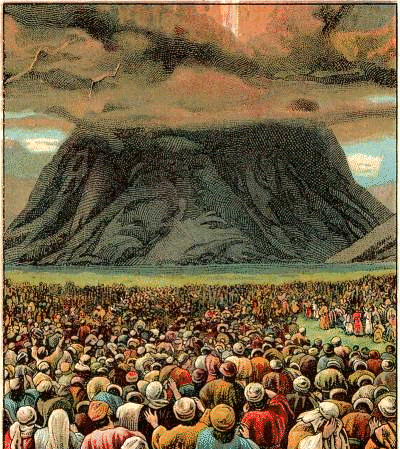
And you shall set limits for the people all around, saying, ‘Take care not to go up into the mountain or touch the edge of it. Whoever touches the mountain shall be put to death.  No hand shall touch him, but he shall be stoned or shot; whether beast or man, he shall not live.’ When the trumpet sounds a long blast, they shall come up to the mountain.”
Exodus 19:12-13

From Cain and Abel to the Israelites in the wilderness to Ananias and Sapphira, God sets limits on the way we may approach Him. He has always said “whosoever will” may come to Him, but He is just as exacting about the way in which we come to Him today as He was back then.

It’s no small matter that many people in the Bible were put to death for approaching God in anything less than an attitude of utmost awe, fear, and reverence for His holiness. Uzzah touched the Ark of the Covenant. Nadab and Abihu offered strange fire before the Lord. The Corinthians took the Lord’s Supper in an unworthy manner.

I recently heard Perry Noble, a well known leader of a seeker sensitive megachurch, who has done such things as having his church’s band play AC/DC’s “Highway to Hell” on Easter Sunday, say, “I’m willing to offend the church people to reach people for Jesus.” When asked where he drew the line at what was too offensive in church, he went on to say, “I probably wouldn’t have a stripper on stage…” and continued to justify using worldly and irreverent antics in church in order to “bring people to Jesus.”

But Perry has missed the point. Worship isn’t about people and what they like or don’t like. It isn’t about entertaining people and making sure they have some sort of enjoyable or emotional experience. It isn’t about attracting the attention of people.

Worship is about God.

What does God think? How does He want to be worshiped? What does He find offensive?

God is not the God of “anything goes.” If you doubt that, go back to the Old Testament and read His precise instructions on constructing the tabernacle, offering sacrifices, the behavior and duties of priests and Levites, and so on. Anything goes? Far from it.

Christ should be the sun in our solar system of worship. Just as the sun’s gravity exerts just the right force on each planet, keeping them revolving around it in exactly the right path, so, when Christ is at the center of our worship, every song, every prayer, every word spoken will fall into exactly the right orbit around Him.

What about your church? The next time you attend a worship service, sit back and view it through the lens of discernment. Is it designed to make you happy? Comfortable? Entertained? Emotional? Or is every element of the service centered on Christ– His holiness, His sacrifice for sin, His love and grace — leading you to exalt Him and forget about yourself?

Pastors and worship leaders, one day you will answer to God for the way you led your church. Do you design worship services to attract and hold the attention of people, manipulate their emotions, and entertain them, or do you sit at your desk, pray, and consider what will please God, how you can best lift up the name of Christ, expose His glory, and keep things centered on Him? God has not called you to be a shock jock, stand up comedian, or motivational speaker. He has called you to preach Christ and Him crucified.

Let’s stop the silliness and stupidity, and repent. Worship is serious business.

Bible, Types and Shadows

Types and Shadows: Study Notes on Exodus 1-2

Image

Do you know what types and shadows are? To put it simply, it’s when we take a look at an Old Testament character and notice things in his life that are similar to, and foreshadow, the life and ministry of Jesus. I really enjoy studying types and shadows. For me it’s like Twilight Zone meets a treasure hunt meets the Bible.

This morning I was studying the first two chapters of Exodus, and I noticed several instances of Moses foreshadowing the life of Jesus. I have a couple of friends who enjoy types and shadows, and I figured there might be a few more of you who get as geeked up about this stuff as we do, so I thought I’d share my study notes with y’all.

A few of caveats: these are just “off the top of my head” study notes, so think of this as a rough draft rather than a polished article. Also, I didn’t consult any commentaries or other resources, so I’m sure I missed a lot of things that others have picked up on. Finally, this pretty much covers only Exodus 1 and 2, which ends before the burning bush episode, before Moses even returns to Egypt, so there are tons of things in Moses’ later life that I haven’t covered. There are many more examples of types and shadows after chapter 2, I just haven’t gotten to them yet.

MH900014974

Types and Shadows in Exodus 1-2

  • Moses and Jesus were both born under oppressive kings who feared a takeover by the Hebrews and ordered a mass infanticide of Hebrew baby boys.
  • Moses and Jesus were both “adopted” by a parent who raised them as their own children: Moses, by Pharaoh’s daughter; Jesus, by Joseph.
  • Moses left the glory of his throne and palace and his position of royalty to “become” one of his own people, whom he delivered out of bondage to slavery. Jesus left the glory of Heaven and emptied himself of His royal position as King to become one of His own people, whom He delivered out of bondage to sin.
  • Rejection of Moses’ and Jesus’ reign/authority by their own people:
    “Who made you a prince or a judge over us?” (Moses)
    “We do not want this man to reign over us.” (Jesus)
    “We have no king but Caesar.” (Jesus)
  • Moses and Jesus both sat down by a well (Ok, this is less type/shadow and more of a common thing for Israelite shepherds to do. Wells were communal gathering places for shepherds.) And speaking of shepherds…
  • Moses was a shepherd. Jesus is the Good Shepherd.
  • Moses and Jesus both escaped from leaders who were trying to kill them.
  • Moses and Jesus were both “sojourners in a foreign land.” 
  • God heard Israel’s groaning and sent them a deliverer at just the right time: after 400 years. He sent Moses after 400 years of slavery and Jesus after 400 years of silence during the intertestamental period (between the end of the Old Testament and the beginning of the New Testament).
  • Both Jesus and Moses returned to their homelands after the kings who wanted to kill them had died. God called Moses back to Egypt. God called Jesus out from Egypt.

Well, what did I miss? What other types and shadows do you see in Exodus 1 and 2?

Christmas, Faith

The “Merry Christmas” Melee

It’s that time of year again. Time for love and good cheer. Peace on earth. Joy to the world.

And war.

Over the last several years, there’s been a sometimes quiet and respectful, sometimes loud and obnoxious battle raging between conservative Christians and merchants over whether said merchants use the term “Merry Christmas” or the more general “Happy Holidays” or “Season’s Greetings” in their advertising and in greeting customers at their stores.

I don’t know about you, but it’s driving me bananas.

Would I prefer for everybody to say “Merry Christmas”? Sure. But on my list of things to have an aneurysm about, it falls somewhere between my dentist telling me I should floss more and deciding where to get the dog a pedicure. I just really don’t care that much. And I’m wondering, in the grand scheme of things that should be pressing upon Christians’ hearts, should something this minor even register on the scale of issues that upset us?

What Do We Expect?

Speaking strictly numerically and statistically, genuine Christians– not just people who say they’re Christians and/or go to church, but people who have actually been regenerated by the blood of Christ –are a very small minority. Despite what you may hear to the contrary, the United States is not a Christian nation. It may have been founded on Biblically inspiried principles, but in practical societal terms today, this is a nation mostly made up of lost people.

This means that it’s a safe bet that the majority of the people at the helms of these corporations are lost. And guess what? Fish gotta swim, birds gotta fly, and lost people gotta act like lost people (Romans 8:7). What this means is that their decision whether to use “Merry Christmas” or “Happy Holidays” has nothing to do with Jesus or respecting the “true meaning of Christmas”. Their decision is going to be based on what’s going to make the corporation the most money. If saying “Merry Christmas” will get more customers in the door, that’s what they’ll do. It doesn’t mean they’re honoring Christ, it mean’s they’re pandering to Christians.

When we exert pressure on these corporations to say “Merry Christmas”, what real change are we effecting? Are we not just creating more people who honor God with their lips while their hearts are far from Him (Isaiah 29:13)? Are we not sending them the subtle message that external behavior, rather than a reborn spirit, is what counts? One day, every knee will bow and every tongue confess that Jesus is Lord (Philippians 2:10-11). One day. But that day is not today. We can’t force change in people’s hearts by coercing them into saying “Merry Christmas”. And, to God, a change of heart is the only thing that matters.

Where Should Our Passions Lie?

I used to belong to a Christian “social issues” organization. In many ways, it’s a great organization. I got frequent e-mails from them regarding which social issues various corporations were investing their profits in, where politicians stood on the issues, and lots of other helpful information and resources.

But every autumn they would begin their annual “Merry Christmas” campaign. They have buttons you can order that urge people to say “Merry Christmas”. They have leaflets and stickers and videos you can order for your church to promote saying “Merry Christmas”. They publish a “Naughty and Nice” list of merchants who use “Merry Christmas” (nice) or some other wording (naughty), so you’ll know which stores to shop and which to boycott.

And it made me stop and think– how many man hours go into that campaign every year? How much money does the organization invest in it? How much money do churches and individuals spend on their materials? Is investing that much time and money in promoting “Merry Christmas” good stewardship?

We have brothers and sisters all over this planet who would give anything to own a copy of the Bible. There are crisis pregnancy centers that operate on a shoestring trying to help women and their babies. There are missionaries who live in poverty in third world nations taking the Gospel to those who have never heard it. There are people starving. There are children who have been kidnapped by human traffickers.

And “Merry Christmas” is what we want to get all worked up about?

What’s more upsetting to us, the fact that someone says “Happy Holidays” or the fact that the person who said it might die and spend an eternity in hell? Where do our passions truly lie? Are we passionate about the same things God is passionate about?

This Christmas, can we just focus on what’s important? We have a God who loves every person so deeply and so intensely, and whose mercy and grace are so unfathomable, that He came here personally to redeem us.

And there are people all around us who don’t know that.

And they desperately need us to love them enough to tell them that in Jesus there’s hope. A way out of their sin. A way to get clean. A secure eternity. Peace.

God and sinners, reconciled. Oh, what a Merry Christmas!