Top 10

Top Ten: Favorite Passages from Isaiah

Top 10 Isaiah


1. Isaiah 53:2-5
2 For he grew up before him like a young plant,
    and like a root out of dry ground;
he had no form or majesty that we should look at him,
    and no beauty that we should desire him.
3 He was despised and rejected by men;
    a man of sorrows, and acquainted with grief;
and as one from whom men hide their faces
    he was despised, and we esteemed him not.
4 Surely he has borne our griefs
    and carried our sorrows;
yet we esteemed him stricken,
    smitten by God, and afflicted.
5 But he was pierced for our transgressions;
    he was crushed for our iniquities;
upon him was the chastisement that brought us peace,
    and with his wounds we are healed.

2. Isaiah 40:8 
The grass withers, the flower fades,
    but the word of our God will stand forever.

3. Isaiah 9:6 
For to us a child is born,
    to us a son is given;
and the government shall be upon his shoulder,
    and his name shall be called
Wonderful Counselor, Mighty God,
    Everlasting Father, Prince of Peace.

4. Isaiah 64:6 
We have all become like one who is unclean,
    and all our righteous deeds are like a polluted garment.
We all fade like a leaf,
    and our iniquities, like the wind, take us away.

5. Isaiah 55:6-9
“Seek the Lord while he may be found;
    call upon him while he is near;
7 let the wicked forsake his way,
    and the unrighteous man his thoughts;
let him return to the Lord, that he may have compassion on him,
    and to our God, for he will abundantly pardon.
8 For my thoughts are not your thoughts,
    neither are your ways my ways, declares the Lord.
9 For as the heavens are higher than the earth,
    so are my ways higher than your ways
    and my thoughts than your thoughts.

6. Isaiah 53:6 
All we like sheep have gone astray;
    we have turned—every one—to his own way;
and the Lord has laid on him    the iniquity of us all.

7. Isaiah 30:18 
Therefore the Lord waits to be gracious to you,
    and therefore he exalts himself to show mercy to you.
For the Lord is a God of justice;
    blessed are all those who wait for him.

8. Isaiah 49:13
Sing for joy, O heavens, and exult, O earth; break forth, O mountains, into singing! For the Lord has comforted his people and will have compassion on his afflicted.

9. Isaiah 44:22
I have blotted out your transgressions like a cloud and your sins like mist; return to me, for I have redeemed you.

10. Isaiah 7:14
Therefore the Lord himself will give you a sign. Behold, the virgin shall conceive and bear a son, and shall call his name Immanuel. 

The Holy Bible, English Standard Version Copyright © 2001 by Crossway Bibles, a division of Good News Publishers.

Those are some of my favorites.
Do you have a favorite verse from Isaiah?

Politics, Prayer

Not Gonna Bow: 5 Reasons Prayer in School Isn’t the Magic Bullet Christians Think It Is

Prayer In School

“We need to put prayer back in school!” It’s a well worn mantra that many Christians have been shouting from pulpits, in PTA meetings, and now on social media since the early 1960s when it was outlawed. No, we don’t need to put prayer back in public schools, and I think if Christians who think that the United States would revert to some idyllic 1950’s utopia by reinstituting classroom prayer would give it five minutes of serious thought, they would run as far as they could from the idea of prayer in public schools.

Now, just so there are no misunderstandings, when I say “prayer in public schools,” I’m not talking about things like a child saying the blessing over his own lunch, or a group of kids who want to pray together during free time, or an after school club that wants to include prayer. Those are all voluntary, private things that should, by all means, be allowed. When I say “prayer in public schools,” I’m talking about a teacher or a student or someone over the loudspeaker leading the entire class in prayer during class time. And we definitely do not want that. Why?

1. What’s good for the Christian goose is good for the Muslim/Mormon/Atheist gander.
There is no way in the current cultural climate –none whatsoever- that any court in this land will reinstitute Christian prayer, and only Christian prayer, in the classroom. And even if some well meaning judge did manange to do so, his decision would be overturned faster than you could say “amen.” You want prayer in the public school classroom? You might get Christian prayer, but you’re also going to get Muslim prayer, Mormon prayer, atheist prayer, Hindu prayer, Satanist prayer, and any other sect that comes along and wants to do prayer in the classroom. Do you really want your six year old faced with the choice of participating in a Satanic prayer or trying to get permission to abstain? Neither do I.

2. Why is it so important that we have prayer in schools?
Assuming you don’t work at a church or ministry, does your workplace gather all the employees at the beginning of the day and start with prayer? No? Has that been deeply detrimental to you personally or to your workplace? No? Then why is it so important that schools have prayer?

3. Post hoc ergo propter hoc.
This nifty little Latin phrase means “after this, therefore, because of this.” It refers to the faulty reasoning people sometimes use by assuming that because two events occurred near the same time or seem to be related, one of them must have caused the other.

Time and time again, I have heard Christians bemoan the moral state of this country and wail, “It all started when they took prayer out of schools!”

Post hoc ergo poppycock.

If the moral state of this country was so perfect before 1962, then how in the world did prayer ever get taken out of schools in the first place? No, things started going downhill in this country long before prayer was removed from schools. It was as a result of that moral decay that prayer was taken out of schools.

Saying that the removal of prayer from public schools created the mess our country is in today would be like someone sixty years from now saying, “When the Supreme Court legalized gay marriage nationwide, that’s when things started going bad for America.”

Because things are just so morally peachy right now.

4. It isn’t biblical.
It is not the job of a secular governmental institutition or employee to monitor or lead our children in prayer, and no one could make the case from God’s word that it is. Scripture tells us that leading in prayer is the job of Christian parents and the church.

Neither would it be biblical for the sake of unsaved children in your child’s class that you’re hoping will somehow get saved by someone leading a prayer every morning. That’s not how people get saved. If you’re concerned about lost children, teach your child how to share the gospel. Befriend the children’s parents and share the gospel with the parents yourself. It’s free, it can be done immediately, without waiting for court decisions (that won’t be coming anyway) and it’s biblical.

5. It’s hypocritical.
It is often Christians who exclaim the loudest, and rightly so, that the government should back off and stop trying to control, regulate, and meddle in every square inch of our lives. Yet with regard to prayer in schools, Christians talk out of the other side of their mouths and practically beg the government to insinuate itself into an issue it has no business touching. (Not to mention that the government does such a bang up job of handling things like this.)

Will those very Christians complain if the government reinstitutes prayer and then tries to regulate it just like they do everything else? And what about depending on the government for a handout of prayer when we are the ones who should be doing the work of teaching prayer and sharing the gospel? Isn’t that a sort of prayer “welfare” system?
Putting prayer back in public schools would be a nightmare of false religions and government regulations.

We don’t need prayer in schools. We need prayer in homes and in churches. We need people sharing the gospel with their friends, fellow students, neighbors, and co-workers. We need Christians to be the salt and light Jesus called us to be in the world we actually live in rather than pining away for an imaginary ideal that will never come to fruition.

Christian women, Idolatry, Old Testament, Sunday School

Idolatry: No Turning Back ~ Sunday School Lesson ~ 8-24-14

idolatry

These are my notes from my ladies’ Sunday School class this morning. I’ll be posting the notes from my class here each week. Click here for last week’s lesson.

Through the Bible in 2014 ~ Week 34 ~ Aug. 17-23
Jeremiah 35-50, Psalm 74, 79, 2 Kings 24-25, 2 Chronicles 36, Habakkuk
Idolatry: No Turning Back

Background:
Israel is gone, carried off into captivity by Assyria. Judah has managed to hang on a little longer, due in part to Hezekiah’s and Josiah’s godliness, but, now, Nebuchadnezzar has beseiged and overthrown the last of Judah’s fortified cities, slaughtered the king and the nobles, and carried nearly all the citizens off to a 70 year exile in Babylon. Nebuchadnezzar left a small remnant of the poorest of the poor to continue living in Judah to work the land, and set up Gedaliah as governor over them. Gedaliah was subsequently assasinated by the Ammonites, and the remnant decided -against God’s clear instruction through Jeremiah- to go to Egypt, and to force Jeremiah to go with them. This is where we now find them in chapter 44.

Jeremiah 44

God takes sin seriously.
As usual, Israel’s (here, Judah’s) main sin was idolatry, a clear violation of the first and second Commandments. That’s not something God just sweeps under the rug as an “oopsie”. In verse 3, He calls it evil. Verse 4, “this abomination that I hate.” In verse 6, God reminds them of His wrath and anger poured out becaue of idolatry. And think back over the scope of Israel’s history: the plagues, the pestilence, the snakes, the natural disasters, being conquered by enemies, and so on.

The vehemence with which God responds to idolatry shows us that He doesn’t take it, or any other sin, lightly. If there’s one major takeaway from the Old Testament, it’s that sin has a price tag, and somebody’s got to pay it.

Why does God respond so harshly to sin?  (1 John 4:8)
1. Because God is love (1 John). When we read that the penalty for sin is an eternity in Hell, we really have no idea what we’re talking about. We know Hell is bad, but that’s about the extent of it. God can see Hell. He knows precisely what it’s like, and He loves us so much that He doesn’t want a single person to go there. So much, in fact, that He was willing to go to the farthest extreme of sending His Son to provide us the way out of Hell and into Heaven.

2. Believers are God’s walking billboard to the world. When we share the gospel and walk in godliness, we can attract people to a saving relationship with Christ. But when we sin unrepentantly, and/or in what the world would consider to be a “big” way (adultery, embezzlement, drunkenness, etc.) we can turn people off to God. God wants to prevent us from doing that because He loves and wants to save those people just as much as he loves and wanted to save us.

3. Sin hurts people in the here and now. God doesn’t like that. He doesn’t want us to be victimized by other people’s sin and He doesn’t want us to hurt other people.

God pursues His people relentlessly, but not endlessly. (Romans 1:18-32, 2 Corinthians 6:2)
Take a look at verses 4-5:

“Yet I persistently sent to you all my servants the prophets, saying, ‘Oh, do not do this abomination that I hate!’ But they did not listen or incline their ear, to turn from their evil and make no offerings to other gods.”

Again, think back over all the ways and times God has tried to bring His people back to Himself. Hundreds of years, dozens of prophets, painful circumstances. Time after time as Israel rebelled against Him, God mercifully and patiently offered them opportunities to turn back to Him. He didn’t throw them away or give up on them. And here, even though He is about to destroy this remnant, it is not God who has thrown in the towel. It is the people who have relentlessly demanded His wrath. God could not have been more clear to His people in this chapter about what would happen to them if they continued to rebel, and still they said, “we will not listen to you, but we will do everything we have vowed” (16-17). So he gave them what they wanted- the freedom to reject Him forever.

God is the same way today. He pursues people relentlessly, but not endlessly. Romans 1 makes this clear. Three times in this passage, he says, “God gave them up…” culminating in verse 28:

“And since they did not see fit to acknowledge God, God gave them up to a debased mind to do what ought not to be done.”

This is why there is such a danger in people putting off salvation, thinking they can get around to it on their death bed. If people reject God long enough, He will eventually give them what they want and stop pursuing them. The Bible says (2 Cor.) today is the day of salvation.

The goal of God’s pursuit and discipline is restoration. (Jeremiah 42:9-12, 2 Corinthians 5:20)
Even here at the end of God’s patience, God’s desire is still to restore His people to a right relationship with Him. Just two chapters ago, He told the people that if they would only obey Him and stay in Judah instead of going to Egypt, He would have mercy on them. The same loving Lord who says in 2 Corinthians, “be reconciled to God,” has always desired that His people walk in right relationship with Him, and He uses whatever means and measures He has to in order to turn His people back to Himself.

Women have the power to influence our families, communities, and nation for evil or for godliness. (1 Peter 3:1-2) 
The worship of “the queen of Heaven” (Ishtar, an Assyrian/Babylonian goddess, the wife of Baal or Molech) started with the women of Judah (15,19). They then influenced their husbands to participate in, or at least approve of, this idolatry. The women, and the husbands they had corrupted, stood in Jeremiah’s face and said, “We will not listen to you. We will keep on with our idolatry.”

Why? Because the women had the false notion that the reason they lately “lacked everything and have been consumed by the sword and by famine” (18) was becase they had stopped sacrificing to her. (Of course, the truth was that they were experiencing these things at the hand of God because they had been sacrificing to her.(23))

Several months ago, when we studied biblical womanhood, we discussed the line from My Big, Fat Greek Wedding where the mother tells her daughter, “The man may be the head, but the woman is the neck, and she can turn him any way she wants.” First Peter puts it this way:

Likewise, wives, be subject to your own husbands, so that even if some do not obey the word, they may be won without a word by the conduct of their wives, when they see your respectful and pure conduct.

Every day, we have opportunities to be like the women of Judah and turn our families and our communities away from Christ and towards idolatry. Let’s not be like those women, but, instead, women who, by our godly character, our respectful and pure conduct, and our submission to our husbands, turn the world upside down for Christ.

Idolatry, Old Testament, Sunday School

Jeremiah and His Message ~ Sunday School Lesson ~ 8-10-14

Jeremiah and His Message

These are my notes from my ladies’ Sunday School class this morning. I’ll be posting the notes from my class here each week. Click here for last week’s lesson.

Through the Bible in 2014 ~ Week 32 ~ Aug. 3-9
2 Chronicles 32-35, Nahum, 2 Kings 22-23, Zephaniah, Jeremiah 1-9
Jeremiah and His Message

Background:

Hezekiah to Josiah (2 Kings 21:11)
As you will recall, Judah had had a good king in Hezekiah. He had done his best to do away with idol worship and re-institute the proper worship of Yahweh. But outward reforms cannot change individual hearts, and idolatry was already so entrenched in Judah that when Hezekiah died, the people quickly turned back to their old ways under Hezekiah’s son Manasseh.

Manasseh reigned for 55 years and did more evil than the pagan nations God had originally told Israel to annihilate from the Promised Land. (2 Kings) He was followed by Amon, who was equally evil and reigned two years. By the time Josiah took the throne, the people had been under pagan rule for nearly 60 years. Since Josiah’s reforms (removing idolatry and idol worship paraphernalia) did not begin for another 18 years, the people were actually involved in the practice of idolatry for 75 years.

Jeremiah and Josiah (Jeremiah 1:2)
Jeremiah’s prophetic ministry began in the 13th year of Josiah’s reign (1:2). Josiah did not begin his reforms until the 18th year of his reign, meaning, he was likely influenced by Jeremiah’s preaching for five years preceding the reforms. In fact, it is probable that Jeremiah’s preaching, at least in part, led to Josiah’s reforms.

Jeremiah’s Message
Jeremiah was one of the final prophets God would send to warn Judah about her sin. In fact the first 45 chapters of Jeremiah can generally be summed up as: “Turn from idolatry and back to the Lord to avoid judgment and exile.”

Second Verse, Same as the First
As we read both the major and minor prophets of the pre-exilic era, their messages can sometimes feel very repetitive. To a great extent, they are. There are two reasons for this.

1. God had one, very simple message for His people: repent and turn back to Me. He didn’t have a long list of demands or complicated instructions, just “repent and return.” Even with varied object lessons, there are only so many ways a prophet can say that before you start feeling like you’ve heard it before. God wanted to drive this point home.

2. We need to keep in mind that the book of Jeremiah (and some of the other prophetic books) was not, at the time, a book for people to sit down and read from beginning to end. Jeremiah is a collection of sermons (and some writings) given in various places to various audiences over a period of about fifty years. Today, we’re looking at a representative sample of Jeremiah- chapter 7.

Jeremiah 7:1-28

7:1 (Matthew 4:9)
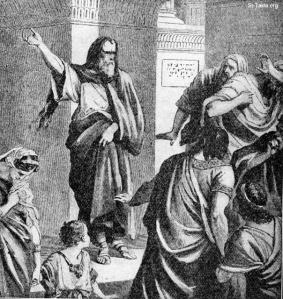
Notice where God told Jeremiah to preach this sermon: in the gate of the temple. Think about it. These people are supposedly coming in to worship God, and here God is (speaking through Jeremiah), at the entrance to His own house, speaking directly to them about what He wants from them. Do they listen? Obey? No, they walk blithely past Him into His house and do things their way.
www-St-Takla-org--jeremiah-warns-the-people-of-judah

Why? Because they didn’t want an actual relationship with God. They wanted to wallow in the sin of their idol worship while still getting all the benefits (agricultural blessings, protection from enemies, etc.) they thought God would continue to provide if they went through the outward motions of sacrifices and going to the temple. This blending of idolatry with the worship of God is called syncretism

Syncretism is alive and well today. There have been churches that have held Christian-Islamic worship services, churches that teach yoga (a Hindu worship practice), even when we join ourselves or our churches to “Christian” churches whose doctrines aren’t biblical, we are guilty of syncretism.

Let’s not forget what Jesus told Satan in the wilderness when Satan tempted Jesus to worship him:

You shall worship the Lord your God
and him only shall you serve.’ (Matt 4)

After all Jesus did for us to save us from our sin, it is the ultimate understatement to say that He ALONE is worthy of all our worship, love, and devotion.

7:2-10 (2 Timothy 4:3-4)
“Amend your ways and your deeds, and I will let you dwell in this place.” That’s it. That’s all there was to it. It might not have been what they wanted to do, but it wasn’t impossible, and it was what God desired.

God urged the people not to trust in the empty words and false beliefs they wanted to believe and had convinced themselves were true–namely, that since the “temple of the Lord” was in their midst and they were still attending and making sacrifices, God’s favor still rested on them– but to believe and act on what HE was actually telling them: repent and return.

God exhorts us to do the same thing. We are not to be people who “will not endure sound teaching, but having itching ears they will accumulate for themselves teachers to suit their own passions, and will turn away from listening to the truth and wander off into myths.” (2 Tim.) We are to believe and practice what His word says -not what we desire to be true- even if it’s difficult.

11-20
Ever since God had brought Israel out of Egypt nearly a thousand years earlier, He had been warning them of the consequences of idolatry. Here the time of His patience is almost at a close, and He will soon be carrying out those consequences. God even tells Jeremiah not to pray for the people. He knows they will not repent.

In a similar way, throughout our lifetimes, God persistently calls to each of us sinners to come to Him in repentance and faith in Christ. He graciously and patiently calls to us again and again, but, if, by the time we die, we have refused to surrender to Him, He will execute judgment on us.

How much better to turn to Christ early and experience the sweet fellowship that comes from being forgiven for our sin and reconciled to God. Jeremiah saw this and wanted this for his people, but they would not have it. We see in chapter 9 how grieved he was about this.

21-26
“Add your burnt offerings to your sacrifices, and eat the flesh”- The burnt offerings were completely consumed by fire. Parts of the sacrifices (or peace offerings) were eaten by the one offering them. What God is basically saying here is, “Take what you would have offered as a burnt offering and turn it into a sacrifice and go ahead and eat both of them. You might as well just eat them, because I’m not going to accept them.”

God again takes the people back to the Exodus and reminds them that when He initially brought them out, and all during their wilderness wanderings, there was no sacrificial system. All He asked of them was to obey Him and walk in His ways. That was His priority. That was what came first: their love for Him and obedience to Him. The sacrificial system came later. Sacrifices were to be a natural outward expression of the people’s inward love for God.

It is no different for Christians. God is not interested in mere outward behavior, service, or religious practices. He wants our hearts. Our outward actions are to reflect the love for Christ that is already present in our hearts.

27-28
Unfortunately, even though Jeremiah faithfully preached God’s word, the people would not listen. Did this mean Jeremiah was a failure or that God was disappointed in him? No. He did exactly what God told him to do, and that’s what God judges His servants by, not the results.

We will experience the same thing at some point if we faithfully preach the gospel to people and stand on God’s word. People will reject the gospel, preferring to live in sin. People who call themselves Christians will reject the truth of God’s word no matter how clear it is or how nicely we present it to them. Does this mean we are failures or that God is disappointed in us? No. God considers us faithful if we believe, obey, and share the gospel. The results are up to Him.


Pop Theology, Prayer

Pop Theology ~ The Bottle

Pop Theology- the bottle


Dear Pop Theology-

I keep seeing Christian pages post this video, but I was wondering, does this bottle prayer thing match up with what the Bible says?

Signed,

Praying for an Answer

Well, what about it, Pop? Could you give us any reasons why this might not be a biblical way to learn about prayer?

Spurgeon dawg

Lemme lay it down for ya homies:

1. No one has the right to put words in God’s mouth. When you hear someone say, “God says _____,” the only thing that blank can safely be filled in with is Scripture. Otherwise, you’re turning God into a ventriloquist’s dummy and making Him say what you want Him to say. (Deuteronomy 18:21-22, Ezekiel 22:28, Jeremiah 14:13-16).

The truth is, things DON’T always become clear to us on this side of Heaven. Talk to a woman whose husband has abandoned her, or someone in chronic pain, or a parent who has lost a child in an accident. There are things in this life that are painful, dark, and confusing, and no where in Scripture does it say that God owes us an explanation for them or that things will “become clear.”

Did you notice the gentleman in the video didn’t use a single Bible verse to back up his “God says____,” or “Things will become clear,”  statements? That’s because he can’t. Scripture doesn’t teach this. It’s just his opinion.

What Scripture DOES promise Christians is that, even in the darkest times, Christ will never leave us nor forsake us (Hebrews 13:5), that God can use even the worst difficulties for the good (Romans 8:28), that even our Master learned obedience through suffering (Hebrews 5:8), and that when we trust God (regardless of whether or not we get what we want), He will keep us in perfect peace (Isaiah 26:3).

2. Where does Scripture say that “in order for Him to really begin to do the work that YOU want done” you have to “take the limitations off”? It doesn’t. Prayer isn’t about us maneuvering and manipulating God to get Him to do what we want Him to do. Prayer is about US getting on the same page with GOD’S agenda. Us submitting to His will. Us trusting Him regardless of the outcome. It’s not about the work that we have to do (and no matter how holy it might sound, all the “ya gotta…ya gotta…ya gotta” stuff in this video is work) to force God’s hand. The gentleman in the video makes it sound like everything rests on YOU and that if you’ll just pray hard enough, long enough, and with enough faith, everything will work out the way you want it to.

And if things don’t work out, guess whose fault it is? Yours. Because you didn’t have enough faith, or you didn’t pray long enough, or whatever. That’s a Word of Faith false teaching. It is not what the Bible teaches.

The Bible says that God is in the Heavens and does whatever He pleases (Psalm 115:3), that His ways and thoughts are higher than ours, not the same as ours (Isaiah 55:8-9), and that when we pray, we don’t have to feel anxious. Prayer is to produce peace (Philippians 4:6-7), not worry over whether we’ve said the right things or said them long enough (Matthew 6:7-8). Even our perfect, sinless, holy Jesus, when He prayed in Gethsemane before going to the cross, said “NOT My will, but Yours, be done.” (Matthew 26:39).

3. Watch this video again, paying attention to HOW the liquid in the bottle becomes clear. Who, in this analogy, initiates the action? You. Who does all the work? You. (You take off the lid, you put the bottle in the sink, you turn on the water, you make sure the bottle is in the right place, you readjust the bottle to make sure you’re getting the result you want, you decide when it’s clear enough.) So who gets the glory if everything works out the way you want it to? You.

God says He will not share His glory with another (Isaiah 48:11), and that HE is the one who wills and works for His good pleasure (Philippians 2:13).

Ladies, if you want to know how to pray, a video like this featuring a guy who dares to speak for God outside of, and in conflict with, Scripture and doesn’t offer a single Bible verse to teach you about one of the most important aspects of the Christian life is not the way to go.

Don’t believe somebody just because what he says makes you feel good and he has a cool visual aid. Instead, if we want to know how to pray, we need to go straight to the horse’s mouth. That’s what the disciples did when they wanted to know how to pray (Luke 11:1-4), and here’s what Jesus told them in Matthew 6:7-13:

And when you pray, do not heap up empty phrases as the Gentiles do, for they think that they will be heard for their many words. Do not be like them, for your Father knows what you need before you ask him. Pray then like this:

“Our Father in heaven,
hallowed be your name.
Your kingdom come,
your will be done,
on earth as it is in heaven.
Give us this day our daily bread,
and forgive us our debts,
as we also have forgiven our debtors.
And lead us not into temptation, but deliver us from evil.

If that was good enough for Jesus, it should be good enough for us. Ya feel me?

Prayerfully,

Pop