Wednesday's Word

Wednesday’s Word ~ Esther 4

esther 4 14

Esther 4

When Mordecai learned all that had been done, Mordecai tore his clothes and put on sackcloth and ashes, and went out into the midst of the city, and he cried out with a loud and bitter cry. He went up to the entrance of the king’s gate, for no one was allowed to enter the king’s gate clothed in sackcloth. And in every province, wherever the king’s command and his decree reached, there was great mourning among the Jews, with fasting and weeping and lamenting, and many of them lay in sackcloth and ashes.

When Esther’s young women and her eunuchs came and told her, the queen was deeply distressed. She sent garments to clothe Mordecai, so that he might take off his sackcloth, but he would not accept them. Then Esther called for Hathach, one of the king’s eunuchs, who had been appointed to attend her, and ordered him to go to Mordecai to learn what this was and why it was. Hathach went out to Mordecai in the open square of the city in front of the king’s gate, and Mordecai told him all that had happened to him, and the exact sum of money that Haman had promised to pay into the king’s treasuries for the destruction of the Jews.Mordecai also gave him a copy of the written decree issued in Susa for their destruction, that he might show it to Esther and explain it to her and command her to go to the king to beg his favor and plead with him on behalf of her people. And Hathach went and told Esther what Mordecai had said. 10 Then Esther spoke to Hathach and commanded him to go to Mordecai and say, 11 “All the king’s servants and the people of the king’s provinces know that if any man or woman goes to the king inside the inner court without being called, there is but one law—to be put to death, except the one to whom the king holds out the golden scepter so that he may live. But as for me, I have not been called to come in to the king these thirty days.”

12 And they told Mordecai what Esther had said. 13 Then Mordecai told them to reply to Esther, “Do not think to yourself that in the king’s palace you will escape any more than all the other Jews. 14 For if you keep silent at this time, relief and deliverance will rise for the Jews from another place, but you and your father’s house will perish. And who knows whether you have not come to the kingdom for such a time as this?” 15 Then Esther told them to reply to Mordecai, 16 “Go, gather all the Jews to be found in Susa, and hold a fast on my behalf, and do not eat or drink for three days, night or day. I and my young women will also fast as you do. Then I will go to the king, though it is against the law, and if I perish, I perish.” 17 Mordecai then went away and did everything as Esther had ordered him.


The Holy Bible, English Standard Version Copyright © 2001 by Crossway Bibles, a publishing ministry of Good News Publishers.


Questions to Consider:

1. The book of Esther is short, and chapter 4 can best be understood in its context in the middle of the story. I highly recommend reading the whole book, starting in chapter 1. Who are the main characters in this story? What are their backgrounds? What causes them to act the way they do?

2. What was the king’s decree (7-8)? Why would the decree have been cause for the Jews’ “fasting, weeping, and lamenting” (3)?

3. Give two reasons why it would have been dangerous for Esther to go to the king and plead the cause of the Jews (8-11). Read verses 12-14 through the lenses of a loving parent like Mordecai. He was asking his “daughter” to do what was godly, even at the risk of her life. Do you raise your children to be godly, even at risk of their lives?

4. In what ways is the story of Esther a type and shadow of Christ’s redemption of His people? Whom do King Ahasuerus, Esther, Haman, and the Jews represent? The three days of fasting?

5. God will probably never call you to save a nation as He did with Esther, but He has placed each one of us right where we are “for such a time as this,” because all of us have people in our lives who need to hear about Jesus, the Savior who steps between the wrath of God and the scheming of Satan and laid His life on the line to save His people from their sin. Think of some people and situations in your life where God has placed you “for such a time as this” to share the gospel, speak the truth of God’s word, or minister His love.
Wednesday's Word

Wednesday’s Word ~ 2 Thessalonians 3

2 Thess 3 5

2 Thessalonians 3

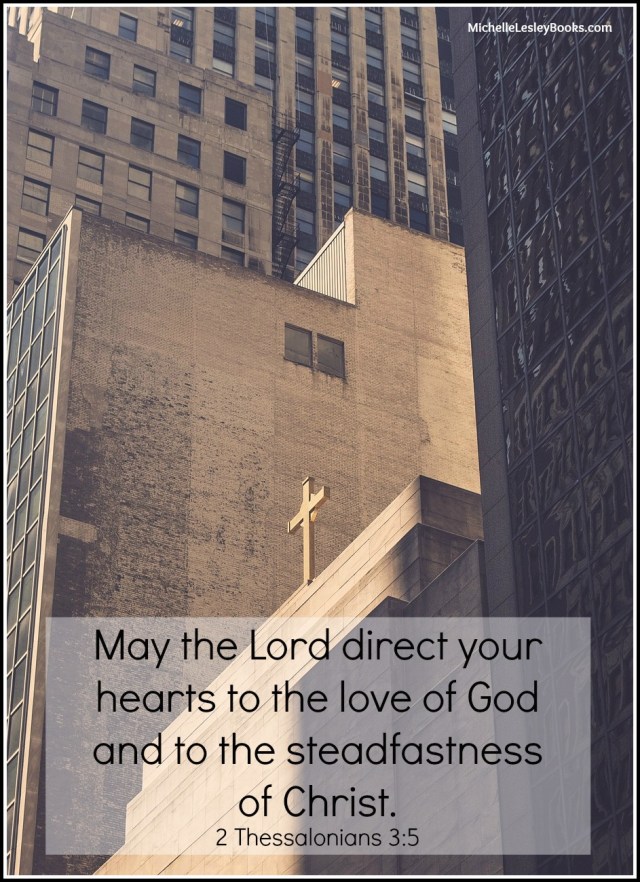
Finally, brothers, pray for us, that the word of the Lord may speed ahead and be honored, as happened among you, and that we may be delivered from wicked and evil men. For not all have faith. But the Lord is faithful. He will establish you and guard you against the evil one. And we have confidence in the Lord about you, that you are doing and will do the things that we command. May the Lord direct your hearts to the love of God and to the steadfastness of Christ.

Now we command you, brothers, in the name of our Lord Jesus Christ, that you keep away from any brother who is walking in idleness and not in accord with the tradition that you received from us. For you yourselves know how you ought to imitate us, because we were not idle when we were with you, nor did we eat anyone’s bread without paying for it, but with toil and labor we worked night and day, that we might not be a burden to any of you. It was not because we do not have that right, but to give you in ourselves an example to imitate. 10 For even when we were with you, we would give you this command: If anyone is not willing to work, let him not eat. 11 For we hear that some among you walk in idleness, not busy at work, but busybodies. 12 Now such persons we command and encourage in the Lord Jesus Christ to do their work quietly and to earn their own living.

13 As for you, brothers, do not grow weary in doing good. 14 If anyone does not obey what we say in this letter, take note of that person, and have nothing to do with him, that he may be ashamed. 15 Do not regard him as an enemy, but warn him as a brother.

16 Now may the Lord of peace himself give you peace at all times in every way. The Lord be with you all.

17 I, Paul, write this greeting with my own hand. This is the sign of genuineness in every letter of mine; it is the way I write. 18 The grace of our Lord Jesus Christ be with you all.


The Holy Bible, English Standard Version Copyright © 2001 by Crossway Bibles, a publishing ministry of Good News Publishers.


Questions to Consider:

1. What three things does Paul ask the members of the church at Thessalonica to pray for his team? (1-2)

2. Do the first five verses of this chapter seem to indicate that the Thessalonian church is generally healthy, obedient to the Word, and headed in the right direction, or unhealthy and declining? Which words and phrases lead you to think this? Could the same be said of your church?

3. What topic is Paul dealing with in verses 6-12? Which word, repeated three times (6, 7, 11) is a key word for this section? What does it mean? What is God’s will for Christians with regard to work versus idleness? How could this theology of work affect the way you do your job, run your business, or vote on economic issues?

4. Some pastors are bi-vocational. They have a regular job during the week and a part time pastorate. Do verses 7-9 require pastors to be bi-vocational? Why (9) does Paul say that he and his team worked in addition to their pastoral duties?

5. What are Paul’s instructions (14-15) regarding disobedient church members? How do these instructions compare with other New Testament teaching about church discipline? What is the ultimate goal of church discipline?

Wednesday's Word

Wednesday’s Word ~ Ezra 3

For further study on the book of Ezra, try my study, Ezra.

ezra 3 11

Ezra 3

When the seventh month came, and the children of Israel were in the towns, the people gathered as one man to Jerusalem. Then arose Jeshua the son of Jozadak, with his fellow priests, and Zerubbabel the son of Shealtiel with his kinsmen, and they built the altar of the God of Israel, to offer burnt offerings on it, as it is written in the Law of Moses the man of God. They set the altar in its place, for fear was on them because of the peoples of the lands, and they offered burnt offerings on it to the Lord, burnt offerings morning and evening. And they kept the Feast of Booths, as it is written, and offered the daily burnt offerings by number according to the rule, as each day required, and after that the regular burnt offerings, the offerings at the new moon and at all the appointed feasts of the Lord, and the offerings of everyone who made a freewill offering to the Lord. From the first day of the seventh month they began to offer burnt offerings to the Lord. But the foundation of the temple of the Lord was not yet laid. So they gave money to the masons and the carpenters, and food, drink, and oil to the Sidonians and the Tyrians to bring cedar trees from Lebanon to the sea, to Joppa, according to the grant that they had from Cyrus king of Persia.

Now in the second year after their coming to the house of God at Jerusalem, in the second month, Zerubbabel the son of Shealtiel and Jeshua the son of Jozadak made a beginning, together with the rest of their kinsmen, the priests and the Levites and all who had come to Jerusalem from the captivity. They appointed the Levites, from twenty years old and upward, to supervise the work of the house of the Lord.And Jeshua with his sons and his brothers, and Kadmiel and his sons, the sons of Judah, together supervised the workmen in the house of God, along with the sons of Henadad and the Levites, their sons and brothers.

10 And when the builders laid the foundation of the temple of the Lord, the priests in their vestments came forward with trumpets, and the Levites, the sons of Asaph, with cymbals, to praise the Lord, according to the directions of David king of Israel. 11 And they sang responsively, praising and giving thanks to the Lord,

“For he is good,
    for his steadfast love endures forever toward Israel.”

And all the people shouted with a great shout when they praised the Lord, because the foundation of the house of the Lord was laid. 12 But many of the priests and Levites and heads of fathers’ houses, old men who had seen the first house, wept with a loud voice when they saw the foundation of this house being laid, though many shouted aloud for joy, 13 so that the people could not distinguish the sound of the joyful shout from the sound of the people’s weeping, for the people shouted with a great shout, and the sound was heard far away.


The Holy Bible, English Standard Version Copyright © 2001 by Crossway Bibles, a publishing ministry of Good News Publishers.


Questions to Consider:

1. The book of Ezra deals with the second wave (out of three) of Israelites returning from exile in Persia after the destruction of Jerusalem. Why was it important to them (3) to set up the altar? Why did they begin keeping the feasts and offering sacrifices before the temple was rebuilt?

2. What was the Feast of Booths (4), and which event in Israel’s history did it commemorate? What are some similarities between the Exodus and Israel’s recent return from exile which might have made this celebration of the Feast of Booths especially meaningful for the people? Which attributes of God are on display in both the Exodus and the return from exile?

3. Why would it have been important for the Levites (8) to supervise the work on the temple? How does this show the people’s reverence for God’s house and their desire to do things “decently and in order“?

4. Try to put yourself in the shoes of the average Israelite in verses 10-11. Think about what your experience in exile might have been like and how you might feel finally back, free, in your homeland. Now, the temple is at last being rebuilt so you can worship God – maybe for the first time in your life – in the place and the way He intended. What emotions might you be experiencing? What sorts of things might you be praising God for? Take some time to thank God for some specific things about your own church.

5. For what reasons might the old men have been weeping? (12-13) How could both tears and joy be proper expressions of worship in this passage and in worship today? What gives you joy in worship? What brings you to tears when you worship?

Doctrinally Sound Teachers

10 More Biblically Sound Blogs and Podcasts by Christian Women

10 blogs

This article has been updated and moved. You can now find it at:

Doctrinally Sound Christian Women to Follow – 2

1 John Bible Study

Am I Really Saved?: A First John Check Up ~ Lesson 9: Wrap Up

Am I Really Saved? A First John Check Up
Lesson 9: Wrap Up

Previous Lessons: 1, 2, 3, 4, 5, 6, 7, 8

Examine yourselves, to see whether you are in the faith. Test yourselves. Or do you not realize this about yourselves, that Jesus Christ is in you?—unless indeed you fail to meet the test!
2 Corinthians 13:5

It’s been quite a journey through the book of 1 John! I hope you have taken the time to honestly examine your heart and your behavior against Scripture to discover whether or not you are truly in Christ.

I want to be sure that I stress once again that the checkpoints we’ve covered in the previous lessons are not things to strive to accomplish in order to earn salvation or to work your way onto God’s good side. You can’t do that. It’s impossible. Salvation is by grace through faith in Christ alone. All of the things we have looked at are the naturally occurring fruit of a person who has already been born again. (Remember our little oak tree/apple tree illustration from lesson 3?)

If you think you might be unsaved or a false convert (someone who thought she was saved, or claimed to be saved, but actually isn’t), you can know Christ as Savior today. Confess to God that you are a sinner, and turn away from your sin. Ask Christ to forgive you for your sin. Believe in Christ’s death, burial, and resurrection as payment for your sin so that you would not have to pay for it yourself with an eternity in Hell, and ask God to save you. You might wish to watch this video and the “Good News” video in the sidebar to your left. And, of course, you’re welcome to contact me with any questions.

I also want to be sure to stress to those who genuinely are born again that you are not going to be perfect in any of these areas this side of Heaven. And that doesn’t mean you aren’t saved. John’s intent in writing this letter was not for you to freak out over the sin you committed yesterday or the fact that your progress in one area seems to be slower than in other areas. He wants you to look back over the direction of your life since you were saved and see if you’re generally growing in holiness and towards more Christlikeness.

I’ve mentioned before that, when I was a kid, a popular question for youth leaders to ask was, “If you were arrested for being a Christian, would there be enough evidence to convict you?” I think that’s a good schematic to use for 1 John. As you come to the conclusion of the study, realize that you aren’t “convicted” on the basis of one or two isolated checkpoints. Rather, ask yourself, does the preponderance of the “evidence” gleaned from the checkpoints point me, beyond a shadow of a doubt, to a verdict of “saved” or a verdict of “not saved”? How would you vote if you were on the jury that was deciding the case of “Am I Really Saved?”

Here, for your convenience, are the 19 checkpoints we’ve looked at in the previous lessons:

Checkpoint 1: Do I walk in the light or the darkness? (1 John 1:6-7)

Checkpoint 2: Do I confess or deny my sin? (1 John 1:8-10)

Checkpoint 3: Do I keep God’s commands? (1 John 2:3-6)

Checkpoint 4: Do I hate others? (1 John 2:9-11)

Checkpoint 5: Do I love worldliness? (1 John 2:15-17)

Checkpoint 6: Do I want to be faithful to a doctrinally sound church? (1 John 2:18-20)

Checkpoint 7: Do I believe in the Jesus of Scripture? (1 John 2:21-25)

Checkpoint 8: Do I practice righteousness? (1 John 2:29)

Checkpoint 9: Do I make a practice of sinning or righteousness? (1 John 3:4-10)

Checkpoint 10: Do I love my brothers? (1 John 3:10-15)

Checkpoint 11: Am I bearing the fruit of love? (1 John 3:18-22)

Checkpoint 12: Do I keep the ultimate commandment? (1 John 3:23-24)

Checkpoint 13: Do I follow false teachers? (1 John 4:1-6)

Checkpoint 14: Is my motivation for love Christocentric? (1 John 4:7-12)

Checkpoint 15: Do my words and actions confess Christ? (1 John 4:13-15)

Checkpoint 16: Am I afraid of God’s judgment? (1 John 4:16-21)

Checkpoint 17: Do my love for God and my love for His people testify to each other? (1 John 5:1-3)

Checkpoint 18: Have I “overcome the world”? (1 John 5:4-5)

Checkpoint 19: Do I have God’s testimony of Christ and eternal life in my heart? (1 John 5:6-12)

It’s my prayer that, as you walk away from this study today, you will do so in full assurance and joy that you do, indeed, know Christ as Savior. Remember, that’s the whole point of the book of 1 John:

I write these things to you who believe in the name of the Son of God that you may know that you have eternal life. 1 John 5:13

Additional Resources:

The Character of Genuine Saving Faith by John MacArthur

How Do I Know If I Am Really Saved? by Costi Hinn

Assurance: “How Can I Know I’m Really Saved?” at Things Above Us