Throughout this study we will be looking at various passages of Scripture rather than working our way through a book of the Bible verse by verse. Because of that, we will need to be extra vigilant to rightly handle these passages in context. I will always attempt to provide the context you need for understanding these passages correctly, but if you need more clarity please feel free to read as much of the surrounding text as you need to – even the whole book, if necessary – in order to properly understand the passage presented.
1. Do you notice the similarities between 2 Peter 2 and Jude? Click here and read the second paragraph under “Author and Date”. What might be the reason for some of the similarities?
Make a two column chart. Examine Jude and 2 Peter 2 side by side, verse by verse. (You may want to do this with two Bibles, two devices, or a split screen on your Bible app or device.) List the verses or phrases that are strikingly similar in wording and concept. What does each mean? Why might God have emphasized a particular verse or phrase by placing it in Scripture twice?
2. To what general group of people are Jude’s (v.1) and Peter’s (1:1) letters addressed? What is Jude’s (3) appeal to the church? Why is he urging them to contend for the faith (Jude 4, 2 Peter 2:1-3)? What are some of the things that happen to a church when false teachers gain a foothold?
Do these epistles apply to you as a Christian, and to the church, today? Why? Have you (or your church) ever been urged by a pastor or teacher to contend for the faith? Why do you think that admonition is so lacking in the church and from Christian teachers today?
2. How does Jude (4a) describe false teachers entering the church? How does Peter (1) say false teachers will bring in destructive heresies? Compare this characterization to the way these passages say false teachers infiltrate the church and the home. What does this characteristic of sneakiness tell you about false teachers? Why aren’t they just open and honest with Christians and the church about what they want to teach?
3. What do Jude (4, 13) and Peter (3, 17) say is the final destiny of false teachers?
Examine 2 Peter 2:4-10. Who are the godly people mentioned in this passage and how did God deal with them? Who are the ungodly who are listed, and how did God deal with each of them? Do these ungodly people include false teachers (10, Jude 8)?
What does this tell you about how God views false teachers? How He views and protects His faithful children?
4. What are Jude (8-9) and Peter (10b-11) telling us about angels, blasphemy and the glorious ones? How does this reflect the pride and arrogance of false teachers?
What are Jude (10) and Peter (12) telling us about the ignorance of false teachers? Think about how the indwelling Holy Spirit illumines Scripture to the Christian. What might be one reason false teachers do not understand Scripture or how to properly handle it?
What is the significance of Jude’s (11) comparison of false teachers to Cain? Of Jude’s (11) and Peter’s (15-16) comparison to Balaam?
Consider the imagery in Jude’s (12-13) and Peter’s (17) comparative metaphors to false teachers. What are the characteristics of each metaphor mentioned, and how do they apply to false teachers?
5. In your own words, write a brief summary of the character of false teachers according to Peter and Jude. Do you know of any pastors or teachers who could be described this way? Who, and why?
6. What does Jude (17-23) say about how we should respond to the types of teachers he and Peter are describing?
Homework
If you’d like a little extra study on these passages, check out:
Today’s Scripture passages are embedded in the body of the study. Please click the links in each question.
Questions to Consider
Throughout this study we will be looking at various passages of Scripture rather than working our way through a book of the Bible verse by verse. Because of that, we will need to be extra vigilant to rightly handle these passages in context. I will always attempt to provide the context you need for understanding these passages correctly, but if you need more clarity please feel free to read as much of the surrounding text as you need to – even the whole book, if necessary – in order to properly understand the passage presented.
1. Have you ever studied the book of Judges? If you have, you know this book has a very clear theme which can be found in Judges 17:6b and 21:25b. What is that theme? What does it mean to do what is right in your own eyes? Is believing what is right in your own eyes part of doing what is right in your own eyes? How and why? As Christians, how are we supposed to live and believe? What are some ways Christians (or those who claim to be Christians) today do and believe what is right in their own eyes rather than doing and believing what is right in God’s eyes?
How do we know the difference between what is right in our own eyes and what is right in God’s eyes? What is our standard for answering that question? Our authority for life and doctrine? If this is how we’re to live and believe – submitting to the truth of God’s written Word as our authority in life and our measuring stick for evaluating right actions from wrong actions, right beliefs from wrong beliefs – is it biblical to say that this is also how teachers are to teach?
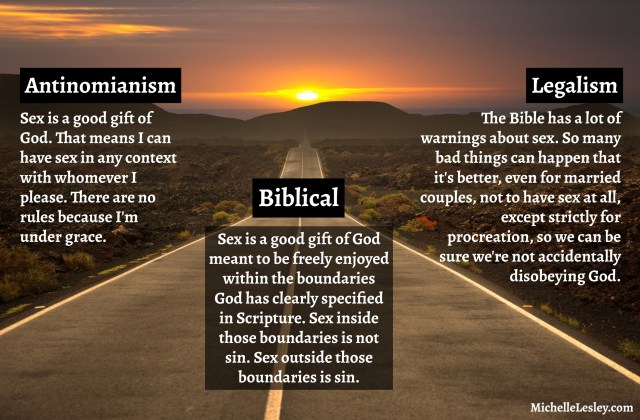
2. When you get right down to the bottom line, there are two basic ways of doing and believing what’s right in your own eyes – failing to rise to the standard of God’s Word, and going above and beyond the standard of God’s Word. Not being as restrictive as God’s Word is, or being more restrictive than God’s Word is. Too much “grace” or too much “law”.
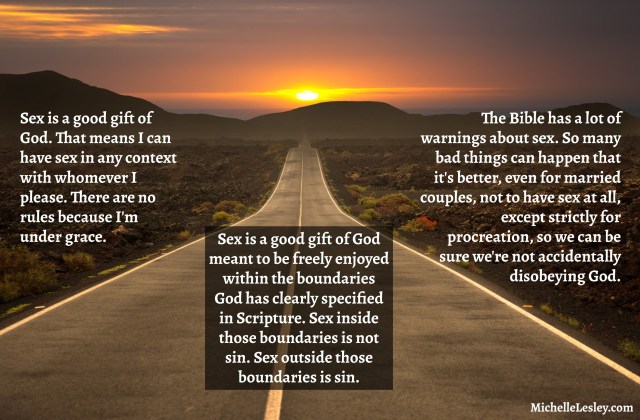
Consider this concept as applied to sex, and what the Bible says about it:
Which side of the road is the “too much ‘grace'” side? “Too much ‘law'”? Which view is the biblical view? (Notice that the biblical view is a “middle of the road” balance between the extremes of man-made “law” and “grace”. If you wander off the road you’re wandering off into darkness. The biblical view is the only one which leads to the sun (Son).)
The theological term for “too much ‘grace'” is antinomianism (also sometimes called “license” – as in, “a license to sin” – or “licentiousness”). The theological term for “too much ‘law'” is legalism (showcased in the Pharisees of Jesus’ day).
3. Antinomianism often fleshes itself out today as:
“I’m saved and all my sins – past, present, and future – are forgiven, so why not sin as much as I want?”
An “It’s no big deal!” approach to sin
The idea that the sin in question is actually biblical (or loving / loving your neighbor, tolerant, compassionate, “what ‘Jesus’ would do”)
Obeying what the Bible actually is says is legalism (“Pharisaism”).
What are some specific examples of antinomianism that you’ve observed in evangelicalism, in your denomination or church, in your own heart and life?
5. Legalism is most often seen today in churches or individuals who make issues of preference, conscience, or Christian liberty – which are neither prescribed nor prohibited in rightly handled Scripture – into “law”. They consider these “laws” equal to Scripture and believe that anyone who violates them is in sin. A few (generalized) examples:
Christians should not observe Christmas (or have a Christmas tree) or Easter
Christians must observe Old Testament feasts and festivals
What does the Bible say about legalism? What are some specific examples of legalism that you’ve observed in evangelicalism, in your denomination or church, in your own heart and life?
Would you say that antinomianism or legalism is the false doctrine most people tend towards today…
…in evangelicalism in general?
…in your denomination and / or your church?
…in your own heart?
6. If you believe falsely about God, sin, the gospel, etc., what impact will that have on your life and your worship?
Let’s look at some examples of unbiblical worship in Scripture. In each of these instances:
What was the false belief or doctrine that led these people to worship unbiblically?
Was this an expression of legalism or antinomianism?
What was God’s response to their false doctrine / false worship? How does God’s response demonstrate how seriously He takes false doctrine / false worship?
7. Since God takes false doctrine / false worship so seriously, what is His posture toward those who teach false doctrine?
8. Some Christians believe that only aberrant soteriology – a false gospel, unbiblical teaching about how to be saved – is false doctrine. Consider these Scriptures. Is this idea biblically accurate?
9. What is false doctrine? Carefully and biblically define this term in your own words.
Homework
Today’s study includes passages from Judges and Ezekiel. You may wish to peruse the relevant parts of my Bible studies on Judges and Ezekiel. How is the state of the church today similar to the state of God’s people and the temple in Judges and Ezekiel?
Throughout this study we will be looking at various passages of Scripture rather than working our way through a book of the Bible verse by verse. Because of that, we will need to be extra vigilant to rightly handle these passages in context. I will always attempt to provide the context you need for understanding these passages correctly, but if you need more clarity please feel free to read as much of the surrounding text as you need to – even the whole book, if necessary – in order to properly understand the passage presented.
1. Quickly read or skim Job 1:1-34:37, especially chapters 32-33, so you’ll have the major points of the story line fresh in your mind. Summarize the story of Job to this point in your own words in a few sentences.
2. Why does Elihu feel the need to speak his piece here (ch. 32-34)? What was the false doctrine with which Job’s three friends were counseling him? What was Job’s position in response to them (32:2)?
Meditate on Elihu’s words in 34:2-4. What does each phrase of this passage teach us about discernment? How does the passage as a whole explain discernment? In your own words, what is this passage saying to us as 21st century Christians? Be sure to explore the concepts of wisdom (2), “testing words,” (3) and the corporate nature, unity, and fellowship (4) of discernment.
3. Carefully examine the two Deuteronomy passages. Which genre of biblical literature is the book of Deuteronomy (law, history, wisdom, poetry, narrative, epistles, or prophecy/apocalyptic)? Generally speaking, were the laws of Deuteronomy laws that governed the Old Testament nation of Israel or New Testament Christians and the church?
Do these two passages in Deuteronomy center on our (vertical) relationship with God, our (horizontal) interpersonal relationships (with friends, family, neighbors, etc.), or maintaining an orderly society (similar to our modern day traffic, liability, tax, etc. laws)?
Which parts of these laws no longer apply to New Testament Christians? (13:5, 18:20) Why? Carefully explain the biblical principles underlying the remainder of these passages:
What is God telling His people about our relationship with Him?
What is God telling us about how He relates to His people?
Why is He telling us the things in this passage?
What do these passages teach us about the nature, character, and attributes of God, and how He desires to be worshiped? Why is it vital that our worship, beliefs, and doctrine are based on truth?
What were the two ways God’s people in the Old Testament could “test the words” of these prophets “as the palate tastes food”? (13:2-3a, 18:21-22) How does this relate to the fact that God used miraculous signs and wonders to authenticate and endorse the message of His true prophets (e.g. Moses, Elijah), Jesus, and the apostles? In what ways do false teachers of today say, “Let us go after other gods.”?
How many times could a prophet prophesy falsely before the death penalty was to be imposed? (Hint: Notice the words “sign,” “wonder,” and “word” in 13:1-2 and 18:20. Are those words singular or plural?) What does this, and the fact that false prophecy/teaching was a capital offense, tell you about how seriously God takes false prophecy/teaching? Does the absence of the death penalty for false teachers in the New Testament indicate that God has changed His mind, “gone soft” on false teaching, or no longer takes it seriously?
Explain what “God is testing you” means in 13:3b. Does God test us because He doesn’t know our hearts and needs to find out whether or not we’ll pass the test?
4. Did you notice that, as we begin to address the concepts of discernment, false doctrine, and false teachers – for Christians – that we’ve started in the Old Testament rather than the New Testament? Many theologians believe the events of the book of Job took place chronologically some time between the tower of Babel and Abraham. Can you think of any instances of false teachers and false doctrine that took place before Genesis 11? What does all of this tell you about the longevity of false doctrine and false teaching?
5. Examine the Acts 17 passage. To whom did Paul and Silas first go with their message – God’s people or the pagans? (10) Upon hearing Paul and Silas’ message, what was the Berean Jews’ initial response? (11) Their subsequent action? (11) The result of their action? (12) Which came first, believing the teachers’ message or examining the teachers’ message against Scripture? Why is this order important? How can we imitate the Bereans’ response>>action>>result when we encounter a new teacher today?
What word does God use in verse 11 to describe these Jews due to their discernment? Many professing Christians today characterize discernment and discerning Christians as “critical,” “negative,” “devoid of love,” “divisive,” and so on. How does God characterize discernment and discerning Christians?
Homework
Consider Job’s story. How can suffering make us vulnerable to believing false doctrine, and why is it especially important that we believe sound doctrine during times of suffering? Do you know a sister in Christ who is currently in a season of suffering? How can you help her avoid being deceived by false teachers and false doctrine? Pray for her, and how you might encourage her with the truth of God’s Word, this week.
How do each of today’s passages fit with the definition of discernment in the image at the beginning of this lesson?
Suggested Memory Verse
(Every week of our study, you’ll see a suggested memory verse like the one above. You are welcome to grab the memory verse pic to use as your screensaver or wallpaper on your phone or computer, print it out and stick it somewhere you’ll see it frequently, or use it in any other way you wish to help you memorize the verse.)
The Lord’s richest blessings to you, readers. It is an honor and a joy to serve you in Christ. Welcome to all the newbies and to you seasoned veterans of the blog.
Because some of y’all are new, you aren’t yet aware of all of the resources here to help you. Or maybe you’ve been around a while and haven’t noticed something that might be helpful. Let’s remedy that!
Second, be sure to familiarize yourself with all of the tabs in the blue menu bar at the top of the page. That’s where I keep the info I’m most frequently asked about.
Third, there’s a search bar at the bottom of every page (and one in the blue menu bar at the top of every page) which might help you find what you need.
And finally, let me get you new readers some answers to the questions several of you have asked. Some of you long time friends may have missed these along the way, so I hope they’ll be helpful to you, too!
Do you do have study Bibles you recommend?
I’m looking for a new study Bible. I looked at the ESV John McArthur Study Bible, but I read some alarming comments in its reviews on Amazon that it’s missing Scripture verses from Matthew and a few other books. I’m curious if missing verses are typical of this translation.
The accusations of verses being left out of the ESV (or any other modern translation) are most likely coming from King James Onlyists. Since 1611, when the King James Version of the Bible was published, thousands more – and much older – manuscripts of Scripture have been discovered, allowing modern translators to be far more accurate about which material is actual Scripture, and which might be something like a clarifying note or commentary added later by a scribe, than translators of the KJV were 400 years ago.
It’s not that modern translators of the ESV (or any other accurate and reliable modern translation) have “left out” verses, it’s that the KJV translators, doing the best they could with the manuscripts they had at the time, inadvertently added in “verses” they shouldn’t have.
Missing Verses in the Bible – Part 1Part 2 by Gabriel Hughes
I am looking for a resource to introduce a completely unchurched neighbor to the Bible and the gospel. She is tender and open.
I’m so glad you want to share with your neighbor. What a good example you are to all of us!
I would recommend working through the verses and materials at the What Must I Do to Be Saved? tab (in the blue menu bar at the top of this page) with her.
You might also want to check through the studies and materials in my Bible studies tab (in the blue menu bar at the top of this page) to see what might be helpful.
I was hoping to see where you stood on predestination.
That would be in my Statement of Faith tab in the blue menu bar at the top of this page.
Is the Catholic religion false? Are they going to heaven?
This is such a painful issue for all of us who have Catholic loved ones. If that’s the case for you, dear reader, I’m so sorry I can’t reassure you that your Catholic loved ones are indeed saved and on their way to Heaven.
Roman Catholicism is an anti-gospel, unbiblical, heretical non-Christian religion that has sent millions of souls to Hell by teaching false doctrine. It is one of the accursed “another gospels” of Galatians 1:6-9. You no more belong at a Catholic “church” than at an altar of Baal or in the temple of Artemis.
Catholicism teaches numerous heresies, but perhaps the most grievous is that it anathematizes salvation by grace alone through faith alone. In other words, Catholic doctrine says if you believe this…
For by grace you have been saved through faith. And this is not your own doing; it is the gift of God, not a result of works, so that no one may boast.
Ephesians 2:8-9
…instead of believing that your good works help earn your salvation (as Catholic doctrine teaches), you are anathema- condemned to Hell.
If someone believes that she can earn her salvation – even partly – by her own good works, she is not a Christian. She is still lost and dying in her sins and will spend eternity in Hell.
Can someone get saved while still attending a Catholic “church”? Yes, praise God – if she somehow hears the biblical gospel from someone or reads it in her Bible, repents, and believes it. God mercifully and kindly saves people out of Catholicism every day, just like He saves people out of Mormonism, atheism, Hinduism, and so on.
Invariably, when I (or any other Protestant for that matter) address a well established doctrine or practice of Catholicism and how/why it isn’t biblical, a Catholic will argue: “That’s not what we really believe!”. If you’re a Catholic and you’re about to make a comment along those lines, here’s my response: That’s what your own “church” teaches, so it IS what Catholics are supposed to believe. If you don’t believe your own “church’s” doctrine, why are you still a Catholic?
I am writing to see if you know of any resources for parents of adult special needs as far as Bible reading and studies go. I have 2 special needs daughters that I lead in Bible study. I don’t want to make it too kid like but I also don’t want it too hard to grasp either. Any advice or suggestions would be greatly appreciated.
What a blessing to be able to continue teaching your daughters the Bible even into adulthood!
I am wondering if you had a recommendation for a chronological Bible? My sister and I have both desired to get one, yet often Bibles are pricey and thus we don’t want to get one that isn’t excellent.
Great question! I’ve never really looked at a chronological Bible because, to me (now you have to know this about me: I’m pretty frugal – read: cheap) it always seemed like a waste of money to buy a Bible arranged in chronological order when you could just use a regular Bible you already own and like along with a chronological reading plan that’s free.
So I can’t really recommend a chronological Bible since I’m not familiar with any of them, but I can recommend some decent Bible translations…
Not usually, though I have worn a few Easter bonnets in my time. In my opinion, I don’t look that great in hats. But I can rock a pair of sunglasses.😎 (Which I also don’t typically wear during the worship service)
(Tell you what, readers – I won’t judge you for covering if you won’t judge me for not covering. Deal?)
I’m turned upside down. For the last several years, I have led a group of 15 women through dozens of Bible studies written by many of the authors your have warned against in your articles. As I grow in my faith and Bible education, I am concerned about the “all about me” trends I see from Lifeway and Bible Study writers/producers. I see a worldly influence in most of what is written today. Who is a safe Bible study teacher? I used to think it was Beth Moore but, after doing her Daniel Study, I’m scratching my head about her reference to levels of heaven. The group I lead needs a structured lesson and isn’t prepared to dig into commentaries to do the work on their own. It would be far too intimidating and time consuming for many of the ladies I am blessed to lead. Is there any study or author that you do recommend?
I had to include your whole email, because I know lots of readers will be as encouraged as I was to read about how God is growing you – and, soon, hopefully, your group – in the knowledge of His Word.
Are there any studies I recommend? Yes. Mine. You’ll find them at the Bible Studies tab in the blue menu bar at the top of this page. They’re all free and they’re all suitable for groups or individuals, for study or for teaching.
My studies are designed for women and groups exactly like you and yours. They’re to help you transition from using what I call “canned” studies (books, workbooks, DVDs, etc.) to studying and teaching straight from the text of Scripture. And once you get the hang of it, you’ll never have to ask “Who is a safe Bible study teacher?” again, because you’ll never have to depend on anyone else’s books and materials again, including mine.
I would like to know if you think it is unbiblical to teach my grandson Scripture. He is 16 years old, and I try to hold him accountable to church attendance as well as a private Bible study and memory Scripture. I’m the only one to encourage in that area of his life.
You go for it, Granny!
Thank God …THANK GOD… for women like you who pour the gospel into their grandchildren. You are in good company with Lois. What a blessing it would be if your grandson turns out to be a Timothy!
The biblical prohibition against women teaching men has a very specific context, and that context isn’t private instruction in the family. It’s public instruction (pastoring, preaching, teaching the Bible to men, and holding authority over men) in the gathering of the church body.
It would be very helpful if a godly older man at your church could take your grandson under his wing and disciple him, not because you’re violating Scripture, but because your grandson is at an age where he needs male role models and mentors to show him what a godly man looks and acts like.
Is it sinful for a wife to lead family worship (devotions) if the man is unwilling to read Scripture or even pray aloud? In our home that looks like mom gathering the children around, reading a chapter of Scripture, asking a few questions to the kids, singing a hymn, and praying. Sometimes the husband stays in the room. How should a wife handle this? Should we try to do this before Dad gets home, as to not violate the command of women not to teach men?
No, Hon, it is not sinful, it’s your responsibility as a Christian parent. Please see my answer to “Granny” above. She’s “Lois,” you’re “Eunice”.
No, I wouldn’t throw it in his face that you’re leading the children in worship, but I also wouldn’t make any special effort to do it when he’s not home, nor discourage him from staying in the room if he wanders in. If he’s not saved, he needs to see your living testimony and hear the gospel. If he is saved, yet shirking his responsibility as the spiritual leader of your home, perhaps the Lord will use your faithfulness to convict him.
I would also recommend that you set up an appointment with your pastor for counsel about all of this (you go alone if your husband won’t go with you). If your husband claims to be a Christian, he probably needs some godly older men to rally around him and disciple him about how to lead his wife and children. If he’s not saved, perhaps your pastor could recommend a godly older woman to disciple you through living with an unsaved husband.
If you have a question about: a Bible passage, an aspect of theology, a current issue in Christianity, or how to biblically handle a family, life, or church situation, comment below (I’ll hold all questions in queue {unpublished} for a future edition of The Mailbag) or send me an e-mail or private message. If your question is chosen for publication, your anonymity will be protected.
Ladies, be sure you don’t skip this introductory lesson to our study!
Welcome to our new study, Choose What is Right: A Study in Discernment!
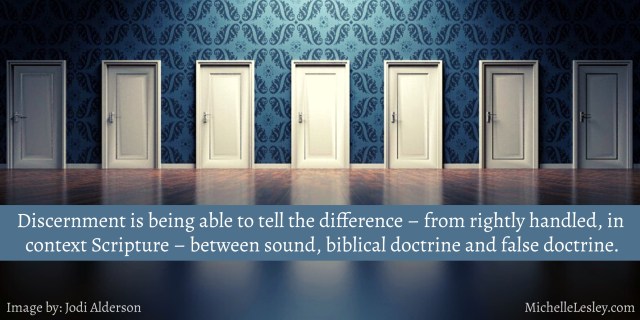
Discernment has various connotations in various contexts, but for the purposes of this study, we’re going to keep the focus narrow and define discernment as being able to tell the difference – from rightly handled, in context Scripture – between sound, biblical doctrine and false doctrine.
What does the Bible say about discerning between true and false doctrine? How does God regard false teachers, and how are we to deal with them in our personal lives and families, and as the church?
Have you ever read the book of Job? When we think about Job’s story, our minds usually turn to the theme of suffering, and how to suffer well as Christians, but did you realize another major theme of the book of Job is discernment? Job’s three friends come to him in his suffering and comfort him with … false doctrine. Job is well on his way to believing them when his true friend, Elihu, steps in and, though he’s not perfect, does his level best to correct them.
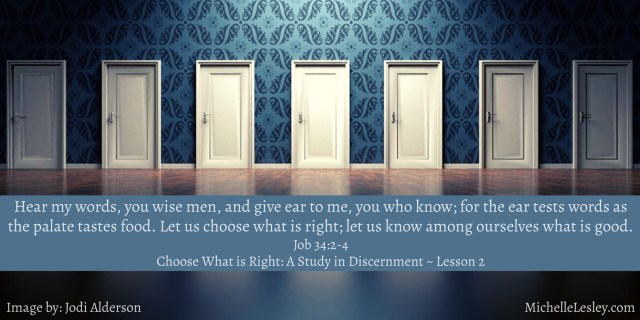
The theme verse for this topical study in discernment comes from Elihu’s speech in Job 34:
Hear my words, you wise men, and give ear to me, you who know; for the ear tests words as the palate tastes food. Let us choose what is right; let us know among ourselves what is good.
Job 34:2-4
This 11-15 lesson study will help us to be wise women who pay attention to what God says about discernment and how to avoid false doctrine. It will show us how to test words as the palate tastes food. It will teach us to know what is good, so we can choose what is right.
The striking title image for our study was designed by Jodi Alderson. To me the doors represent the idea that we are often presented with several options of teachers or doctrines that all appear, on the surface, to be equally good and biblical. We must use our discernment skills to find out which ones actually match up with Scripture.
Another aspect of the image I like is the use of light and darkness. We live in a world of darkness. Some of the doors we’re presented with are obviously dark and will only lead to more darkness. But some of the doors appear to shine forth the light of truth. (It reminds me of 2 Corinthians 11:14-15, which is a verse we’ll tackle later in this study.) Which ones really lead to truth? We have to know what is good so we can choose the ones that are right. Great job, Jodi!
Many thanks to all of those who worked so hard on your entries for our title pic contest. You ladies were very creative and did some outstanding work!
There were too many entries to share all of them with you, but here are a few “honorable mentions”:
Laura Ezinga
Brenna Van Cleve
Robin Self
Cheryl Toepfer
(I need to apologize for creating some confusion in the article announcing the title pic contest about whether the title was supposed to be “Choose What is Right” or “Choose What is Good“. I think what happened is that I have a teaching session for my speaking engagements on Titus 2:3-5 entitled “Teach What Is Good” and that title kept getting mixed up in my brain with the title and key verse for this study. Thank you so much to those who brought this error to my attention. I promise my mix up did not affect the contest in any way. I was judging images and design, not wording.)
If you’re new to using my Bible studies, just a few housekeeping items and helpful hints:
The studies I’ve written (you can find all of them at the Bible Studies tab in the blue menu bar at the top of this page) are like “training wheels”. They’re designed to teach you how to study the Bible for yourself and what kinds of questions to ask of the text so that, when you get the hang of it, you won’t have to depend on other people’s books and materials – even mine – any more. To that end, I do not provide answers for the study questions in the studies I’ve written.
My studies are meant to be extremely flexible and self-paced so that you can use them in the way that works best for you. You can do an entire lesson in one day or work on the questions over the course of the week (or longer). You do not need to feel obligated to answer all (or any) of the questions. If the Holy Spirit parks you on one question for several days, enjoy digging deep into that one aspect of the lesson. If He shows you something I haven’t written a question about that captures your attention, dive in and study it! Those are ways the Holy Spirit speaks to us through His Word. This is your time to commune with the Lord, not a school assignment or work project you are beholden to complete in a certain way by a certain deadline.
I will post a new lesson on the blog every other Wednesday, so there is nothing to sign up for or commit to. Simply stop by the blog every other week, or subscribe to the blog via e-mail to have the lessons delivered to your inbox.
I use hyperlinksliberally. The Scripture passage for each lesson will be linked at the beginning of the lesson. As you’re reading the lesson, whenever you see a word in a different color text, click on it, and it will take you to a Scripture, article, or other resource that will help as you study.
All of the studies I’ve written are suitable for groups or individuals. You are welcome to use them as a Sunday school or Bible study class curriculum (for free) with proper attribution.
You are also welcome to print out any of my Bible studies (or any article I’ve written) for free and make as many copies as you’d like, again, with proper attribution. I’ve explained more about that in this article (3rd section).
From time to time I receive inquiries from men about using my studies for their personal quiet time or for teaching a co-ed or men’s Bible study class. It is my personal conviction that it is more in keeping with the spirit (though not the letter) of 1 Timothy 2:12, Titus 2:3-5, and related passages for men to use Bible study materials authored by men rather than by women. Therefore, on the honor system, I would request that men please not use my studies for personal use, or when teaching a class with male members. (Vetting the studies for your wife, daughter, or the women of your church, is, of course, fine. Encouraged, actually.)
Introduction to Choose What Is Right: A Study in Discernment
Part of my philosophy of Bible study is that our main “diet” should be systematic, expositional study of the text. In other words: pick a book of the Bible, start at the beginning, and study it through to the end. Then, pick another book and start again. This method of studying helps us understand passages in their context and correctly apply them to our lives, and helps us avoid eisegesis, taking passages out of context, and incorrectly applying them.
However, there is a place for the study of a biblical topic such as peace, sin, the family, God’s wrath, or biblical womanhood. For example: if you’re struggling to trust God because of a sudden circumstance in your life, you don’t have time to study through every book of the Bible to learn what the Bible says about trusting God. You may need to spend some time in focused study on passages from various books that deal specifically with the topic of trusting God, and that’s OK. My goal with this study is not only that you learn what the Bible has to say about the topic of discernment, but also to demonstrate how to do a topical study properly so you can do topical studies on your own when the need arises.
Normally, in the introductory lesson to my studies, we take a look at the author of the book of the Bible we’re studying, the audience he wrote it to, the historical setting of the book, and other “backstory” issues. But because this is a topical study, and we’ll be examining passages from various books of the Bible, we’ll have to briefly address those issues as needed in each lesson.
So in the introduction to this study, I’d like to address two items in your “backstory.”
Salvation
If you’re not saved, this study isn’t going to be very helpful to you, because, as we’ll soon learn, lost people are naturally drawn to false teachers and false doctrine, and are incapable of truly embracing the things of God.
This week, before we tackle discernment, I’d like everyone – even if you know beyond a shadow of a doubt that you’re saved – to work through the Scriptures and materials at the What Must I Do to Be Saved? tab in the blue menu bar at the top of this page (and while you’re there, let’s do a little social media evangelism – share the link for that page around to your friends and followers!).
Do you understand the biblical gospel? Have you truly repented of your sin and trusted Christ as Savior? Spend some time alone with God examining your heart and life against these Scriptures. If you’re unsure whether or not you’re genuinely saved, I would encourage you to put this study aside and work through my study Am I Really Saved?: A First John Check Up first. You cannot be discerning if you don’t belong to God.
Expectations and Presuppositions
What do you expect out of this study? What kinds of ideas or preconceived notions are you carrying into this study? Take some time to answer the following questions.
1. When you hear the word “discernment,” what do you think of?
2. Without looking in your Bible, jot down five or ten things you think the Bible teaches about discernment.
3. What does your church teach about discernment? Is your church careful about its doctrine and the materials it uses? Is there someone in your church that you look up to as a good example of discernment?
4. What Scriptures come to mind when you think about discernment?
5. Why are you interested in a study about discernment, and what do you hope to get out of this study?
6. What are your strengths and weaknesses when it comes to discernment? What are some things you’d like to improve on?
Take some time in prayer between now and our next lesson to begin preparing your heart for this study. If there’s a specific issue you struggle with when it comes to discernment, ask God to teach you the truth of His Word about that issue and strengthen you in that area. Write down your prayer and review it when the study is over to see how God answered you through the study of His Word. I’m excited to have you join me in this journey of discovering what God’s Word has to say about discernment!