Uncategorized

The Word on Wednesdays

I’m going to be taking a break on Wednesdays getting ready for our new study. I hope you’ll enjoy it and that it will edify you as you seek to grow in Christ and His Word. (The picture above does not mean we will be studying James. :0) Unless Providentially hindered, I hope to announce the new study in the next few weeks. Stay tuned, and keep an eye on the blog on Wednesdays.

In the meantime, I’ll be posting some articles from the archives that I think you’ll find helpful as we make our way toward our next study. Here is this week’s article:

Wednesday’s Word

Wednesday is Bible study day here on the blog. In my Wednesday’s Word Bible study series you’ll find miscellaneous, one lesson Bible studies from each book of the Bible. One chapter of Scripture followed by study questions. This sampler series demonstrates that there’s nothing to be afraid of when approaching those “lesser known” books and that every book of the Bible is valuable and worth studying.

Wednesday’s Word ~ Lamentations 3

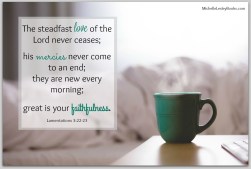
lam 3 22 23

I am the man who has seen affliction
under the rod of his wrath;
he has driven and brought me
into darkness without any light;
surely against me he turns his hand
    again and again the whole day long…Continue reading

Favorite Finds

Favorite Finds: June 9, 2020


Here are a few of my favorite online finds…


“Behind the storyline of Scripture is the story of how God, in his providence, gave his words to us. When God spoke, he ensured that it would be preserved through a process of writing, collecting, copying, translating, and printing. After thousands of years, the Scripture that began with the breath of God now comes to us in the Book that is worthy of our supreme trust.” Check out this fascinating article from Dirk Jongkind, How We Got the Bible: The Great Story of Sacred Scripture.


Here’s an informative and helpful infographic from Crossway, How do you read the Bible? “When do you read the Bible? How often? What portions of Scripture do you tend to gravitate toward, and are there particular extra-biblical resources you use alongside your Bible to help you process and study it? We surveyed over 6,000 people to learn about Bible study habits. In some cases, the results were quite convicting.”


Parents of older kids, do you have a prodigal- a child who has chosen worldliness over godliness, sin over the Savior? Hey, About Your Prodigal by our friend Michael Coughlin over at Things Above Us will bring you a great deal of peace and comfort as he walks us through the Scriptures that show us how to cope, and that God knows what it’s like to be the Father of prodigals too.


Freebie time! The good people at Monergism “believe the Church should have open access to Scripturally/Theologically sound edifying Christian literature and that one need not be held back from having a significant Christian library because of cost.” And so they offer us 575 Free eBooks Listed Alphabetically by Author. That should give all of us plenty to read for a while!


Here’s a brief, yet instructive video from WordBoard on Mark 2:20, What Is the Point of Fasting?


The resources listed above are not to be understood as a blanket endorsement for the websites on which they appear, or of everything the author or subject of the resource says or does. I do not endorse any person, website, or resource that conflicts with Scripture or the theology outlined in the Statement of Faith and Welcome tabs at the top of this page.
Uncategorized

The Word on Wednesdays

I’m going to be taking a break on Wednesdays getting ready for our new study. I hope you’ll enjoy it and that it will edify you as you seek to grow in Christ and His Word. (The picture above does not mean we will be studying James. :0) Unless Providentially hindered, I hope to announce the new study in the next few weeks. Stay tuned, and keep an eye on the blog on Wednesdays.

In the meantime, I’ll be posting some articles from the archives that I think you’ll find helpful as we make our way toward our next study. Here is this week’s article:

Wednesday’s Word

Wednesday is Bible study day here on the blog. In my Wednesday’s Word Bible study series you’ll find miscellaneous, one lesson Bible studies from each book of the Bible. One chapter of Scripture followed by study questions. This sampler series demonstrates that there’s nothing to be afraid of when approaching those “lesser known” books and that every book of the Bible is valuable and worth studying.

Wednesday’s Word ~ James 4

What causes quarrels and what causes fights among you? Is it not this, that your passions are at war within you? You desire and do not have, so you murder. You covet and cannot obtain, so you fight and quarrel. You do not have, because you do not ask….Continue reading

Mailbag

The Mailbag: How can we get women to WANT to come to Bible study?

Originally published March 19, 2018


My church is blessed to have two strong ladies’ Bible study leaders – one during the week for those who are available and one on Saturday for those who cannot attend during the week – who have the discernment to choose biblical content, study, and lead scripturally sound discussion. My prayer is that more women in my church would have the desire to attend these Bible studies, not only learning and growing spiritually but also for fellowship with each other and drawing closer to each other. If you have any ideas for actually getting women to want to study God’s word with other women I would love to hear them.

Been there, done that. I once taught a women’s Bible study class that consistently had only one to two women in it. I think our maximum attendance was one day when we had a whopping…four. The other women of the church chose to attend the “fluffier” classes that were being offered, and many just didn’t attend at all.

There could be any number of spiritual and practical reasons women aren’t attending your (or another reader’s) Bible studies.

☞ People are extraordinarily busy these days, especially women. Jam-packed schedules are probably the main reason for your low attendance. I’ll be honest, if I worked a full time job outside the home as well as taking care of my home and family, I’d be very unlikely to attend any Bible study class besides Sunday School. I’d want to devote that time to my family or to rest.

☞ Perhaps there are more false converts in your church than you’re aware of. People who aren’t saved are not new creatures in Christ and are devoid of the Holy Spirit, so they have no organic desire to spend time in God’s Word or with God’s people beyond the minimal amount required to fulfill whatever fleshly agenda brings them to church in the first place. There’s no human way to give them the desire to attend Bible study. Only God can accomplish that by saving them.

☞ If you go to a doctrinally sound church, your ladies may feel like they get plenty of good Bible study already and what they really want is unstructured fellowship time. See my article All Word and No Play: The Importance of Fun and Fellowship in the Doctrinally Sound Church.

☞ There may be something about the teaching style or the materials, that – even though they’re doctrinally sound – are rubbing people the wrong way. Maybe the teacher lectures and your ladies want more discussion. Maybe she talks over their heads in a very academic style. Maybe the materials are too expensive or there’s something about the book that is off-putting. Maybe your church only does “canned” (workbook, DVD, etc.) studies and what your ladies really want is to study books of the Bible, or vice versa.

☞ Hopefully this isn’t the case, but if there are factions in your church, someone could be surreptitiously – out of jealousy, sowing discord, or other reasons – discouraging the women from attending.

☞ The logistics of the class might be inconvenient for some. Do you offer child care for those who need it? Is the class held on a convenient day of the week and time of day? Is your church and the room you’re using for the class accessible to women with disabilities? 

These are just a few things that came to mind. Some of them may have to do with the class or the teacher. Others have more to do with the women themselves. What can you do to encourage more women to attend?

✔ Pray – and be ready to be in it for the long haul – that God will change hearts and give the women of your church a greater desire for His Word. In the end, God is the only One who knows all of the reasons women aren’t attending Bible study, and He is the only One with the power to transform them and overcome those reasons. Pray fervently and trust Him.

✔ If you’re truly stumped as to why women aren’t attending Bible study, ask them. You could do so face to face, individually, or, with your pastor’s permission, send out an anonymous survey (you’ll probably get a better response this way) asking things like, “Is the lecture style teaching we offer a fit for you?” or “Would you be able to attend if we offered child care?”, and also leave space to write in comments. (Naturally, you would not be asking things like whether or not you should water down the theology of the class, but if you can remove a practical barrier to attendance, why wouldn’t you?)

✔ Ask your pastor for advice. He knows the heartbeat of your congregation and will probably have some valuable counsel and suggestions.

✔ Be willing to try something different in the class. If you’ve only ever done workbook studies, do a study of a book of the Bible. Maybe a Saturday class isn’t convenient for a lot of people but a Sunday class would be. “I Shall Not be Moved” is for the theology of the class, not the logistics of it.

✔ Be willing to try something different than the class. There’s more than one way to skin a cat, and there’s more than one way to do discipleship. Bible studies are awesome, but how about taking a semester off and doing some one on one Titus 2 mentoring instead? Or some unstructured “let’s just sit and chat” fellowships or ladies’ night outs? Or a prayer group? Or some outreach projects? If your ladies are already getting good preaching in the worship service and good teaching in Sunday School, it’s OK to try a discipleship method other than a Bible study class.

✔ Are you doing enough publicity well in advance of the class? You should start a minimum of 3-4 weeks before the class begins, and you should blitz with a variety of media: verbal announcements in multiple worship services, announce it in the church bulletin, newsletter, web site, and social media pages, have Sunday School classes announce it, send out a church-wide e-mail, put up fliers around the church, and encourage the ladies who are already attending the classes to personally, individually invite other women.

✔ If your pastor is OK with it, consider having one of the women who has been a faithful member of the class give a testimony (during the worship service, in the church newsletter, or wherever appropriate) about how the class has helped and blessed her, the relationships she has built through the class, etc.

In the end, the old saying is true: “You can lead a horse to water, but you can’t make him drink.” You may bend over backwards and pray your kneecaps off and you may still have a small attendance. That’s OK. That’s on God. All you are responsible for is to pray, trust and obey Him, and be faithful to Him where He has planted you. God doesn’t measure your success by how many women attend, but by your faithfulness to Him.


If you have a question about: a Bible passage, an aspect of theology, a current issue in Christianity, or how to biblically handle a family, life, or church situation, comment below (I’ll hold all questions in queue {unpublished} for a future edition of The Mailbag) or send me an e-mail or private message. If your question is chosen for publication, your anonymity will be protected.


Book Reviews, Guest Posts

Guest Post: A Review of Thomas Coutouzis’ “Agonizing for the Faith”

If your theology pretty much matches up with mine (as outlined in my “Welcome” and “Statement of Faith” tabs in the blue menu bar at the top of this page) and you’d like to contribute a guest post, drop me an e-mail at MichelleLesley1@yahoo.com, and let’s chat about it.

(In case anybody might be confused, a few weeks ago, the author of this book, Thomas Coutouzis, reviewed Jackie Hill-Perry’s “Bible” study on Jude for us. Today’s review is a review of Thomas’ book on Jude by my friend Jason.)


A Review of Thomas Coutouzis’
“Agonizing for the Faith:
A Biblical Exposition of Jude”

by: Jason Marianna

If there is any book of the Bible that speaks directly to most of the issues faced by the 21st century church, that book is Jude. The 21st century church faces a unique problem: The proliferation of media, primarily the internet, not only gives everyone a platform, but it gives the impression that all who have a platform deserve it. Christians are pulled in many directions and overwhelmed by the sheer volume of media – with each content creator doing his or her best to convince the Christian what they teach is worthy of their audience’s time. It is a perfect breeding ground for false teachers to slip into the church unnoticed and unquestioned. In this media environment, they thrive on the ability to communicate their message as effectively as true teachers. Many of the people bringing a dish to pass at your church’s potluck (or “love feast”, if you will) are under their influence in a variety of ways, both directly and indirectly.

Thankfully, God has given us the book of Jude. To read Jude is to understand the grave importance of recognizing false teachers and the subtle traps they lay for God’s people. Much like the elect, false teachers do not walk around with a stripe on their back so you can recognize them. They are instead the proverbial wolves in sheep’s clothing. They go to church, they smile, they even talk a lot about the Bible. Nonetheless, the things that should honor God instead, for them, become a lure to separate you from your money, your joy, your holiness, and (if it were possible) your God. Jude wants God’s people to know these “hidden reefs” are all glitter and no gold – clouds without water. More than that, Jude wants you know how to answer them. He wants you to wage war against them, and all the while maintain a love, concern, and affection for saints under their influence. Jude asks you for nothing less than to “agonize” for the faith.

Yet, in my experience, Jude may be the most overlooked book of the New Testament. Never once have I heard a Christian remark to me that it was his or her favorite book. I never see it in the list of books that new Christians must read first. It is not ignored, but it is certainly not emphasized. In light of the aforementioned pitfalls of the 21st century environment, the church needs to know about the hidden dangers that lie just below the surface. Christians need to know now more than ever about the “unreasoned animals” that prowl around them so readily in our time. Today, perhaps more than ever, God’s people need the book of Jude.

Thank God that Thomas Coutouzis understands this. In his excellent commentary, Agonizing for the Faith, Coutouzis takes Jude’s 25 verses and causes them to blossom into a robust and substantial weapon in the hands of the believer. More than that, Coutouzis sounds the alarm about false teachers which, at times, sounds as much like a battle cry as it does a warning. He pulls no punches and takes no prisoners when it comes to the enemies of the faith; naming names and directing sharp, effective attacks. Yet, Coutouzis knows when to put the sword away and encourage loving concern and gentleness for the elect confused and oppressed by false teaching.

Biblical commentaries usually fall into three categories. The first is purely technical. These are commentaries on language, history, context, and culture. They say less about what the text means and more about what the text says. For teachers, these commentaries are invaluable as they help us understand the dead languages and the ancient situations that inform the idioms and peculiarities within the text. For the average believer just trying to understand what the Bible means, these commentaries are usually more hazard than help. Coutouzis in no way ignores the technical aspects of Jude. In fact, he not only demonstrates competence with the Greek language but also possesses the rare ability to explain it in plain, down to earth ways without sounding like an English teacher. Additionally, Coutouzis shows great skill in explaining the extra-biblical references Jude makes in verses 9, 14, and 15. Yet, it cannot be said that Coutouzis has written merely a technical commentary. Agonizing for the Faith is too readable and accessible for that.

The second kind of commentary is a devotional. The focus of these commentaries are application and practicality. Matthew Henry is the prime example of this type. Commentaries of this sort are helpful to the common believer and teacher alike. For the common believer, they are easy to read and speak directly to living the Christian life. For the teacher, they help to focus our lessons on how the believer can carry out what we teach after they leave the class or sermon. Agonizing for the Faith offers plenty of application. Coutouzis speaks to our present age and the real situations it presents for many believers. He often walks his reader through the everyday practical implications of what Jude is saying. Yet, it would be an empty compliment to call Agonizing for the Faith merely a good devotional book. Make no mistake, every believer will be edified to read it, but for reasons that go far beyond that of a typical devotional.

While it is important to remember that almost every commentary contains elements of all three types, it is the main thrust of the commentary that determines its category. Therefore, it is the third type of commentary where we must categorize Agonizing for the Faith. Coutouzis has written an expository commentary. An expository commentary is one that goes verse by verse and word by word to flesh out every aspect of the Biblical text. John MacArthur writes his commentaries in this way. The advantages of the expository method are on full display in Agonizing for the Faith. Coutouzis writes about every word and doesn’t allow himself to skip difficult passages. He goes where the text goes and allows it to speak for itself. Yet, Coutouzis’ perception and insight is on full display in the process. Jude is a densely packed seed of nutrition for the hungry believer. Under Coutouzis, it blossoms and grows.

While I have much good to say about Agonizing for the Faith, it was by no means a perfect book. On occasion, Coutouzis quoted from secondary sources when his text would have been bolstered by interacting with primary sources. While I don’t reject the usefulness of resources like CARM or the Encyclopedia Brittanica, citing them is beneath the high standard Coutouzis has set for himself. Once or twice I felt Coutouzis did not prove his point as thoroughly as he should have. On occasion, particularly chapter 4, it seemed he imposed upon his readers too much of his background research. Also, while I’m eternally grateful to every author that uses footnotes instead of end notes, Agonizing for the Faith has one glaring absence: A bibliography. Coutouzis misses an opportunity not only to give credence to the obvious great depth of his research but also to bless his reader with authors and books where they could learn more. It is my hope that subsequent printings will fix this – I consider it to be the book’s worst shortcoming.

Nonetheless, we should not expect every author to be perfect nor should we allow perfect to be the enemy of good – or in this case allow perfect to be the enemy of great! For while Coutouzis may have a few minor and forgivable shortcomings, he makes up for them several times over. Chapters 1 and 2 were exceedingly quotable. Chapters 5 and 6 were informative. I particularly found chapters 8 and 9 helpful in my own ministry, and chapter 10 was so rich that I made myself read it twice. In fact, as I flip through my copy, I find notes, highlights, and underlines on almost every page. This book blessed me, encouraged me, and just plain fired me up.

In particular, I want to point out one chapter that is the best display of Coutouzis’ excellence. Chapter 12 deals with verses 20-23 of Jude. When discussing verses 22-23, Coutouzis alerts us on page 142 “Every commentator that I have read believed that these groups are all unbelievers within the church…” and then goes on to make his most courageous and dangerous remark in the book “…while I don’t think that is the case for any of these three.” I remember pausing here to absorb what I had read. This is risky for an author, particularly in a book of this type. He was telling his reader “no one agrees with me”. He was asking his audience to trust him. Any author writing about Scripture who does this had better not only be right, he’d better prove it. It’s not as if “majority rules” when it comes to Scripture – truth rules – but a declaration that no one else agrees is to say that many intelligent and godly men who have gone before him are wrong.

What followed was not complicated nor elaborate. In fact, Coutouzis never once refuted the opposing viewpoints. Instead Coutouzis did what he had been doing the entire book: faithful exposition with rigorous exegesis offered with clever insight and humility. Step after step, word after word, idea by idea Coutouzis let Jude speak for itself; and in doing so he convinced me. He was right, and the cadre of commentators were wrong. Coutouzis does more than win an argument, he offers a convincing and consistent view that spurs his reader to love, concern, and caution for weaker brothers caught up in error. This master stroke of Coutouzis’ book should also be its legacy. We ought to rebuke false teachers, marking and avoiding them at all costs. Yet at the same time, our attitude toward Christians caught up in their error ought to be one that reflects our Lord’s: to love and endure much, and yet compromise nothing.

If my reader will indulge me, I wish to say a brief word about Christian literature and publishing. Agonizing for the Faith is a self-published book. What used to be called “vanity publishing” is typically exactly that – a vanity project. Most self-published books in the Christian world are not worth your time. While I’m glad there is an outlet for creative writers and other writers in niche interests, I also believe those in academic fields benefited from a vetting process that printers and publishers used to provide. Yet, Coutouzis serves as a reminder that the world of self-publishing is not entirely devoid of quality work. If the Christian publishing world can find time and money to publish garbage such as Joel Osteen and Beth Moore, some publisher somewhere should surely find the time to publish Coutouzis. Every Christian publisher that passes on him makes a mistake. He’s demonstrated through this book that he is worth their investment.

It ought to be your ambition to read material that edifies, books that feed your soul, authors that faithfully teach the Word of God. In every sense, Coutouzis’ book fits the bill. Agonizing for the Faith belongs in your library. As you soak up what it has to offer, you’ll be better informed, better equipped, and (God willing) eager to put its teachings into practice. Not only will it serve you well in your own spiritual growth, I also feel it would make an excellent book for a women’s/men’s study or a Sunday school class. It’s the best commentary I’ve ever read of Jude’s precious book. I enthusiastically recommend it to you and pray it will fire you up, as it did me, to agonize for the faith.


Jason Marianna was saved solely by God’s grace when he was 16 years old.  When he’s not leading Bible studies and teaching children in his church, he works as an automation engineer in Pittsburgh PA.  Jason is a father of 4 and is married to a woman he doesn’t deserve.  He and his wife have a heart for orphans, particularly foster children, and have adopted 3 of the 5 children they’ve fostered so far.  Jason is a freelance writer who wants to write for your blog or publication.  You can follow his opinionated and eclectic Twitter feed, or connect with him on Good Reads.