Mailbag

The Mailbag: Potpourri (Budgeting… Abuse and Submission… DIY Sanctification… Prayer)

Welcome to another โ€œpotpourriโ€ edition of The Mailbag, where I give short(er) answers to several questions rather than a long answer to one question.

I like to take the opportunity in these potpourri editions to let new readers know about my comments/e-mail/messages policy. Iโ€™m not able to respond individually to most e-mails and messages, so here are some helpful hints for getting your questions answered more quickly. Remember, the search bar (at the very bottom of each page) can be a helpful tool!

Or maybe I answered your question already? Check out my article The Mailbag: Top 10 FAQs to see if your question has been answered and to get some helpful resources.


Before I get to this week’s questions, I wanted to say – I love getting questions from my readers! Here’s a helpful hint for increasing your chances of getting your question answered in The Mailbag

Your best shot at your question being selected for The Mailbag is to email me, or – if you have a question pertaining to a particular blog article – to comment on that article. Those are the two main sources I draw Mailbag questions from because they’re the most user friendly for that purpose. I also try to grab questions from Facebook private messages whenever I think about it.

I’m rarely able to grab questions from social media comments (on posts) and DMs, especially on Instagram and Twitter. Comments and Instagram DMs move down the notification queue too quickly, and Twitter DMs from people I don’t follow are hidden.

That being said, sending me the same question multiple times or on multiple platforms (emailing and leaving a blog comment and messaging me on Facebook) will not increase your chances of your question being selected. If you send it to me once, I’ve got it. :0)

Thanks for all your questions. Keep sending them in! We wouldn’t have a Mailbag without them!


I was wondering if you can do a video on how a Christian housewife should budget money. I want to learn and trust in God’s will as well.

Great question! I’m much better in writing than on video, so I hope this format is OK.

Every household is unique, with a unique income, unique needs, unique bills and expenses, etc., so I can’t tell you, “Budget X% for this and Y% for that.” The best I can do is give you a few general guidelines:

  • Sit down with your husband with all your numbers: income, bills, expenses, etc. Prayerfully and thoughtfully consider how much you’re bringing in and how much you’re paying out. Do you need to earn more? Spend less? Cut out some expenditures? Save more?
  • Don’t forget to pray about and consider how much you need to set aside for your offerings at church. Christians are not under the Old Testament law of the tithe, but we are to give as generously to the church as we’re able according to what we’ve prayerfully determined in our hearts.
  • If money is tight and bringing in more income isn’t an option, a great way to be a helper to your husband would be to research ways you can reduce your bills, cut expenses, etc. Can you renegotiate your mortgage? Buy generic instead of name brands? Use coupons and shop the sales at the grocery store? Get your clothes at a thrift store instead of a boutique? Turn off the cable? Sell one of your cars?
  • If your husband doesn’t mind you discussing this with someone else, ask one of the godly older women in your church for advice. You can share the specific details with her and perhaps she can offer you some suggestions specific to your particular household.

This is just one of those things every couple has to work on together and figure out for themselves.


I read your article The Mailbag: I โ€œfeel ledโ€ in a different direction from my husband. In that article, you said:

Unless your husband is abusing you or encouraging you to do something sinful, Godโ€™s will is for you to graciously submit to his decisions.

I have always wondered why this circumstance is almost universally accepted as an exception to the principle of submission.

I don’t want to try to answer for the rest of the universe, but let me just explain my position. If a woman is being abused, priority number one is to get her to safety. And that’s going to mean getting away from her husband to a different place to live (until or unless he radically repents and gets saved, bears a lot of fruit in keeping with repentance, the two of them get extensive pastoral counseling, and so on).

What do you think an abusive husband’s immediate response to that is going to be? He’s going to be angry and demand that she come back home. That would be the first thing she would have to submit to before she submits to anything else. As a Christian, should she submit to that first demand? Of course not. He’s requiring her do a variety of ungodly things:

  • We are to be good stewards of our bodies and glorify God with our bodies. It is neither glorifying to God nor good stewardship to put your body in a situation in which you’re virtually certain it’s going to be damaged for no good reason. Putting your body in the hands of an unrepentant abuser is no more glorifying or good stewardship than jumping out of a third story window.
  • If you have children and you go back to an unrepentant abuser, you’re knowingly and intentionally putting them in danger. Godly mothers protect their children by keeping them away from danger as much as it’s within their power.
  • If you go back to an unrepentant abuser, you’re indirectly lying to him about his sin. By going back to him, you’re saying that his sin of abuse is OK, that he doesn’t need to repent or suffer any consequences for it, that you, as a Christian, approve of it, and that, by extension, God must approve of it, too.
  • Going back to an unrepentant abuser puts temptation in his way. When you’re in the home with him, he’s tempted to abuse you. When you’re not, he doesn’t have the opportunity to commit the sin of abusing you. We don’t put stumbling blocks in the paths of sinners.

These are all good, biblical reasons not to stay in an abusive situation, either. You can’t submit to someone who is sinning against you and requiring you to act in an ungodly way.


My question is how do you get out of yourself and your feelings? Yes, turn them over to God, I know this and I have but here I am still hurting and unable to find my way back to being content in all situations. Thank you for your wise words.

How do you cultivate die-to-self love and love God and others more?

Two great questions from different readers, but with the same answer: You can’t. This is something God has to work in you. You can’t sanctify yourself.

When it comes to sanctification and spiritual growth, we often cast about for a plan we can implement to start making things happen, kind of the same way that, when we want to lose weight, we reach for a diet book, join a gym, or call Jenny Craig.

Sanctification doesn’t work that way. There’s no such thing as a “get holy quick” scheme. There’s no program you can implement, book you can read, or specific behavior regimen you can initiate that will help you shed those unsightly sins and lose those pounds of character flaws. There’s nothing you can do to create growth and get the guaranteed results you’re looking for. That’s God’s job. It’s His job to grow you, and it’s His job to grow you in a way that guarantees He’ll get the results He’s looking for.

Your job is to get up every day, trust Him to do His job, and walk faithfully with Him by…

  • Studying your Bible
  • Praying- for help, for wisdom, for guidance, for strength
  • Being faithful to your church
  • Obeying the Word
  • Faith, trust, and utter dependence on God
  • Getting good counsel when you need it from godly friends and loved ones, your pastor, or spiritually mature women in your church

That’s God’s plan. His method. And it works every time it’s tried.

You might find some of the principles in my article You Donโ€™t Need *A* Book, You Need *THE* Book to be helpful on this.


I often donโ€™t know what to pray. Can you give me guidance and whether pre-printed prayers are a good idea or not and if so how they should be used. 

I’ve got tons of resources on prayer here at the blog. I hope you’ve been able to find them (using the search bar, tabs in the blue menu bar at the top of this page, or category cloud in the right or bottom sidebar) in the time since you originally asked this question.

I would recommend starting off with…

Basic Training: 8 Things You Need to Know about Prayer

After this Manner, Therefore Pray

Can We Talk?

Sweet Hour of Prayer: Learning to Pray from the People of Scripture (my Bible study on prayer)

And then you can just start plowing through all of my other articles of interest about Prayer.

There’s nothing sinful about praying a biblical, doctrinally sound pre-printed prayer back to God. The best way to do that is to pray Scripture back to God, because you know Scripture is biblical, doctrinally sound, and pleasing to God since He breathed it out. The Psalms are especially well suited for this (in fact, praying the psalms back to God is one of the components in our current Bible study, Psalm 119: The Glory of God’s Word). You might want to take a look at my article Praying Scripture, to get a feel for it.

Outside of the Bible, the only prayer book I’m familiar enough with to feel comfortable recommending is The Valley of Vision. What I would recommend it for is reading through it for an example of the things we should be praying for and about, rather than using it for reciting or actually praying the prayers in it (although, like I said, it’s not sinful if you do). Your prayers should be personal, between you and God.


If you have a question about: a Bible passage, an aspect of theology, a current issue in Christianity, or how to biblically handle a family, life, or church situation, comment below (Iโ€™ll hold all questions in queue {unpublished} for a future edition of The Mailbag) or send me an e-mail or private message. If your question is chosen for publication, your anonymity will be protected.


Psalm 119 Bible Study

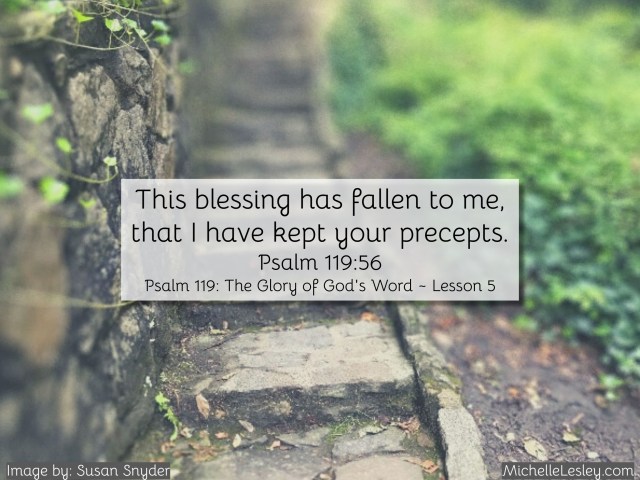
Psalm 119: The Glory of God’s Word ~ Lesson 5

Previous Lessons: 1, 2, 3, 4,

Read Psalm 119:49-64

Recall the things from the introductory lesson that you wanted to keep in mind as you study the text of Psalm 119.

Don’t forget to read in complete sentences instead of stopping at the end of each verse.

Recall the themes you’ve been noticing in Psalm 119. Watch for those themes to be repeated in today’s and future passages. You may wish to make a list of those themes to refer to throughout this study.

Questions to Consider

1. Review your notes from last week’s lesson. Does that passage relate to this week’s passage? How? Do you notice any repeated words, thoughts, or themes?

2. Do you notice a difference in tone between this first section (49-56) and most of the previous sections we’ve studied? How would you characterize the tone of this section? The previous sections? How do our life circumstances impact our perspective of how God’s Word ministers to us? (For example: When you’re joyful, which aspect of God’s Word most ministers to you? Comfort, praise, encouragement, zeal, etc.? When you’re going through hard times?) Proverbs 25:11 tells us “A word fitly spoken is like apples of gold in a setting of silver.” How is Scripture a “word fitly spoken” to each of us, personally, no matter what we’re going through?

3. Anger is often sinful, but how is verse 53 an example of righteous, godly anger?

4. Which verses in these two sections speak to God’s attribute of dependability, being a “man of His word”? How does that bring comfort and stability to the psalmist and to us?

What is the psalmist’s response to God’s dependability? (49, 50, 57) How do you, or how should you, respond to God’s dependability to you?

As God’s people, we are to reflect to others God’s attribute of dependability. How are you doing at being dependable to others – a woman of your word? Are you punctual? Fulfill your commitments? Return correspondence in a timely manner? Follow through? What’s one practical way you could reflect God’s dependability this week? When God’s people aren’t dependable, what does that say to lost people about God?

How does the psalmist “hold God to His word” in prayer in 49, 50, and 58? It is always appropriate in our prayers to recall God’s promises to us (from Scripture) and ask Him to keep or fulfill them. How can we avoid demanding things from God that He never promised us in the first place? Have you noticed any verses or themes we’ve studied so far in Psalm 119 that speak to this?

How is asking God to keep His promises simply asking Him to be who He is?

5. Does verse 56 refer to the blessings that are a consequence of obeying God’s Word, or does it mean that the ability and desire to obey God’s Word is a blessing in and of itself? (It might help to look at this verse in a few other reliable translations.) Why is it a blessing to desire and be able to obey God’s Word? How are we able and Who gives us that desire?

6. Carefully examine 59-60. What kind of “ways” is the psalmist talking about? What is the solution to temptation and sin in…

  • 57, 59-60?
  • 58, 64?
  • 61?
  • 62?
  • 63?

How can you implement each of these in your own life to combat sin?

Consider how Jesus used the weapon of memorized Scripture to combat Satan’s temptations. Why is God’s Word such an effective weapon against temptation and sin? Why doesn’t just avoiding temptation alone – apart from God’s Word – work? Do you run to God’s Word when you’re tempted? What are some verses you could memorize and obey to help you fight temptation and avoid sinning?


Praying Psalm 119

Have you ever tried praying the psalms? I want to encourage you to try praying part of Psalm 119 back to God each week of this study. (If you’re familiar with my other studies, this will take the place of the weekly “Homework” section.)

The psalms are uniquely suited for praying back to God, both verbatim and conceptually, because they are often written as prayers – as though the psalmist is talking to God. Did you notice that about today’s passage? In which verses?

What is a concept or thought for your own life that the Holy Spirit impressed on your heart or convicted you about from today’s passage? Is there a particular verse(s), or maybe the whole passage, that you would like to pray back to God verbatim? Whatever your “prayer point” from today’s lesson, pray it at least daily until we get to the next lesson.


Suggested Memory Verse

Psalm 119 Bible Study

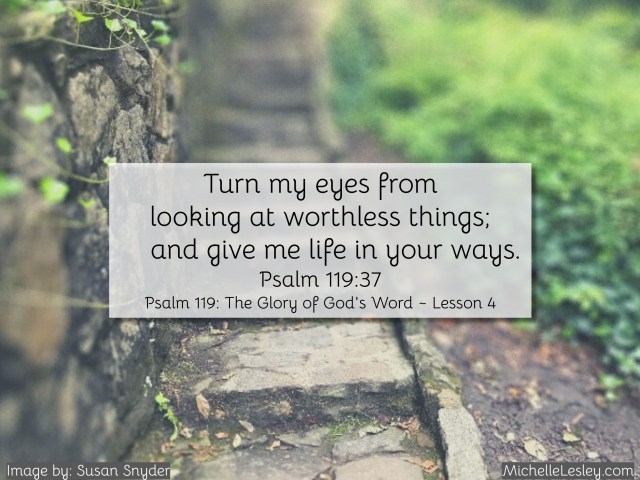
Psalm 119: The Glory of God’s Word ~ Lesson 4

Previous Lessons: 1, 2, 3,

Read Psalm 119:33-48

Recall the things from the introductory lesson that you wanted to keep in mind as you study the text of Psalm 119.

Don’t forget to read in complete sentences instead of stopping at the end of each verse.

Recall the themes you’ve been noticing in Psalm 119. Watch for those themes to be repeated in today’s and future passages. You may wish to make a list of those themes to refer to throughout this study.

Questions to Consider

1. Review your notes from last week’s lesson. Does that passage relate to this week’s passage? How? Do you notice any repeated words, thoughts, or themes?

2. Notice the structure of 33-39. How does each sentence start? Is it a declaration, a question, an exclamation, or an imperative (request or command)? Who is doing the requesting? To whom? For whom? (This will be easier to see if you’ll make a verse by verse list, starting with “Teach me…” in 33.) Does verse 40 start the same way? What about the end of 40? How is this passage “bookended” (beginning of 33, end of 40)? What is the main idea of these imperatives?

Now notice how each verse (33-39) concludes. We’ve seen the initial imperative (“Do this”) of each verse. The structure of the conclusion of each verse is “…so that ______.” How would you fill in that blank with a description of the conclusions of the verses? (Again, this is easier if you make a verse by verse list, starting with, “and I will keep it” in 33.) What is the main idea of these conclusions?

How does this passage demonstrate – both in content and in structure – that God must take the initiative in illuminating the psalmist’s understanding of the Word, and that, when God does this, blessings follow? How does the structure reinforce the content? Does the psalmist want God to take this initiative? Why? What are the blessings that result from God increasing the psalmist’s understanding of, love for, and obedience to His Word? What are your thoughts on God taking the initiative in illuminating your understanding of His Word? What are some blessings you’ve experienced as God has increased your understanding of, love for, and obedience to His Word?

3. In verse 37, what might the psalmist have meant by “worthless things” in his life? Could they, in general, have been some of the same worthless things in your life? Think about the things on which you spend your time. What are some worthless things you need to ask God to turn your eyes from in order that He might give you a richer life in His ways? What would He need to turn your eyes and your focus to in order to accomplish this? Connect the thought in verse 37 with these verses in John.

4. What key word do verses 41, 47, and 48 all have in common? This is the first appearance of this word in Psalm 119. Notice how it bookends this section (41-48). Who is the initiator of love (41)? What is the psalmist’s response (47-48) to God’s love coming to him (41)? How does 1 John 4:19 echo this concept?

5. Until this section (41-48) the psalmist’s main focus has been on his own personal relationship to God’s Word, and, through God’s Word, to God Himself. He has focused primarily on God, and secondarily on himself (e.g. “teach me,” “lead me,” etc.). In this passage, he brings others into the mix. Who are the others he speaks of in 42 and 46?

42- How does the content of God’s Word help us to answer scoffers and taunters? How does the Christian character that studying the Word builds help us to answer scoffers and taunters?

46- How do both the content of God’s Word and the character His Word builds in us help us to answer or testify to His goodness before those who have more power or influence than we do, or are intimidating? Why is the psalmist confident he will not ultimately be put to shame (46-47- Remember, read all the way to the end of the sentence.)? What if the “king” ridicules (or worse) the psalmist’s beliefs and testimony, or mocks God?

Explain how our confidence and security hinges on Who or what we trust in.

6. Verse 43 is the psalmist’s first use of the word “hope”. Some people believe, and some religions teach that our only hope of Heaven or being right with God is in keeping God’s rules, being a “good person,” or for our good deeds to outweigh the bad. Is that what the psalmist is saying in this verse? Why or why not, and how do you know? If an unsaved friend tried to use this verse to justify her belief that God is happy with her because she keeps His rules, how would you answer her? Consider verse 43 in light of John 6:68.

7. What is the difference between the “wide place” in 44-45 and the “wide gate” in Matthew 7:13-14? Can you walk in the “wide place” if you enter through the “wide gate”?

8. What have you learned from today’s passage about God being the initiator of illumination and love? What about other spiritual matters? Can you think of any spiritual matter in which man is the initiator rather than God?


Praying Psalm 119

Have you ever tried praying the psalms? I want to encourage you to try praying part of Psalm 119 back to God each week of this study. (If you’re familiar with my other studies, this will take the place of the weekly “Homework” section.)

The psalms are uniquely suited for praying back to God, both verbatim and conceptually, because they are often written as prayers – as though the psalmist is talking to God. Did you notice that about today’s passage? In which verses?

What is a concept or thought for your own life that the Holy Spirit impressed on your heart or convicted you about from today’s passage? Is there a particular verse(s), or maybe the whole passage, that you would like to pray back to God verbatim? Whatever your “prayer point” from today’s lesson, pray it at least daily until we get to the next lesson.


Suggested Memory Verse

Doctrinally Sound Teachers

Doctrinally Sound Christian Men to Follow – 3

Sometimes we ladies fall for the mindset that if weโ€™re going to pick up a Bible study book, read a blog, or listen to Bible teaching, it has to be from a female author or teacher. Not so! There are a lot of fantastic, doctrinally sound, male Bible teachers, pastors, and writers out there โ€“ far more males than females, actually โ€“ and youโ€™ll really be missing out if you limit yourself to women teachers and writers.

I’ve recommended lots of my favorite doctrinally sound teachers at the Recommended Bible Teachers tab in the blue menu bar at the top of this page. Here are some more; and these lists are by no means exhaustive!

IMPORTANT REMINDER: Donโ€™t take my (or anyone elseโ€™s) word for it that any ministry, podcast, book, or blog is biblical in its doctrine. You MUST do the work of comparing with Scripture everything you read and hear. If it doesnโ€™t match up with Godโ€™s word (in context), chuck it.

 A.W. Pink โ€“ โ€œBiographer Iain Murray observes of Pink, โ€˜the widespread circulation of his writings after his death made him one of the most influential evangelical authors in the second half of the twentieth century.โ€™ His writing sparked a revival of expository preaching and focused readersโ€™ hearts on biblical living.โ€ Pink pastored churches in Britain, Australia, and across the United States. During that time (1922-1953), Pink published a monthly magazine, Studies in the Scriptures. Each edition contained several articles expositing Scripture. He also authored scads of pamphlets and books on a number of theological topics. Perhaps two of his best known books are The Attributes of God and The Sovereignty of God. These, and many other works by Pink are available for purchase or can be read free online.  Facebook 

Tom Ascol โ€“ Tom has served as pastor of Grace Baptist Church in Cape Coral, Florida for over thirty years and has taught theology courses at several seminaries. He is one of the founders, and current executive director of Founders Ministries, the president of the Institute of Public Theology, and a popular author, conference speaker, podcaster, journal contributor, and blogger. I am especially grateful for Tom’s strident efforts in the grassroots movement to bring back biblical and doctrinal fidelity in the Southern Baptist Convention. Check out Tomโ€™s booksread one of his excellent articles, listen to his sermons, or subscribe to The Sword and the Trowel podcast.  Facebook  Twitter Instagram

Allen Nelson โ€“ Better known as โ€œCuatroโ€ to his friends (because heโ€™s Allen Nelson IV), Allen has a deep and abiding passion for the local church, and pastors Perryville Second Baptist Church in Perryville, Arkansas. You might recall reading reviews here on the blog of Allenโ€™s books From Death to Life: How Salvation Works and Before the Throne. Both are well written and helpful, and you’ll want to get a copy of each if you haven’t already. Allen is also contributing writer and roundtable member of the Things Above Us blog and podcast, and is a regular contributor to Servants and Heralds. And donโ€™t forget to check out his sermons, too!  Facebook  Twitter

James White โ€“ An expert in apologetics, textual criticism, and theology, โ€œJames White is the director of Alpha and Omega Ministries….He is Professor of Church History and Apologetics at Grace Bible Theological Seminary….He has authored or contributed to more than twenty four books…He is Pastor/Elder of Apologia Church in Arizona.” Following Dr. White is almost the equivalent of getting a graduate degree from an elite, doctrinally sound seminary. Check out Dr. Whiteโ€™s many books and debates, his blog, and The Dividing Line webcast (also on iTunes).  Facebook  Twitter  

(Note: Dr. White maintains a personal friendship and, in the past, occasional ministerial connections with Dr. Michael Brown, who, although doctrinally sound in many areas of his theology, has become a safe haven for the worst of the worst New Apostolic Reformation heretics. To my knowledge, Dr. White does not endorse this behavior of Dr. Brown, and certainly does not endorse NAR heresy. It is my understanding that he has attempted to correct Dr. Brown’s errors multiple times. I strongly discourage you from following Dr. Brown.)

Darrell Harrison โ€“ “Darrell B. Harrison serves as Dean of Social Media at Grace to You, the bible-teaching ministry of John MacArthur…Darrell has a blog called Just Thinking . . . for Myself…and is the lead host of the Just Thinking podcast, one of the top-ranked Christian podcasts in America…Darrell is currently in the final phase of becoming certified as a biblical counselor with the Association of Certified Biblical Counselors (ACBC).” You can read more from Darrell at his G3 Ministries blog. Darrell is also a beloved author, conference speaker, and all around nice guy. Facebook  Twitter Instagram

Tom Buck โ€“ Tomโ€™s no nonsense quips and keen insight into the current affairs of Southern Baptist life have made him something of a legend on Twitter, but Tom is first and foremost a pastor, and has served as senior pastor of First Baptist Church of Lindale, Texas, for over 15 years. Tom is also the Director of G3 Expository Preaching Workshops, training pastors to become better preachers. Listen to Tomโ€™s sermons online or on iTunes. Follow Tom’s blog, Vessels of Honor, at the G3 Ministries website.  Facebook Twitter

Costi Hinn โ€“ Costi is the Pastor of Preaching & Teaching at Shepherdโ€™s House Bible Church in Chandler, Arizona. He is the author of several phenomenal books (one of which I had the pleasure of writing an endorsement for). Though not one to capitalize on the family name, much of Costiโ€™s background and expertise that uniquely qualify him to address the blight of the prosperity gospel and New Apostolic Reformation, stem from his personal experiences as nephew and ministry assistant of NAR faith healer Benny Hinn, and his zeal for sound biblical doctrine is contagious. Check out all of Costiโ€™s blog articles, videos, and his podcast at For the Gospel.  Facebook  Twitter Instagram

Jerry Bridges โ€“ Jerry Bridges spent most of his professional career in parachurch ministry, serving in a variety of positions and capacities with The Navigators. He is remembered for his clear and easy to grasp writing style which has endeared to the hearts of millions his books The Pursuit of HolinessThe Practice of GodlinessTrusting God, and over twenty others dealing with topics in theology and discipleship. Get a list (with links) of all of Jerryโ€™s books, listen to his sermons, talks, and interviews here and here, and watch his videos on YouTube.  Twitter

Mike Riccardi – “Mike Riccardi serves as the Pastor of Local Outreach Ministries at Grace Community Church, which includes overseeing Fundamentals of the Faith classes, eight foreign language outreach Bible studies, and evangelism in nearby jails, rehab centers, and in the local neighborhood…He also serves as Assistant Professor of Theology [at The Master’s Seminary]. He has the privilege of serving alongside Phil Johnson as co-pastor of the GraceLife fellowship group at Grace Church.” Check out Mike’s sermons, his books, his articles at the TMS blog and his videos on YouTube. Facebook Twitter

Martyn Lloyd-Jones – “David Martyn Lloyd-Jones was a Welsh Protestant minister, preacher and medical doctor who was influential in the Reformed wing of the British evangelical movement in the 20th century. For almost 30 years, he was the minister of Westminster Chapel in London… Lloyd-Jones was well known for his style of expository preaching, and the Sunday morning and evening meetings at which he officiated drew crowds of several thousand, as did the Friday evening Bible studies.” Listen to Dr. Lloyd-Jones’ many fine sermons (or download the app), or purchase his books. You might also wish to watch the excellent documentary Logic on Fire: The Life and Legacy of Dr. Martyn Lloyd-Jones. Facebook


You can always find these โ€“ and more great Christian men and women to follow โ€“ at the Recommended Bible Teachers tab in the blue menu bar at the top of this page.

Psalm 119 Bible Study

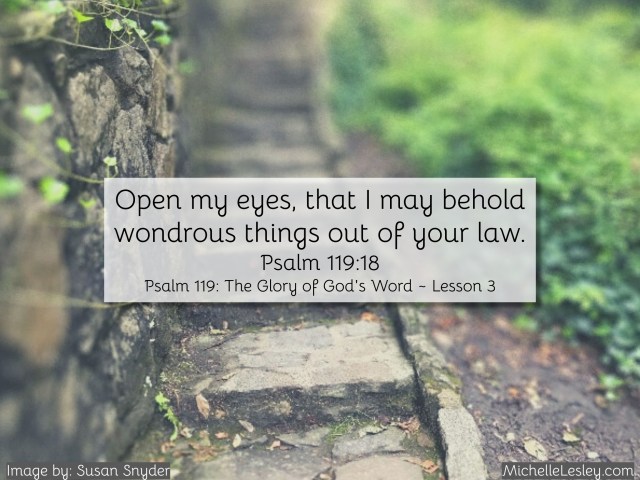
Psalm 119: The Glory of God’s Word ~ Lesson 3

Previous Lessons: 1, 2,

Read Psalm 119:17-32

Recall the things from the introductory lesson that you wanted to keep in mind as you study the text of Psalm 119.

Don’t forget to read in complete sentences instead of stopping at the end of each verse.

Questions to Consider

1. Review your notes from last week’s lesson. Does that passage relate to this week’s passage? How? Do you notice any repeated words, thoughts, or themes?

2. For what purpose does the psalmist ask God to “deal bountifully” with him? (17) When Christians today ask God to “deal bountifully” with them do you think this is what they have in mind? Is it what you have in mind?

3. Think about the approximate time period during which the psalms were written (you may wish to look back at the resources in lesson 1 – link above). Which books of the Bible would the psalmist have had access to? What two kinds of writing – poetry, historical narrative, prophecy, law, or didactic – compose the bulk of those books? (Think and answer first, then scroll down to *.) So when the psalmist uses words like “law,” “commands,” “statutes,” and “rules,” he’s usually using those terms interchangeably with “Scripture” (all of it that he had access to), but in another sense he can be referring specifically to God’s laws. In verse 18, how does he characterize God’s law? Think specifically about the law portions of the Old Testament (the 10 Commandments, Levitical law, etc.). What are some “wondrous things” you see in God’s law? What are some “wondrous things” you see in the other portions of the Scriptures the psalmist had access to?

4. Consider 20-22 together. What is God’s disposition toward those who forsake His Word? Toward those who keep it? Why does this cause the psalmist to “long after” God’s Word? What role does God’s Word play in the psalmist’s relationship with God? Make the connection between this and your own relationship with God.

5. 18, 26-27, 29 – What is the main idea of these verses? Is the psalmist asking God for better reading comprehension skills? Is He saying Scripture is so confusing he doesn’t understand what it means? What, exactly, is he asking God for? What is the illumination of Scripture? Who initiates and drives illumination (18,32)? Why do we need God to illumine Scripture to us? What role does the indwelling Holy Spirit play in illumination? Does God illumine Scripture to unbelievers? Why or why not? How does the doctrine of illumination fit with the concept that God’s Word is “living and active“? Describe the experience of God illuminating His Word to you, personally.

6. Which verses describe the comfort of God’s Word during hard times? What is the psalmist’s perspective or desire regarding God’s Word in these verses?

7. One of the themes you will probably notice in Psalm 119 is those who love and keep God’s law versus those who disobey God’s law. In what ways or verses did you see that theme in today’s passage? What are some other themes you’re beginning to notice? How does the psalmist connect Scripture to each of those themes? Watch for those themes to be repeated in future passages. You may wish to make a list of them to refer to throughout this study.

8. What does today’s passage teach us about the nature and character of God?

*Question 3: At that point in history, the psalmist would have had access to the Pentateuch (Genesis – Deuteronomy), probably Joshua, Judges, and Ruth, and possibly some or all of 1&2 Samuel and some of Psalms. The bulk of these books is historical narrative and law.


Praying Psalm 119

Have you ever tried praying the psalms? I want to encourage you to try praying part of Psalm 119 back to God each week of this study. (If you’re familiar with my other studies, this will take the place of the weekly “Homework” section.)

The psalms are uniquely suited for praying back to God, both verbatim and conceptually, because they are often written as prayers – as though the psalmist is talking to God. Did you notice that about today’s passage? In which verses?

What is a concept or thought for your own life that the Holy Spirit impressed on your heart or convicted you about from today’s passage? Is there a particular verse(s), or maybe the whole passage, that you would like to pray back to God verbatim? Whatever your “prayer point” from today’s lesson, pray it at least daily until we get to the next lesson.


Suggested Memory Verse