Sermon on the Mount Bible Study

The Sermon on the Mount: Lesson 1- Introduction

Welcome to our new study, The Sermon on the Mount!

What does God’s Word teach us about thinking biblically and developing Christian character? Jesus’ Sermon on the Mount in Matthew starts off with a list of character traits God blesses (the Beatitudes), then fleshes out how to submit to Scripture in real life scenarios in order for the Holy Spirit to grow us in those godly character traits. For the next several weeks, we’ll be working our way through the Sermon on the Mount in Matthew 5-7.

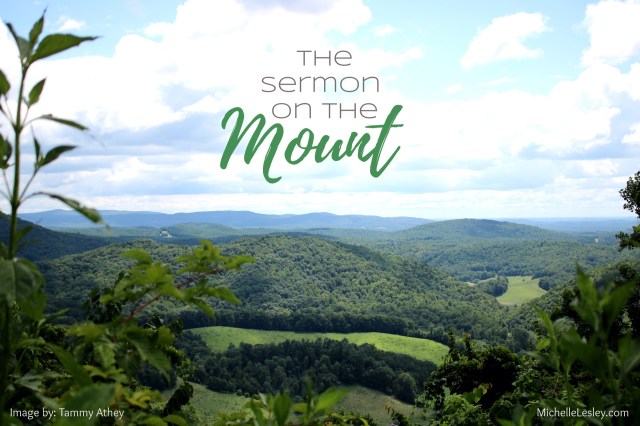
Our lovely title pic for the study was designed by Tammy Athey. The photo is her own, captured in the beautiful mountains of North Carolina. Many thanks to all of those who worked so hard on your entries for our title pic contest. You ladies were very creative and did some outstanding work! 

There were too many entries to share all of them with you, but here are a few “honorable mentions”:
If you’re new to using my Bible studies, just a few housekeeping items and helpful hints:

The studies I’ve written (you can find all of them at the Bible Studies tab in the blue menu bar at the top of this page) are like “training wheels”. They’re designed to teach you how to study the Bible for yourself and what kinds of questions to ask of the text so that, when you get the hang of it, you won’t have to depend on other people’s books and materials – even mine – any more. To that end, I do not provide answers for the study questions in the studies I’ve written.

My studies are meant to be extremely flexible and self-paced so that you can use them in the way that works best for you. You can do an entire lesson in one day or work on the questions over the course of the week (or longer). You do not need to feel obligated to answer all (or any) of the questions. If the Holy Spirit parks you on one question for several days, enjoy digging deep into that one aspect of the lesson. If He shows you something I haven’t written a question about that captures your attention, dive in and study it! Those are ways the Holy Spirit speaks to us through His Word. This is your time to commune with the Lord, not a school assignment or work project you are beholden to complete in a certain way by a certain deadline.

I will post a new lesson on the blog every Wednesday, so there is nothing to sign up for or commit to. Simply stop by the blog each week, or subscribe to the blog via e-mail to have the lessons delivered to your inbox.

I use hyperlinks liberallyThe Scriptures for each lesson will be linked at the beginning of the lesson and in the lesson questions. As you’re reading the lesson, whenever you see a word in a different color text, click on it, and it will take you to a Scripture, article, or other resource that will help as you study.

All of the studies I’ve written are suitable for groups or individuals. You are welcome to use them as a Sunday school or Bible study class curriculum (for free) with proper attribution.

You are also welcome to print out any of my Bible studies (or any article I’ve written) for free and make as many copies as you’d like, again, with proper attribution. I’ve explained more about that in this article (3rd section).


Introduction to The Sermon on the Mount

Before we begin studying a book of the Bible, it’s very important that we understand some things about that book. But even though we’re not going to be studying the whole book this time, we still need to know…

Who the author was and anything we might be able to find out about him or his background.

Who the audience of the book is: Jews or Gentiles? Old Testament Israelites or New Testament Christians? This will help us understand the author’s purpose and approach to what he’s writing.

What kind of biblical literature we’re looking at. We approach books of history differently than books of wisdom, books of wisdom differently than books of prophecy, etc.

What the purpose of the book is. Was it written to encourage? Rebuke? Warn?

What the historical backdrop is for the book. Is Israel at war? At peace? In exile? Under a bad king? Good king? Understanding the historical events surrounding a piece of writing help us understand what was written and why it was written.

When the book was written. Where does the book fall on the timeline of biblical history? This is especially important for Old Testament books which are not always arranged in chronological order.

So this week, before we start studying the actual text of the Sermon on the Mount, we need to lay the foundation to understanding the book by finding the answers to these questions.

Read the following overviews of the book of Matthew, taking notes on anything that might aid your understanding of the book, and, particularly the Sermon on the Mount and answer the questions below:

Bible Introductions: Matthew at Grace to You

Overview of the Book of Matthew at Reformed Answers

Summary of the Gospel of Matthew at Got Questions

1. Who wrote the book of Matthew? How do we know this?

2. Approximately when was Matthew written? What is the geographical setting of the book of Matthew? Here are some maps (scroll down to “Matthew”) that may be helpful as you study through the book of Matthew.

3. Who is the original, intended audience of the book of Matthew? Describe the historical setting (historic events, politics, sociology of the time, etc.) of Matthew.

4. Which genre of biblical literature is the book of Matthew: law, history, wisdom, poetry, narrative, epistles, or prophecy/apocalyptic? What does this tell us about the approach we should take when studying this book versus our approach to books of other genres?

5. What is the theme or purpose of the book of Matthew?

6. What are some of the major topics of instruction in the book of Matthew? How do these topics relate to the theme of Matthew?

7. What are some ways Matthew points to and connects to Jesus?

8. What else did you learn about Matthew or the setting of this book that might help you understand the Sermon on the Mount better?

Take some time in prayer this week to begin preparing your heart for this study. Ask God to grow you in holiness and in following the exhortations of Christ as we study together The Sermon on the Mount.

Ezekiel Bible Study

Ezekiel ~ Lesson 21- Wrap Up

Previous Lessons: 1, 2, 3, 4, 5, 6, 7, 8, 9, 10, 11, 12, 13, 14, 15, 16, 17, 18, 19, 20

Wrap Up

As we wrap up our study today, think about the things God has taught you through His Word and how you might apply them to your life.

Questions to Consider

1. Was there anything new God taught you in this study that particularly impacted you? What was it, and why was it so significant?

2. How is your walk with the Lord different after this study than it was before?

3. How has this study helped you think about living as a doctrinally sound Believer in the midst of false converts, false teachers, heretical “churches,” and all manner of ungodliness in evangelicalism today?

4. What have you learned from this study about God’s wrath against sin and sinners? How will you apply this to your personal spiritual life or to your church life?

5. What have you learned from this study about God’s desire for His wayward people to be reconciled to Him?

6. Have there been any passages or concepts in this study that God used to convict you of disobedience and lead you to repentance? How will you walk differently in this area from now on?

7. What have you learned about God and His nature and character from this study?


Homework

Spend some time in prayer this week asking God to show you how to put into practice one thing you learned from this study.

Recite all of your memory verses from this study. Which one is most meaningful to you right now?

Ezekiel Bible Study

Ezekiel ~ Lesson 20

Previous Lessons: 1, 2, 3, 4, 5, 6, 7, 8, 9, 10, 11, 12, 13, 14, 15, 16, 17, 18, 19

Read Ezekiel 46-48

Next week will be our final – “wrap up” – lesson of Ezekiel.

Questions to Consider

1. Review your notes from our last lesson and be reminded of the things that lead into, and set the stage for, this week’s passage.

2. Read chapters 46-48.

Consider lessons 18-19 (links above) alongside today’s passage. Does today’s passage seem to be a “near” prophecy (for Ezekiel’s immediate audience) or a “far” prophecy (for an audience far in the future), or both? Why?

If 46-48 is a “far,” perhaps even an eschatological (end times / eternity) prophecy, what is the significance of the emphasis on the temple, Old Testament style offerings and sacrifices, and land allotment for the twelve tribes? What about Christians and the church?

3. Explain how God’s specificity in chapter 46 about the entrances and exits, and the offerings and sacrifices, points to His specificity about how He is to be worshiped. Is it OK with God if we approach Him in worship in any old way we choose? How does this passage undergird the regulative principle of worship?

4. How does God’s precision in the measurements and the boundaries of chapters 47-48 demonstrate His attributes of precision and perfection in Creation and in the details of our daily lives? What does this attribute tell you about His knowledge, His power, and His authority over all of Creation, including people?

Compare 47:12 with Revelation 22:1-2. What similarities or differences do you see? What do these similarities and/or differences tell you?

5. In 48:11, God makes a special note of “the consecrated priests, the sons of Zadok, who kept my charge, who did not go astray when the people of Israel went astray, as the Levites did”. How does this reflect God’s attribute of justice – that He knows exactly who has done exactly what and will recompense each person accordingly?

6. Explain why today’s passage might have been a little easier to understand if you lived at the time of Ezekiel and were familiar with the temple’s structure, the sacrificial / offering system, and the geography of Israel. Why do you think God put certain things in the Bible that are difficult for us to understand conclusively? How can this help us to develop humility before God and trust in God?


Homework

Read:


Suggested Memory Verse

Ezekiel Bible Study

Ezekiel ~ Lesson 19

Previous Lessons: 1, 2, 3, 4, 5, 6, 7, 8, 9, 10, 11, 12, 13, 14, 15, 16, 17, 18

Read Ezekiel 43-45

Questions to Consider

1. Review your notes from our last lesson and be reminded of the things that lead into, and set the stage for, this week’s passage.

2. Read chapters 43-45.

Consider last week’s lesson. Does this passage seem to be a “near” prophecy (for Ezekiel’s immediate audience) or a “far” prophecy (for an audience far in the future), or both? Why?

Look up all the cross-references to the book of Revelation. In what ways does this passage in Ezekiel seem similar to the themes in Revelation?

3. Why would it have been meaningful to Ezekiel and the exiles to hear about the glory of the Lord returning to the temple (43:5, 44:4- Hint: use your cross-references.)?

Examine 43:10-11. Why would hearing Ezekiel describe the temple cause Israel to be ashamed of her sin? (10) If Israel was not ashamed of her sin, was Ezekiel to disclose the design, arrangement, etc., of the temple to her? Why? Explain why it is appropriate for God’s people to be ashamed when they have sinned.

4. Who is “the prince”? (44:3- Hint: use your cross-references. Who is “my servant, David“?) Considering that in 45:22, the prince makes a sin offering for both himself and the people, can the prince be Jesus?

How did the Levites sin, and what were the consequences for their sin? (44:9-14). How does this passage demonstrate that, though God forgives repentant sinners, He does not always remove the consequences of our sin?

How were the Levitical priests obedient to the Lord, and what were the consequences for their obedience? (44:15-31). How does this passage demonstrate that God blesses or rewards us when we obey Him?

Explain how God rewards our obedience with the blessings of (44:15-16):

  • coming near to Him
  • ministering to Him
  • standing before Him
  • making offerings to Him
  • entering His sanctuary
  • approaching His table
  • keeping His charge

What does it mean for us as Christians that Christ is our inheritance? That Christ is our possession? (44:28) Examine 44:29-45:8a. How does the priests sharing in the offering that is made to God, and the apportioning of the land to the Lord, the priests, and the prince, point ahead to the concept that Christians are joint heirs with Christ?

5. Carefully examine 45:17 and compare the prince providing these offerings to the offerings the Prince of Peace has provided.


Homework

• Read my article Guilt and Shame: Burden or Blessing?

• Think back over a time of obedience or disobedience to God in your life. What were the consequences of your disobedience? The rewards of drawing nearer to God for your obedience? What did you learn from the consequences of your obedience or disobedience? Take some time to thank God for the consequences of disobedience and the blessings of obedience.


Suggested Memory Verse

Ezekiel Bible Study

Ezekiel ~ Lesson 18

Previous Lessons: 1, 2, 3, 4, 5, 6, 7, 8, 9, 10, 11, 12, 13, 14, 15, 16, 17

Read Ezekiel 40-42

Questions to Consider

1. Review your notes from our last lesson and be reminded of the things that lead into, and set the stage for, this week’s passage.

2. Read chapters 40-42.

3. What is your initial reaction when you read a passage like this one that seems irrelevant or inapplicable to you? Sometimes when we read Bible passages like this – blueprints, genealogies, censuses, inventories, etc. – we approach them with a very “me-centered” attitude. “Why do I need to read this? What am I supposed to get out of this? How is this supposed to apply to my life?” Consider this: is it possible that God didn’t write these passages for you – at least not in the way you might be thinking? That maybe He put these passages in Scripture for another reason? What are your thoughts about that? What could some of those “other reasons” be?

Read 2 Timothy 3:16-17. Explain how chapters 40-42 could be profitable for teaching, reproof, correction, or training in righteousness. Explain how it could help make the man of God complete or equip him for good works.

4. Using your footnotes and cross references, how long is a “long cubit / a cubit and a handbreadth”? (40:5) Pick a room, feature, or item in this passage for which measurements are given in cubits, and convert the measurements to English (i.e. feet/inches) or metric measurements.

5. Compare this vision of the temple to Ezekiel’s earlier vision of the temple in chapters 8-11 (lessons 5 & 6- links above). What are some similarities and differences you note? Through the comparison and contrast of the first and second visions of the temple, what do you think God might be trying to communicate to His exiled people with this second vision?

6. What can you learn from this passage about the nature and character of God, and His care for His people? Explain how God’s specificity about how His house was to be built points to His specificity about how He is to be worshiped. Is it OK with God if we approach Him in worship in any old way we choose? How does this passage undergird the regulative principle of worship?

7. Since the temple described in chapters 40-42 has never been built, theologians have speculated on when, if, and under what circumstances it might be built in the future. Check out the following resources to study this further:

Ezekiel Sees a New Temple at Ligonier

What is the significance of Ezekiel’s temple? at Got Questions

Ezekiel’s Temple at Grace Community Church


Homework

• Your “And you/they shall know that I am the Lord” list is complete as of our last lesson. The final use of this phrase in the book of Ezekiel is in chapter 39. Review your list. What did you learn about God, His people, etc., from making this list? Why do you think God doesn’t use this phrase in chapters 40-42? For example, something like: “And they shall know that I am the Lord when they see this amazing temple.”?

• If you’re an artistic or architectural type, sketch out one of the rooms, architectural features, items, or decorative features mentioned in this passage. Then do an image search on Google for “Ezekiel’s temple,” “cherubim,” etc., to compare your drawings to other artists’ renderings.

• Read my article God’s Not Like “Whatever, Dude,” About The Way He’s Approached in Worship


Suggested Memory Verse