Mailbag

The Mailbag: Applying Twisted Scripture to Pseudo-“Christian” Events, Ideas, and Fads

The Asbury “revival”. Jesus Revolution. Bethel. The Enneagram. IF:Gathering...

Week after week, we see the ads, the social media posts, and the news stories of the latest, greatest “Christian” thing on the horizon.

Discerning Christians speak up in our churches, with our friends, and on our Facebook pages and rightly warn about the dangerous teachings and agendas these things push.

Other concerned Christians, genuinely fearing the “baby will be thrown out with the bathwater,” push back on those warnings. And sometimes, though they often have the best of intentions, they misapply Scripture or biblical principles to do so.

During the recent furor over the so-called Asbury “revival,” I saw, and was asked about, several of those misapplied Scriptures and principles employed in defense of the idea that we shouldn’t be so quick or so willing to publicly and confidently say something is not of God.

These Scriptures and principles could be applied to a myriad of things past and present, and will surely be employed again the next time a pseudo-“Christian” event, idea, or fad pops up, so let’s take a look at them and untangle them…

These Scriptures and principles will surely be employed again the next time a pseudo-“Christian” event, idea, or fad pops up, so let’s take a look at them and untangle themโ€ฆ


In response to doctrinally sound Christians decrying the Asbury event, one genuinely concerned lady asked:

What about Scripture that says “whoever is not against us is for us” in Mark 9:38-40? How do we apply this? Only God knows their heart, and Iโ€™m sure that people did come to know the Lord because of this.

There are several points in her question I’d like to address:

What about Scripture that says “whoever is not against us is for us” in Mark 9:38-40? How do we apply this?

John said to him, โ€œTeacher, we saw someone casting out demons in your name, and we tried to stop him, because he was not following us.โ€ But Jesus said, โ€œDo not stop him, for no one who does a mighty work in my name will be able soon afterward to speak evil of me. For the one who is not against us is for us.

Mark 9:38-40

Because we know that God’s Word never contradicts itself, and Jesus never contradicted Himself or Scripture during His earthly ministry, we have to understand passages like Mark 9:38-40 within the context of the entirety of the New Testament. In this case, we understand it in light of…

Not everyone who says to me, โ€˜Lord, Lord,โ€™ will enter the kingdom of heaven, but the one who does the will of my Father who is in heaven. On that day many will say to me, โ€˜Lord, Lord, did we not prophesy in your name, and cast out demons in your name, and do many mighty works in your name?โ€™ And then will I declare to them, โ€˜I never knew you; depart from me, you workers of lawlessness.โ€™

Matthew 7:21-23 (emphasis added)

โ€ฆand…

“Why do you call me โ€˜Lord, Lord,โ€™ and not do what I tell you?”

Luke 6:46 (emphasis added)

Notice Jesus is the speaker in all three of these passages. Again, Jesus did not contradict Himself during His earthly ministry.

We have to understand that there are a great many people out there who claim to be Christians and who, at first glance, look very much like Christians, but are not living in obedience to Christ, and/or are not teaching what accords with sound doctrine. Scripture calls those people liars and false teachers.

So when Jesus says in Mark 9:38-40 and other passages, that whoever is not against Him is for Him and vice versa, He’s defining “for Him” as someone who’s genuinely regenerated, obedient to Scripture, and teaching sound doctrine. Everybody else, regardless of what they might claim, is against Him according to Scripture.

You might think of it like this. When the disciples came to Jesus and said, “We tried to stop those guys because they aren’t part of our group,” and Jesus said, “Don’t. They’re still ‘with’ us,” it would have been similar to Him saying, “Don’t stop them. They’re doctrinally sound Presbyterians. We’re doctrinally sound Baptists. We preach the same gospel. We’re on the same team.”.

What He would not have been saying would have been something like, “It’s OK that they’re [Catholic, Mormon, prosperity gospel, New Apostolic Reformation, or any other heretical religion that claims to worship Jesus]. They say they love Me, so don’t stop them. Maybe some good will come out of this and a few people will get saved.”

Every week during his pastoral prayer, my pastor leads us to pray for a sister church in the area, and in his prayer, he always says, “Lord, we thank you that we are not the only expression of a Bible believing, God honoring, Christ exalting, Spirit filled church in this area.”

It’s kind of like that.

Only God knows their heart…

That’s not an excuse for failing to exercise discernment as Scripture commands us. God doesn’t require us to know other people’s hearts. He does require us to evaluate their observable behavior and teaching, compare it to Scripture, and stay away from it, warn others about it, and eradicate it from the church if it’s false.

“Only God knows their heart” is not an excuse for failing to exercise discernment as Scripture commands us.

…and Iโ€™m sure that people did come to know the Lord because of this.

1. That’s speculation on your part. Is it possible some people did get genuinely saved at this event? Yes, but we don’t have any proof of that. It’s an assumption.

2. The only way someone could have gotten saved at this event is if she heard the biblical gospel of law and grace, sin and repentance, and Jesus’ vicarious life, death, burial, and resurrection explicitly preached or explained. Here’s the biblical gospel. Was it proclaimed and explained at this event? If not, no salvations took place.

3. That idea is pragmatism. People come to Christ in all sorts of horrible situations and under all sorts of horrible teaching. People came to Christ in concentration camps, while they were still Muslims, in Catholic “churches,” while working as prostitutes, while practicing homosexuality, etc. The fact that people get saved while in those horrible situations or under that horrible teaching doesn’t magically make those situations and that teaching good. It means that God is so good and powerful and merciful that, through the power of His Word, He can save someone out of those situations and teaching.


But if even one person got saved, wasn’t it worth it?

Let me begin my answer to that question with another question.

Did you know that several medical procedures that have saved the lives of many people were discovered in World War II concentration camps by performing torturous experiments on inmates? Does the fact that those medical procedures have helped so many people justify the torture the Nazis inflicted on their victims?

Of course it doesn’t. Neither does one person (or even a bunch of people) getting saved excuse, nullify, justify, or make sin and false teaching “worth it”.

Stop and take a few moments to meditate on how high, and holy, and worthy of all honor, glory, majesty, praise, and reverence is God, the almighty King of the universe. Think about the excruciating pain Jesus went through on the cross, and the agony of having every drop of God’s wrath against sin poured out on Him. So that He might bear your sin and mine. So that we could be forgiven and free and saved from an eternity in Hell.

How could we ever say that the sewer slime of committing any sin against that God is “worth it,” no matter what the outcome might be?

No. A blasphemy-fest isn’t “worth it”. God doesn’t consider false teaching “worth it” if someone gets saved. He’s perfectly capable of saving everyone He means to save without such events.


You discerning Christians speaking out against this event should just back off like Gamaliel suggested in Acts 5 and let it play out. If it’s not of God, it will come to nothing.

So in the present case I tell you, keep away from these men and let them alone, for if this plan or this undertaking is of man, it will fail; but if it is of God, you will not be able to overthrow them. You might even be found opposing God!โ€

Acts 5:38-39

{Be sure to read that passage in its entirety (Acts 5:17-42), so you can get the context and all the details.}

Sisters, we’ve got to get it through our heads that the book of Acts is largely historical narrative like Genesis or Judges or Nehemiah. Not only that, it is also a historical narrative of transition from Old Testament Judaism to New Testament Christianity. Many of the things we read about in Acts are not to be understood as normative of, or instruction to the church today. (Those sorts of things are mainly in the pastoral epistles – 1&2 Timothy and Titus.)

Such is the case with the Gamaliel passage in Acts 5. This is a descriptive passage (it simply tells us what happened), not a prescriptive passage (instructions for us to follow). And be thankful for that, because the disciples get beaten a lot in Acts 5.

Nowhere in God’s didactic instruction to the New Testament church does He tell us to back off an event or teacher that claims to be “Christian” and just let things play out. Nowhere. Instead, we repeatedly see instruction throughout the New Testament (and even the Old Testament) to be wise and discerning, test the spirits, and have nothing to do with false teachers, either as individuals or the church.

We also have to take into account that Gamaliel was a Pharisee who was still hanging out with the rest of the Council. Know what that means? He wasn’t a Believer. You take Gamaliel’s advice, and you’re taking the advice of a lost person – over God’s instructions – about how to handle a situation in the church.

Gamaliel is not the hero of this story. If he were, he would have believed the gospel the disciples proclaimed, and prevented the Council from beating them and forbidding them to preach. And he probably would have suffered the same consequences the disciples suffered.

Gamaliel isn’t the hero of this story. If he were, he’d have believed the gospel the disciples proclaimed, and prevented them from being beaten & forbidden to preach. And he probably would have suffered the same fate as the disciples.

Finally, though Gamaliel, in his limited experience, could cite a couple of instances in which this rubric seemed to work, we have the advantage of looking back across much more history, over many more years, and in many more places, and we can see that his advice doesn’t always work. How long has Islam been hanging around? Hinduism? Mormonism? Buddhism? Catholicism? Certainly none of those religious movements are of God, and still, here they all are.

Don’t take Gamaliel’s advice in these situations, submit to God’s instructions to the church.


Be careful that you are not calling what is of God as not. Very serious thing to do.

It may not always be meant this way, but this kind of warning can come across as a veiled threat.

Be careful you are not calling something “of God” when it is not. That is also a very serious thing to do, especially if what you’re basing your conclusion on is your feelings, opinions, experiences, and out of context, misapplied Scripture, rather than on rightly handled, in context Scripture.


God can bring good out of anything!

Of course He can. God is out for His glory and the good of His people. But that doesn’t make the situation or false teaching itself good or excusable or that we shouldn’t warn against it if it’s bad. Scripture says the opposite.

When God sovereignly brings something good and holy out of a bad or sinful situation, it doesn’t mean that bad or sinful situation is good and holy. It means God is good and holy.

For example: A Mormon who studies her Bible and/or is evangelized can get genuinely saved while still in Mormonism. (And God will save her out of Mormonism.) That doesn’t make Mormonism Christian or good or biblical. That means God is good and merciful and kind.

When God sovereignly brings something good and holy out of a bad or sinful situation, it doesn’t mean that bad or sinful *situation* is good and holy. It means *God* is good and holy.

Be ready. The next “Christian” thing is just around the corner. Study your Bible and be prepared to correctly apply rightly handled Scripture as you carefully evaluate it according to God’s Word.


If you have a question about: a Bible passage, an aspect of theology, a current issue in Christianity, or how to biblically handle a family, life, or church situation, comment below (Iโ€™ll hold all questions in queue {unpublished} for a future edition of The Mailbag) or send me an e-mail or private message. If your question is chosen for publication, your anonymity will be protected.

Discernment

Asbury, Revival, and Discernment

Have you been hearing about this “Asbury Revival” thing lately, and wondering what it is? Is it a “real” revival? Is it biblical? Are people getting saved? These are just a few of the questions Christians have been asking as video, eyewitness accounts, and, undoubtedly, a good deal of speculation have made their way out of Kentucky to other parts of the country.

I would encourage you to examine the resources below and compare everything to rightly handled, in context Scripture. This is a way of testing the spirits as Scripture commands us, rather than simply believing every spirit that comes along.

Beloved, do not believe every spirit, but test the spirits to see whether they are from God, for many false prophets have gone out into the world.

1 John 4:1

To help you practice your discernment, here (and throughout this article) are some questions to keep in mind as you read about and watch the “Asbury revival”:

๐Ÿ”ฅWhere does the Bible say that, in context, and rightly handled? Does the Bible really say that?

๐Ÿ”ฅIs what I’m reading objective, rightly handled, in context Scripture, or someone’s subjective personal experiences, opinions, feelings, or preferences? Which am I hearing more of?

๐Ÿ”ฅCould what I’m reading about have been replicated by a non-Christian person, event, or experience?

๐Ÿ”ฅWho, or what, is my attention being drawn to – Jesus and His written Word, or people, opinions, feelings, and experiences?

๐Ÿ”ฅA good, biblical approach to evaluating events like this, initially, is to “wait and see” what will transpire. We don’t want to make snap, uninformed judgments, but when there’s the possibility that spiritual damage could be done, at what point have we waited long enough and seen enough evidence that it is time to stop waiting and start warning?

What’s this all about?

“The 2023 Asbury Revival is an ongoing Christian revival at Asbury University in Wilmore, Kentucky. The event was prompted after students spontaneously stayed in Hughes Auditorium following a regularly scheduled chapel service on 8 Feb. 2023. News of the phenomena was quickly spread on social media and in Christian online publications. The revival has been compared to similar revivals at Asbury, notably one that occurred in 1970, which had far-reaching consequences in Methodism, US culture, and in the growth of the Jesus movement. The revival is noted for its use of social media, as the participants are mainly members of Generation Z.” 2023 Asbury Revival, Wikipedia

(Normally, I would not use Wikipedia as a resource, but after sifting through a dozen or so news stories for one that wasn’t slanted, didn’t drown the reader in tons of superfluous information, and simply presented the basic facts, unbelievably, Wikipedia is what I was left with. There are a few more details and a decent timeline of events at the link above.)

Entering week three, Asbury President Kevin Brown issued an announcement that the event will end on Wednesday, February 22. Asbury revival in Kentucky will end after two weeks of non-stop services, worship, Lexington Herald Leader

Theological Foundation, Background, and Context

๐Ÿ”ฅAre all of Asbury’s doctrines and practices biblical? If not, which ones, and why?

๐Ÿ”ฅConsider the following passage as you learn about Asbury’s doctrine and practices. Which parts of what you will read below are “tree,” and which parts are “fruit”? According to Scripture, does Asbury seem to be a healthy tree that will bear good fruit, or a diseased tree that will bear bad fruit?

You will recognize them by their fruits. Are grapes gathered from thornbushes, or figs from thistles? So, every healthy tree bears good fruit, but the diseased tree bears bad fruit. A healthy tree cannot bear bad fruit, nor can a diseased tree bear good fruit. Every tree that does not bear good fruit is cut down and thrown into the fire. Thus you will recognize them by their fruits.

โ€œNot everyone who says to me, โ€˜Lord, Lord,โ€™ will enter the kingdom of heaven, but the one who does the will of my Father who is in heaven. On that day many will say to me, โ€˜Lord, Lord, did we not prophesy in your name, and cast out demons in your name, and do many mighty works in your name?โ€™ And then will I declare to them, โ€˜I never knew you; depart from me, you workers of lawlessness.โ€™ Matthew 7:16-23

Asbury University has “its roots in the American Methodist and holiness tradition.” Here is their theological foundation as explained by Asbury University: Wesleyan-Holiness Theology

Briefer and more contemporary: Who are the Wesleyans, and what are the beliefs of the Wesleyan Church?

Though Asbury University retains many biblical standards on paper, genearally speaking, Wesleyans are Arminian, egalitarian rather than complementarian, pro-abortion, pro-homosexuality, and social justice oriented. They tend toward theological “progressivism” – the liberal end of the theological spectrum rather than the conservative end.


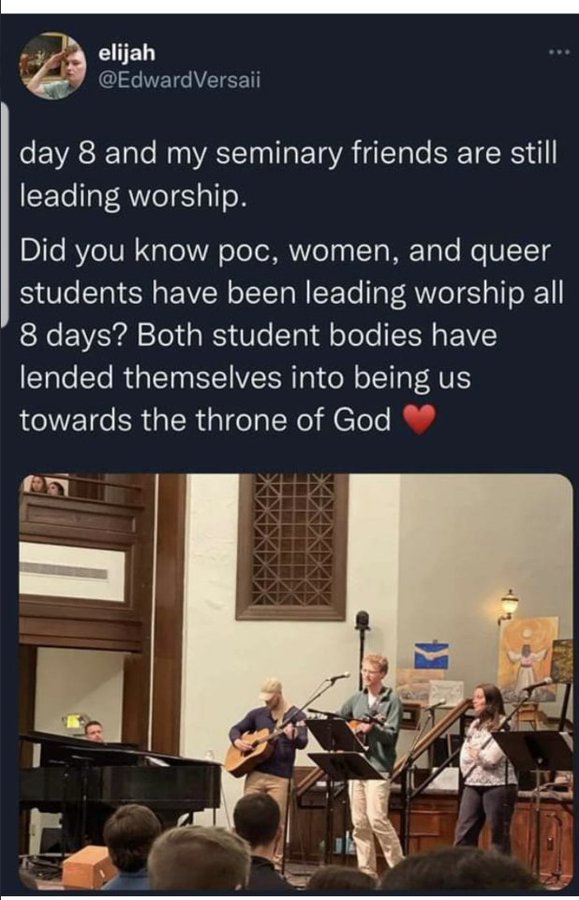
And, indeed, there are openly homosexual students at Asbury, and they have been helping lead this event. From an Asbury student:

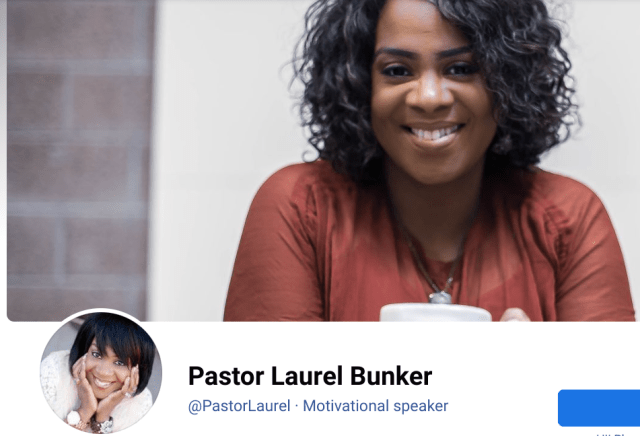
And here is “Pastor” Laurel Bunker, who is scheduled to preach at chapel on March 20, 2023 – just one of the numerous women they regularly have preach.


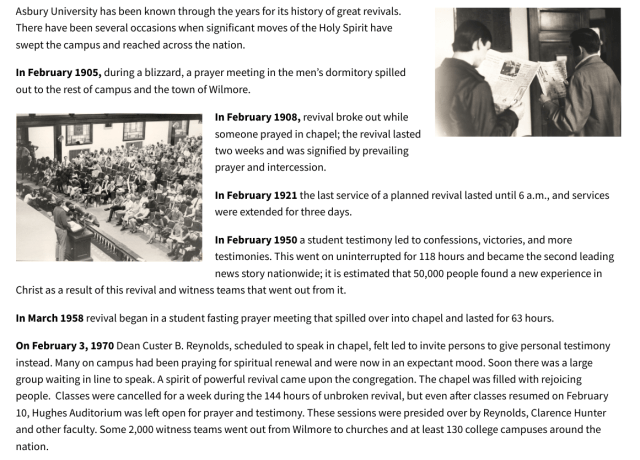
Asbury University also has a history of recurring spiritual events which they have dubbed “revivals” and attribute to the Holy Spirit. From the Asbury University website:

Notice anything about the dates of these events? They all occurred near the time of the Collegiate Day of Prayer, which is always the last Thursday of February. This has raised questions as to whether or not these events may have been at least somewhat contrived or encouraged. Coincidentally or not, Asbury University is hosting the 200th anniversary simulcast for the Collegiate Day of Prayer on Thursday, February 23 – the day after the current “revival” is scheduled to end.

Content of the Meetings

๐Ÿ”ฅWhat does the Bible say about the way we are to worship? How does the content of the Asbury meetings measure up against Scripture’s commands and instructions for biblical worship?

What’s being called the “Asbury revival” started after a regular weekly chapel service. This is the message that was preached during that chapel service that apparently got things going.

Many people have said that the gospel was preached during this sermon. Many others have said the gospel appeared nowhere in this sermon.

This is the gospel:

You are a sinner. You were born in sin and rebellion against the holy God of the universe, and youโ€™ve also willfully chosen to break His law. Youโ€™ve lied. Youโ€™ve wanted and taken things that didnโ€™t belong to you, which is coveting and stealing. Youโ€™ve lusted after someone, which Jesus said is committing adultery in your heart. Youโ€™ve been sinfully angry, which Jesus says is committing murder in your heart. Youโ€™ve dishonored your parents. And thatโ€™s only 6 of the 10 Commandments.

James 2:10 says, โ€œFor whoever keeps the whole law but fails in one point has become guilty of all of it.โ€ So youโ€™re guilty of breaking all of Godโ€™s law.

When you break the law, justice must be meted out. And the just punishment for rebellion against God is an eternity in Hell, which all of us richly deserve. And you can take that eternal death sentence for your sin, and serve it yourself if you want to, but God, who is rich in mercy, has provided another way out. A better way out. He sent His son, Jesus, to earth to live a perfect sinless life so He could take your death penalty for you. And thatโ€™s just what He did on the cross. He died in your place. He took the punishment for your sin. And then he rose bodily from the grave on the third day afterward.

If you want to be right with God, have your sins forgiven, and stand clean before Him now and when you die, confess your sin and rebellion against Him. Sorrowfully turn your heart and life away from sin and toward Him, believing that Jesusโ€™ death, burial, and resurrection paid the penalty for your sin, and you ask Him to save you. And He will.

(For a more extensive version of the gospel with more Scripture references click the What Must I Do to Be Saved? tab in the blue menu bar at the top of this page.)

๐Ÿ”ฅWas the gospel preached during this message? Did you hear about sin, repentance, God’s law, Christ’s life, death, burial, and resurrection for your sin, and God’s grace, mercy, and forgiveness? Can people get genuinely saved without hearing the full biblical gospel?

While many people have stood and spoken in front of those assembled, there have been conflicting reports about whether or not any further sermons have been preached.

Not all public speaking, even in a Christian or church setting, is preaching. To preach is to point the congregation to Christ and His written Word by taking a passage of Scripture and teaching, exegeting, expositing, and proclaiming it. Rightly handled Scripture is the substance around which a sermon revolves. Other forms of Christian speaking – such as personal testimonies, public prayer, words of encouragement, and merely reading or alluding to Scripture – are valid and appropriate at times, but they are not the same thing as preaching a sermon.

Below is the livestream of the Asbury meeting.

๐Ÿ”ฅWhich types of speaking do you see and hear? Preaching? Teaching Scripture? Personal testimonies? Is the speaker teaching and explaining Scripture, speaking about personal thoughts and experiences, speaking about the experience of the “revival” itself? Do you see more singing and prayer or more preaching?

๐Ÿ”ฅConsider this passage as you listen to the speakers in the livestream:

For โ€œeveryone who calls on the name of the Lord will be saved.โ€ How then will they call on him in whom they have not believed? And how are they to believe in him of whom they have never heard? And how are they to hear without someone preaching? And how are they to preach unless they are sent? As it is written, โ€œHow beautiful are the feet of those who preach the good news!โ€ But they have not all obeyed the gospel. For Isaiah says, โ€œLord, who has believed what he has heard from us?โ€ So faith comes from hearing, and hearing through the word of Christ. Romans 10:13-17

๐Ÿ”ฅCould someone hear the full gospel and get saved through what any of the speakers are saying? Why or why not?


There have been a number of reports that the nearly perpetual music during the meetings has largely been songs from Bethel, Hillsong, and Elevation. What do you observe in the livestream?

๐Ÿ”ฅHave all of the songs’ lyrics been doctrinally sound according to Scripture? Is God pleased when we use music from heretical sources to worship Him even if the lyrics of a particular song don’t conflict with Scripture?


One of the concerns early on in the meetings was that rank heretics of the worst order such as Todd Bentley, Rodney Howard Browne, Tasha Cobbs, and Greg Locke were attracted to and enjoyed attending the Asbury meetings. Some speculated that they attended in order to gain some sort of power, take over the meetings, or garner attention for themselves.

๐Ÿ”ฅWould such demonically controlled people have shown up at a “revival” meeting at any doctrinally sound church you can think of where the gospel was being preached and Scripture was being rightly handled? If they had, what impact should that have had on them, spiritually?

False teacher Todd Bentley posts he is โ€˜booked to spend several daysโ€™ at โ€˜Asbury revivalโ€™ โ€” university says he was not invited to speak

OP Continued: “…This happens when people get hungry for more of God. Many will refer to this as a sovereign move of God, however God sovereignly moved 2000 years ago on the day of Pentecost, and he has never stopped. He is still moving today. Canโ€™t wait to hear all the critics, the controllers or better yet the opportunists who would love to co-opt what God does. Let this shut down the whole university! Let the fire continue to fall & spread! #Revival #HolySpirit #Awakening @AsburyUniv

In addition to the worst of the worst evangelical heretics, several in Catholic leadership have attended the meetings and spoken glowingly about them. (Catholicism is not Christianity. Those who hold to Catholic doctrine – and we certainly would expect Catholic leaders to hold to Catholic doctrine – are not Christians because Catholicism anathematizes the biblical gospel.)

‘Jesus was right next to me’: Asbury revival sets Catholics on fire with Holy Spirit

๐Ÿ”ฅIs it possible for an unbeliever who anathematizes the biblical gospel (i.e. believes and teaches that anyone who believes the biblical gospel is condemned to Hell) to be “set on fire with the Holy Spirit”? According to Scripture, what is the function of the Holy Spirit in the life of an unbeliever?


There has been one (that I’m aware of) instance of someone allegedly exorcising a demon during the meetings. If you’re familiar with the trappings of the New Apostolic Reformation, you know that what you see in the video below goes hand in glove with the NAR’s heretical theology of “spiritual warfare”.

๐Ÿ”ฅDoes a “tree” (see Matthew passage above) of sound doctrine produce heretical fruit? Would this type of incident be likely to happen at any doctrinally sound church you know of? If not, why not? If so, how would it have been handled by the pastors and elders?

What Other Biblically Trustworthy Voices Are Saying

๐Ÿ”ฅSome have said it’s sinful or wrong to biblically critique the Asbury meetings without physically going there to experience it personally in real time. Does the Bible require us to be physically present while something is happening in order to experience it personally before making informed, biblical evaluation, observation, or critique?

If yes, have you ever evaluated the Holocaust or slavery as sinful? Have you ever said that Mormonism, Hinduism, Satanism, etc., were unbiblical, having never practiced one of those religions yourself? Consider this passage in which Jesus comments on events at which He was not physically present.

The Mailbag: Applying Twisted Scripture to Pseudo-โ€œChristianโ€ Events, Ideas, and Fads

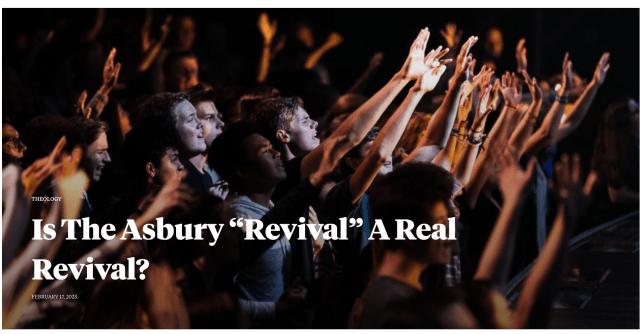
Is The Asbury โ€œRevivalโ€ A Real Revival? by Samuel Sey

Let’s have some real talk about this whole Asbury revival thing. We’ll start with a lesson from the Western Front. at Not the Bee

The Asbury Revival: observations from a local pastor at The Cripplegate

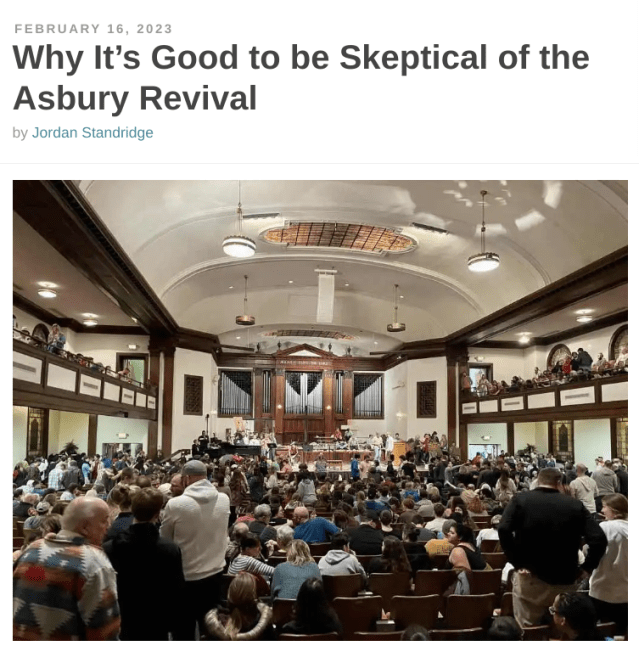
Why Itโ€™s Good to be Skeptical of the Asbury Revival at The Cripplegate

Can Anything Good Come Out of Asbury?

๐Ÿ”ฅConsider these passages. God is able to take any sin, any false doctrine, any bad situation, and use it for His glory and our good. What are some scripturally good, doctrinally sound things that could happen as a result of the meetings at Asbury?

๐Ÿ”ฅWhat are some things doctrinally sound Christians and churches could do to reach out to and help the students at Asbury?

๐Ÿ”ฅWhen someone hears the biblical gospel and gets genuinely saved while still a member of a “bad tree” belief system or a follower of a false teacher, does she stay in that unbiblical environment or does God grow her and bring her out of it? What is something you could do to share the gospel with and disciple someone caught in a false belief system?