
Wednesday's Word

Wednesday’s Word ~ 2 Kings 7

2 ki 7 9

2 Kings 7

But Elisha said, “Hear the word of the Lord: thus says the Lord, Tomorrow about this time a seah of fine flour shall be sold for a shekel, and two seahs of barley for a shekel, at the gate of Samaria.” Then the captain on whose hand the king leaned said to the man of God, “If the Lord himself should make windows in heaven, could this thing be?” But he said, “You shall see it with your own eyes, but you shall not eat of it.”

Now there were four men who were lepers at the entrance to the gate. And they said to one another, “Why are we sitting here until we die? If we say, ‘Let us enter the city,’ the famine is in the city, and we shall die there. And if we sit here, we die also. So now come, let us go over to the camp of the Syrians. If they spare our lives we shall live, and if they kill us we shall but die.” So they arose at twilight to go to the camp of the Syrians. But when they came to the edge of the camp of the Syrians, behold, there was no one there. For the Lord had made the army of the Syrians hear the sound of chariots and of horses, the sound of a great army, so that they said to one another, “Behold, the king of Israel has hired against us the kings of the Hittites and the kings of Egypt to come against us.” So they fled away in the twilight and abandoned their tents, their horses, and their donkeys, leaving the camp as it was, and fled for their lives. And when these lepers came to the edge of the camp, they went into a tent and ate and drank, and they carried off silver and gold and clothing and went and hid them. Then they came back and entered another tent and carried off things from it and went and hid them.

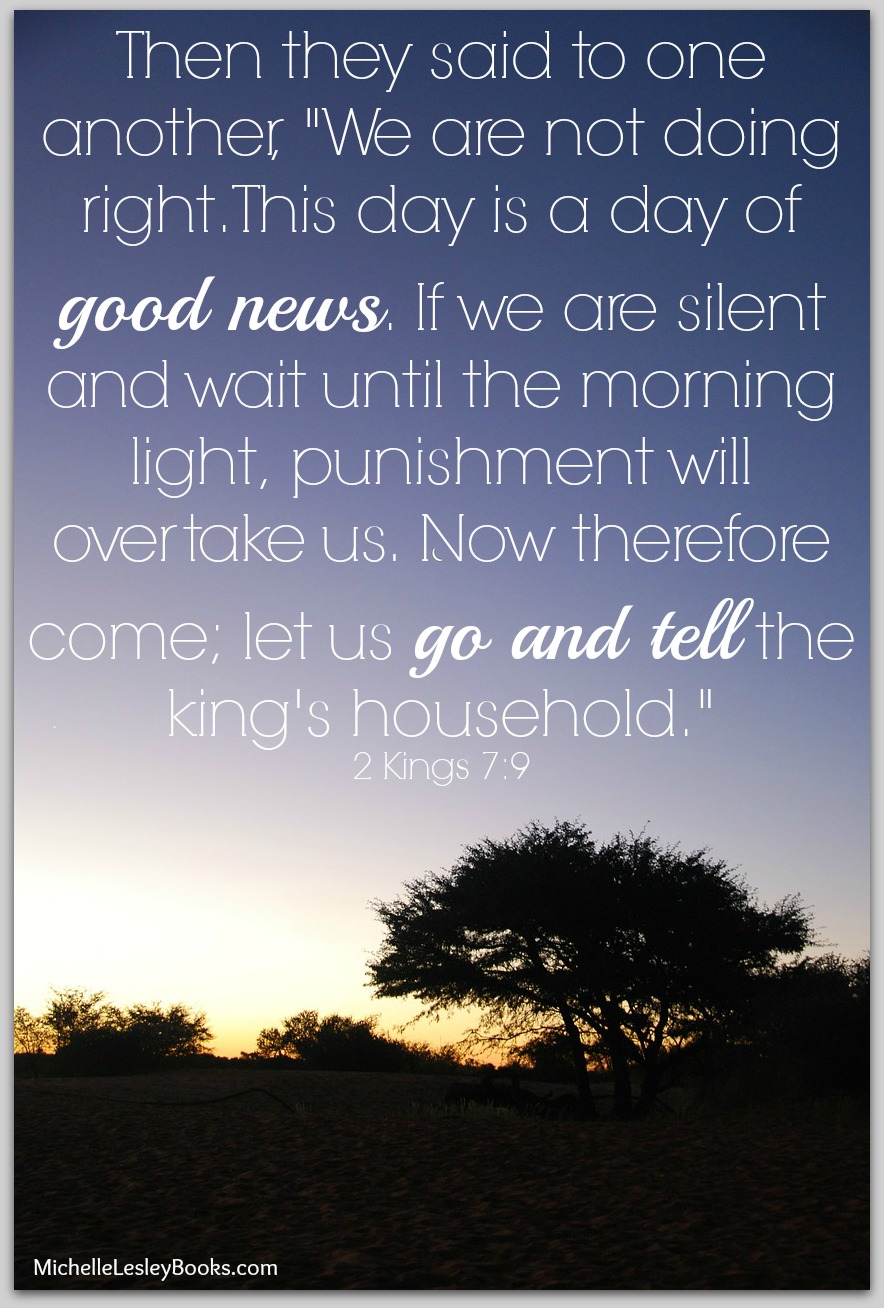
Then they said to one another, “We are not doing right. This day is a day of good news. If we are silent and wait until the morning light, punishment will overtake us. Now therefore come; let us go and tell the king’s household.” 10 So they came and called to the gatekeepers of the city and told them, “We came to the camp of the Syrians, and behold, there was no one to be seen or heard there, nothing but the horses tied and the donkeys tied and the tents as they were.” 11 Then the gatekeepers called out, and it was told within the king’s household. 12 And the king rose in the night and said to his servants, “I will tell you what the Syrians have done to us. They know that we are hungry. Therefore they have gone out of the camp to hide themselves in the open country, thinking, ‘When they come out of the city, we shall take them alive and get into the city.’” 13 And one of his servants said, “Let some men take five of the remaining horses, seeing that those who are left here will fare like the whole multitude of Israel who have already perished. Let us send and see.” 14 So they took two horsemen, and the king sent them after the army of the Syrians, saying, “Go and see.” 15 So they went after them as far as the Jordan, and behold, all the way was littered with garments and equipment that the Syrians had thrown away in their haste. And the messengers returned and told the king.

16 Then the people went out and plundered the camp of the Syrians. So a seah of fine flour was sold for a shekel, and two seahs of barley for a shekel, according to the word of the Lord. 17 Now the king had appointed the captain on whose hand he leaned to have charge of the gate. And the people trampled him in the gate, so that he died, as the man of God had said when the king came down to him. 18 For when the man of God had said to the king, “Two seahs of barley shall be sold for a shekel, and a seah of fine flour for a shekel, about this time tomorrow in the gate of Samaria,” 19 the captain had answered the man of God, “If the Lord himself should make windows in heaven, could such a thing be?” And he had said, “You shall see it with your own eyes, but you shall not eat of it.” 20 And so it happened to him, for the people trampled him in the gate and he died.


The Holy Bible, English Standard Version Copyright © 2001 by Crossway Bibles, a division of Good News Publishers.


Questions to Consider:

1. What events led up to this story? Why was the situation so dire?

2. Why did Elisha tell the king’s captain he would not eat of the food the next day? (v.2) Did the captain’s statement show faith or doubt? What ended up happening to the captain? (v. 18-20)

3. How do the lepers (v.3-4) symbolize people, pre-salvation, who are lost and dying and on their way to hell? Which of their words and actions symbolize a sinner throwing himself on the mercy of Christ? What might their actions in verse 8 prefigure for a new Christian?

4. What were the lepers doing that was not right? (v.9) Is it right for Christians to keep the good news of the gospel to themselves? Do you see any parallels between the lepers’ story and the story of the prodigal son?

5. Elisha’s words from verses 1-2 came true in verses 17-20, and he continually pointed Israel back to the one true God. This tells us that God really was speaking through him and he was a true prophet. Contrast this with the two proofs of a false prophet in Deuteronomy 13:1-3 and 18:20-22. Have you ever heard a modern day “prophet” give a prophecy that did not come true or point people to a “God” or a “Jesus” that doesn’t match up with what Scripture says about Him?

Idolatry, Old Testament, Sunday School, Worship

Israel Is Exiled ~ Sunday School Lesson ~ 7-20-14

PicsArt_1405907394797

These are my notes from my ladies’ Sunday School class this morning. I’ll be posting the notes from my class here each week. Click here for last week’s lesson.

Through the Bible in 2014 ~ Week 29 ~ July 13-19
2 Chronicles 27-31, Isaiah 9-27, Micah, 2 Kings 16-18:8, Psalm 48
Israel is Exiled

2 Kings 17:1-20
Second Kings 17 is sort of the “Cliff Notes” version of Israel’s era of the kings. We have read about each king of Israel, all of whom “did what was evil in the sight of the Lord.” Second Kings 17 sums up the effect these evil kings had on Israel’s relationship with God and the consequences for their idolatry.

Israel’s Sin
The sin that brought God’s judgment upon Israel was idolatry. Israel participated in idolatry in two different ways, usually at the same time:

They worshiped false gods instead of the true God. (12,16-17)
As Israel got to know her pagan neighbors, she began to worship some of their false gods such as Ashera, Baal, Molech, and the stars and planets. This was expressly forbidden by God in the 10 Commandments and throughout the Old Testament. While other nations often worshiped many gods, Israel was to be holy and set apart to the one true God and serve only Him.

They worshiped the true God in false ways. (16, 1 Corinthians 14:40, 2 Corinthians 9:7, 1 Corinthians 5, 1 Timothy 2:12-14, 1 Timothy 3, Titus 1, 1 Corinthians 11:17-33)
You will recall the two golden calves Jeroboam had set up in the north and south for the people to worship. He wanted to keep the Israelites from traveling out of Israel into Judah to worship at the temple because he did not want the people to turn their loyalty back to the throne of David. So he took the worship and festivals God had set up for Himself and transferred them to these two calves. The calves were basically a stand in for God.

God was very specific about how, when, and where He was to be worshiped. When we studied Exodus and Leviticus, we saw hundreds of instructions about God’s house, the utensils, the men who served as priests and Levites, the offerings and sacrifices, cleansing rituals, and on and on. God requires that He be worshiped in certain ways. His ways. He did not leave it up to His people to worship Him freestyle.

Even today, God has given us specific instructions about worship that we are to obey. For example, He tells us that, in the church, all things are to be done decently and in order (1 Cor. 14), that we are to give our offerings cheerfully and not reluctantly or under compulsion (2 Cor. 9), that we are to discipline, not tolerate, unrepentant sin in the church (1 Cor. 5), that women are not to instruct or hold authority over men in the church (1 Tim. 2), the qualifications for pastors and elders (1 Tim. 3, Tit. 1), instructions about the Lord’s Supper (1 Cor. 11), and so many more things. Although God has given us freedom in some areas of worship, as long as they do not violate any specific instructions He has given us (music style, order of service, what we wear to church, etc.), He has not turned us loose to worship Him in any way we please. We must be careful not to do this as the Israelites did.

God’s Patience (1 Peter 3:20, 2 Timothy 4:1, 2 Peter 3:9, Romans 2:4, 2 Corinthians 6:2)
After Solomon died, Israel and Judah split into two separate kingdoms. In the 209 years between Solomon and the exile (931-722 B.C.), Israel had twenty kings, all of whom participated in and promoted idol worship among the people of Israel. During that time period, God sent at least seven prophets (Ahijah, Jehu, Elijah, Micaiah, Elisha, Amos, and Hosea) to warn Israel to turn back from her idolatry and the consequences if she would not. Two hundred and nine years. That’s a lot of chances God gave His people to repent and turn back to Him.

God has a track record of patience. First Peter 3:20 tells us “God’s patience waited in the days of Noah, while the ark was being prepared.” God stayed His hand of judgment for 120 years while Noah was building the ark, preaching repentance with every swing of the hammer. In His mercy, God was giving the people of Noah’s day a chance to repent and turn to Him before the flood, but none did, except Noah’s family.

In the same way, God has been patient with mankind for the last 2000+ years since He provided the way of salvation for us through Jesus.

Second Timothy 4:1 tells us that Christ will return to judge the living and the dead, but what’s taking Him so long?

Second Peter 3:9 says: “The Lord is not slow to fulfill his promise as some count slowness, but is patient toward you, not wishing that any should perish, but that all should reach repentance.”

He wants everyone to turn to Him in repentance, but we are not to take advantage of His patience and continue in sin. Romans 2:4 says, “Or do you presume on the riches of his kindness and forbearance and patience, not knowing that God’s kindness is meant to lead you to repentance?”

“For he says, ‘In a favorable time I listened to you, and in a day of salvation I have helped you.’ Behold, now is the favorable time; behold, now is the day of salvation.” (2 Corinthians 6:2). In the same way that Israel should have repented immediately because they didn’t know how long God’s patience with them would last, we must turn to Him now instead of later because we do not know when He is coming back. And once He does, it will be too late for those who have not put their trust in Christ.

God’s Judgment (18-20)
God’s time of patience with the ungodly always comes to an end. It happened with Noah, and here we see it happening with Israel. God’s judgment fell upon Israel. He allowed them to be torn apart by enemy nations, and, finally, exiled from the Promised Land to Assyria. Judah held out for a while with a few good kings, but eventually, she followed in Israel’s footsteps and was exiled to Babylon in 605 B.C.

But even in exile, there were those few faithful Israelites and Judahites whom God saved: Daniel, Nehemiah, Esther, Ezra, and many others whose names we don’t know. Today, despite persecution and rampant sin in the visible church, God is still preserving a remnant of Christians who are faithful, whom He will preserve when He brings the final judgment upon the earth. Until that time, the words of Jesus are just as relevant today as when He said them 2000 years ago:

“The time is fulfilled, and the kingdom of God is at hand; repent and believe in the gospel.” Mark 1:15