The mission of the Shepherds’ Conference is to provide the opportunity for men in church leadership to be challenged in their commitment to biblical ministry and to find encouragement as together we seek to become more effective servants of our chief Shepherd.
You don’t have to be a pastor or church leader to enjoy good preaching from mighty men of God, and that’s just what you’ll get if you click here. Conference sermons from John MacArthur, Mark Dever, Steve Lawson, Phil Johnson, Paul Washer, and more! Also available as an iTunes app. (Translated into several languages, so share with your international friends!)
OK, so this one is aimed at pastors, too. But I’ve been “eavesdropping” and learning a lot. I would highly recommend this brief weekly podcast from 9Marks Ministries for pastors and church members. It’ll help you understand some of the things your pastor has to deal with, why he does things the way he does them, how a biblically healthy church should function, and so on. Maybe it’ll even help you help your pastor. Click here to listen. (Also available on iTunes.)
Should Christians boycott businesses or charities that financially support abortion, homosexual marriage, or other unbiblical things?
This question has gotten a lot of attention lately because of the ice bucket challenge and the ALS charity that funds embryonic stem cell research. I think whether or not to boycott a business or charity is something every Christian needs to decide for herself based on Scripture and her own conscience. Some good Scriptures to study to help with your decision are 1 Corinthians 8 and 10:23ff, and Romans 14:5-12.
Since there’s no one right answer to this question, I’d like to just share with you how I have come to handle it in my life, in case it might be helpful.
I used to do boycotts (I was on an e-mail list that was basically a constant call to boycott this or that business), but it got to the point where there were so many companies and subsidiaries of those companies that donate here and there to unacceptable causes that it was impossible to track all of them down and keep up with them all. Since I would have felt like a hypocrite for boycotting one company but not another, I amended my “policy” on boycotting:
1. I don’t boycott places where I get necessities for my family–phone company, grocery stores, gas stations, etc. If there were a very big public splash about one of these places supporting something unacceptable and I had another option, I might reconsider a boycott.
2. If there’s an alternative to a “boycottable” business, I take it. For example, I would not donate to Komen because they support Planned Parenthood, but I might donate to another cancer/breast cancer charity that doesn’t.
3. If it’s not a necessity and there’s no alternative, I probably wouldn’t donate/buy/shop there. For example, within the last 5 years, Starbucks has, among other very publicized pro-homosexuality actions, filed a brief against DOMA (the Defense of Marriage Act) and worked to support legislation in Washington state to legalize same sex “marriage.” Starbucks isn’t a necessity, and if there weren’t an alternative coffee place in my area, I would just do without. (Full disclosure- Starbucks is expensive and several miles from my house. My coffee maker is cheap and only several yards from my bed. So, I don’t go to Starbucks, but it’s because I’m broke and lazy, not because I’m boycotting.)
My way isn’t the perfect way, and there’s probably still some hypocrisy in it that I can’t see or reconcile, but it works for me.
School’s out and it’s time to play! I’m taking a few days off from blogging to do some fun stuff with my family. We’re leaving it a little open-ended, so, while I should be back to writing some time this week, I’m not sure at this point precisely which day that will be. But stick around- I’ve got some great articles from the archives scheduled that I think you’ll enjoy. See you soon!
For more in the Basic Training series, click here.
When I was a little girl, I remember one of my Sunday School teachers saying, “Prayer is just talking to God.” With all the complex, confusing, convoluted, and even conflicting resources out there today on prayer, that sounds rather simplistic to our adult ears, but it’s still the best definition of prayer I’ve ever heard. Prayer is, indeed, simply talking to God.
And, along with studying God’s word and being a faithful member of a local church, it’s one of the three legs of the stool we call sanctification, or growth in Christ. Yet prayer is the leg that tends to be most neglected in our churches, our families, and our personal walk with the Lord.
Why is that? Why don’t we want to sit down and just talk – no frills, no weird machinations, just talk – to the most interesting, powerful, loving, and kind Being in the universe? If you received an invitation to sit down and chat with the President, your favorite celebrity, or a long lost loved one, you’d jump at the chance, right? I would, too. So what is it about our broken brains and hardened hearts that causes us to say, “Nah, not today,” to a simple monologue with our King? Those broken brains have learned some unbiblical things about prayer, and those hardened hearts have some ungodly attitudes toward prayer.
1. We don’t NEED God enough Western Christians are pretty prosperous and self-sufficient people. We don’t have to cry out to God to provide food so we don’t starve. We have jobs and grocery stores. We don’t have to pray that we won’t be arrested for reading our Bibles or going to church, because that’s not happening where we live (yet). Except in the most dire of circumstances, we don’t have to plead with God to heal. We have doctors, hospitals, and medicine. Don’t get me wrong, those are all tremendous blessings, but one of the pitfalls of being blessed is that we start trusting in the blessing rather than trusting in the Blesser. And when that happens, we tend to pray less often and more superficially. Daily prayer is part of our battle to be dependent on God.
2. We’re idolaters My husband’s uncle used to say, “You do what you want to do.” In other words, you spend your time and resources on the things you value most. I’m a Type A personality: workaholic, git ‘er done, ain’t got time to die. One of the reasons I neglect my own prayer time is that I don’t want to take time out of my busy schedule to stop and do nothing but pray. When I operate that way, I’m demonstrating that I don’t want to pray- that I love something else more than I love obeying God and spending time with Him. That’s idolatry.
3. We don’t trust God and His prescribed methods When we’re in need, when we want to commune with God, when we want to grow in holiness, God’s way is for us to pray. Not climb the highest mountain or offer some amazing sacrifice or fulfill a bunch of items on a checklist- pray. But, to our fleshly hearts, this just doesn’t compute. It’s not enough. We’ve got to conjure up our own efforts and do something worthy of God acting on our behalf. Our hearts don’t trust God enough to simply take Him at His word, bring all of our requests to Him, and believe that He will take care of us. We don’t pray because we don’t trust God to follow through on His Word.
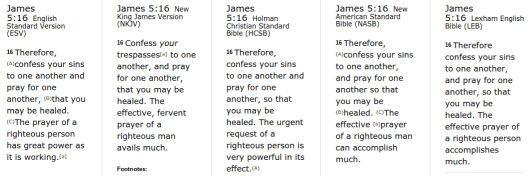
4. “Fervency” in prayer is qualitative, not quantitative Sometimes we get it into our heads that being “fervent” in prayer means we have to constantly voice that prayer over and over in order to get God to give in and do what we want Him to do. But God’s provision isn’t dependent on our prayers. He truly doesknow what we need before we ask. In other words, you could stop praying right this minute for that thing you desperately want, and never pray about it again, and God is not going to forget that that’s what you want, or move it to a lower priority level on His prayer-answering list, or punish you by denying your request simply because you stopped praying about it. There are things God blesses us with that we’ve never spent a moment praying for. There are things we stop praying for that God finally gives us years later. And there are things we pray constantly for that God says “no” about. God is going to do what is best for you and what brings Him the most glory, and that doesn’t hinge on whether you pray about that specific thing every day or not. “Fervency” doesn’t mean repetition. It means an intense trust and dependence on God to do what is right in His eyes in response to your prayer. Sometimes it helps to examine a few good translations side by side:
5. Prayer isn’t a letter to Santa Claus Back in the stone age of my childhood there used to be this thing called the Sears catalog. It was kind of like Amazon, but on paper. Every year, a few months before Christmas, they would publish their “Wish Book” edition that had all the toys in it. My sister and I would go through that catalog and circle all the things we wanted for Christmas and then hand it back to my parents, hoping that, this year, we’d get everything we asked for (and we asked for practically everything).
If this is how you approach prayer, you’re doing it wrong. God is not looking for you to provide Him with a list of stuff your greedy little heart desires so He can wrap it up in a bow and leave it under your tree. He’s not a wish-fulfillment center.
6. Weird stuff and unbiblical beliefs- knock it off ♦ Prayer is not a two-way conversation. We talk to God through prayer. He talks to us through His all-sufficient Word. Yes, while you’re praying, the Holy Spirit may remind you of Scripture that’s relevant to what you’re praying about, or bring to mind someone you should pray for, or you might think of a way you can help or bless someone, but prayer is not a dialogue. You don’t say your piece and then sit there and wait for God to say something back. That’s often called listening prayer or contemplative prayer, and it’s unbiblical. Likewise soaking prayer, sozo prayer, etc. In fact, if you see the word “prayer” preceded by an adjective not found in Scripture, it’s most likely not biblical.
♦ Prayer doesn’t require any special accessories. You don’t need to draw a circle to stand in, build a “war room,” blow a shofar, stroke a prayer cloth, or lay your hands on a prayer list, picture, object, etc. Scripture doesn’t tell us to do any of these things, and many of them are patently unbiblical.
♦ Prayer is not about you doing something, it’s about humbly beseeching God to do something. Nowhere in Scripture does God say that the purpose of prayer is for us to assert any power over anything through our words. He does not give us the authority to “bind” Satan, demons, or anything else, or “decree” or “declare” anything as though we could make something happen by doing so. These are false and unbiblical teachings of the heretical Word of Faith and New Apostolic Reformation movements.
7. Watch your language ♦ Having a “private prayer language” (speaking in “tongues”) as it is practiced today has zero basis in Scripture. None. When the disciples point blank asked Jesus to teach them to pray, there wasn’t a single “honda shonda” in His instructions, and nothing in Scripture says your prayers will be more meaningful to you or more likely to be heard by God if they’re in gibberish than if they’re in your native, real language.
♦ If you grew up fundie or old school, you might feel like you have to use “King James” lingo when you pray. You don’t. If you want to use “thee’s” and “thou’s” when you pray, you can, but you don’t have to. You can use the same vocabulary – respectful and pure speech, of course – you’d use when talking to a friend or loved one.
♦ If you’re tacking the phrase “in Jesus’ name” on to your decreeing and declaring and binding and rebuking as some sort of way to harness the power of God into making your words a reality, you’re taking God’s name in vain because you’re doing the same thing witches and pagans do when they use incantations and cast spells. “In Jesus’ name” isn’t the Christian version of “abracadabra.” To pray in Jesus’ name means to pray that what God wants – not what we want – will be done.
8. It isn’t about getting what we want. It’s about God getting what He wants. We tend to think of prayer as a means to an end that centers around us. It’s a time to tell God what we want and need and for Him to fulfill those wants and needs, and that’s that. But is that how God thinks about prayer? God tells us to come to Him, to present our requests to Him, ask Him for daily bread, forgiveness, give thanks to Him, and a number of other things. But we also know that He is sovereign. He already knows what we need and what’s best for us, and He does what He pleases. So if God knows better than we do what we need, and if He’s going to do whatever He wants anyway, why bother praying, right?
We say things like that because we think the point of prayer is to get God to do what we want Him to do. But it’s not. The point of prayer is for God to get us to do what He wants us to do. He wants us to pray, not because He needs a “honey do” list, but because coming back to Him time and time again in prayer teaches us to depend on Him and trust Him. It strengthens our understanding of His power and sovereignty. It grows us in humility and submission. It conforms our will and our wants to His. It reminds us of our sin and the cross. It keeps us from taking God’s blessings for granted as we thank and praise Him. It helps us to want what God wants more than what we want.
Ultimately, prayer is not about what we want God to do for us. It’s about what He wants to do in us. So bow your head and close your eyes and make that daily time communing with the Lord your highest priority. God working through prayer to conform you to the image of Christ? That’s not something you want to say, “Nah, not today,” to.
Again he entered the synagogue, and a man was there with a withered hand.2 And they watched Jesus, to see whether he would heal him on the Sabbath, so that they might accuse him.3 And he said to the man with the withered hand, “Come here.”4 And he said to them, “Is it lawful on the Sabbath to do good or to do harm, to save life or to kill?” But they were silent.5 And he looked around at them with anger, grieved at their hardness of heart, and said to the man, “Stretch out your hand.” He stretched it out, and his hand was restored.6 The Pharisees went out and immediately held counsel with the Herodians against him, how to destroy him.
7 Jesus withdrew with his disciples to the sea, and a great crowd followed, from Galilee and Judea8 and Jerusalem and Idumea and from beyond the Jordan and from around Tyre and Sidon. When the great crowd heard all that he was doing, they came to him.9 And he told his disciples to have a boat ready for him because of the crowd, lest they crush him,10 for he had healed many, so that all who had diseases pressed around him to touch him.11 And whenever the unclean spirits saw him, they fell down before him and cried out, “You are the Son of God.”12 And he strictly ordered them not to make him known.
13 And he went up on the mountain and called to him those whom he desired, and they came to him.14 And he appointed twelve (whom he also named apostles) so that they might be with him and he might send them out to preach15 and have authority to cast out demons.16 He appointed the twelve: Simon (to whom he gave the name Peter);17 James the son of Zebedee and John the brother of James (to whom he gave the name Boanerges, that is, Sons of Thunder);18 Andrew, and Philip, and Bartholomew, and Matthew, and Thomas, and James the son of Alphaeus, and Thaddaeus, and Simon the Zealot,19 and Judas Iscariot, who betrayed him.
20 Then he went home, and the crowd gathered again, so that they could not even eat.21 And when his family heard it, they went out to seize him, for they were saying, “He is out of his mind.”
22 And the scribes who came down from Jerusalem were saying, “He is possessed by Beelzebul,” and “by the prince of demons he casts out the demons.”23 And he called them to him and said to them in parables, “How can Satan cast out Satan?24 If a kingdom is divided against itself, that kingdom cannot stand.25 And if a house is divided against itself, that house will not be able to stand.26 And if Satan has risen up against himself and is divided, he cannot stand, but is coming to an end.27 But no one can enter a strong man’s house and plunder his goods, unless he first binds the strong man. Then indeed he may plunder his house.
28 “Truly, I say to you, all sins will be forgiven the children of man, and whatever blasphemies they utter,29 but whoever blasphemes against the Holy Spirit never has forgiveness, but is guilty of an eternal sin”—30 for they were saying, “He has an unclean spirit.”
31 And his mother and his brothers came, and standing outside they sent to him and called him.32 And a crowd was sitting around him, and they said to him, “Your mother and your brothers are outside, seeking you.”33 And he answered them, “Who are my mother and my brothers?”34 And looking about at those who sat around him, he said, “Here are my mother and my brothers!35 For whoever does the will of God, he is my brother and sister and mother.”
1. In verses 1-6, we see again one of the major themes of Mark: Jesus’ lordship over the Sabbath. Take a moment to review question 6 from Lesson 4 (link above). What are the similarities and differences between Mark 2:23-28 and Mark 3:1-6? Look at these two passages in a physical Bible. What do you notice about their placement, or sequence, in the manuscript, despite the fact that some time elapsed between the two incidents? Why might Mark have organized his manuscript this way?
2. Why was guarding against profaning the Sabbath such a major issue for the Pharisees? (1-6) What might they have worried God would do if Jesus influenced Israel to (in the Pharisees’ eyes) break the Sabbath? What did Jesus mean by his question in verse 4? Why didn’t the Pharisees answer Jesus? (4-6) Sometimes we think of anger as being sinful. Here, we see Jesus get angry. Why was His anger not sinful? (5)
3. What was Jesus doing (8) that drew such large crowds to Him? (10, 20-21) Compare the crowds, and their reason for flocking to Jesus in verses 7-12, 20-21, with this passage. What was the reason Peter and Jesus’ true followers stuck with Him? Do you see any similarities between the crowds that came to Jesus in droves for miracles, yet turned away from His teaching, and the crowds that fill miracle-promising “churches” today, even though those “churches” do not preach the truth of the gospel? What does Jesus want us to come to Him for?
4. How did Jesus’ ability to heal, his lordship over the Sabbath, His ability to cast out demons, and His definitive teaching on forgiveness (28-29) demonstrate that Jesus was God and that His authority over the physical and spiritual realms was equal to God’s? How would the authority over demons that Jesus gave the disciples for this mission (15) have authenticated the message they were preaching? (14) Was the disciple’s primary objective to preach the gospel or cast out demons? (14)
5. You may wish to examine verses 22-30 alongside these parallel passages in Matthew and Luke for better understanding. What is the blasphemy against the Holy Spirit (also called the unpardonable sin)? What were the scribes accusing Jesus of? (22) In your own words, explain Jesus’ reasoning to them. (23-27) Why did Jesus say the scribes making these accusations would never be forgiven? (30)
6. Why might Mary and Jesus’ siblings have been looking for Him? (20-21, 31-32) Was Jesus dishonoring his mother or rejecting his siblings in favor of others? (33-35) What point was Jesus trying to make? Compare verses 31-35 with these passages. What do we learn from these Scriptures about the importance of our spiritual family? Think about religions that unbiblically venerate Mary and ascribe supernatural attributes to her. Would this passage seem to support those beliefs?
Homework
Think about your church family. Is there a brother or sister, or maybe even a spiritual “mother” or “father,” who has helped you in your walk with the Lord, encouraged you, been there for you, maybe even led you to Christ? Take a moment this week to touch base with that person and express your love and appreciation.
Suggested Memory Verse
For whoever does the will of God, he is my brother and sister and mother.”
Mark 3:35