Christmas, Mailbag, Parenting

The Mailbag: What should we tell our kids (and grandkids) about Santa Claus?

Originally published December 4, 2017

As Christian parents, is it OK for us to tell our children about Santa Claus?

Christmastime can be so much fun when you have children. Many of us remember the excitement of Santa, the Christmas tree, and presents from our own childhood. They’re happy memories, and we want to recreate those for our children.

But as Christian parents, our first priority isn’t fun, it’s obedience to Scripture. Yet is there a way to make Christmas merry for our children while still upholding God’s Word? Is Santa patently unbiblical?

No, he doesn’t have to be, as long as he keeps his sleigh parked inside the parameters of Scripture. Let’s take a look at some of the ways Santa can be unscripturally naughty, and how godly parents can keep him nice and biblical.

Santa Claus isn’t real. If you tell your children he is, or that he is the one who brings their presents, or that he knows whether they’ve been naughty or nice, you’re lying. The Bible says that lying is a sin, period. Thereโ€™s no exception for jolly old elves who pass out toys (or for tooth fairies or Easter bunnies, either, for that matter). And not only is lying a sin, it is extraordinarily hypocritical to lie to your children about Santa Claus and then turn around later and punish them when they lie about something. Lying to your children about Santa Claus teaches them that it’s OK to lie (i.e. sin) when you want to or when it would be to your advantage.

Don’t lie to your children about Santa Claus. Tell them the truth: he’s a fun, fictional character that we can enjoy reading stories and singing songs about, just like Goldilocks or Superman or Old MacDonald. As for the presents, maybe you’d like to handle it similarly to the way my husband and I did with our children. When they were very small, my husband or I would don a Santa hat on Christmas Eve and say something like: โ€œYou know how you like to play pretend? Well, mommies and daddies like to play pretend, too, especially at Christmas! Now itโ€™s time for you to go to bed so we can pretend to be Santa Claus.โ€

Santa Claus isn’t omniscient. 

He sees you when you’re sleeping
He knows when you’re awake
He knows if you’ve been bad or good
So be good, for goodness’ sake!ยน

Uh uh. No way. Omniscience is an incommunicable attribute of God. He is the only One who has the power to see and know all things, and it is an insult and an affront to Him to even suggest that a mere mortal – let alone a fictional character – has the same power and knowledge that He has. In reverence and awe for God’s preeminence, we should never ascribe to others the things that belong to God alone.

Teach your children about the attributes of God. When you read your children stories about Santa Claus or hear Santa Claus Is Comin’ to Town on the radio, it’s a perfect opportunity to teach them about God’s omniscience and power. “Did y’all just hear that? That song said Santa Claus can see you and knows how you’re behaving. Is that true? Who is the only One who always sees you, cares for you, and knows what you’re doing and thinking? Can anybody else besides God do that?”
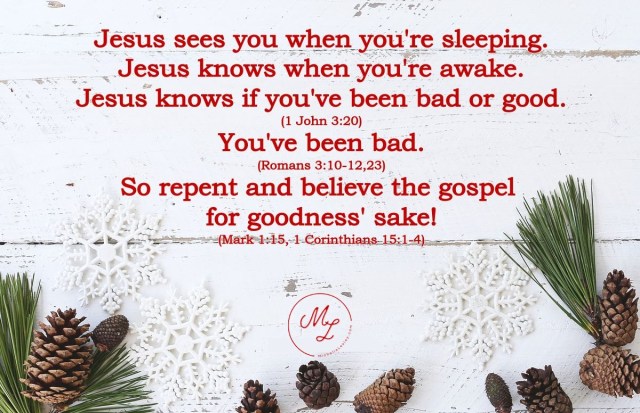
Santa Claus teaches works righteousness. In St. Nick’s economy, good behavior earns a reward (presents). Bad behavior earns punishment (coal). If you’ve ever shared the gospel with anybody, that will probably sound familiar. Most lost people think that’s what Christianity is. If you’re a “good person” God is happy with you and you’ll go to Heaven. Hell is the punishment for “bad people”: Hitler, murderers, and rapists. This is not what the Bible teaches, either about salvation, or about why children should obey their parents.

Teach your children the gospel.ย Again, this whole “naughty or nice” part of the Santa Claus narrative is a perfect gospel-teaching opportunity. Take advantage of it! Ask your child to be “nice” for one whole day. At bed time, take a few minutes to talk about the times she messed up and was “naughty” when she was supposed to be trying to be “nice.” Nobody can be nice and obedient all the time, no matter how hard we try. We areย all naughty – sinners with coal black hearts deserving the punishment of Hell. Jesus came and lived a life ofย perfectย “niceness” (obedience), died on the cross to take the punishment for our naughtiness, was buried, and rose again. He did that, not because we earned it with good behavior, but because of His mercy and grace. And then He gave us the greatest gift ever. A gift we naughty people don’t deserve: salvation and eternal life in Heaven. And it is because of our love and gratitude to Christ for saving us that we obey Him, not so that He will give us what we want. Indeed, the Bible tells us that the more obedient to Christ we are, the more persecution we will face.

Santa Claus doesn’t automatically have to be on the Christian parent’s naughty list. There are lots of ways to enjoy the fun of Santa and even turn him into an opportunity to teach your child biblical truth, all while being obedient to Scripture. But if Santa makes you biblically uncomfortable in some way, then by all means, don’t go against your conscience. Whichever way you decide – after prayer, study of the Scriptures, and discussing it with your spouse – do not judge other Christian parents by your personal convictions about Santa Claus.

Any advice for grandparents about Santa? Our son wants our grandchildren to believe in Santa. How do we respond to a grandchild who asks of the reality of Santa? I will not lie, but I want to keep peace with my son.

Thank you for being a godly grandma!

I think the solution to this dilemma is going to start with being a godly mom. Is your son a Believer? If so, you might want to show him all of the information above and talk to him about any Scriptures he’s violating. Let’s pray that will be convicting to him and he’ll decide to handle Santa in a godly way with your grandchildren.

But if he’s not convinced, or if he’s not a Believer, talk to him about your convictions about not lying to his children. Explain the difficult position he’s putting you in. He’s essentially asking you to choose between pleasing him by sinning (lying) or pleasing God by not sinning.

If he still won’t relent, the only solution I can see that keeps you from sinning yet doesn’t go against your son’s wishes is to put it back on him. When your grandchild comes to you and asks, “Grandma, is Santa Claus real?” you reply, “That’s a great question, but I think you should ask your mom and dad about that. How about some hot chocolate?”.

Your son made this bed. You shouldn’t have to lie in it.

Additional Resources:

Santa Pause with Justin Peters at A Word Fitly Spoken


ยนSanta Claus Is Comin’ to Town. John Frederick Coots and Haven Gillespie, 1934.

If you have a question about: a Bible passage, an aspect of theology, a current issue in Christianity, or how to biblically handle a family, life, or church situation, comment below (Iโ€™ll hold all questions in queue {unpublished} for a future edition of The Mailbag) or send me an e-mail or private message. If your question is chosen for publication, your anonymity will be protected.


Parenting, Poetry

The Prodigal’s Mom

Thereโ€™s an empty chair at the table
Where my child once used to sit
When we all broke bread together
A family whole and fit

Thereโ€™s an empty place in the photo
As his siblings celebrate
Without him again, missing him in
The memories they create

Thereโ€™s an empty stocking at Christmas
Another year far from home
Joy with tarnished edges
As the wayward one still roams

Thereโ€™s an empty place in my heart
That longs to be peaceful, content
Praying my child heeds the call of Christ
But fearing heโ€™ll never repent

And so goes the song - it goes on and on -
Of a godly motherโ€™s heart
Lifeโ€™s full of empty moments
Her prodigalโ€™s sin imparts

Until our knees and hearts are raw
We pray and pray again
A thousand tears we offer up
โ€œHow long, O Lord?โ€ and โ€œWhen?โ€

And the Father who once welcomed us home 
- For we were His prodigals too -
Says, โ€œCome and rest, and stand the test,
My grace is sufficient for you.โ€

Men, Parenting

Six Ways to Raise a Godly Man

Originally published October 24, 2015

Boys. Arenโ€™t they phenomenal? My husband and I have five boys ranging in age from 12 to 28. Theyโ€™re loud, theyโ€™re gross, theyโ€™re physical, and I wouldnโ€™t trade them for girls in a hot minute. While I love my daughter and the precious relationship we have as girls, I genuinely feel like God specially crafted me to be a mom of boys.

But boys will be boys, and girls will be girls, and sometimes, as โ€œgirls,โ€ we moms need to think outside the pretty pink box of femininity in order to relate to, and rightly raise, these extraordinary creatures God has blessed us with. Here are six ways Iโ€™ve learned through the years to raise a Godly man.

1. Remember youโ€™re raising boys.

Despite what you might hear from the scientific community, boys and girls are not the same except for genitalia. The way God wired them to see and relate to the world, think, react, and solve problems, is completely different from the way God wired girls to do these things. In 1 Corinthians 16:13, Paul tells the men of the church at Corinth:

Be watchful, stand firm in the faith, act like men, be strong.

Thereโ€™s a certain way that men (and boys) act, and itโ€™s not the same as the way girls act. God made them that way, and we must parent them like theyโ€™re boys, not anatomically male girls.

2. Make way for Daddy.

There have been so many times I have been tempted to baby my boys over bumps and bruises or give them a light scolding for disobedience. It took a lot of lip biting to stand out of the way while my husband told them to walk it off or got out the paddle for correction. But husbands know better than we do what itโ€™s like to be a little (or big) boy. Point your boys to your husband as an example, and make sure youโ€™re not getting in the way as they relate to each other โ€œman to manโ€.

3. Tell them to take a lap.

One thing that moms often donโ€™t realize about boys is that they are wired to need physical activity for their emotional, behavioral, and educational well being. Require them to sit still and be quiet for hours at a time, and you may have a son who gets that need for physicality out of his system by acting out behaviorally. God created boys with a need to run, throw, and hit, so honor His design by letting them.

4. Show them what a godly woman looks like.

They wonโ€™t be able to find a godly woman to marry one day if they donโ€™t know what one looks like. Show them. Study your Bible. Pray. Repent and apologize when you sin. Submit to your husband. Manage your home well. Be hospitable. Serve your family and your church. Give them a gold standard to shoot for.

Many women have done excellently, but you surpass them all. Proverbs 31:29

5. Instruct them, from a womanโ€™s point of view, godly ways to honor women.

Because boys donโ€™t think the way girls do, they need to be taught how women like to be treated by men. Boys tend to have an โ€œevery man for himselfโ€ mindset, so things like โ€œladies first,โ€ opening doors for women, keeping bodily functions to themselves, and helping out around the house donโ€™t always occur to them. They have to be proactively taught these things as a way of โ€œserving one another in loveโ€ (Galatians 5:13).

(Oh, and by the way, they will never learn to keep bodily functions to themselves. Ever. Sorry.)

6. Realize the impact of your role in building godly men. 

Samuel. Jesus. Timothy. Godly men, all. And every one of them had a godly mother โ€“ Hannah, Mary, Eunice โ€“ who raised them to love and serve God. Donโ€™t ever think of yourself as โ€œjust a mom.โ€ God has given mothers the enormous responsibility and privilege of pouring the gospel into little boys and raising them to godly manhood. Thank Him for that and steward your influence well.

Boys are strange and wonderful little beings. Thereโ€™s nothing like being a mom of boys to drive you crazy, drive you to your knees in prayer, and drive you to rise to the challenge of being a godly mom raising godly men.


And for all you girl moms, be sure to check out…

Avoiding the Creepers: Six Ways to Raise a Biblically Strong Woman

Old Testament, Parenting

Bad Dad David?

I recently finished reading through the life of David during my quiet time. When we think of David, the first thing to jump to mind is probably โ€œand Goliathโ€ or โ€œand Bathshebaโ€ or maybe that he was a king or a psalmist. But have you ever thought of David and the first thing to come to mind was โ€œlousy fatherโ€? I havenโ€™t. And the Bible doesnโ€™t explicitly tell us that he was a bad dad. And, letโ€™s face it, even the most godly parents in the world can have a kid or two who turn out to be prodigals. But if you look at how some of Davidโ€™s children turned out, you have to at least wonder about his parenting skills.

First youโ€™ve got Amnon โ€“ as disgusting a specimen of a human being as ever walked the planet. He makes himself physically ill lusting day after day for his half sister, Tamar. Thatโ€™s a lot of lust. But at least โ€“ at least โ€“ he keeps it to himself. For a while, that is.

Amnonโ€™s got an equally disgusting cousin, Jonadab โ€“ who, instead of smacking him senseless when Amnon shamelessly confesses his dastardly daydreams โ€“ devises a scheme to help Amnon indulge his foul and festering flesh by tricking David into making Tamar available to him. David sends Tamar to Amnonโ€™s house, and Tamar pleads with him not to force himself on her.

(While Tamar is pleading with her pustule of a brother, she says something interesting: โ€œPlease speak to the king, for he will not withhold me from you.โ€ Now, arguably, itโ€™s likely she was just saying whatever she could think of in the moment to get away from Amnon and didnโ€™t really believe David would allow Amnon to marry her. But if she did believe that to be true, that definitely says something about David. Because, by that time in Israelโ€™s history, intermarriage between two people who shared a parent was big-time illegal with severe consequences for the offenders. And David and everybody else in the kingdom knew that. Did Davidโ€™s children think he would break the law for them and excuse them from punishment? And for such a nauseating reason?)

But Amnon ignores Tamarโ€™s heartbreaking pleas and forcibly rapes her. He rapes his sister. David finds out what happened and is understandably angry. But does he follow the law and have Amnon executed? Nope. (So we at least have our answer to the question of whether or not David would break the law for his children.) If David did anything about the situation, the Bible doesnโ€™t record it.

Fast forward two whole years. David has still not made his rapist son face the music, so Absalom, Tamarโ€™s full brother, metes out his own brand of justice, putting Amnon to death.

Fast forward a few more years and Absalomย thinks, โ€œI believe Iโ€™d make a better king than dear old Dad.โ€ So he sets about manipulating and stealing the hearts of his countrymen away from David and stages a bloodless coup. David ends up having toย flee for his life from his own son.ย Meanwhile, Absalom moves into the palace, sets up a love nest on the roof where everybody can see, and sleeps with Davidโ€™s concubines.ย Then, Absalom gathers up an army to hunt down David โ€“ his father โ€“ in order to kill him and secure his throne.

Davidโ€™s men fight valiantly for him, risking their own lives. Joab, the commander of Davidโ€™s army โ€“ perhaps considering Davidโ€™s command to โ€œdeal gentlyโ€ with Absalom as ludicrous after all Absalom has done โ€“ seizes an opportune moment, and kills Absalom. David flips out in grief, so much so that Joab has to rebuke him: all these men risked their lives to save you, David, and youโ€™re crying and moaning over this wretch who was trying to kill you! Snap out of it or theyโ€™re going to turn on you! Fortunately, David has the sense to listen to him.

After some more wars, some famine, and a โ€œsin-sus,โ€ Adonijah decides he can pull off the coup his brother Absalom so spectacularly failed at. David is old and sickly, and it should be easy for Adonijah to make a grab for the throne. And in the description of Adonijah, hereโ€™s what was said that initially got me thinking David wasnโ€™t Dad of the year:

His [Adonijahโ€™s] father [David] had never at any time displeased him [Adonijah] by asking, โ€œWhy have you done thus and so?โ€ 

Are you picking up what the author of 1 Kings is laying down? David was an indulgent father. He had never at any time questioned his sonโ€™s actions or intervened in a way that upset him. He let Adonijah run wild and do what he wanted to do. And the way Amnon and Absalom acted, itโ€™s reasonable to surmise that David raised them the same way, along with all the rest of his children. Itโ€™s a miracle Solomon turned out as well as he did (at least until his wives drew him away from the Lord into idol worship). Reading the first nine chapters of Proverbs, I canโ€™t help but wonder if Solomon observed Davidโ€™s parenting and was determined not to follow his poor example. Listen to my instructions, son. Get wisdom. Donโ€™t be a fool.

Sometimes Bible characters set a great example for us. David, a man after Godโ€™s own heart, set many. But sometimes God lets us see their poor and sinful behavior so we can learn not to follow their example. Moms and Dads, letโ€™s make sure we are men and women after Godโ€™s own heart when it comes to parenting our kids.

Happy Fatherโ€™s Day, yโ€™all.


If this article sounds familiar, it’s because you just read it in last Friday’s Random Ramblings, Ruminations, and Resources. A reader asked if I would make it a stand-alone article for easier sharing. :0)
Parenting

Do You Trust God with Your Kids?: 8 Ways to Parent Your Children Like God “Parents” You

The world can be a scary place if you have kids. There’s the danger of online predators luring kids into meeting them in person. Kids can take inappropriate pictures of themselves or their peers only to have those pictures spread around on the web. Porn sites abound. Drugs and alcohol seem to be easy for kids to come by. There are kidnappers and sex traffickers and child molesters lurking where you least expect them, even in the church. And, society would have us believe, every teenager is having sex.

It’s a blessing from God that there are so many ways to protect our kids. There are all kinds of software locks and blocks and filters you can put on your electronics in order to keep your kids safer when it comes to technology. There are phone apps that allow you to track your child’s location, and do it yourself drug testing kits, and breathalyzer attachments you can put on your car to keep your child from driving drunk. And then there are the more “analog” precautions of keeping the family computer in a common room, scrolling through your child’s phone log every day and asking about each call or text, banning sleepovers, and never letting her spend time alone with friends.

Certainly, we should use wisdom about the activities we let our kids take part in. Maybe some of those locks, blocks, and filters, or restrictions on places she can go and people she can see would be a wise idea for your family, especially if your child has proved herself untrustworthy with the freedom you’ve already given her.

But, increasingly, as I hear Christian parents in a near frenzy about installing multiple security measures on their electronics or the car and making all kinds of restrictions on activities with friends – not to clamp down on a rebellious child, but to prevent children from getting into trouble who have never showed any signs of rebellion – I have to wonder, what’s the foundational mindset here?

Increasingly, as I hear Christian parents in a near frenzy about preventing their children from getting into trouble, I have to wonder – what’s the foundational mindset here?

Are we putting these safety measures in place because we’ve prayed about it andย  believe it’s reasonable, godly wisdom, or are we putting these safety measures in place because we’re fearful of evil and trust devices and restrictions more than we trust God and our kids? For the Christian, it’s not that it’s wrong or bad to take precautions – indeed, God doesn’t want us to be careless or foolish – it’s the motivation for the precautions we take that we need to examine.

It’s not wrong to take reasonable precautions, but are we putting these safety measures in place because we’re fearful of evil and trust devices and restrictions more than we trust God and our kids?

Do we really trust God with our kids, or are we taking matters into our own hands out of fear?

Trusting God can be scary. We can’t see Him, hear Him, or touch Him, and He never promised us a life free from difficult or painful circumstances. It’s much easier and more comforting to our flesh to trust something tangible. Something that guarantees us it’ll do what we want it to do. It reminds me of an event that took place toward the end of King Asa’s life in 2 Chronicles 16.

Asa was one of the good kings of Judah. He “did what was good and right in the eyes of the Lord his God. He took away the foreign altars and the high places and broke down the pillars and cut down the Asherim and commanded Judah to seek the Lord, the God of their fathers, and to keep the law and the commandment.” (2 Chronicles 14:2-4) But one day, Baasha, king of Israel, came up against Judah. Did Asa cry out to the Lord, trusting Him to help, as he had years before when the Ethiopian army came out against him? No. Asa’s response was to gather up a truckload of silver and gold from the palace and the temple and bribe the king of Syria to break his covenant with Israel and attack them. Instead of fully trusting in the Lord and seeking His help and guidance, Asa took matters into his own hands and attempted to protect Judah with his own strength.

We love our children. We don’t want to see them hurt or fall into sin. We want to do whatever we can to protect them. Those are all good and godly desires of the heart. But we must make sure we are seeking and trusting God and His ways firstย instead of acting upon our fears and relying on our own strength.

We must make sure we are seeking and trusting God and His ways firstย instead of acting upon our fears and relying on our own strength.

What are God’s ways? How does He “Father” us? How can we imitate our Heavenly Father as we parent?

1. God makes clear that He is the Father and we are the children.

Throughout Scripture, God is crystal clear that He is the one in charge. He made us, He sets the rules, He provides for us, He protects and cares for us, He knows what’s best for us. Because of all this, He instructs us, our responsibility is to be obedient children.

Do you and your children understand that you are the parent? That you are in charge and that they are to obey? That you make the rules and they are to follow them? Are the roles of parent and child clearly defined in your home with a godly authority structure in place?

2. God spells out what He expects from us.

The Bible is chock full of explicit commands. Sometimes God tells us what to do. Sometimes He tells us what not to do. Often, He explains why He is telling us to do or not do a certain thing. We can always rest assured that all of His commands are for our own good, the good of others, and the glory of God, and that they flow out of His great love for us. But God never accepts excuses for disobedience. He expects us to obey.

God never accepts excuses for disobedience. He expects us to obey.

Have you thoughtfully and prayerfully developed rules for the online and offline activities your child participates in? Have you sat her down and lovingly explained the rules to her, answering any questions she might have? Does she have a clear understanding of what the rules are and how to obey them? Does she grasp your expectation that she will obey the rules without excuses?

3. God warns us of the consequences and dangers of disobedience and the blessings of obedience.
God doesn’t hide the unpleasant truth from us that the wages of sin is death. In fact, He gives us enough of a description of that eternal death to help us understand that we don’t want to go there. He explains that He disciplines those He loves in order to keep them away from sin and harm. But God also reminds us of the blessings of obedience – that it will help us flourish, grow in joy, and bring glory to God.

God explains that He disciplines those He loves in order to keep them away from sin and harm. But God also reminds us of the blessings of obedience.

Have you warned your child of the consequences for disobeying your rules about her activities? Do you carefully and consistently enforce those consequences? Have you explained to her that theย reason there are disciplinary consequences for her disobedience is to protect her from danger and sin? It’s neither necessary nor appropriate to go into all of the specific, terrifying details of child trafficking or the disgusting elements of pornography, but our children must have an age-appropriate understanding of the very real dangers that are out there.

And it’s just as important to explain the blessings of obedience to your child: she won’t have to live in fear or in shame, she’ll be protecting her purity for marriage, her health, or her life, her parents will trust her, and she’ll be acting in a way that’s pleasing to God. Maybe you’ll even be more inclined to give her extra privileges.

4. God doesn’t give the consequencesย before the sin.

Look at what Jesus said in Matthew 5:29-30 with regard to lust:

If your right eye causes you to sin, tear it out and throw it away. For it is better that you lose one of your members than that your whole body be thrown into hell. And if your right hand causes you to sin, cut it off and throw it away. For it is better that you lose one of your members than that your whole body go into hell.

Jesus doesn’t tell us to gouge out an eye or cut off a hand as a precaution toย preventย lust that has not taken place. He tells us to respond toย sinย with an appropriate consequence.

God doesn’t give the consequencesย before the sin. Jesus doesn’t tell us to gouge out an eye or cut off a hand as a precaution toย preventย lust that has not taken place. He tells us to respond toย sinย with an appropriate consequence.

Is there any way you might be “maiming” your child to prevent her from committing sin – especially sin she’s never shown an interest in or temptation to? Maybe it’s time to reconsider that rule or restriction? Conversely, do you have a child who struggles with a particular sin? She may need your love and your help mortifying that sin by “gouging out the eye” of the internet or “cutting off the hand” of that destructive friendship.

5. God wants our obedience to be motivated by our love for Him.

God doesn’t want us to obey Him because we have an unbiblical view of Him as a mean old ogre and we’re terrified of Him. He also doesn’t want us to obey Him in order to get something from Him, to impress others, or just to go through the motions. God wantsย us toย want to obey Him because we love Him.

God wantsย us toย *want* to obey Him because we love Him.

Have you fostered an environment of sacrificial love for your children in your home? Do you lay down what you want or how you feel to do what’s best for them? Do you invest time in them, pouring the gospel into them, teaching them God’s Word, and demonstrating that we obey Christ because we love Him? Do you take time to talk and play with your children? Do you tell them you’re proud of them? Discipline them and say no when necessary? Are you generous with hugs, “I love you’s”, and encouragement? Do you encourage them to develop their talents and skills? Having parents who love their children in a godly way doesn’t guarantee obedience, but it does encourage it.

6. God doesn’t micromanage every move we make.

At least not the way humans sometimes micromanage. Have you ever noticed that there are no commands in the Bible like, “Thou shalt wear blue socks every Tuesday,” or “Thou shalt not stay up past 11:38 p.m.”? Regulating every little thing we do isn’t God’s way. He loves us and cares for us, He tells us what He expects from us and the consequences of obeying and disobeying Him, and then He gives us space within those parameters to make decisions that are aligned with His will as revealed in His Word. As long as we’re not violating any of His principles or commands and we’re exercising godly wisdom, it’s fine with Him if we want to wear red socks on Tuesday or stay up until midnight.

Regulating every little thing we do isn’t God’s way. God doesn’t micromanage every move we make.

Our children need space to make decisions within the confines of the rules we’ve set up, especially children who haven’t given us any reason not to exercise reasonable trust in them. Nitpicking, checking, regulating, and hovering over every little move your child makes is smothering and frustrating to her. It says, “I don’t trust you to do what’s right without constant monitoring from me.”

7. God allows us to fail.

I once read the biography of a girl who went blind. She enrolled in a life skills class at a school for the blind to learn how to navigate the world. During orientation, her counselor showed her around the common room of the dorm she was staying in. The counselor took her hand, placed it on the protruding mantel of the fireplace and said, “This is a sharp corner. You’ll need to watch out for it.” The girl gasped, “That’s dangerous! Why don’t you put some padding on it?”. The counselor replied, “You need to learn to be carefulย and aware of your surroundings. Nobody’s going to pad the sharp corners of the world for you.”

God doesn’t pad the sharp corners of the world for us, either. He doesn’t put us in a protective little bubble where we’ll never be hurt or fail or sin. He gives us everything we need for life and godliness in His Word and allows us to obey or disobey Him. Even when we fail, give in to temptation, and sin.

God doesn’t pad the sharp corners of the world for us, either. He doesn’t put us in a protective little bubble where we’ll never be hurt or fail or sin.

Consider that your child needs to learn the skill of facing and resisting temptation on her own. Give her enough age appropriate, situation appropriate freedom to do that – and to fail at it and repent – in the spiritual safety of your home. One day you won’t be there to put a lock on the computer. God will hold her responsible for her own sin. Will your child have developed the spiritual strength to say no to temptation when there’s nobody to stop her?

8. God is always there.

He’s not a “helicopter parent,” but He’s always there to listen to us, help us, nurture us, and be our Wonderful Counselor and Everlasting Father.

If you are a parent, job one is not your career, it’s parenting. Generally speaking (yes, there are sometimes exceptions and exigent circumstances), that means, Mom, your primary vocation is to raise your own children. Don’t just assume you have to work outside the home. Prayย fervently for God to make a way for you to raise your children. Be creative and look for ways to get out of the workforce and get home. Slash every possible expense. Move. Eat at home. Home school instead of private school. Sell a vehicle. Bargain hunt. Find a way to earn money from home. Make the effort. Your children don’t just need any random person to raise them, they needย you.

Your children don’t just need any random person to raise them, they needย you.

ย 

Are we imitating our Heavenly Father in the way we parent? Do we cry out to Him for wisdom in the rules and restrictions we set for our children, trusting Him to help us and to protect our children? Or do we live in fear of what might happen, worrying and trying to protect our children in our own strength?

As much as we’d like to sometimes, we canโ€™t build walls around our children to protect them from every sin or from anything bad ever happening to them. That is not how God deals with us. He loves, cares, and provides for us. He disciplines us appropriately when we need it. He clearly spells out what He expects from us. He warns us of the dangers and consequences of disobedience and teaches us the blessings of obedience. It’s then up to us to decide whether we love Him enough to obey Him, or if we’d rather go our own way.

Do we parent our children like God “parents” us?

Do we parent our children like God “parents” us?