Holidays (Other)

Top Ten 4th of July Twisted Scriptures

Originally published July 7, 2017

Independence day is my favorite of the non-major holidays. Fireworks, picnics, barbecues, and what other holiday has such grand music that nearly the whole country can enjoy and sing together? It’s the one day of the year when we, as Americans, can set aside our political differences and bickering and celebrate our God-given freedom to have political differences and bickering.

It is good to thank God for the blessing of liberty. It is right to be patriotic and celebrate our nation’s founding. It is evangelistic to use Independence Day as a springboard for explaining to people how they can find real freedom in Christ.

And with that freedom – our freedom in Christ and our freedom as American citizens – comes great responsibility. Namely, the responsibility not to throw all of those things into the Cuisinart at once and turn them into an Americhristian smoothie with red, white, and blue sprinkles.

There is a vast difference between American political freedom and the spiritual freedom found only in Christ. But when we lift Bible verses out of their context and stick a flag behind them in celebration of Independence Day, we conflate the two. Weaker brothers and sisters in the faith who already muddle American citizenship with heavenly citizenship are further confirmed in their confusion. We should be making these distinctions clearer, not encouraging their commingling.

Yet this is exactly what happens on Christian web sites, social media, and even in our churches as the 4th of July draws near. Sisters, this should not be so.

None of the verses in the Bible which contain words like “freedom” and “liberty” are referring to American political freedom. None. The verses containing these words are usually speaking of freedom from sin in Christ, freedom from Mosaic Covenant law, or freedom from literal slavery. We must use and understand them in context, or we are doing violence to the text and treating God’s holy Word with apathetic irreverence.

Here are the top 10 Scriptures I’ve observed being twisted on the 4th of July.

1.
Now the Lord is the Spirit,
and where the Spirit of the Lord is, there is freedom.
2 Corinthians 3:17

Most of the memes using this verse omit the first phrase, because even including those six extra words tends to give too much context to the verse for the person trying to make it about American freedom. If you read all of chapter three, or even just verses 12-18, you can see that this verse is about being set free in Christ from the demands of the Mosaic Covenant. Although 2 Corinthians 3:17 was misused by many, the first place I saw it was was from Lysa TerKeurst’s Proverbs 31 Facebook page – emblematic of why Christian women should not receive Bible teaching from anyone associated with this organization.


2.
For freedom Christ has set us free; stand firm therefore,
and do not submit again to a yoke of slavery.
Galatians 5:1

Most incorrect citations of this verse include only its first phrase. Indeed, Christย has set us free for freedom, but freedom from what? English tyranny? Political oppression? No, as the rest of the verse goes on to say, Christ has set us free from the yoke of slavery to the Law. In Christ, we are free to stop striving to be good enough to earn right standing with Him, and to rest in His finished work on the cross to clothe us in His righteousness. That’s way better than American constitutional freedoms because that kind of freedom is available to anyone, in any country, at any time in history, who repents and places her faith in Christ for salvation.


3.
For you were called to freedom, brothers.
Only do not use your freedom as an opportunity for the flesh,
but through love serve one another.
Galatians 5:13

This is a great verse that Christians can live out in service to our families, our church families, and even our fellow Americans. But we need to understand that when this verse says we were “called to freedom” it’s not talking about the rallying cry of the American Revolution. The freedom we were called to – as with Galatians 5:1 – is the freedom from striving to obey the Law to obtain righteousness. But just because we’re no longer under the constraints of the Law doesn’t mean we can go out and sin at will, or indulge the flesh by doing whatever we feel like doing. That’s antinomianism. Instead we’re to use our freedom from the Law as an opportunity to deny self and serve others.


4.
if my people who are called by my name humble themselves, and pray and seek my face and turn from their wicked ways, then I will hear from heaven and will forgive their sin and heal their land.
2 Chronicles 7:14

I’ve written at length on this verse in my article Is 2 Chronicles 7:14 God’s Promise to American Christians Today? The short answer is “no,” it is not about America. Although there’s plenty that Christians can learn from this verse, it is a promise to Israel, as the surrounding context clearly indicates.


5.
So if the Son sets you free, you will be free indeed.
John 8:36

Even adding just two verses (34-35) to this one gives us enough context to help us understand that Jesus is talking about being freed from slavery to sin through the salvation only He can provide – the salvation that is about to cost Him the agony of scourging and death on a cross. It is appalling that this verse – spoken by our Lord Himself, about the earth-shattering, awe-provoking amazingness that is the forgiveness of sins by the grace of God in Christ – should be so lowered and sullied as to try to make it refer to American freedom.


6.
Live as people who are free,
not using your freedom as a cover-up for evil,
but living as servants of God.
1 Peter 2:16

The context of this verse is similar to Galatians 5:13 (#3 above), but it adds a couple of extra facets. If you read verses 9-17 of 1 Peter 2, you’ll notice the same instruction to live as people who have been set free in Christ and to use that freedom in Christ to serve others. Why? “…So that when [the Gentiles] speak against you as evildoers, they may see your good deeds and glorify God… For this is the will of God, that by doing good you should put to silence the ignorance of foolish people.” (12,15) When we use our freedom in Christ to serve and do good, it is a testimony of the gospel to the lost. This passage also exhorts us to be subject to our government and our political leaders. And if you know anything about the first century Roman Empire, you know its Christian citizens (Peter’s audience) knew nothing of the political freedoms American Christians experience.


7.
Blessed is the nation whose God is the Lord, 
the people whom he has chosen as his heritage!
Psalm 33:12

In the immediate context and application of this verse, “nation” and “the people” is referring to Israel. Examining verses 10, 16, and 17 alongside verse 12, it’s a safe assumption that the psalmist had observed some part of Israel’s history that included war against neighboring nations. And, certainly, any Old Testament Scripture referring to the people God “has chosen as His heritage” could only be speaking of Israel. America didn’t even exist at that time, nor has God, at any point in Scripture, said that America is His chosen people or His heritage.

If you want to think of a New Testament “nation” or “people” God has blessed and chosen as His “heritage,” that would be the church- the worldwide body of born again believers. While, ostensibly, any nation whose God is the Lord would be blessed, we have only to look back at Old Testament history to see how unlikely it would be for America’s God to be the Lord. Israelย wasย God’s chosen people and heritage. Theyย were “the nation whose God is the Lord”- literally. They were a theocracy – under the direct rule of God Himself – yet they rejected Him in favor of earthly kings and repeated cycles of idol worship. And we think America is capable of becoming “one nation under God”?


8.
And you shall consecrate the fiftieth year, and proclaim liberty throughout the land to all its inhabitants. It shall be a jubilee for you, when each of you shall return to his property
and each of you shall return to his clan.
Leviticus 25:10

It’s pretty easy to see why only the phrase “proclaim liberty throughout the land” is lifted out of this verse. It is obviously talking about Israel’s Year of Jubileeย which has never been practiced in America because we are not, and never have been, under the Mosaic Covenant. Even Israel doesn’t observe the Year of Jubilee any more. The use of this verse is simply a case of someone looking for a Scripture to attach to a patriotic meme, doing a concordance search for the word “liberty,” and whittling away everything in the verse that is obviously un-American. This is not the way Christians properly and reverently handle God’s holy Word.


9.
The Spirit of the Lord is upon me, because he has anointed me to proclaim good news to the poor. He has sent me to proclaim liberty to the captives and recovering of sight to the blind, to set at liberty those who are oppressed,
Luke 4:18

Except for the fact that this verse includes the word “liberty” or “free,” depending on your translation, it’s incomprehensible to me that anyone would see this as a verse to use in the celebration of Independence Day. This verse doesn’t even make any sense when applied to America. It’s not about a country, it’s about a person: Jesus. Jesus spoke these words. He’s quoting Isaiah 61:1-2,ย which is a prophecy of the Messiah to come. If you read a mere three more verses of Luke 4, you’ll see in verse 21 that Jesus says, “Todayย this Scriptureย has been fulfilled in your hearing.” Meaning what? Jesus is saying, “You know that Messiah you’ve been waiting on for centuries, Israel? I’m it. I’m here.” And the liberty or freedom He’s talking about? Once again, it’s freedom from sin and freedom from the Law. Becauseย that’s what Jesus came to give us.


10.
Out of my distress I called on the Lord;
the Lord answered me and set me free.
Psalm 118:5 

Nope, this one isn’t about American political freedom either. A couple of things to notice: first, this is clearly set in the context of Israel’s Old Testament history, as verses 2-3, with their references to “Israel” and “Aaron”, indicate. Next, look at the personal pronouns, not only in verse 5, but also in verses 6-7: “I,” “me,” “my.” This verse is not about America being set free from England, or even about Israel being set free from one of its enemies. This is a descriptive passage about an individual – the psalmist – being in some sort of distressing situation, and God answering his prayer for deliverance. Have you ever prayed that God would deliver you from a difficult time in your life? If He did, do you think that unique situation is applicable to anyone else, much less an entire country? This passage is kind of the same thing. The psalmist is sharing something God did for him, not commenting on politics or even assuring other individuals that God will do the same for them.


Memorial Day Bonus:
Greater love has no one than this,
that someone lay down his life for his friends.
John 15:13

Memorial Day is a solemn and precious day to honor those who have laid down their lives for our freedom as Americans. My grandfather, father, husband, and two of my sons served in the military, and I know just how blessed I am that they all returned safe and sound. It takes a special kind of person to make the ultimate sacrifice for his country, and I certainly don’t want to take anything away from that.

But as meaningful as that is, it can’t – and shouldn’t – compare to Christ laying down His life to make sinners His friends. And that’s what this verse is about. For twelve verses, Jesus has talked to His disciples about abiding in Him because He loves them so much. In verse 13, He talks about the proof of His love for them: He’s about to give His life as the atoning sacrifice for their sin. He wants them to love each other the same way – that forย Christ’s sake, inย Christ’sย name – they would be willing to die for the sake of the gospel. Eleven of the twelve of them would go on to do so.

When we use this verse in reference to Memorial Day – as deeply consequential as that day is – it tarnishes the infinitely more important sacrifice of Christ by comparing a mere man’s offering of his life for temporal, earthly freedom, to God’s offering of His sinless Son to purchase for eternity the redemption of sinful rebels.

I’m proud and grateful to be an American. I’m thankful for this nation and the freedoms we have as citizens. But for everyone who’s a citizen of the Kingdom of God, our loyalty and reverence must lie with Him first and must surpass all other loyalties – to family, to friends, and even to country. That means we reverence God’s holy Word by being good students of it and handling it correctly, by preserving and standing up for its meaning and intentions, and by refusing to manipulate it for our own lesser purposes- even such a noble purpose as patriotism.


Did you enjoy Top Ten 4th of July Twisted Scriptures? Check out our 3 part podcast series on A Word Fitly Spoken:

Twisted Scripture:

Part 1 Part 2 Part 3


Photo Credits
The references below are for the purpose of photo credits only. I have not examined most of these sites and do not endorse any which contradict my beliefs as cited in the Statement of Faith and Welcome tabs at the top of this page.

1. https://www.facebook.com/Prov31Ministries/photos/a.390955286960.162138.99550061960/10154692176801961/?type=1&theater
2. https://stjosephslanc.com/july-5-2015-the-fourteenth-sunday-in-ordinary-time/
3. https://www.facebook.com/ConcernedWomenforAmerica/photos/a.119423980992.123545.77903485992/10155305900670993/?type=3&theater
5. https://twitter.com/robertjeffress/status/746696996208074752
6. http://dailybiblememe.com/tag/1-peter-216/
7. http://simplylkj.blogspot.com/2016/07/happy-4th-of-july.html
8. http://redbubble.com/i/poster/Motivational-Bible-Quote-Liberty-People-4th-of-July-by-mairabay/50664737.LVTDI
9. http://www.klove.com/
10. http://bibleversestogo.com/products/psalm-118-5-freedom
Memorial Day Bonus: http://unitetheusa.org/id165.html

Holidays (Other)

Is 2 Chronicles 7:14 God’s Promise to American Christians Today?

Originally published July 3, 2015

Is 2 Chronicles 7:14 God’s promise to American Christians today?

“if my people who are called by my name humble themselves, and pray and seek my face and turn from their wicked ways, then I will hear from heaven and will forgive their sin and heal their land.”
2 Chronicles 7:14

This verse is often quoted as a call to prayer and revival for American Christians, suggesting that if we pray, repent, and humble ourselves, God will turn America around and make it โ€œone nation under Godโ€ again. Since the 4th of July is coming up, you’ll probably be seeing this verse all over social media, but is it really a promise to us today about America?

Not this particular verse, no. Here’s why:

1. This verse is only part of a sentence (you can tell by the way it starts with a lowercase letter). In order to rightly handle God’s word (2 Timothy 2:15), it’s imperative that we consider a verse’s immediate context as well as the way it fits in with the big picture of the entire Bible. Even adding just verses 13 and 15 shows us that this verse was written about Old Testament Israel, not America. Reading all of chapter 7 sheds even more light on this verse, and if we throw in chapter 6, especially 6:26-31, we can clearly see that 7:14 is part of God’s specific answer to Solomon’s prayer at the dedication of the temple.

2. There are no supporting Scriptures in the New Testament (remember, Believers are in the church era under the new covenant of grace) that imply that if Christians humble themselves and repent that God will give them a nation governed by biblical laws and leaders and that we will have a society that behaves itself, morally. In fact, in the New Testament, in the early church, we see the exact opposite. The more the church prayed, humbled itself, and spread the gospel, the more Rome persecuted Christians. And yet, we never hear of them claiming 2 Chronicles 7:14 as Godโ€™s promise to them that He would turn things around if they would only humble themselves and seek His face more. The New Testament, even Jesus Himself, says that we will be persecuted for godly living (John 15:20, Matthew 10:22, 2 Timothy 3:12-13).

3. We canโ€™t claim the promise without claiming the punishment. Look again at verse 13. It specifies that pestilence and the agricultural hardships of drought and locust infestation are the ones that God promises to heal. It is a promise of literal healing of the land so that crops will grow unharmed, game will be plentiful, and people will be healthy and able to eat, not a promise of a metaphorical โ€œhealingโ€ of a nationโ€™s immorality.

If we claim that this โ€œhealing of the landโ€ applies to us today, then we also have to claim that God will punish our disobedience with those very things He promises to heal (drought, locusts, and pestilence), because thatโ€™s what these verses are talking about.

4. The reason this passage sounds like it applies to us is because there are some principles in this verse that do apply to us. How do we know? Because they are supported by other clear and direct Scriptures:

Are we Godโ€™s people who are called by His nameโ€? Yes (Acts 11:26)

Should we humble ourselves? Yes (1 Peter 5:6)

Should we pray and seek Godโ€™s face? Yes (1 Thessalonians 5:17)

Should we turn from any wicked ways we practice? Yes (Acts 3:19)

Will God hear from Heaven if we do these things? Yes (1 John 5:14-15)

Does God promise to heal our land of bad morals or the agricultural problems He has punished our disobedience with if we do these things? No.

Asking God to fulfill His promises and thanking Him for those already fulfilled is a wonderful and worshipful way to pray. But, if we truly want to pray โ€œin the name of Jesusโ€ and pray rightly for Godโ€™s will to be done, we must use wisdom, discernment, and the tools God has given us to discover exactly what He has promised us.


Additional Resources:

Properly Praying the Promises

What is the meaning of 2 Chronicles 7:14? at Got Questions?

Holidays (Other)

The Mailbag: Patriotism in Church

Every year near Independence Day, I re-run this article, and every year professing Christians actually get angry at me for suggesting that the weekly worship service should be reserved strictly for the worship of God. The One Who sent His only Son to be brutally tortured and crucified for our sins – that God. There are 168 hours in a week. If you can’t commit 1-2 of them solely to worshiping the God who saved you, check your heart. You might be guilty of idolatry.

Originally published July 2, 2018

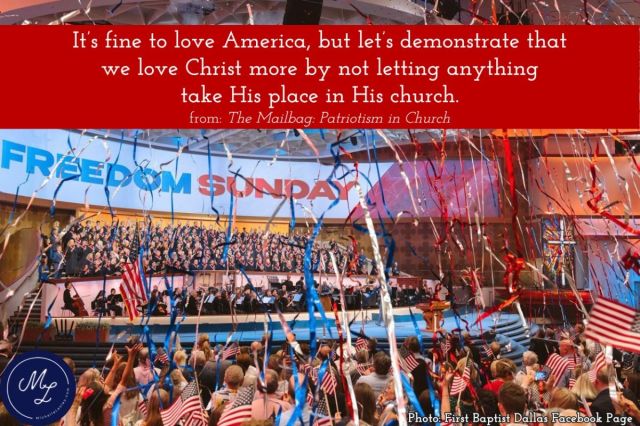
Every year on the Sunday closest to the 4th of July, our worship service turns very patriotic. All of the hymns and worship songs are replaced with patriotic songs like God Bless America, America the Beautiful, and the National Anthem. The choir and whoever is singing a solo that day sings a patriotic song. A color guard marches in with the American flag and we say the Pledge of Allegiance. Sometimes the sermon is even on a patriotic topic. It makes me uncomfortable because I think the worship service should focus on God, not America. What do you think?

Independence Day is one of my favorite holidays. I love the fireworks and picnics, the bands, and watching my favorite musical, Yankee Doodle Dandy.

I’m as red, white, and blue, rah rah America as the next guy, but there’s a time and a place for all that, and the Sunday morning worship hour isn’t it. You’re correct. The worship service is exactly that: worship and service. And who are Christians supposed to worship and serve when we go to church? God.

We are to sing to, and about, God. The pastor is to preach the Word of God. We pledge our allegiance in prayer, worship, and confession to God. Our thoughts are to be focused on God. Every element of the worship service – songs, symbols, readings, offerings, prayer, praise, everything – is to draw our attention to God. He is the only One worthy of our worship.

Patriotic songs, the Pledge, and all of those other things can take the focus off God and put it on something lesser. Sometimes God gets pushed aside in favor of what we want to focus on. That’s a very man-centered attitude in the very place and time when everything is supposed to be centered on God.

And really, if you think about the main reason America was founded – freedom of worship – what better way is there to honor our forefathers and celebrate the gift of freedom God has given us than to exercise our First Amendment right to worship God? Certainly, we could use the 4th of July as a reminder to take some time in corporate prayer to express gratitude to God for our country and our liberties and to pray for our country. Scripture tells us to present our requests to God with thanksgiving. We could also dedicate some time to praying for our governmental officials as 1 Timothy 2:1-4 instructs us to do. There’s a biblical, worshipful way to be thankful for the freedoms God has blessed us with and intercede for our country and our governing authorities. And it shouldn’t be limited to one Sunday a year.

But when it comes to patriotic hoopla, we can set aside another time for that and still celebrate with our brothers and sisters in Christ. If your church family wants to celebrate America’s birthday together, that’s great! Have a church-wide cookout on the 4th. Schedule an Independence Day patriotic sing-along or choir pageant. Meet up and head out to the county fireworks show together. Fellowship! Have fun!

But when it’s time to worship, let’s make sure we’re reserving that time for worship of the King of Kings and Lord of Lords. It’s fine to love America, but let’s demonstrate that we love Christ more by not letting anything take His place in His church.

It’s fine to love America, but let’s demonstrate that we love Christ more by not letting anything take His place in His church.

photo source

If you have a question about: a Bible passage, an aspect of theology, a current issue in Christianity, or how to biblically handle a family, life, or church situation, comment below (Iโ€™ll hold all questions in queue {unpublished} for a future edition of The Mailbag) or send me an e-mail or private message. If your question is chosen for publication, your anonymity will be protected.

Holidays (Other), Parenting

Beautiful Motherhood: A Mother’s Day Bible Study

As we look ahead to Mother’s Day,
let’s check out what the Bible has to say about mothering.
This is lesson 12 of my topical Bible study:

Imperishable Beauty- A Study of Biblical Womanhood.

Read These Selected Scriptures

Questions to Consider

1. What are some attributes or character traits of a godly mother from Proverbs 31 that we can emulate? In todayโ€™s lesson, rather than attributes to emulate, weโ€™ll be focusing on Godโ€™s instructions to obey for mothers. We’ll examine how we’re to regard motherhood and our children, how we’re to train our children in godliness, how we’re to discipline our children out of ungodliness, and the example we’re to set for our children. Some of these instructions can also apply to childless women in their relationships with their spiritual children (i.e. younger women or children they disciple) and others. As you read over todayโ€™s passages, explain how childless women might apply some of these Scriptures.

2. Examine the first three passages (Psalm 127-Titus 2) together. What do these passages say about how we are to regard motherhood and our children? What should the attitude of our hearts be? In what sense are children a reward? How do we know that Psalm 127:3 does not mean that if you act in a way that pleases the Lord He will reward your good behavior with children? What does this verse mean? Is loving your children (Titus 2:4) simply a feeling of affection toward them? If so, why would young women need to be trained to love their children? When you finish today’s lesson, come back to Titus 2:4 and give a fully-orbed biblical definition of what it means to love your children.

3. Examine the next five passages (Proverbs 22-Ephesians 6) together. Why does God want us to train our children in godliness? Explain the phrase “in the way he should go” (Proverbs 22:6). How does the gospel figure in to training your child? Look carefully at the three Old Testament passages. At what age should we begin training our children in godliness and the Scriptures and how long should this training continue? Is Proverbs 22:6 an iron-clad guarantee or promise from God that if we raise our children in a godly home they will definitely get saved and turn out to be godly adults? Why not? (Scroll down to the Deuteronomy 21 passage if you need help.)

To whom are the Colossians and Ephesians verses addressed? Does this mean they don’t apply to mothers or that it’s OK for mothers to provoke their children, but not fathers? If they apply to both parents, why are they addressed to fathers? How are we not to deal with our children according to these verses? What does it mean to provoke your children? Why are we not to provoke them (Colossians), and how are we to deal with them instead (Ephesians)? Compare Ephesians 6:4b to the Old Testament verses in this section. How are they similar?

3. Examine the next three passages (Proverbs 29-Deuteronomy 21) together. What is the purpose of godly discipline? What are the biblical definitions of the words “discipline” and “reproof”? Are discipline, reproof, and training the same as punishment? Why or why not? What are some of the consequences of disciplining your child? The consequences of refusing to discipline your child? According to Proverbs 13:24, what motivates someone to discipline her child? What motivates someone to refuse to discipline her child? Are “love” and “hate” simply emotional feelings in this verse or an attitude, posture, or orientation of mindset toward the child? Look closely at Deuteronomy 21:20. Is this passage most likely talking about a very young child or an older child/teenager? According to the Deuteronomy 21 passage, does godly discipline always result in an obedient son or daughter, or can there be exceptions to the rule?

Why is it important to both train your child in godly ways and discipline him out of ungodly ways? Explain how this fits into the “put off the ungodly, put on the godly” model of biblical sanctification.

4. Examine the last five passages (Deuteronomy 21-Matthew 10) together. What do these passages teach us about the godly example we need to set for our children?

Sometimes we see implicit instructions to parents in passages that explicitly teach children how to treat and regard their parents. For example, if there were a verse that said, “Children, love your parents,” we could learn from that verse that we need to act in a way (lovable) that makes it easier for our children to obey that Scripture. Considering this concept, look at the Exodus 20 and Proverbs 1 passages. If your children are to honor you, in what manner should you behave? What should your teaching be like if your children are not to forsake it and to consider it a “graceful garland” and a “pendant”?

What is the context of Ezekiel 16? To whom is the parent/child metaphor in this  passage addressed? Explain the phrase “like mother, like daughter”. Why is it important to set a good example for our children with our own behavior, and why was this a good metaphor for God to use in addressing Israel’s unfaithfulness to Him?

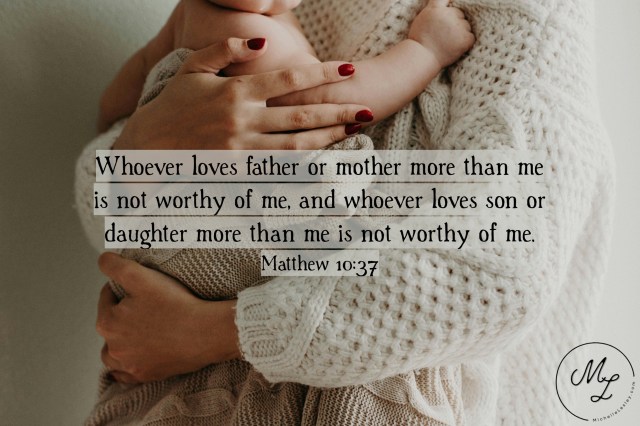
Examine the Deuteronomy 21 and Matthew 10 passages together. What is to be a mother’s highest priority – her relationship with her child, even the life of her child, or her love for, obedience to, and loyalty to Christ? Do you love Christ more than your child? If you had to choose between your child and Christ, who would you choose? What message does it send to our children when we show and tell them that we love Christ more than we love them? How can you demonstrate to your child that your highest love and loyalty is reserved for Christ?


Homework

Examine each of the instructions in Deuteronomy 6:6-9. Make a list of practical ways your family could put each of these instructions into practice and discuss it with your husband. Together, pick one of these practices and implement it with your children this week.


Suggested Memory Verse

Christian women, Complementarianism, Holidays (Other)

The Mother of All Rebellions: Having a Woman Preach on Mother’s Day

Originally published May 10, 2019

When you gaze out across the landscape of the visible church through an earthly, superficial lens, you’ve got to scratch your head and wonder, “Has evangelicalism lost its ever-lovin’ mind?”.

And the answer is to take off those inch-deep dollar store glasses, fire up the electron microscope of Scripture, look long and deep into God’s Word, and reply to yourself, “Of course it has, silly rabbit. What did you expect?”. The Bible is perfectly clear about these things and why they happen.

Exhibit A: The trend in recent years to invite a woman to preach the Sunday morning sermon in church, to the whole congregation (including men) just because it’s Mother’s Day. Not a brief personal testimony, the sermon. This isn’t anything brand new. Lisa Harper has done it at Max Lucado’s church. Christine Caine has done it. Lisa Bevere has done it. Lysa TerKeurst has done it. Priscilla Shirer has done it. And a host of other famous and unfamous women at famous and unfamous churches have been doing it for years, even at churches that normally obey Scripture and don’t let women preach.

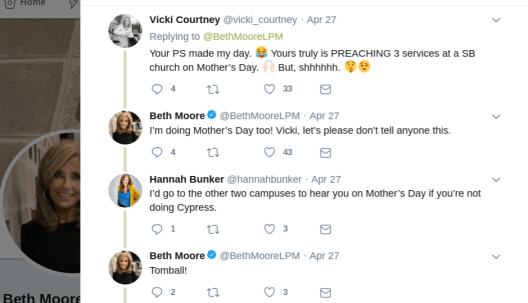
This year (2019), Beth Moore has caused quite the stir by hiding in plain sight the fact that she will be preaching the sermon “doing Mother’s Day” this coming Sunday, presumably at the Tomball, Texas, campus of the church she attends (founded and pastored by her son-in-law Curtis Jones1) Bayou City Fellowship:

I say “hiding in plain sight” because she has given enough of an impression here that she is preaching the sermon to test the waters and see what the reaction will be, but has worded her tweet vaguely enough that if she meets too much resistance she can still decide to back out of preaching, give a brief word of biblically appropriate Mother’s Day greeting or encouragement to the ladies at another point during the service, and come back and claim with wide-eyed innocence that that’s what she meant all along by saying she was “doing” Mother’s Day. (Someone asked Beth point blank, in a subsequent tweet if Beth’s tweet meant that she would be preaching the Sunday service and Beth did not answer her. If she’s not, why not just say so? And if she is and isn’t ashamed of it, why not just say so?)

I say “presumably” at BCF-Tomball because, even though she publicizes specific details about time and place with other speaking engagements, she has not mentioned (at least not anywhere I can find as of the time I’m writing this) the specific church she’s preaching at on Sunday, and the church hasn’t mentioned on their website that she’ll be the guest preacher. Additionally, unlike other speaking engagements Beth does, this speaking engagement is not listed on the calendar of events at her website and she hasn’t mentioned it (other than the tweet above) on social media. With all this “open secrecy” I will be surprised if the video or audio of her sermon is posted on YouTube and/or the church website.

Why all this cloak and dagger about the highest profile woman in the Southern Baptist Convention2, possibly in the entirety of evangelicalism, preaching the Mother’s Day sermon?

Because she knows it’s unbiblical. Because we know it’s unbiblical. And it doesn’t take an electron microscope to see it. It’s right there, in black and white, jumping off the pages of Scripture:

I do not permit a woman to teach or to exercise authority over a man; rather, she is to remain quiet. 1 Timothy 2:12

It couldn’t be more clear. And for pastors who ought to know better to either fall prey to or intentionally perpetuate the serpentine seduction of “Did God really say you can’t preach?”, using Mother’s Day as an excuse to induce a woman to sin by having her deliver the sermon is a slap in the face – to God, to the church, and to women.

Using Mother’s Day as an excuse to induce a woman to sin by having her deliver the sermon is a slap in the face – to God, to the church, and to women.

What do his actions say to God? “I don’t like Your way and I won’t submit to it. I don’t trust that Your way is right regardless of what the world says. I’ll do what’s right in my own eyes.” It’s the lesson his church learns from his actions as well.

But why is inviting a woman to preach an affront to Christian women? Take a stroll down to verse 15 of 1 Timothy 2:

Yet she will be saved through childbearingโ€”if they continue in faith and love and holiness, with self-control.

Not only does the pastor who invites a woman to preach adulterate the role God has set aside specifically for men, he also denigrates one of the good and holy roles God has specifically and intentionally set aside for women: the role of literal, and spiritual, mother.

Eve shattered God’s perfect, unique design for women by allowing herself to be seduced into rebellion. But are we daughters of Eve forever doomed to bear the shame and guilt of her sin, never to have a role in building the Kingdom? Pariahs, to be shunned and shut out of God’s plan? No, praise God! Through the cross, the good works Christ has ordained for Christian women to do – including mothering our own children and being spiritual mothers to our daughters in the faith – redeem the prestige of women. Mothering, in every sense in which God intended it, raises the role of women back to its rightful place in God’s plan.

And we don’t need men – especially men who are supposed to be rightly leading God’s people – to come along and entice us to mess that all up again.

But that’s exactly what’s happening.

When a pastor invites a woman to sin by taking over the pulpit, he drags her and the women of his church right back to post-Fall Eden. He trashes the rank and repute of our God-given high and holy role of mother and implicitly says Being a woman isn’t good enough. You have to steal the role of men to be valued and esteemed. 

When a pastor invites a woman to sin by taking over the pulpit, he implicitly says, “Being a woman isn’t good enough. You have to steal the role of men to be valued and esteemed.”

Ladies, he’s wrong.

We don’t need to be second rate imitations of men in order to “count”. We need to be first rate, full throttle, take it to the limit women of God. God loves us and values us so much more than to give men a special and amazing role and leave us without an equally special and amazing, yet totally distinct, role. The God who spoke the universe into existence and planned out an unparalleled purpose for every single plant, animal, bacterium, and every other atom of the cosmos, did not leave the queen of His creation roleless. He did not bring us into being only to toddle along after the Hairy Ones trying to copy their every move. How unloving of God, and devaluing to women, would that be? Why would you want to act like a man when God blessed you with the gift of being a woman?

If, by God’s good Providence, you’ve “stumbled across” this article and you’re a woman who has been invited to preach, I plead with you: don’t buy the lie. Say no. Your Savior has a whole treasure chest of good works for you to do as a woman. You are worth infinitely more to Him as the woman He created you to be than you are to the world, or a worldly church, as a cheap knock-off of a man.

The practice of denigrating women, devaluing our God-given role, disobeying God, and darkening the understanding of the church by inviting women to sinfully take the pulpit must stop in the house of God.

Let us be the mothers our own children need, raising up a godly seed unto the Lord. Let us be the spiritual mothers longed for by younger women in the faith, daughters orphaned by Christian women who have abandoned them to take on the role of men. The practice of denigrating women, devaluing our God-given role, disobeying God, and darkening the understanding of the church by inviting women to sinfully take the pulpit must stop in the house of God and be replaced by strong godly women, unafraid and unashamed to flourish in the precious role our Lord has blessed us with.

Especially on Mother’s Day.


Updates to this article:

1Curtis Jones (Beth Moore’s son-in-law) resigned his pastorate at BCF in July 2020.

2Beth Moore has left the Southern Baptist Convention and is now attending an Anglican church where – surprise, surprise – she preaches from time to time.


Additional Resources:

Rock Your Role

Beth Moore vs. Owen Strahanย on WWUTT Podcast
(Related links):
โ€ขMichelle Lesley’s Twitter thread on Beth’s Sunday sermon preaching
โ€ขBeth Moore’s Twitter response to Midwestern Seminary professor Owen
Strahan’s article on biblical complementarianism

Divine Order in a Chaotic Age: On Women Preaching by Owen Strahan