Bible, Pop Theology

My “Life Verse”

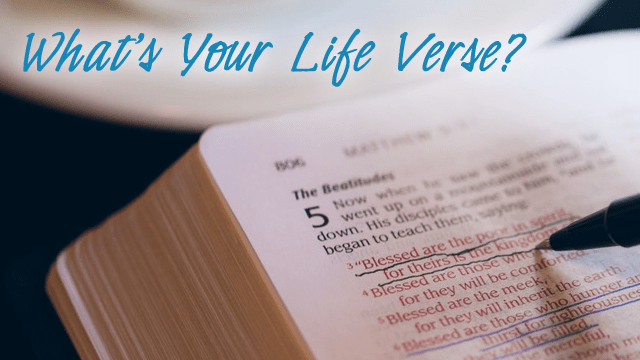
Have you ever heard someone say, “Such and such a verse is my ‘life verse'”? It’s a trend that has become popular over the last several years.

I think people’s hearts are usually in the right place when they embrace the idea of a life verse. They want to cling to God’s word and have it govern their lives, and that desire is good, godly, and biblical.

The concept of a life verse isn’t biblical, though. The Bible doesn’t say anywhere that we’re to choose a particular verse as our life’s slogan or mantra. There might be times in our lives when a particular verse is especially meaningful, but Christians are people of the Book, not people of the verse. Paul speaks about proclaiming “the whole counsel of God.” (Acts 20:27) Psalm 119:160 says, “the sum of Your word is truth.” Psalm 139:17 declares: “How precious to me are your thoughts, O God! How vast is the sum of them!”

The Bible can’t be boiled down to one verse. We need all of the Bible for all of life, not one life verse. So let’s make sure we’re doing the hard work of studying the entire Bible and applying it correctly to the various situations that arise in our lives.

Bible, Old Testament

6 Reasons You Need to Stay Hitched to the Old Testament

Oops, he did it again. Only it wasn’t an “oops”, it was quite intentional.

In a recent sermon, Andy Stanley declared that the modern church needs to “unhitch” the gospel from the Old Testament. He attempted to draw a parallel between James’ pronouncement in Acts 15 that Gentiles did not have to convert to Judaism prior to becoming Christians with the difficulty some non-Christians today have with some of the gory, hard to understand, or otherwise distasteful (to them) passages of the Old Testament (for example: God’s various commands to Israel to utterly destroy all people in certain nations). The apostles cut out the requirement for circumcision to make things easier for Gentiles who wanted to come to Christ, he reasons, so the 21st century church should basically divorce itself from the Old Testament to make it easier for lost people who have a problem with certain Old Testament passages to come to Christ.

There’s only about a million problems with this line of thinking, and, honestly, the more I investigate what Stanley said and his subsequent explanations of why he said it and what he meant, the angrier it makes me. That a man with a master’s degree from a decent seminary, who’s a pastor of several churches, a best-selling “Christian” author, and a leadership and church growth guru to thousands of pastors across the globe should say, or even believe, such things is reprehensible. If he were generally doctrinally sound and this was the first “iffy” thing he had ever said, I’d be inclined to extend grace and give him the benefit of the doubt. But this is somebody with every theological advantage who should know better, yet still has been on a trajectory of attempting to deconstruct the New Testament church for quite some time now. (For more on Andy Stanley’s aberrant theology, click the “Popular False Teachers” tab at the top of this page.)

So, for the sake of my own blood pressure, I’m just going to throw out a few of the most embarrassingly obvious errors here, and let better people than I handle the blow-by-blow.

1. Andy Stanley is not an apostle personally commissioned by Christ to set up the New Testament church. James and those other guys mentioned in Acts? They were. Andy doesn’t have the authority to change New Testament ecclesiology, which is permanently and inextricably hitched to the Old Testament.

2. Acts is generally a descriptive book, not a prescriptive one. While there are certain principles we can learn from Acts and follow, it’s a history of the establishment of the first century church, not a step by step list of instructions to implement in today’s church. If there were a church today that was insisting Gentiles become Jews before they could become Christians, Acts 15 would be applicable. But I don’t know of any churches like that, do you?

3. The two church scenarios Andy is trying to make analogous aren’t. No church I know of requires unbelievers to understand, agree with, or even have read whatever Old Testament passages Andy thinks are problematic prior to becoming a Christian.

Furthermore, how many lost people are actually out there saying, “I recognize I’m a sinner in need of a Savior. I want to repent of my sin and place my faith in Christ for salvation, but I just can’t, because of 1 Samuel 15:2-3.”? People who bring up Old Testament passages like that when confronted with the gospel are presenting excuses for rejecting the gospel, not looking for ways to embrace it.

4. Shoving difficult passages of Scripture into the broom closet is not how God has instructed the church to handle His holy Word. We’re to be “a worker who has no need to be ashamed, rightly handling the word of truth.” (2 Timothy 2:15b) We don’t get rid of challenging passages, we dive into them, study them, and explain them to others.

The Old Testament is absolutely essential to New Testament Christianity, and a rich blessing to the church, individual Christians, and lost people, besides. Here are six reasons you and your church should stay hitched to the Old Testament.

1.
God says so

All Scripture is breathed out by God and profitable for teaching, for reproof, for correction, and for training in righteousness, that the man of God may be complete, equipped for every good work. 2 Timothy 3:16-17

That should be the end of any discussion of ditching any part of Scripture for any reason. God could not have been clearer. “All Scripture” means all Scripture, from Genesis 1:1 to Revelation 22:21. And every single verse of Scripture is profitable. Even the genealogies. Even the inventories. Even the Levitical law. There is stuff in every single verse of the Bible that is useful and beneficial to us. God says so (and He says so in the New Testament, by the way).

2.
You need the Old Testament
to understand the New Testament

Can you come to a saving knowledge of Christ by reading only the New Testament? Yes. But it’s kind of like saying, “I know American history,” when you’ve only studied the years 1900 to the present. The New Testament was birthed out of the Old Testament. The gospel is the culmination of Old Testament doctrine. Jesus Himself is the ultimate fulfillment of every Old Testament prophecy and covenant.

And then there are all the New Testament details that need explaining. Who are these Jews and how did they come to be God’s people? Why do they have such a problem with Gentiles? What are these laws the Pharisees keep talking about? If Jesus is the “second Adam”, who was the first Adam? What on earth is circumcision anyway? And…Hebrews? What’s that all about?

3.
The Old Testament teaches how we CAN’T be saved

Therefore the Law has become our tutor to lead us to Christ, so that we may be justified by faith. Galatians 3:24 (NASB)

and how from childhood you have been acquainted with the sacred writings, which are able to make you wise for salvation
through faith in Christ Jesus. 2 Timothy 3:15

How was the Old Testament Law our tutor to lead us to Christ? How was it able to make Timothy wise for salvation through faith in Christ Jesus? It shows us the futility of thinking we can keep the law to earn righteousness. It shows us that right standing with God always comes by repentance and faith, not works. How many times have you shared the gospel with someone only to hear her say some variation of, “I’m OK with God and I’m going to Heaven because I’m a good person.”? Really? Take a stroll through the Old Testament, and watch how “good” God’s chosen people were. He spelled everything out for them, sent them prophets to tell them exactly what He wanted them to do, performed amazing miracles right before their eyes, and they still couldn’t be “good people.” And you, a pagan, think you can do better?

Remember the old saying, “You can lead a horse to water, but you can’t make him drink.”? Some smarty pants came up with the rejoinder, “Yes, but you can feed him salt.” The Old Testament is our salt. Its lessons in the futility of trying to be good makes us thirsty for the Living Water we find in the New Testament.

4.
The Old Testament vividly shows us
God’s wrath against our sin

I’m not saying the Old Testament only shows us God’s wrath against sin, because it also shows us His compassion, mercy, and love. I’m also not saying the New Testament doesn’t show us God’s wrath. It does, but in a different way than the Old Testament does. In the New Testament, the main ways we see God’s wrath against sin is when it’s poured out on Christ at the cross, and the wrath of God that’s yet to come as it’s described in Revelation.

When it comes to God’s wrath against me, personally, for my individual sin, those demonstrations of God’s wrath can feel a little detached sometimes. But in the Old Testament, I see, in vivid detail, the horrific plagues God rained down on Pharaoh for his sin. I see the ground open up and swallow Korah for his rebellion. I see God immolating Nadab and Abihu for offering illegal worship. I see the once mighty and majestic Nebuchadnezzar forced out into the wilderness to live like an animal because he took God’s glory for himself. And when I know that God doesn’t change – that His wrath towards my sin as a lost person burns just as hot as it did toward those Old Testament rebels – well, it can hit a lot closer to home and convince me of my need to run to the cross and throw myself on the mercy of Christ.

5.
The Old Testament teaches by example

The largest portion of the Old Testament is history and biography. Most of the New Testament is didactic. The New Testament gives us the subject matter we need to learn. The Old Testament puts flesh and blood on it and shows us what it’s like for real, flawed people just like you and me to walk it out. In the New Testament, we learn “by grace are you saved through faith.” In the Old Testament, we see just how God accomplished that in the life of Noah, who found grace in the eyes of the Lord. In the New Testament we learn what it means to repent. In the Old Testament, we walk with David through the loss of his child and his grief over his sin with Bathsheba. In the New Testament, we learn that the godly will face persecution. In the Old Testament, we stand next to Shadrach, Meshach, and Abednego refusing to bow to an idol, even if it means being burned alive. The New Testament gives the facts of the matter. The Old Testament says, “For example…”.

6.
The Old Testament is a warning to the church

People are people. God’s people of the Old Testament are not significantly different from God’s people today. We’re all made in the image of God. We’re all tempted by similar things.

If you begin studying the Old Testament, you can’t help but notice some of the same themes running through the story of God’s people back then that run through our story today. Idolatry. Ecumenism. Doing what’s right in our own eyes. Going through the motions of religious activity without true repentance and faith. Depending on our own power and resources rather than depending on God. False prophets. Persecution and derision of those who stand firmly on God’s Word by those who claim to be His people. Fickle hearts and tickled ears. Oh sure, we might be a little more sophisticated and subtle about it, but, as Solomon put it:

What has been is what will be, and what has been done is what will be done, and there is nothing new under the sun. Ecclesiastes 1:9

And because the Old Testament shows us more direct interpersonal interaction between God and His people, we get to see exactly how God feels about all of those things. We hear what He has to say about it. We see how He responds to it. And, if we’re wise, we take heed to those warnings, humble ourselves, and grow in our fear of the Lord and our desire to please Him with holy living and clean worship.


I could give far more than a mere six reasons why the Old Testament is so vital, a precious blessing, and such a spiritual treasure trove. It tells us where we, and the world around us, came from. It shows us the beauty and precision of worship. It extols the charm of Creation. It displays God’s power, grace, trustworthiness, mercy, justice, His plan for mankind, and all of His other attributes. And so much more.

Are there some passages in the Old Testament that are hard to understand or accept at first blush? Sure. But they’re not keeping anybody from coming to Christ. People reject Christianity, not because of difficult Old (or New) Testament Scriptures, but because they love their sin more than Jesus. And that’s no reason to unhitch anything or anyone from the beauty, the joy, and the benefits of the Old Testament.

How has the Old Testament been profitable in your walk with the Lord?

Basic Training, Bible, Bible Study

Basic Training: The Bible is Necessary

For more in the Basic Training series, click here.

Then Jesus was led up by the Spirit into the wilderness to be tempted by the devil. And after fasting forty days and forty nights, he was hungry. And the tempter came and said to him, “If you are the Son of God, command these stones to become loaves of bread.” But he answered, “It is written, “‘Man shall not live by bread alone, but by every word that comes from the mouth of God.’”
Matthew 4:1-4

I have not departed from the commands of His lips; I have treasured the words of His mouth more than my daily food.
Job 23:12

More to be desired are [the words of God] than gold, even much fine gold; sweeter also than honey and drippings of the honeycomb.
Psalm 19:10

I have a question for you. Try to answer it within three seconds.

Where’s your Bible? (Not the one on your phone or computer- your real Bible.)

Were you able to answer in three seconds because you read it today and remember where you left it when you were finished? Because it stays on your night stand and rarely gets opened? Did it take longer than three seconds because you frequently carry it around with you and can’t remember where you most recently left it?

The point of the question isn’t really where your Bible is in geographical relationship to you, but where you are in relationship to your Bible.

David said God’s word was more valuable to him than gold, even much fine gold.

Job said he treasured God’s word more than his daily food.

Jesus hadn’t eaten a bite in over a month, and He still valued every word that comes from the mouth of God over bread.

If someone put a stack of fine gold in front of you and said you could have it as long as you hardly ever read your Bible, would you take it?

What if you had gone without food for forty days and someone offered you a loaf of bread in exchange for your agreement to put your Bible away and open it only rarely? Could you withstand the temptation?

I’d like to believe I would choose God’s word over a stack of gold or even life-sustaining food. But when I think about all the lesser things I sometimes choose to do instead of setting aside time to study God’s word…

…television
…social media
…reading
…sleeping
…hobbies

…well, I can’t help but wonder:

Do I really value God’s word as deeply as He wants me to?

We need God’s word. It is more necessary to us, spiritually, than food is to us, physically. Yet many Christians unintentionally starve themselves spiritually, thinking a “meal” or two of Scripture at church every week (if they actually attend every week, that is) is enough to sustain them. It’s not. We need to feast on God’s written Word every single day.

We need to know who God is

Saved people are in a one-on-one, personal relationship with God. But how can you have a relationship with someone you don’t really know? How can you love Him, please Him, or enjoy spending time with Him if you know nothing about Him? His character, His attributes, His likes and dislikes, the way He operates – these are all integral to knowing this God who created and saved us. And in His infinite love, God has chosen to reveal all these things about Himself in a book we call the Bible.

We need to know who we are

Just as an employee can’t rightly relate to her employer if she doesn’t understand her role, her place, and her responsibilities, we can’t rightly relate to God unless we understand both who He is and who we are in relationship to Him. We need to understand that He is God and we are not. That He is perfect in holiness and righteousness and we are depraved from the womb. That we are sinners in need of a Savior, created for the purpose of bringing glory to God, servants of the most high King. The only place to learn all of this, and more, about who we are, and where we stand with God, is in the pages of His word.

We need to know what God wants from us

What does God want me to do with my money? How can I be a godly wife if my husband is unsaved? Does God think it’s important for me to go to church? Is it always a sin to lie? Is it wrong to watch pornography? In addition to being a revelation of the nature and character of God, the Bible is also an intensely practical book, instructing Christians on issues of every day life and helping us to understand how God wants us to think, act, and speak. God knows we have questions and in His kindness and mercy has provided all the answers we need in Scripture.

We need to hear from God

While the idea and practice of “hearing God’s voice” is unbiblical, the desire to commune with God- to visit with Him as a loved one – is not. We only have to look back to the Garden of Eden to see that God’s perfect design was for people to fellowship with Him. Because of the Fall, we can’t do that face to face this side of Heaven. For now, we talk to God through prayer and worship. He talks to us through His written Word. Constant communion with God deepens our love for Him and increases our Christlikeness.

More than daily food. More than gold. More than any earthly pleasure, wisdom, or experience, we need God’s word. And we need it every day, all the days of our lives.

Basic Training, Bible

Basic Training: The Bible Is Sufficient

For more in the Basic Training series, click here.

God said to me…/I heard God say…

Listen for God’s voice…

God spoke to me in a dream…

God gave me a vision of…

We hear things like this non-stop these days in pop-evangelicalism. And it’s not just in the whack job Word of Faith or New Apostolic Reformation movements, or in Charismatic churches, either. These words are coming out of the mouths of regular, every day Baptists and Methodists and Lutherans and Presbyterians, too. It’s largely due to the infiltration of Word of Faith and New Apostolic Reformation false doctrine into our churches via a) “Bible studies” from false teachers like Beth Moore, Joyce Meyer, Priscilla Shirer, Christine Caine, Lysa TerKeurst and others and b) individual church members who feed on a steady diet of “Christian” television such as TBN, CBN, Daystar, and GodTV. Christians are getting the false idea that they need to hear, or should be hearing, God speak to them instead of trusting in the sufficiency of God’s word.

The theological term for “God spoke to me/showed me in a dream/etc.” is extra-biblical revelation– words or revelations, supposedly directly from God, that happen outside the pages of the Bible. I’d like to share with you six reasons God’s word is sufficient, and extra-biblcal revelation is both unbiblical and unnecessary.

1. Extra-biblical revelation is not the method God has established for communicating with us.
Maybe you and I would prefer it if God would just talk to us and tell us, one on one, in no uncertain terms, what He wants us to do. But that’s not the way that God prefers to communicate with New Testament Christians this side of a closed canon. God chooses to communicate with us through His written word. He says:

All Scripture is breathed out by God and profitable for teaching, for reproof, for correction, and for training in righteousness, that the man of God may be complete, equipped for every good work. 2 Timothy 3:16-17

Long ago, at many times and in many ways, God spoke to our fathers by the prophets, but in these last days he has spoken to us by his Son, whom he appointed the heir of all things, through whom also he created the world. Hebrews 1:1-2

Let’s bear in mind, it is God Himself who breathed out these words. These verses are God speaking to us, and He says Scripture is enough to make us complete and mature, and to equip us for everything He has for us to do.

When we insist on “hearing God speak” outside of Scripture, we’re essentially saying, “God, I reject Your way and demand you do things my way instead.” Remember, God set up this whole Christianity thing, and He gets to make the rules, not us.

2. What makes you so sure it’s God who’s speaking to you?
Just because you have a feeling, an urge, or an intense experience doesn’t mean that was God speaking to you. Maybe it was Satan. Maybe it was your own wicked heart. Maybe it was a temptation to sin. Maybe it was just an old memory resurfacing. How can you know, objectively (not based on your feelings, the intensity of the experience, etc.), beyond a shadow of a doubt, that it was actually God speaking to you? And if you can’t know for sure it was God, why would you put your trust in whatever “He said” to you?

As Christians, we can irrefutably know God is speaking to us when we read His word because we know He is the author of Scripture.

3. Extra-biblical revelation is redundant and unnecessary.
Even those (most of them, anyway) who believe God still talks to people will tell you that God will never say something to you that contradicts His written Word. So why not just bypass the whole “God spoke to me” thing and go straight to the Bible? Or as Puritan John Owen put it:

As God Himself has told us in His written Word, the Bible is sufficient instruction for every situation in our lives. We don’t need God to speak to us verbally. He has already spoken. Why aren’t we satisfied with that?

4. Insisting on extra-biblical revelation demonstrates a lack of trust in God and His ways.
James 1:5 says:

If any of you lacks wisdom, let him ask God, who gives generously to all without reproach, and it will be given him.

And where do we get wisdom to handle the situations and decisions of life? Not from a voice from Heaven saying “do this” or “do that,” but from Scripture:

The unfolding of your words gives light; it imparts understanding to the simple. Psalm 119:130

Let my cry come before you, O Lord; give me understanding according to your word! Psalm 119:169

The law of the Lord is perfect, reviving the soul; the testimony of the Lord is sure, making wise the simple; Psalm 19:7

and how from childhood you have been acquainted with the sacred writings, which are able to make you wise for salvation through faith in Christ Jesus. 2 Timothy 3:15

We don’t need God to tell us what decision to make, we want Him to, because that’s easier than doing the hard work of digging into Scripture, studying the biblical principles that apply to our situation, making the best and most godly decision we can, and trusting God for the outcome. But that’s exactly what God wants us to do:

Trust in the Lord with all your heart, and do not lean on your own understanding. In all your ways acknowledge him, and he will make straight your paths. Proverbs 3:5-6

When we honor and trust God by looking to His written word for the Holy Spirit’s guidance, He has promised to give us wisdom to make godly decisions and make our paths straight.

5. What about being led by the Holy Spirit?
For some reason people often draw a distinction between being “led” by the Holy Spirit and studying the Scriptures He breathed out, as though they’re two different things. Studying, believing, and obeying the words the Holy Spirit inspired is being led by the Spirit.

6. Extra-biblical revelation sets up a class system within Christianity.
Why do some people “hear” from God and others don’t? The reason implied by the Christian leaders (or even your fellow church members) – who make sure you know they’ve personally heard from God – is that people God speaks to are, spiritually, a cut above. Special. More faithful. More favored by God than you are. It’s like a carrot dangling in front of a horse. It keeps you buying their books, attending their conferences, following them on social media, hoping against hope that one day you’ll become one of the spiritual elite.

But how does the idea that others are “hearing God speak” affect a Christian who isn’t hearing from God? She starts thinking maybe God isn’t pleased with her. Maybe she’s sinning against God in some way. Maybe she’s not being faithful enough, praying enough, giving enough. Maybe God doesn’t love her. Maybe she’s not even saved. It turns her into a second class citizen of God’s Kingdom and causes her to covet something she doesn’t have and God never promised her.

None of this is biblical. There are no first tier and second tier Christians. A lot of the people God actually spoke to in Scripture were hardly paragons of spiritual awesomeness: BalaamSaul, and Moses, just to name a few. And God measures “spiritual awesomeness” not in strutting your closeness to Him before others, but in humility, servanthood, and crucifying self.

Ladies, God’s written Word is sufficient for our every need. We can trust that the words of Scripture are directly from the lips of God Himself. No one can say that with any certainty about extra-biblical revelation. Trust God to direct your paths and give you biblical wisdom to make godly decisions as you grow in the knowledge and understanding of His word.


Additional Resources

God Doesn’t Whisper! With Jim Osman at A Word Fitly Spoken

That’s Enough! The Sufficiency of Scripture at A Word Fitly Spoken

Isn’t the Gospel enough? (The Sufficiency of Scripture) at A Word Fitly Spoken

How Does the Holy Spirit Lead Us? at A Word Fitly Spoken

Basic Training: 8 Steps to Finding God’s Will for Your Life

Where is it written that God doesn’t speak audibly any more? at Naomi’s Table

God Told Me: The Pentecostalization of Evangelical Theology of Revelation at G3 Ministries

Listening to God Without Getting All Weird About It by David Appelt

How God Speaks To Us Today by Tim Challies

Bible, Mailbag

The Mailbag: Which Bible Do You Recommend?

I was saved out of Mormonism but, as a new Christian, spent some time in the Word of Faith movement. I want a Bible that hasn’t been tampered with by a false religion, but I’m not sure which one I can trust. Which Bible do you recommend?

What a blessing it is to even be able to ask this question! You would not ask this question if God had not graciously saved you, and you could not ask this question if there weren’t a ton of different Bibles available in English, nor if you lived in a country where it is illegal to own a copy of God’s word. It’s a dilemma, but it’s a good dilemma to have.

The good news is that there are many fantastic Bibles out there- far more good ones than bad, and far more than I could recommend in this brief article. So, please don’t take this as an exhaustive list or think that because I’ve left a certain Bible out that it isn’t any good.

The first thing you want to look for is a good translation, not a paraphrase. You want to know what God said through Paul, not what somebody 2000 years later thinks about what God said through Paul. You’re looking to get as close to the original wording as is possible.

There are several great English translations on the market. I started using the English Standard Version (ESV) about four years ago, and I love it. Prior to that I used the New American Standard Bible (NASB) for about 20 years. It is also an excellent translation. If you’re familiar with various Bible translations, ESV is, in my opinion, like a more accurate, more linguistically sophisticated 1984 New International Version (NIV). NASB is like a cross between the King James Version (KJV) and the 1984 NIV, but more accurate. The Legacy Standard Bible (LSB), is excellent and is basically a recent precision update of the NASB. In my opinion, ESV, NASB, and LSB are the best translations out there today.

There are, however, several other solid translations such as the New King James Version (NKJV), the Lexham English Bible (LEB), the Christian Standard Bible (CSB– This is a newly revised version of the Holman Christian Standard Bible {HCSB}, and they’re dropping the “Holman”. So HCSB and CSB – whichever one you happen to see – are the same thing.), and the “old” or “1984” NIV (You want to stay away from the TNIV {Today’s New International Version}, now out of print, and any 2011 or later NIV, as those both contain gender neutral/inclusive language. The 1984 edition is also out of print, but you may be able to acquire one from a second hand store.)

The KJV is a good translation and the language is beautiful, but if you have trouble with 1611 English, it’s not the only game in town anymore. Some of our modern translations are actually more accurate than the KJV because thousands more biblical manuscripts have been discovered since it was first published, allowing translators to be more precise.

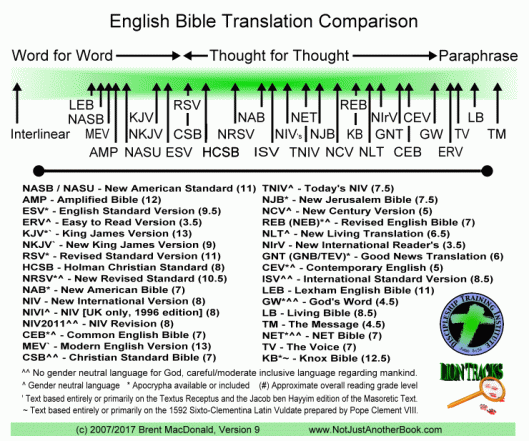
Below is a helpful chart from Brent MacDonald of Not Just Another Book comparing a number of different translations and paraphrases. (On this chart, it’s good to be a “leftist”).

bibletranslationcomparisonsmall

You can try most of these translations out for free at Bible GatewayThere’s even a great feature that allows you to compare several versions side by side:

Just as there are a number of good Bible versions I would recommend, there are a few I’m familiar with which I would strongly recommend againstThe Message, The Voice, The Passion Translation, The Amplified Bible, and any “translation” that uses gender neutral language.

More than a few articles have voiced concerns over The Message’s – a paraphrase – often misleading texts. (I would add that Eugene Peterson {author of The Message} frequently shows poor discernment. One recent example is his front cover endorsement of the heresy-laden book – and movie – The Shack.)

The Voice is not only a paraphrase, its contributors include female “pastors” and false teachers such as Brian McLaren, Phyllis Tickle, Chris Seay, and Leonard Sweet.

The Passion Translation is a New Apostolic Reformation version of the Bible which actually changes the wording of many verses in order to fit the NAR agenda. Click here for a Bible translation scholar’s review of Passion’s version of Psalms.

The Amplified Bible falls prey to an improper translation technique called illegitimate totality transfer, which, in its attempt to clarify a particular word or phrase, may actually end up causing you to misunderstand the correct meaning of the verse.

I’ve already mentioned the post-1984 versions of the NIV, but be sure to avoid any “translation” of the Bible that uses gender neutral language extensively or exclusively. And you certainly don’t want a “Bible” that uses neutral or feminine pronouns or references to God – those should always be male.

There are some perfectly reliable and accurate newer Bible translations that will, for example, occasionally render (or add a footnote) “brothers” as “brothers and sisters” when it’s clear from the context that Paul is talking to or about the entire church. That’s not what we’re talking about here. We’re talking about changing passages clearly referring only to men to include women. Thus, these “translations” are actually changing God’s words. Let me give you an example from the Common English Bible (CEB). This is 1 Timothy 3:1-7:

This saying is reliable: if anyone has a goal to be a supervisor in the church, they want a good thing. 2 So the church’s supervisor must be without fault. They should be faithful to their spouse, sober, modest, and honest. They should show hospitality and be skilled at teaching. 3 They shouldn’t be addicted to alcohol or be a bully. Instead, they should be gentle, peaceable, and not greedy. 4 They should manage their own household well—they should see that their children are obedient with complete respect, 5 because if they don’t know how to manage their own household, how can they take care of God’s church? 6 They shouldn’t be new believers so that they won’t become proud and fall under the devil’s spell. 7 They should also have a good reputation with those outside the church so that they won’t be embarrassed and fall into the devil’s trap.

Compare this to any reliable translation, and you’ll see the problem (and not just with the gender neutral language). I recently saw a woman “pastor” defend her right to serve in that office from this passage in the CEB “translation,” which, I imagine, is precisely the reason it was rendered this way. (It appears that there are likely a number of other problems with the CEB, as well. I looked only at the passage above and 1 Timothy 2:11-15, and the translation of that passage is completely botched as well, erroneously rendering “woman” and “man” as “wife” and “husband,” removing the “for/because” at the beginning of 13, and completely mangling the meanings of verses 14 and 15. This passage could also be used to support the sins of women preaching, pastoring, and holding authority over men in the church. Again, compare this to any reliable translation.)

If you’re looking for a good study Bible (or want to avoid a bad one), I’ve discussed that a bit here (#4). I frequently use and highly recommend both the ESV MacArthur Study Bible and the Faithlife Study Bible (which is FREE!). When shopping for a study Bible, do you homework and vet the contributors. Avoid any study Bibles whose contributors are false teachers, theologians from apostate churches, female “pastors,” etc. Some in particular I would recommend you avoid are the CSB LifeWay Women’s Bible, ESV Women’s Study Bible and the YouVersion app (all feature false teachers). And check out this article from Tim Challies: What Makes a Really Good Study Bible?.

Looking for a great Bible app? Check these out.


If you have a question about: a Bible passage, an aspect of theology, a current issue in Christianity, or how to biblically handle a family, life, or church situation, comment below (I’ll hold all questions in queue {unpublished} for a future edition of The Mailbag) or send me an e-mail or private message. If your question is chosen for publication, your anonymity will be protected.