1&2 Timothy Bible Study

1 & 2 Timothy: Lesson 3

Previous Lessons: 1, 2

Read 1 Timothy 2

Questions to Consider

1. Briefly review the theme or purpose of the book of 1 Timothy from lesson 1 (link above). Who is the ultimate Author of this book? Are the ideas and instructions in this book God’s ideas and instructions, or something Paul came up with on his own? Who was the original audience of this book?

2. You may be familiar with the little hermeneutical rule of thumb, “Whenever you see therefore in a verse, you need to find out what it’s there for.” “First of all, then,…” at the beginning of verse 1 serves the same purpose as “therefore” (in fact, some translations render that phrase as “therefore” instead of “first of all, then”). God, through Paul, is saying, “Because of all that stuff I told you in chapter 1, do what I’m about to tell you to do in chapter 2.” Review 1 Timothy 1 and/or lesson 2 (link above). What are the main issues addressed in chapter 1?

3. Make a “bullet point” list of each instruction given to Timothy and the church in chapter 2. Now make the connection between the two chapters – how can the church’s obedience to the instructions in chapter 2 fix the issues brought out in chapter 1?

4. Which group of verses is the focal point, or main idea, of chapter 2?

  • 1-3
  • 4-7
  • 8-10
  • 11-15

Read each of these groupings of verses and describe how each of them revolves around the idea that God desires to save people (4). Notice how the words, “I desire then” (8) and “likewise also” (9) point back to the focal passage. Why did God put the gospel smack dab in the middle of these instructions about how the congregation is to behave?

5. Why does Paul again cite his qualifications and credentials? (7)

6. Why does God want His church to pray for others, including kings and leaders? (1-2) What is the immediate desired outcome of this kind of prayer? (2) What is the long-term desired outcome of this kind of prayer? (3-4) Think about the political and cultural context surrounding the church at Ephesus. How could the church at Ephesus and the church today leading “a peaceful and quiet life, godly and dignified in every way” (2) lead to people getting saved (3-4)?

7. Does verse 8 mean that only men should pray when the church is gathered together? (Use your footnotes)

Questions 8-12 are drawn from lessons 15 and 14 (respectively) of my Imperishable Beauty study of biblical womanhood. If you have completed that study, you may wish to review your notes from those lessons.

8. Examine verses 9-10. Describe how women are not to adorn themselves and how they are to adorn themselves. Are things like braids, jewelry, and clothes intrinsically sinful, or is Paul giving cultural examples to illustrate a theological point he’s making? What is that point? What is it about the bent of women’s hearts that would cause God to give this instruction to women in the context of the home and the church, but not to give this instruction to men at all? How does it benefit the church for us to “wear”, or portray, godliness by adorning ourselves modestly and with good works?

9. Study verses 11-15. What is the first word of verse 11? Think about women’s social status and value in Paul and Timothy’s culture, and in many cultures since that time, even today. Why does the Holy Spirit instruct pastors to “let” women learn? What does this teach us about the responsibility God places on us as women to learn His Word? Would you categorize verse 11 as a “do this” or “don’t do this” verse?

10. Examine verse 12. Is this mainly a “do this” or “don’t do this” verse? What two things does the Holy Spirit say women are not to do in the gathering of the church body? What does He say women are to do? Think about God’s nature and character. Does He ever give instructions arbitrarily or just to spoil our fun? Why does God give us commands and instructions, generally speaking? Are the instructions in verse 12 good for women and for the church?

11. Take a look at 13-14. God kindly gives not one, but two reasons for His instructions in verses 11-12. What are those two reasons? How do they fall in line with God’s design for male headship and leadership across biblical history in the hierarchical structures He has set up?

12. Verse 15 can be a little cryptic to us today because we equate the word “saved” with salvation. Does verse 15 mean that women gain salvation by having children? How do we know it doesn’t? The NASB helpfully, and more accurately, renders this word as “preserved.” We don’t feel it much today, but think about the stigma women (particularly Jewish women) carried at the time this was written simply because they were daughters of Eve. Paradise was lost and the curse of sin entered the world because of a woman, many men thought, and they viewed and treated women accordingly. Yet who was chosen to bring the Messiah into the world? And following in her footsteps, a major way godly women can “save” or “preserve” the reputation, esteem, and value of womankind is to “continue in” what 3 godly character traits? (15) Because if they continue in those three godly character traits, they will be raising up a godly seed to the Lord (even if the children they bear aren’t perfect like Mary’s child was.) :0)


Homework

If you’d like to study more about modesty (9-10), check out these articles:
Imperishable Beauty: Lesson 15- A Beautiful Portrayal of Biblical Womanhood in the Church
The Mailbag: Potpourri (Calvinism, Baptism, Modesty…)

If you’d like to study more about the role of women in the church (11-15), check out these articles:
Imperishable Beauty: Lesson 14- A Beautiful Position in the Church
Jill in the Pulpit (1 Timothy 2:11-12)
Order in His Courts: Silencing Women? (1 Corinthians 14:33b-35)


Suggested Memory Verse
1&2 Timothy Bible Study

1 & 2 Timothy: Lesson 2

Previous Lessons: 1

Read 1 Timothy 1

Questions to Consider

1. Briefly review the housekeeping/helpful hints section and “Introduction to 1 Timothy” section from lesson 1 (link above).

2. Why did the Holy Spirit inspire Paul to list his credentials and explain his relationship to Timothy in verses 1-2? Why would this have been important to Paul and Timothy, to the members of Timothy’s church, to anyone else at that time who happened to read this letter, and to readers of 1 Timothy today? Where was Timothy’s church located? (3)

3. What is the very first issue Paul tackles regarding Timothy’s church? (3-11) What does this tell you about the urgency of this issue then, and now?

Today, with regard to false teachers, Christians will often say things like, “You shouldn’t say anything negative about that person, you should just pray for her,” or “You should just teach the truth of the Bible and people will figure out for themselves who the false teachers are.” Is this what the Holy Spirit, via Paul, instructs Timothy to do? (3-4) How is Timothy instructed to address the false teachers? (3-4) Why is it urgent that Timothy (and pastors today) deal with false doctrine and not allow it in his church? (4b, 7)

What is supposed to be the motive and goal of pastors, teachers, and church members when it comes to living the Christian life and serving the church? (5) When teachers “swerve from these,” what does that swerving lead to? (6-7)

Compare verse 19 to verses 5-6, noting the similarities. Who were Hymenaeus and Alexander? (use your cross references) How does Paul say he handled these false teachers? (20) Why did he do this? (20) Compare Paul’s handling of unrepentant false teachers in the church to Matthew 18:15-20, Jesus’ instruction of how to handle unrepentant sinners in the church (18:17b). Why is it necessary to remove unrepentant sinners and false teachers from the church and to regard them as non-Christians (“hand over to Satan”, “let him be to you as a Gentile and a tax collector”)? (20b, 4b) What is the goal of a Christian regarding anyone who is not a Christian? Are these actions toward false teachers in keeping with the motive and aim Paul expressed in verse 5?

4. Examine the words “genealogies” (4), “teachers of the law” (7), and the discussion about the law in verses 8-9. Now, draw from what you may already know about the false teaching of the Judaizers in the early church. What do you think is the general topic the false teaching Paul addresses in chapter 1 has to do with?

5. What does it mean to “use the law lawfully” (8)? (9) Who are the “just”? (9) Who are “the lawless and disobedient…the ungodly and sinners” (9a)? (9b-10) Which is the correct (lawful) group to “lay the law down for” (9a)? (9b-10)

If 8-11 describe the lawful use of the law – who it should be laid down for – what can you conclude about the false teachers’ use of the law? Who were they laying it down for? Why is this false teaching? (10b-11)

6. What is “sound doctrine” (10b)? (11) Why is it important that all pastors and teachers preach and teach sound doctrine?

7. Read 12-17. What are some adjectives you would use to describe Paul’s character and his view of himself? What is Paul’s view of his position in relationship to Christ? How does Paul see what Christ has done in his life as an example for others? (16) Pray through these verses asking God to develop in you the same view of yourself and your position before God that Paul had.

8. We’re going to see the word “charge” several times in 1 & 2 Timothy. How many times does this word appear in chapter 1? What does the word “charge” mean in verse 3? In verses 5 & 18?


Homework

Believe it or not, there are still false teachers out there today teaching that Christians must obey Old Testament civil and ceremonial laws. Do some research on the Hebrew Roots Movement to learn more, and if you come across a good resource about it, please comment below and share.


Suggested Memory Verse

1&2 Timothy Bible Study

1 & 2 Timothy: Lesson 1- Introduction

Welcome to our new study, 1 & 2 Timothy: The Structure and Spirit of the Church!

What is God’s plan for the church? How did He intend for it to be structured and run, and what is His vision for us, His people, as we worship Him and love and care for one another? For the next several weeks we’ll work our way through the books of 1 & 2 Timothy, one of God’s “policy and procedure manuals” for the church, to learn about its organizational skeleton as well as the spirit of its people.

Many thanks to those who worked so hard on their entries for our title pic contest. You ladies were very creative and did some beautiful work! 


Cheryl Toepfer                             Becky McGraw


Patti Green                                    Terri Mobley

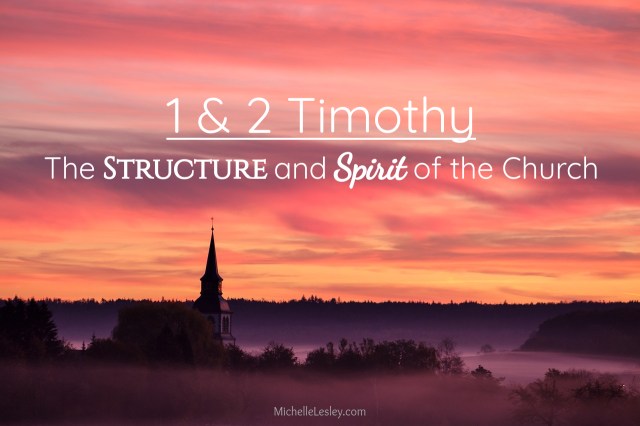
In the end, I had such a hard time figuring out how to capture the theme I had in mind for the study – bouncing from one thought to another and discontent with every idea that popped into my mind – that I decided to design the title pic myself. (If there’s a chance I might end up dissatisfied, I’d rather be dissatisfied with my own work than the work of one of you lovely ladies!)

My thought is that the sunrise in this photo conveys the idea of the dawn of the church in history, when 1 & 2 Timothy were written. As the light of God’s instruction “rises” upon the church as they read through these epistles, it clears away the surrounding fog of uncertainty about God’s will and His ways for His people. Also, I really like the colors. :0)

If you’re new to using my Bible studies, just a few housekeeping items and helpful hints:

The studies I’ve written (you can find all of them at the Bible Studies tab at the top of this page) are like “training wheels”. They’re designed to teach you how to study the Bible for yourself and what kinds of questions to ask of the text so that, when you get the hang of it, you won’t have to depend on other people’s books and materials – even mine – any more. To that end, I do not provide answers for the study questions in the studies I’ve written.

My studies are meant to be extremely flexible and self-paced so that you can use them in the way that works best for you. You can do an entire lesson in one day or work on the questions over the course of the week (or longer). You do not need to feel obligated to answer all (or any) of the questions. If the Holy Spirit parks you on one question for several days, enjoy digging deep into that one aspect of the lesson. If He shows you something I haven’t written a question about that captures your attention, dive in and study it! Those are ways the Holy Spirit speaks to us through His Word. This is your time to commune with the Lord, not a school assignment or work project you are beholden to complete in a certain way by a certain deadline.

I will post a new lesson on the blog every Wednesday, so there is nothing to sign up for or commit to. Simply stop by the blog each week, or subscribe to the blog via e-mail to have the lessons delivered to your inbox.

With our last study (Imperishable Beauty) I “beta tested” a Facebook discussion group specific to that study. It was enthusiastically received, but after the first couple of weeks, there was virtually no participation. So with this study, I’ve decided not to put in the extra work of admin-ing a discussion group. You are welcome to form and admin your own discussion group if you like. I will also post the lessons on my own Facebook page each week, and anyone who would like to discuss the lesson can do so in the comments section of those posts.

I use hyperlinks liberallyThe Scriptures for each lesson will be linked either at the beginning of the lesson or in the lesson questions. Whenever you see a word in red, click on it, and it will take you to a Scripture, article, or other resource that will help as you study.

All of the studies I’ve written are suitable for groups or individuals. You are welcome to use them as a Sunday school or Bible study class curriculum (for free) with proper attribution.

You are also welcome to print out any of my Bible studies (or any article I’ve written) for free and make as many copies as you’d like, again, with proper attribution. I’ve explained more about that in this article (3rd section).


Introduction to 1 Timothy

Before we begin studying a book of the Bible, it’s very important that we understand some things about that book. We need to know…

Who the author was and anything we might be able to find out about him or his background.

Who the audience of the book is: Jews or Gentiles? Old Testament Israelites or New Testament Christians? This will help us understand the author’s purpose and approach to what he’s writing.

What kind of biblical literature we’re looking at. We approach books of history differently than books of wisdom, books of wisdom differently than books of prophecy, etc.

What the purpose of the book is. Was it written to encourage? Rebuke? Warn?

What the historical backdrop is for the book. Is Israel at war? At peace? In exile? Under a bad king? Good king? Understanding the historical events surrounding a piece of writing help us understand what was written and why it was written.

When the book was written. Where does the book fall on the timeline of biblical history? This is especially important for Old Testament books which are not always arranged in chronological order.

So this week, before we start studying the actual text of the book of 1 Timothy, we need to lay the foundation to understanding the book by finding the answers to these questions.

Read the following overviews of the book of 1 Timothy, taking notes on anything that might aid your understanding of the book, and answer the questions below:

Bible Introductions: 1 Timothy at Grace to You

Overview of the Book of 1 Timothy at Reformed Answers

Book of 1 Timothy at Got Questions

1. Who wrote the book of 1 Timothy? How do we know this?

2. Approximately when was 1 Timothy written? What is the geographical setting of the book of 1 Timothy? Here are some maps (scroll down to “1 Timothy”) that may be helpful as you study through the book of 1 Timothy.

3. Who is the original, intended audience of the book of 1 Timothy? Describe the historical setting (historic events, politics, sociology of the time, etc.) of 1 Timothy.

4. Which genre of biblical literature is the book of 1 Timothy: law, history, wisdom, poetry, narrative, epistles, or prophecy/apocalyptic? What does this tell us about the approach we should take when studying this book versus our approach to books of other genres?

5. What is the theme or purpose of the book of 1 Timothy?

6. What are some of the major topics of instruction in the book of 1 Timothy? How do these topics relate to the theme of 1 Timothy?

7. What are some ways 1 Timothy points to and connects to Jesus?

8. What else did you learn about 1 Timothy or the setting of this book that might help you understand the text of the book better?

Take some time in prayer this week to begin preparing your heart for this study. What are some ways your pastor and church could be encouraged by the instruction of 1 Timothy? What might you learn that could make you a healthier church member? Do you have any areas that need improvement when it comes to the way you serve God or your brothers and sisters in Christ? Ask God to grow you in those areas as we study together 1 & 2 Timothy: The Structure and Spirit of the Church.

1&2 Timothy Bible Study

New Bible Study Kickoff and Title Pic Contest

Happy Wednesday, Ladies!

Today, we’re kicking off our new study…

…with a fun title pic contest!

It’s common these days to hear pastors say that they have a “vision” for the church. But how often do we stop and think about God’s vision for the church? In 1 & 2 Timothy, God’s instructions to a young pastor, we’ll see the beauty of God’s attribute of administration as He sets the practical aspects of the structure of the church in order, but we’ll also see His heart for the spirit of the church to be wholly oriented toward Him – for His glory and our good. This is church as it was meant to be – then and now.

But before we get started studying, how about a little fun?

You’ve probably noticed that I design a title picture for each Bible study I write. Here are a few past title pics:

(You can see the rest of them at the Bible Studies tab, if you like.)

Y’all have sent in some beautiful and creative entries in our past title pic contests, so, once again, I wanted to get some of you involved in the design process for our new study.

Do you enjoy and have a knack for photo editing? Know someone who does? If so, I’m accepting submissions for title pictures for the 1 & 2 Timothy study. If your submission is chosen it will be used each week of the study, and you’ll be credited (name or website) by watermark. I’d love to be able to offer a huge cash prize, but, hey, we’re small potatoes here. This is just for fun and maybe a little publicity for your site, if you have one.

Contest Guidelines

 You must use images that don’t require attribution. Pictures you’ve taken yourself are fine, as are images from sources such as Pixabay, Pexels, Freely, Unsplash, StockSnap, or other free stock photo web sites. Please include the image source web sites you use along with your submission. (You cannot just grab and use any old picture off the internet. Photographers own their images and usually require permission, attribution, and often a fee, for their use.)

Title pics should be landscape (a horizontal rectangle) with a width of 640-1500 pixels and proportionate height. I prefer JPG images, but PNG is fine, too, if necessary.

 Your title pic must contain the full title of the study: 1 & 2 Timothy: The Structure and Spirit of the Church. (Be sure to double check your spelling). 

 If your submission is selected, I’ll be glad to watermark it with your website address (please submit your picture without any watermarks) as long as your web site doesn’t conflict with my statement of faith or my beliefs outlined in the Welcome tab.

 Deadline for submissions is 11:59 p.m. Monday, April 15, 2019

E-mail your title pic submission along with your full name, web site address (if any), and the source(s) you used for your image(s) to MichelleLesley1@yahoo.com.

 Please don’t be offended if your submission isn’t selected. If I peruse all the submissions and I’m just not “feeling it,” I may still elect to design one of my own.

Feel free to share this around with friends who have an interest in photo editing. If you want to take a whack at it for fun but don’t know where to start, play around with Be Funky, PicMonkey, or Canva and see which one works best for you. Think about God’s vision for His church and try to capture the theme of 1 & 2 Timothy in your image.

Happy designing!