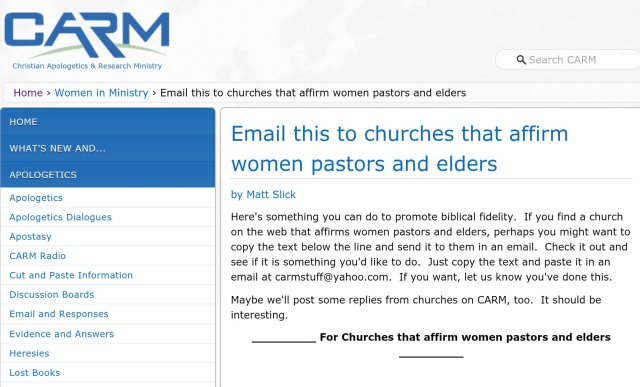
Are you familiar with the Christian Apologetics & Resource Ministry (CARM)? You should be. It’s an invaluable resource. From answers to tough questions, to apologetics training, to information on tons of cults, world religions, and heresies, CARM is a treasure trove of materials that will inform you, help you grow in your faith, and evangelize and disciple others.
Recently, I came across this resource article for churches which approve female pastors and elders. Readers often ask me for information like this that they can send out, so I thought I’d pass it along. Click here for the full article.
Contemplative prayer, often called centering prayer, (and connected to sozo prayer and soaking prayer) is very much like a “Christianized” transcendental meditation (similar to New Age or Buddhist meditation). You are supposed to sit quietly, empty your mind, and repeat a biblical word or phrase over and over until you begin “hearing from God.”
Is this a biblical form of prayer? No, and it is also very dangerous. Many who have come out of this practice and churches or organizations which promote it (the International House of Prayer, or IHOP, and Bethel “Church” in Redding, California, are major proponents) report that contemplative prayer is much like being hypnotized and that it was an open door for demonic opression and even possession.
Our beliefs and worship practices are to be drawn from Scripture, and nowhere in Scripture are we told to pray like this. When the disciples asked Jesus how to pray, He did not tell them to empty their minds and repeat a mantra. He said,
“And when you pray, do not heap up empty phrases as the Gentiles do, for they think that they will be heard for their many words. Do not be like them, for your Father knows what you need before you ask him. Pray then like this:
“Our Father in heaven,
hallowed be your name.
Your kingdom come,
your will be done,
on earth as it is in heaven.
Give us this day our daily bread,
and forgive us our debts,
as we also have forgiven our debtors.
And lead us not into temptation,
but deliver us from evil.”
Matthew 6:7-13
Jesus taught us to talk to God using intelligible words, worshiping Him, repenting and seeking His forgiveness, and asking Him to provide for our needs. It is not His desire that we mimic a pagan form of meditation.
If you have a question about: a well known Christian author/leader, a Bible passage, an aspect of theology, a current issue in Christianity, or how to biblically handle a family, life, or church situation, comment below (I’ll hold all questions in queue {unpublished} for a future edition of The Mailbag) or send me an e-mail or private message. If your question is chosen for publication, your anonymity will be protected.
It happened again last week. Another scandal. Another high profile pastor stepping down from the ministry in disgrace. Another family broken. Another church stunned and bereft.
And it’s not just the money grubbing televangelists anymore, either. This was one of the theological good guys. Sadly, pastors and Christian leaders – both those in the public eye and those right around the corner – seem to be dropping like flies these days. Adultery. Financial sin. Pornography. Abuse. Fraud. The list of sinful behavior goes on and on, leaving a wake of destruction in its path and giving Christ and His bride a black eye in the process.
So, what is the biblical response to scandals like these for Joe and Jane Christian? We view the situation through the lenses of Romans 8:28:
And we know that for those who love God all things work together for good, for those who are called according to his purpose.
How can God use this scandal, awful as it is, for my good and the good of my brothers and sisters in Christ? It’s an opportunity to learn, teach, and minister in so many ways:
Fully grasp the destructive power of sin…
Imagine the agony the pastor’s sin is creating in so many lives. What must his wife be going through? His children? His church? What about his own relationship with God? What about the lost people he was trying to win to Christ? What about the fact that his career may be over and he may lose his house?
It’s been said that sin destroys completely and completely destroys. It’s a good time to reflect on the fact that sin is not something to be trifled with. Count the cost. Would it be worth it to you to commit the same sin in your own life?
Realize your need for Christ…
“There, but for the grace of God, go I.” “Therefore let anyone who thinks that he stands take heed lest he fall.” (1 Corinthians 10:12) “Pride goes before destruction, and a haughty spirit before a fall.” (Proverbs 16:18)
Don’t fall into the trap of thinking you’re better or holier than the person who sinned, therefore, you would never do what he did. Instead, let his sin push you towards the cross, realizing that you’re just as weak and susceptible to temptation as he is. Let it amp up your prayer life and drive you to cling to Christ and His word lest you fall into sin.
Dive into God’s word…
What does the Bible say about the sin in question? Learn what God’s word says. Apply it to your life, your work, or your marriage. Teach it to your children. Share it with those in your circle of influence. Build up your brothers and sisters in Christ so they might stand firm against temptation.
Implement safeguards…
People don’t just wake up one day and decide to commit adultery or embezzlement or whatever. Every sin starts with a wayward thought, which, when left unchecked (or entertained), snowballs into action. What could the scandalized pastor have done, practically, to prevent his sin? What are some concrete, proactive steps you can take to guard against sin in your life? Maybe your husband should hold the credit cards or you should cut ties with that certain male friend. Don’t wait for sin to find you. Build some walls before it arrives.
Use the scandal as a springboard for prayer…
Pray for those involved in the scandal. Ask God to protect you, your husband, and your loved ones from that particular sin. Realize that your own pastor and church staff are tempted to sin every day, pray for them regularly, and let them know you’re praying for them.
What if you were the one who sinned? How would you want people to talk about and treat you and your family? Call a sin a sin, but let’s remember, when it comes to scandals, to watch our words and actions, and treat others the way we would want to be treated.
Use the scandal as an opportunity to share the gospel…
Inevitably, some lost people will see pastoral sin as one more candle in their “Christians are just a bunch of hypocrites” cake. Don’t be embarrassed if an unbeliever approaches you with this line of fire (and whatever you do, don’t try to make light of or justify the pastor’s sin). Own it. Admit it. “You’re right. This guy sinned. He needs to repent and be forgiven by Christ. He needs to make things right with the people around him. Just like me. Just like you. By the way, Christ was crucified for sinners like him and me and you. Have you ever repented of your own sin and trusted in Christ’s death, burial, and resurrection as the payment for your sin? Mind if I tell you how?”
Repent and Forgive…
It’s hurtful when someone you trust and look up to lets you down. But because we’re sinful humans living in a broken world, it’s going to happen. The pastor who sinned needs to repent. When he does, the people around him need to forgive, even though there will probably still be disciplinary consequences to his actions. Is there sin in your life that you need to repent of and face the consequences for? Is there someone who has sinned against you that you need to forgive? God extends the grace of forgiveness to repentant sinners and the grace to forgive to their victims. Repent. Forgive.
Scandals among Christian leaders are heartbreaking, disappointing, embarrassing. But the God who sent His only Son to the cross to turn sinners into saints has a wonderful way of taking offenses and turning them into opportunities for His kingdom.
When we think about “ministry” or “serving the church,” we often – sometimes exclusively – think about Paul’s preaching, and forget about things like Jesus washing the disciples’ feet, the seven men who served the widows (Acts 6:1-6), the generous givers in Corinth (2 Corinthians 9), the Shunamite who provided a room for Elisha (2 Kings 4:8-10).
Ministry and servanthood are often dirty and unglamorous jobs that nobody else wants to do, but they’re filling a need. When you clean up the church kitchen after a fellowship meal, you are doing ministry. When you sit with a church member at the hospital, you are doing ministry. When you take a turn in the nursery, you are doing ministry. When you pray for your church, you are doing ministry. When you mow the church grounds or fix the leaky baptistery or watch someone’s child so she can keep an appointment, you are doing ministry. You’re not going to be applauded for doing these things. Few, if any, will even notice that they’ve been done, and some of those folks will complain about the way you did it.
And that’s OK, because ultimately, we aren’t doing it for them. We’re serving Christ (Colossians 3:23-24).
Notice the kinds of ministry Jesus commends believers for at the final judgment (Matthew 25:31-40). Not teaching dozens or preaching to hundreds or singing to thousands (though those things are certainly needful and commendable when done biblically), but providing food, drink, and clothing to needy brothers and sisters in Christ, welcoming strangers into the church, visiting sick or imprisoned church members. It’s the little, personal, one on one, taking care of each other’s needs that Christ praises.
“Truly, I say to you,” our King will say, “as you did it to one of the least of these my brothers, you did it to me.” (Matthew 25:40)
May we all get out of the mindset that the spotlight is the only route to ministry, put on our grungy clothes, roll up our sleeves, get down on our hands and knees, and do the dirty, lowly work of servanthood.
As you can see from the “Additional Resources” section that follows this article, a number of concerns have been raised since (and even before) I published it in 2016. My podcast partner, Amy Spreeman, and I recently heard from a listener who has resigned her leadership position in BSF due to some of these same concerns. With her permission, Amy has published her letter to us at Berean Research. I urge you to read it, especially if you are considering signing up for BSF: Leaving BSF 2023: Testimony from a former teacher.
On the whole, I would not recommend BSF as an entity for all of the reasons cited below and in the podcast episode above. I would also not recommend BSF or any other parachurch Bible study organization (e.g. Community Bible Study, The Daily Grace Co., etc.), particularly those run by women, for two main reasons. First, Bible study is the purview of the local church, not parachurch organizations. Biblically, it should be conducted in the context of the local church so the pastor and elders can oversee it and make sure only sound doctrine is being taught. Second, I have yet to see a popular parachurch organization run by women that isn’t theologically wonky in some aspect (usually several aspects).
You may believe your particular BSF group is doctrinally sound and that the false doctrine discussed here hasn’t trickled down to it yet. That may be the case, and you will have to use your own judgment on that. However, I would encourage you to consider what I’ve said above about the biblical context for Bible study, as well as the fact that the false doctrine taking place at the national level will almost certainly trickle down to your group at some point, and you may not notice when it does.
What are your thoughts on BSF (Bible Study Fellowship)? Is it doctrinally sound? Is it a good way of studying the Bible?
According to the BSF web site, “We believe people discover their true purpose and identity by knowing God through His Word. That is why BSF offers free, in-depth Bible studies in community for people of all ages around the world.” BSF Bible study groups are held in various local churches and are open to anyone.
I have never participated in BSF myself, but I am somewhat familiar with it through a couple of friends who have been very involved.
While I totally support the idea of delving deeply into the Scriptures with other women, there are a few of aspects of BSF that concern me. Let me start off by saying that every BSF group is different, so I’m sure these may or may not be issues with every group depending on the leaders and participants.
First, the amount of time required for BSF homework and other responsibilities may not be a fit for every participant. Some women have the hours required for these things and embrace it, but many do not. For the women who do not, this can become discouraging. They may come to view studying the Bible as a chore. They may sometimes neglect their husbands, children, homes, churches, friends, etc., in favor of completing the assignments. They may even give up on organized Bible study all together, assuming that all classes require the same investment of time as BSF. For these reasons alone, I would probably not recommend BSF for a new believer.
Next, BSF is limited to studies of only ten books/topics. I understand why BSF may have to do this from a logistics standpoint, but if BSF is a woman’s only form of personal or group Bible study, that’s leaving out a lot of the Bible. We need all of the Bible for all of life.
Finally, my major concern with BSF is that it is ecumenical. It is my understanding that BSF is open to, and led by, people from all denominations (and non-denominations) that call themselves Christian. This is a problem because there are many churches and denominations which call themselves Christian but whose doctrine is not in compliance with Scripture (for example, Catholics, Oneness Pentecostals, Mormons, and New Apostolic Reformation).
BSF could be very helpful in this regard if it would require its leaders to hold to sound doctrine (our doctrine colors the way we teach Scripture) and would allow its leaders and members to discuss correct biblical doctrine, but the way it has been explained to me, “BSF doesn’t teach doctrine, it just teaches the Bible.” That statement, if an accurate representation of BSF’s stance, demonstrates a fundamental flaw in their view of Scripture and its regulation of the church. The Bible is doctrine. There is no way to teach the Bible without teaching doctrine.
What if, during a discussion of that day’s lesson, one of the Catholic members says, “This verse seems to say that praying to Mary would be wrong. Have I been sinning all these years?” or a Mormon says, “This passage indicates that we can be baptized for the dead. We should all be doing this.”? These are doctrinal issues, whether BSF sees them as such or not, and from a biblical standpoint these members need to be taught that praying to Mary and baptism for the dead are unscriptural and sinful. But, according to what I’ve been told, BSF will not correct people’s false doctrine in order to remain open to people of all “Christian” faiths. In fact, I’ve been told it’s against the rules for members/leaders to even disclose which church they belong to. Nor, for the same reason, can anyone recommend (or warn against) any pastor, author, or teacher, despite the fact that his/her materials might be very helpful (or harmful) to someone in the group. BSF leaders are also told not to use any Scripture other than what is being studied that day, which is most unhelpful, as one of the basic tenets of sound hermeneutics is that “Scripture interprets Scripture” and that unclear passages are to be understood in light of clear passages. Cross-referencing Scripture could help clear up doctrinal issues.
The Bible tells us that the job of a pastor (and by the extension of this principle, Bible teachers) is to “give instruction in sound doctrine and also to rebuke those who contradict it” (Titus 1:9b). It also says Christians are not to yoke ourselves together with unbelievers (2 Corinthians 6:14-18). Those who claim to be Christians yet deny the essentials of the faith (the Trinity, salvation by grace alone, etc.) are just as much unbelievers as atheists and agnostics (Matthew 7:21-23). It seems to me that there is something foundationally wrong with a Bible study in which genuine believers and false converts, people who hold to sound doctrine and people who hold to false doctrine, can sit side by side with neither being offended or corrected.
Mature, discerning believers can probably attend BSF without being swayed to believe any false doctrine (and, just to be clear, I’m certain it’s not BSF’s intention to teach false doctrine). However, I imagine that those mature, discerning believers would find it difficult to abide by the rules of keeping quiet on issues of sound doctrine as those issues arise.
If you have a question about: a well known Christian author/leader, a Bible passage, an aspect of theology, a current issue in Christianity, or how to biblically handle a family, life, or church situation, comment below (I’ll hold all questions in queue {unpublished} for a future edition of The Mailbag) or send me an e-mail or private message. If your question is chosen for publication, your anonymity will be protected.
UPDATE: I’ve received numerous comments on this article. About half have disagreed with some or all of it and the other half have said it’s spot on. As mentioned in the article, “every BSF group is different, so I’m sure these may or may not be issues with every group depending on the leaders and participants.” Comments are now becoming redundant, and some of them downright ugly, so I’ve closed comments on this article. (Just to save you some time, please don’t go to another article’s comment section and attempt to comment on this article there. It won’t be published. I also will not be responding to e-mails/social media messages about this article.)