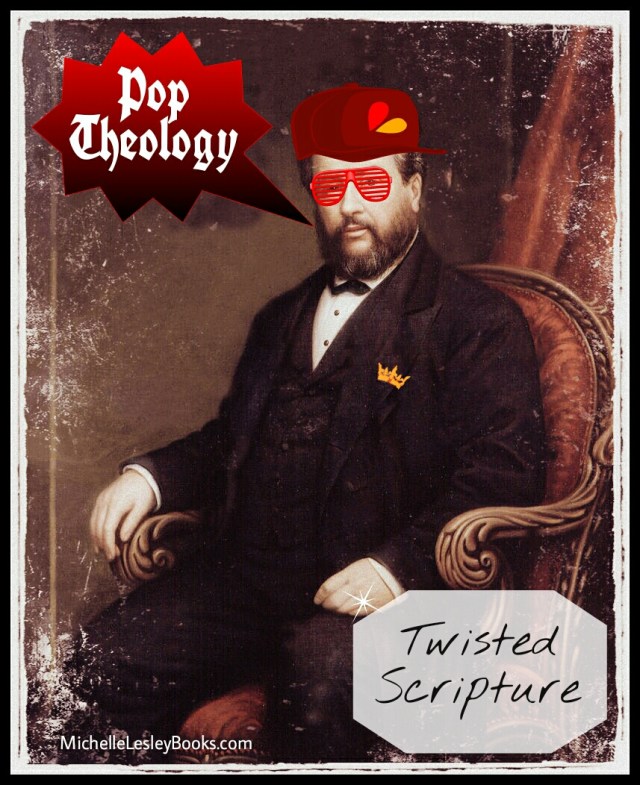
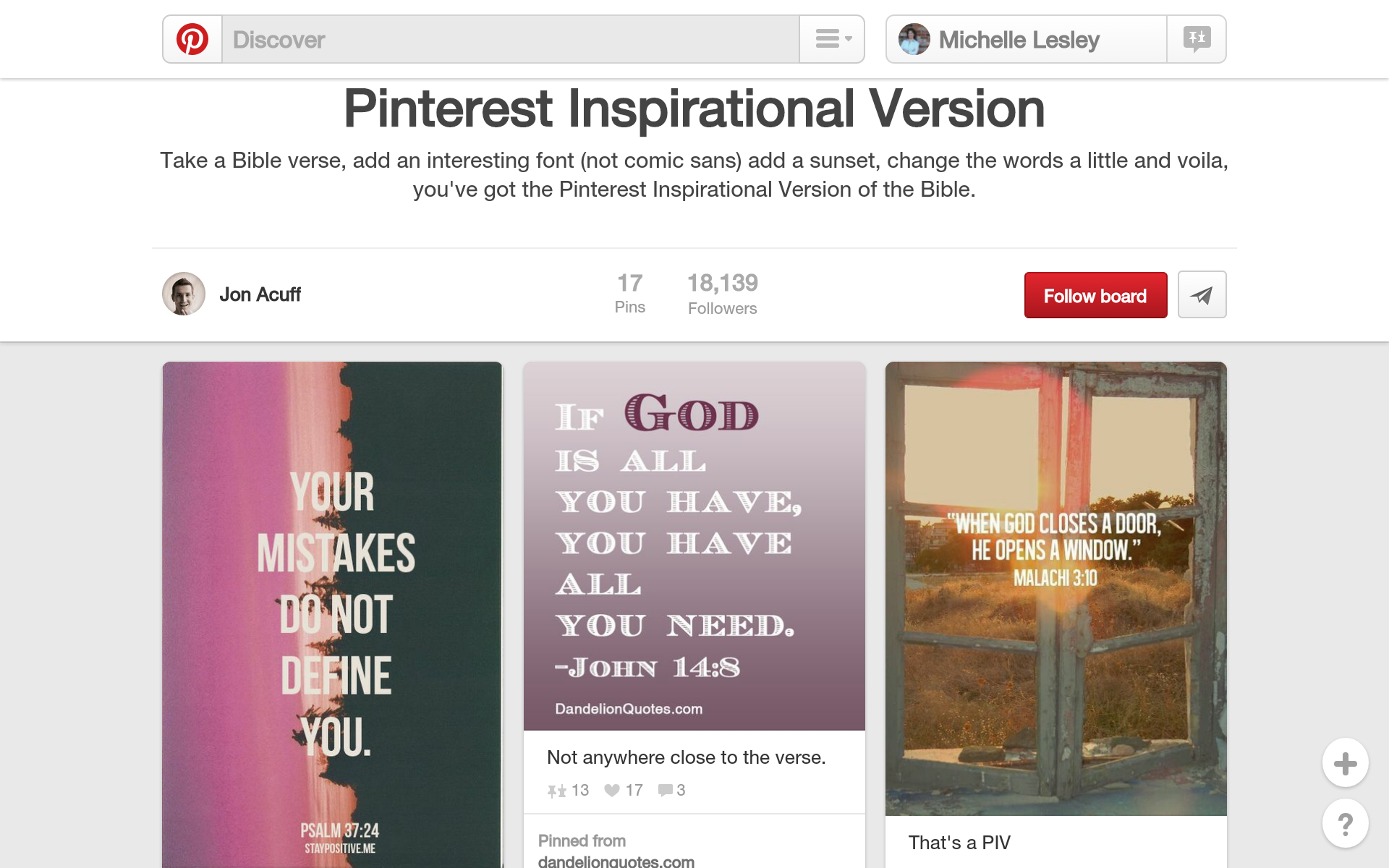
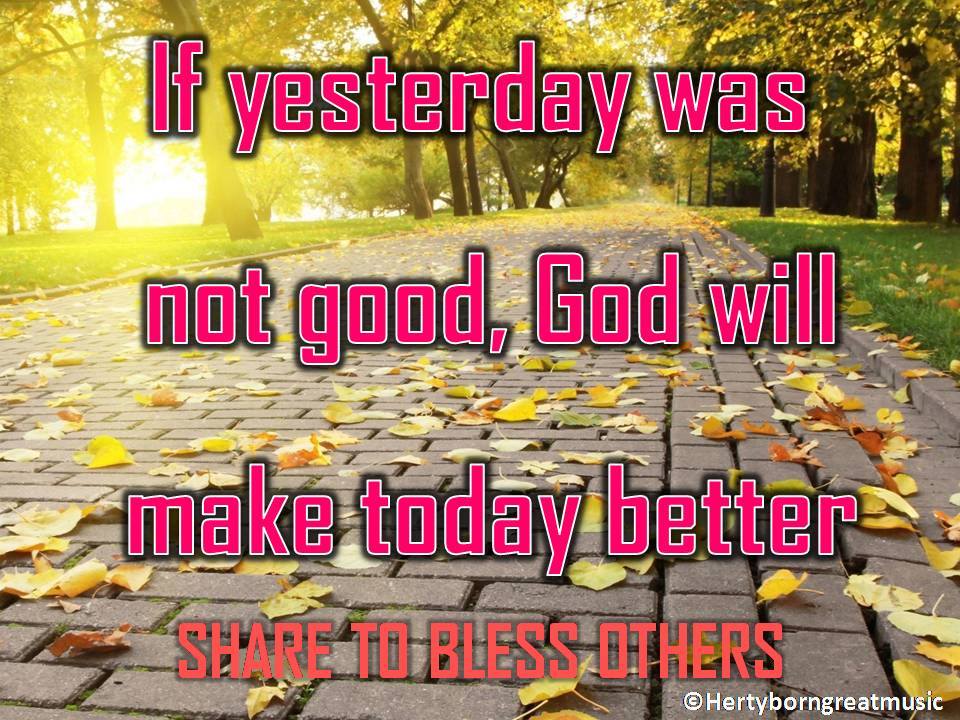
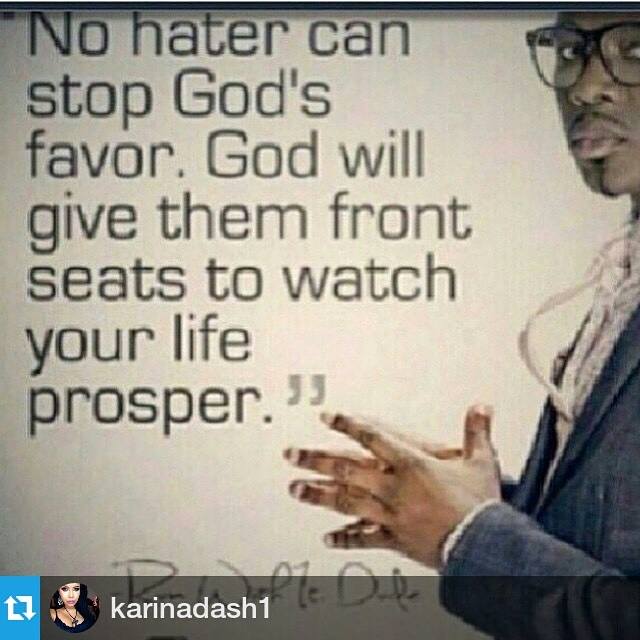
I saw this meme that I thought was a Bible verse. It had a nice thought and a Scripture reference after it, but when I turned there in my Bible, the nice thought didn’t say anything close to what the verse actually said. It turns out that someone wrote what the verse meant to her and then put the Scripture reference after it. And there’s a whole Pinterest board dedicated to memes like this! Is it OK to handle God’s word like that? I’ve also included some other memes I found that sound fishy to me. Your thoughts?
Penny Pinterest
Dear Penny,
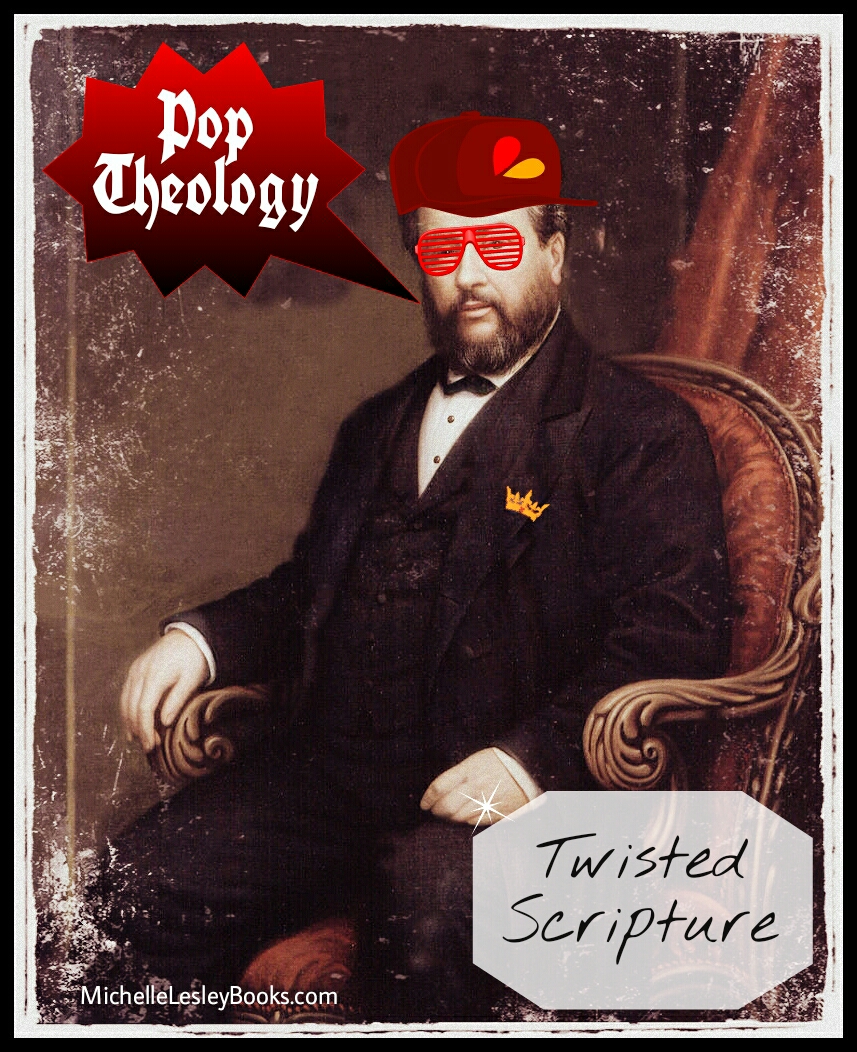
Jon Acuff’s a fun dude, but this is dissin’ God’s word. Ain’t nobody – NO-O-O-O-O-BODY got the props to bling up the Bible. No addin’ to it. No subtractin’ from it. Bad things’ll go down, ya dig? Jots? Tittles? Keep your mitts off, and swing that sword right. And what up with all this “Inspirational Version”? God’s word is da bomb diggity all by its onliness, got me?
Fo’ relz? Where’s that in the Big Book? Lemme let you in on a little inside info: nowheresville. Jesus said as long as we’re hangin’ on the big blue, there’s gonna be trouble. Lots of it. But check it out- who cares? We don’t throw down our faith on havin’ a good day. We throw down our faith on Jesus, even when it’s a bad scene.
Yeah? Tell that to Jesus. His haters had front row seats to torture Him and watch Him die. Or the eleven out of Jesus’ twelve closest homeboys who were executed by their haters. Put your peeps on a copy of Foxe’s Book of Martyrs and quit littering up social media with this mess. Kick that prosperity gospel junk to the curb.
Well, Penny. I’ve laid down the gospel 411 for ya. Keep your specs on Jesus and keep the faith.
The Lord spoke to Moses, saying,2 “If anyone sins and commits a breach of faith against the Lord by deceiving his neighbor in a matter of deposit or security, or through robbery, or if he has oppressed his neighbor3 or has found something lost and lied about it, swearing falsely—in any of all the things that people do and sin thereby—4 if he has sinned and has realized his guilt and will restore what he took by robbery or what he got by oppression or the deposit that was committed to him or the lost thing that he found5 or anything about which he has sworn falsely, he shall restore it in full and shall add a fifth to it, and give it to him to whom it belongs on the day he realizes his guilt.6 And he shall bring to the priest as his compensation to the Lord a ram without blemish out of the flock, or its equivalent, for a guilt offering.7 And the priest shall make atonement for him before the Lord, and he shall be forgiven for any of the things that one may do and thereby become guilty.”
Isaiah 61:8a
For I the Lord love justice;I hate robbery and wrong;
Luke 19:1-10
He entered Jericho and was passing through.2 And behold, there was a man named Zacchaeus. He was a chief tax collector and was rich.3 And he was seeking to see who Jesus was, but on account of the crowd he could not, because he was small in stature.4 So he ran on ahead and climbed up into a sycamore tree to see him, for he was about to pass that way.5 And when Jesus came to the place, he looked up and said to him, “Zacchaeus, hurry and come down, for I must stay at your house today.”6 So he hurried and came down and received him joyfully.7 And when they saw it, they all grumbled, “He has gone in to be the guest of a man who is a sinner.”8 And Zacchaeus stood and said to the Lord, “Behold, Lord, the half of my goods I give to the poor. And if I have defrauded anyone of anything, I restore it fourfold.”9 And Jesus said to him, “Today salvation has come to this house, since he also is a son of Abraham.10 For the Son of Man came to seek and to save the lost.”
1 Corinthians 6:10-11
nor thieves, nor the greedy, nor drunkards, nor revilers, nor swindlers will inherit the kingdom of God.11 And such were some of you. But you were washed, you were sanctified, you were justified in the name of the Lord Jesus Christ and by the Spirit of our God.
Ezekiel 18:16
[He] does not oppress anyone, exacts no pledge, commits no robbery, but gives his bread to the hungry and covers the naked with a garment,
Ephesians 4:28
Let the thief no longer steal, but rather let him labor, doing honest work with his own hands, so that he may have something to share with anyone in need.
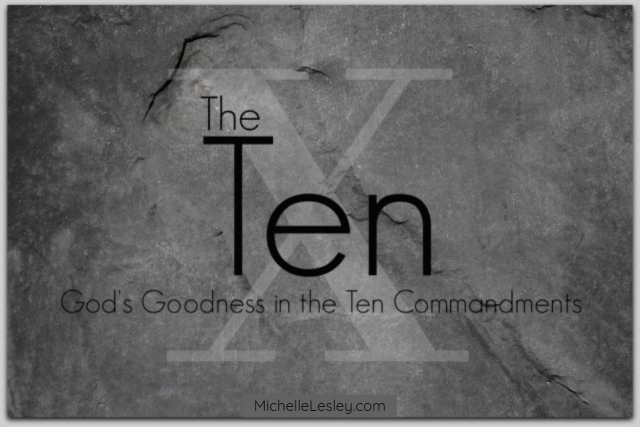
1. Going back to the immediate context of the eighth Commandment, (God is setting apart Israel as His own special people and establishing them as a nation), why would it have been important, on a societal level, that Joe Israelite refrain from stealing? How would respecting their neighbor’s rights of private ownership of property have pointed the pagan nations surrounding Israel to the one true God? How can being a law abiding citizen today be a step toward witnessing to lost people?
2. According to verses 2,5-7 of Leviticus 6, whom has a thief sinned against? Are the consequences in this passage for a repentant or unrepentant thief? (4) How was a thief to repent to his victim? (5) How was a thief to repent to God? (6-7) Were the Old Testament consequences for stealing the same as the consequences for stealing where you live? How are they alike or different? Are the OT consequences more punitive or more focused on restitution? Why do you think this was?
3. What attribute of God does Isaiah 61:8a tell us that stealing is an affront to? In what ways is stealing unjust? The Bible tells us that God is jealous for His name and reputation and that we are ambassadors for, and representatives of, Him. Are we representing God well if we steal? How does it mar God’s reputation in the eyes of others if a Christian steals?
4. Study the story of Zacchaeus in Luke 19. Tax collectors in Jesus’ time were despised for various reasons, one of which was that they would often lie to people about the actual amount owed, charge them much more, and pocket the difference, which certainly qualifies as thievery. What impact did the gospel have on Zacchaeus’ thievery? Was he repentant or unrepentant? Compare verse 8 with verse 5 of the Leviticus 6 passage. How does Zacchaeus’ amount of restitution compare with what was required of him by the law? How does Zacchaeus’ story demonstrate to us that truly being regenerated by Christ moves us from merely fulfilling the letter of the law to “going the extra mile” in obedience and servanthood?
5. What does 1 Corinthians 6:10 tell us is the penalty for unrepentant sinners such as thieves? What does verse 11 tell us about the forgiveness available for all repentant sinners? What do the words “washed,” “sanctified,” and “justified” mean in this verse? What is the difference between the people mentioned in verse 10 and those referred to in verse 11?
6. Examine the Ezekiel and Ephesians passages. In light of these verses, how would you restate the eighth Commandment as a positive (a “Thou shalt ____.” statement rather than “Thou shalt not ____.”)? What actions does God give as examples of the opposite of stealing in these two verses? What are some ways Christians can live out the opposite of stealing?
Homework:
Stealing isn’t just absconding with a tangible item that belongs to someone else. Have you ever cheated on your taxes? Stolen someone’s spouse through adultery? Stolen someone’s virginity? Pirated music or movies? Fudged your hours at work? Failed to tip appropriately or pay a worker as promised? Taken credit for someone else’s work?
Ask God to reveal to you any way you may have stolen something from someone, then follow the principles in the Leviticus and Luke passages. Repent to God and, if possible, to the person you stole from. Is there any way you can make generous restitution?
If you haven’t stolen anything, go back to the Ezekiel and Ephesians passages and think of one concrete way you can live out the opposite of stealing this week.
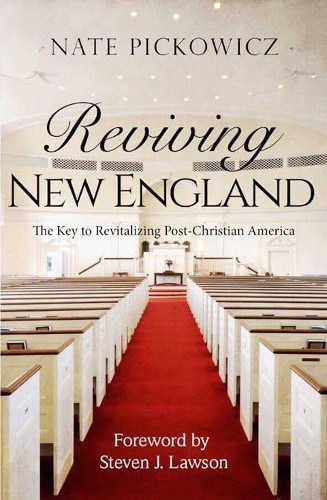
I’ve said it dozens of times: I don’t write book reviews. But I’m fortunate that there are awesome, godly people out there who do, and who do a bang up job of it. So today I wanted to share a great review of the book Reviving New England. The review was written by my friend Rachel Williams over at danielthree18.com, and the book was written by my other friend, Nate Pickowicz, pastor, podcaster, and blogger extraordinaire. They are both lovely, doctrinally sound people I’m proud to know, so I’m certain you’ll enjoy both the review and the book.
I ordered Nate’s book, Reviving New England: The Key to Revitalizing Post-Christian America, and I sit down to enjoy a treatise on the history of liberalism in New England, and what pastors in New England need to do today to turn the churches back to Christ.
Instead, I spent the majority of my time reading chunks of the books out loud to my husband, whispering, “YES!,” and underlining massive sections of it, realizing that every woman who leads women’s ministries across the United States (and beyond) needs this book.
Today.
Pickowicz does start the book with a brief history of the rise (and fall) of Christianity in New England. For those of you not students of church history, he does an excellent job of making this information relevant to today and fast-paced. (Trust me, I’ve heard my fair share of less-than-exciting lectures on this topic. He does a great job keeping your interest.) However, the history lesson is brief, and this is where the book becomes, in my opinion, necessary for women’s ministry leaders today.
The rest of the book is written for pastors and centers on how to preach the Word of God. He does a masterful job of navigating the problems in so many pulpits and offering real practical solutions to guiding the church back to sound biblical principles.
So why do I think women’s ministry leaders need this?…
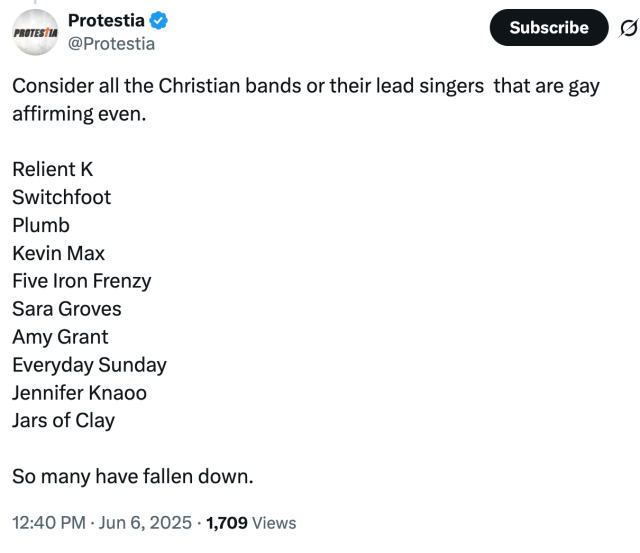
I’ve noticed that false doctrine is not just restricted to sermons, conferences, and Bible studies, but that I have to watch out for it in the contemporary Christian music (CCM) I listen to as well. Are there any CCM groups, artists, or songs I should avoid? Can you recommend any specific doctrinally sound artists or groups?
You’re absolutely right that we need to be careful about what we listen to that wears the label “Christian.” There is a lot of beautiful, doctrinally sound, theologically rich music of all genres out there, and there’s a lot of junk as well.
I’d like to offer a couple of caveats before diving into the answer for this question:
1. I plead extreme ignorance when it comes to CCM. With rare exception, it’s not a genre I enjoy, I don’t listen to it, and the worship service I attend uses “traditional” (mostly hymns) music, so I’m not often exposed to it. I’m all in favor of doctrinally sound CCM for those who like that genre, it’s just not my personal cup of tea or an area I research.
So, in this article I’m going to tell you what little I know, point you to people and resources better equipped to answer this question, and lean heavily on you discerning CCM listeners for help (more on that in a bit).
2. There is lousy theology in every genre of music. There are lousy hymns, lousy Christian rap, lousy CCM, lousy gospel, lousy Southern gospel, etc. This question was asked specifically about CCM, so that’s what the answer is going to focus on. It’s not a debate about hymns or exclusive psalmody versus CCM.
3. Depending on music from currently popular musicians is a lot like depending on Bible studies from currently popular evangelical authors. The majority of them aren’t doctrinally sound, and even the few that are seem to be apostatizing at an alarming rate. My recommendation to churches? Either go back to using tried and true doctrinally sound hymns, sing the Psalms, or find some talented musicians and lyricists in your own (doctrinally sound) church and put them to work writing songs for your worship service.
Why is it important to be discerning about Christian music? Because the music we use in church and listen to at home teaches us theology, and it sticks in our memories (which is why a lot of Scripture memory programs set Bible verses to music to help with memorization). You probably couldn’t recite verbatim a quote from last Sunday’s sermon, but I’ll bet you know the lyrics of a lot of songs by heart. It’s important that those lyrics contain good theology.
It’s imperative for churches to be discerning about the CCM they use in worship. If Jane Churchmember hears a CCM song in church and likes it, she’s likely to Google the song (probably right there in church- I’ve done it!), find out who sings it, and begin following that artist. Worship pastors who use CCM have a responsibility to vet the artists who perform the songs they select for the worship service to make sure they’re not sending Jane into the arms of a heretic. Additionally, music costs money, and you don’t want your church’s offerings supporting false doctrine.
Now, every time I address the subject of being discerning about worship music and that churches should not use worship music from heretical sources (such as Bethel, Hillsong, and Elevation, see below) someone who’s defending using music from these heretical sources will invariably pipe up with this well worn canard1:
Well, [insert name of hymn writer here] wrote lots of perfectly biblical hymns, but he had some theological problems too, and you’re not recommending we get rid of all of his hymns.
Well, first of all, maybe we should more closely examine the theology of some of our most prolific hymnists and stop using their music because of what they believed. Quick – off the top of your head, name the three we should start with…
…And that’s what separates the errant hymnist from Bethel, et al. Most Christians, even those who prefer hymns over CCM, could probably not name three people who wrote hymns, let alone tell you anything about their theology. But if you ask the average Christian to name three top Christian artists, she could rattle them off in a second.
Most hymn writers have been dead for up to hundreds of years. They don’t have Facebook pages you can follow, nobody’s playing their stuff on KLOVE, they’re not on tour to promote their latest album, they don’t have thousands of followers worldwide, and their music is in the public domain, so your church isn’t financially supporting them or their work. If you wanted to follow their errant theology, you’d have to hit the books to research and study it. Contemporary musicians’ theology is only a click away on YouTube, social media, live streamed concerts and conferences, and on their web sites. Nobody is following dead hymnists’ false doctrine, but hordes are following contemporary musicians’ heresy.
And anyone else who closely associates with any of the above (performing together, co-writing songs, Bethel Music produces their albums, etc.)
🟡Artists I Don’t Proactively Recommend (i.e. Use Caution or Avoid)
Casting Crowns has toured with Hillsong. Hillsong – not CC – pulled out of their 2022 tour due to the scandals with Brian Houston.
CityAlight is the music ministry of St. Paul’s Anglican Church, which occasionally allows women to preach and has a few ties to Hillsong (covering Hillsong songs, also this video was recorded at Hillsong studios, see info. section).
Selah member, Todd Smith, is the husband of Angie Smith.
There are probably many others that belong on all three of these lists, but those are the only names I personally know to give you.
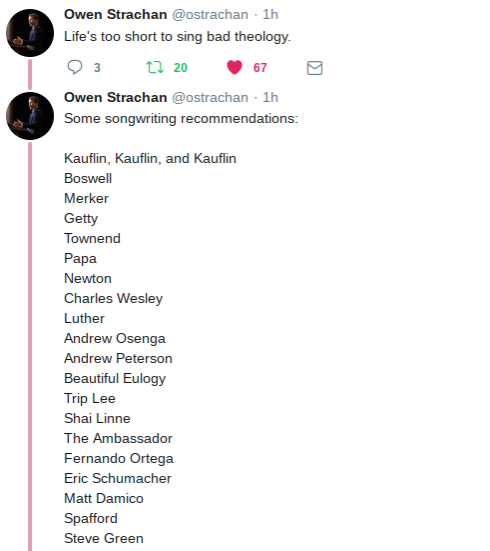
Owen Strachan recently made some recommendations of songwriters, though they’re not all contemporary, on Twitter: (others also responded with suggestions, click here to see):
(I’m not familiar with all of these, but in case you need their first names to look them up: Bob Kauflin, Stuart Townend, Matt Papa, John Newton, Martin Luther, Horatio Spafford.)
You will, of course, need to vet for yourself the theology and associations of any musician or group you decide to follow. It’s not quite the same as vetting a teacher or pastor, but several of the principles in my article Is She a False Teacher? 7 Steps to Figuring it Out on Your Own can be adapted for vetting musicians. Additionally, I would recommend three things when deciding whether or not to listen to someone:
1. Look up the lyrics of about half a dozen of her latest songs and examine the lyrics against Scripture. It’s helpful to look at the words in front of you without hearing the music so you can really think about them without being emotionally influenced by the music. Are they biblical?
2. Look to see who the artist associates with and admires. The easiest way to do this is to check their Facebook and Twitter feeds. Do you see scads of re-tweets and shares of posts from false teachers? Is she on tour with, co-writing songs with, or having her albums produced by a musician you know should be avoided?
3. Go to the artist’s web site, and examine her statement of faith (if she has one) and the venues she’ll be playing. Does she frequently play at places like Bethel? Lakewood? The Potter’s House? Is she the worship leader at a lot of conferences featuring false teachers? You might also want to look at her bio to see if she mentions her home church. If she’s a member of a church headed up by a false teacher, that’s definitely a red flag.
Below you’ll find some helpful additional resources relating to specific songs, artists, and the CCM industry. I’d also like to solicit the help of you discerning listeners of CCM:
Are there CCM songs or artists you would recommend avoiding due to biblically demonstrable sin or false doctrine? Please comment below with the exact name of the artist/song, the reason to avoid said artist/song, and a link(s) providing lyrics and/or objective support for your reason. Unsubstantiated accusations will not be published. Are there doctrinally sound artists you would recommend? Please comment with the name of the artist (and preferably a link to his/her web site) below.
If you have a question about: a Bible passage, an aspect of theology, a current issue in Christianity, or how to biblically handle a family, life, or church situation, comment below (I’ll hold all questions in queue {unpublished} for a future edition of The Mailbag) or send me an e-mail or private message. If your question is chosen for publication, your anonymity will be protected.
It’s an honor for me to be able to say that my family has a love of country and of military service. My dad served in the Army, as did his dad. My husband served in the Air Force. Our oldest is currently serving in the Air Force, and his younger brother is currently serving in the Navy. Numerous members of my extended family have served or are serving in every branch of the military.
If you’re close to someone in the military, maybe you’ve heard him tell heart-wrenching or horrifying tales of combat. But often, the more humorous stories are the ones that transpire prior to battle- while greenhorns are being transformed into soldiers, AKA: boot camp.
At boot camp, recruits undergo rigorous physical training, but they also learn the most basic of military customs, procedures, and protocol: how to stand in formation, how and whom to salute, how to march, how to properly wear their uniforms, and so on. Sometimes they goof these things up, and their drill sergeants…well…let’s just say their drill sergeants correct them in such a memorable way that the recruit won’t goof it up next time.
The military doesn’t expect civilians to know military procedure, which is why basic training exists. But they certainly expect seasoned soldiers, sailors, and airmen to know the fundamentals as well as they know how to breathe. We might chuckle at the story of a rookie confusing “attention” with “at ease,” but a lieutenant? A captain? We’d wonder what was wrong with him and why he hadn’t been properly trained.
Now, ladies, you and I may never march in the infantry, ride in the cavalry, shoot the artillery. We may never fly o’er the enemy, but we’re in the Lord’s army! Yes, sir! (A little VBS humor there for all you oldsters like me.) If God has been our C.O. for a while, we should know the basics of Christianity and the Bible.
But, sadly, I’m discovering more and more Christian soldiers who are clueless about some of the some of the most fundamental tenets of our faith. Not because they’re dumb. Not because they’re rebellious. Not because they don’t sincerely love the Lord. But simply because they’ve never had a drill sergeant who properly instructed them in these things.
Maybe that’s you. Maybe you’re a Christian who has spent most of her life in a church that was heavy on comfort and encouragement and light on doctrine. Maybe you’re a baby Christian who’s never darkened the doorstep of a church. Maybe you’ve been in a good church all your life and were out sick the day a particular subject was taught. We’ve all missed something along the way. Nobody has “arrived” yet. We’re all still learning, and we’re all in this together.
That’s why I’m starting a new blog series today that I’m calling Basic Training, and it’s for everybody, whether you’ve been saved for five minutes or fifty years. We’re going to cover several of the practical basics of church, the Bible, and Christian living. Things like…
Repeating a prayer doesn’t necessarily make you a Christian.
Christians are to join, and faithfully attend and serve, a doctrinally sound local church.
While Christians are not under the Old Testament law of the tithe, we are to generously, regularly, and cheerfully give offerings to our local church.
Homosexuals have to repent of their sin in order to be saved, just like everybody else.
Baptism is important and isn’t optional for a believer (not to become a believer).
Ditto the Lord’s Supper.
Being “led” by the Holy Spirit and studying and obeying the Scriptures He authored are not two separate and unrelated things.
Scripture prohibits women from preaching to, teaching Scripture to, and holding authority over men in the gathered body of believers.
Just because Jesus didn’t address a particular topic during His earthly ministry doesn’t mean we can do what we want to about it.
The Bible, not our own feelings or opinions, is to govern what we believe and what we do.
Cohabitation and sexual activity prior to or outside of wedlock are sins.
I probably won’t address every single one of those topics, and there are others I will address that aren’t included in the list above, but you get the idea: basic things you would expect someone who’s been a Christian for years to know and are surprised to find out she doesn’t.
Here’s where I need your help. As you can see, I’ve got a good list of topics started, but I don’t want to leave out something that’s important to a lot of people just because I didn’t think of it. What are some things you as a new believer, or someone who’s new to sound doctrine, need to know? If you’re older in the faith, what are some basic biblical teachings or issues you’re surprised to find other believers just aren’t aware of or knowledgeable about? Comment below and let me know. Let’s help each other out!