Ladies, as our study of 1 & 2 Timothy draws to a close over the next couple of weeks, I’ve been thinking about our next Bible study. I’ve narrowed it down to two options, but I wanted to get your input as to which one you’re up for. Or down with. Or whatever. The two options are:
A topical study on prayer My thought here is to study about 5 to 10 prayers from various Bible characters, Old and New Testament, to learn more about prayer and how to strengthen our prayer lives. For example, the Lord’s Prayer, Solomon’s prayer for wisdom, etc.
An expositional study of a New Testament book Similar to the 1 & 2 Timothy study, my study on Mark, and so on. I’m leaning toward Galatians or Philippians, but I’m not 100% settled on a particular book yet.
We will most likely do both of these studies, it’s just a question of which one to do next.
Here’s where y’all come in! Leave a comment below and let me know two things:
1. Which study would you like to do next?
2.a. If you prefer the prayer study, what are some prayers from the Old or New Testament that you’d like to see included?
2.b. If you prefer the expositional book study, which book of the New Testament would you like to study? (We have already done Mark, Colossians, 1&2 Timothy, 1, 2 & 3 John, Philemon, and Jude)
I’ll take everybody’s input into consideration, pray about it, and let you know soon what our next study will be!
Nearly three weeks ago, six Christian women (and nearly 500 subsequent signers) addressed An Open Letter to Beth Moore, asking five questions about her views on homosexuality:
1. Do you believe homosexuality is inherently sinful?
2. Do you believe that the practice of the homosexual lifestyle is compatible with holy Christian living?
3. Do you believe a person who dies as a practicing homosexual but professes to be a Christian will inherit eternal life?
4. Do you believe same sex attraction is, in and of itself, an inherently sinful, unnatural, and disordered desire that must be mortified?
5. Why have you been so silent on this subject in light of your desire to “teach the word of God?”
Since the discussion of the events and commentary surrounding the open letter have mostly taken place on Twitter, and many who have an interest in these events and comments are not Twitter users, this article is intended to be a timeline outlining the sequence of events, beginning with the publication of the open letter.
Several Christian news outlets, bloggers, and podcasters have reported on the story since the letter was released. For the sake of brevity, most of these have not been included, but if you’re interested, you should be able to find the majority of them by Googling “Open Letter to Beth Moore”. Notably absent in reporting on the open letter issue has been Baptist Press (the news outlet of the Southern Baptist Convention), even though they have been made aware of the situation and routinely publish articles on issues of far less significance.
Wednesday, June 19- 5:00 a.m.:Michelle Lesley publishes the letter on her blog with the option for other women who agree with the letter to add their signatures (continually updated).
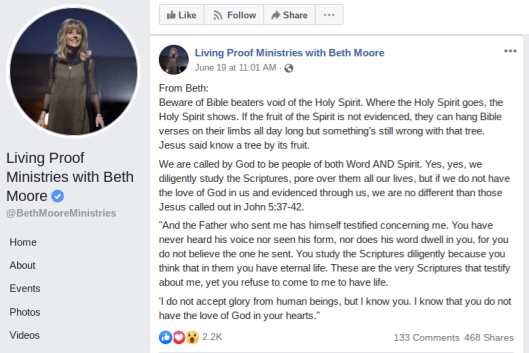
11:01 a.m.: Beth posts this cryptically vague Facebook post. Due to the timing of the post, people begin to speculate on whether or not it is a response to the open letter even though it does not mention the letter, the signers of the letter, or homosexuality, nor does it answer any of the questions posed in the letter.
Saturday, June 22- Amy Spreeman publishes the letter on her blog.
Four days after the publication of the letter, Beth still has not answered the questions in the letter or otherwise made her position on homosexuality clear.
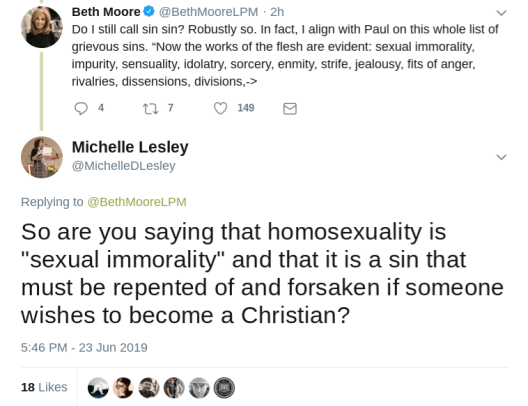
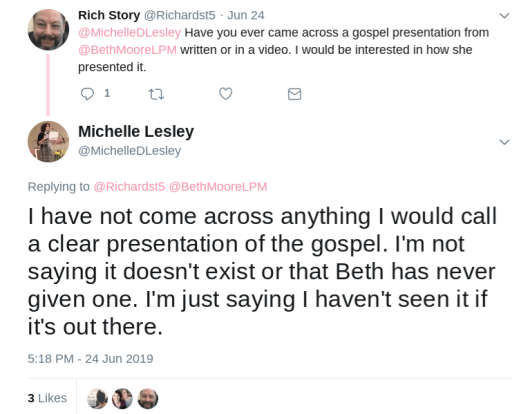
Sunday, June 23- Beth posts this Tweet thread, which seems to be responding somewhat more directly to the letter, but still doesn’t mention the letter, the signers of the letter, or homosexuality, nor does it answer any of the questions posed in the letter. Pertinent excerpts:
To date, Beth still has not answered this question asked by Michelle Lesley. (More commentary on this tweet thread here, #10.)
Wednesday, June 26- One week after the publication of the letter, Beth still has not answered the questions in the letter or made her position on homosexuality clear in any other way.
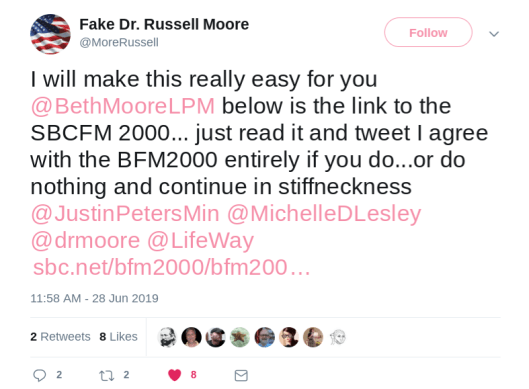
“In the spirit of Christ, Christians should oppose racism, every form of greed, selfishness, and vice, and all forms of sexual immorality, including adultery, homosexuality, and pornography.”
To date, Beth has not responded that she affirms the statement of faith of her own denomination (nor have Russell Moore nor LifeWay, also tagged in this tweet, responded).
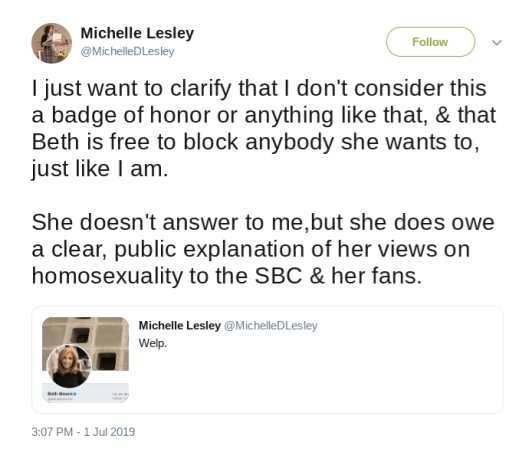
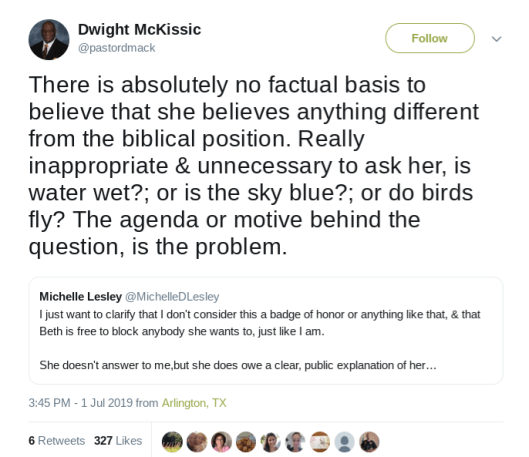
Monday, July 1- Still not responding to the questions in the letter or making her position on homosexuality clear in any other way, Beth blocks original signer of the letter, Michelle Lesley, on Twitter.
(The “factual bases” for the for the questions were clearly stated in the open letter, namely, that Beth has not articulated an unambiguously biblical position on homosexuality in recent years, and that she maintains public, adulatory friendships with well-known homosexuality-affirming public figures, leading others to wonder if her current position on homosexuality is affirming. These are the reasons we deemed the questions “necessary.”)
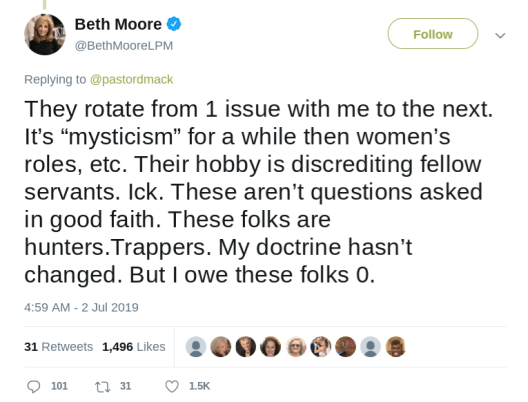
Responding to Michelle Lesley‘s retweeted comment, “She doesn’t answer to me, but she does owe a clear public explanation of her views on homosexuality to the SBC and her fans,”Beth replies (actually on July 2) to Dwight:
Beth unbiblically judges the signers of the letter as “hunters, trappers” and not asking the questions in the letter in “good faith.”
Beth also declares that she owes the Southern Baptist Convention zero. She is the best known and most influential member of the SBC as well as its (LifeWay’s) best selling author. The Southern Baptist Convention, through the promotion of her conferences and materials has made her what she is both in fame and financially. Thousands of SBC churches use her materials. But, “I owe these folks 0.” And, apparently, she doesn’t feel she owes her millions of fans clear, biblical teaching on this issue either.
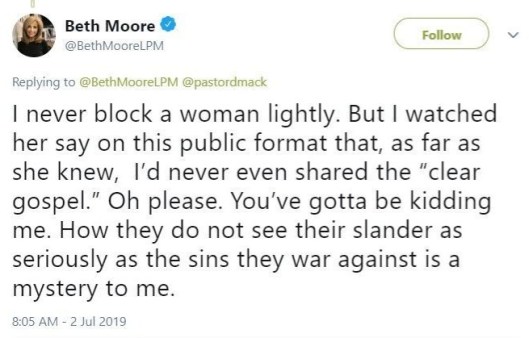
Tuesday, July 2- (Tweet from Beth above, under July 1, is actually posted on July 2.)
Beth blocks original signer of the letter, Elizabeth Prata, on Twitter.
(Michelle Lesley did not say Beth had “never even shared the ‘clear gospel’,” only that she (Michelle) had never seen/read said presentation. Beth has repeatedly stated she has been a Bible teacher for forty years. Michelle, having only viewed/read a fraction of that forty years of material, was giving Beth the benefit of the doubt that such a presentation does, in fact, exist, only that Michelle does not happen to have seen it. Notice Beth provides no links to where one might find an example of her clearly presenting the gospel.)
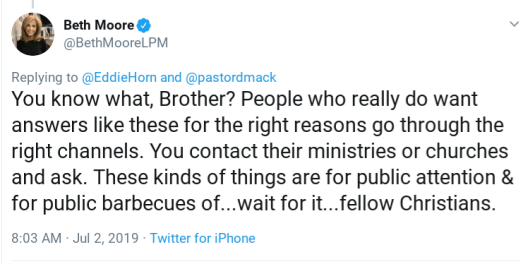
Wednesday, July 3- 8:03 a.m.: Beth unbiblically judges the hearts of the signers of the letter as having the wrong reasons, wanting “public attention,” and wanting to “barbecue” a fellow Christian. She also accuses the signers of the letter of not going through the “right channels” to contact her (even though, as explained in #5&6 here, asking a Bible teacher questions about the Bible is not a Matthew 18 issue of confronting someone in sin in the local church, and dozens of people have confirmed that they have tried, over the years, to contact her/her ministry through the “right channels” and have been ignored – here’s just one example):
(Original signer of the open letter, Elizabeth Prata, discusses Beth Moore’s “right channels” here.)
At this point, two weeks after the publication of the letter, Beth still has not answered the questions in the letter or otherwise made her position on homosexuality clear. In two weeks of being asked her position on homosexuality from numerous people, she has not once pointed to anything she has previously written on the subject.
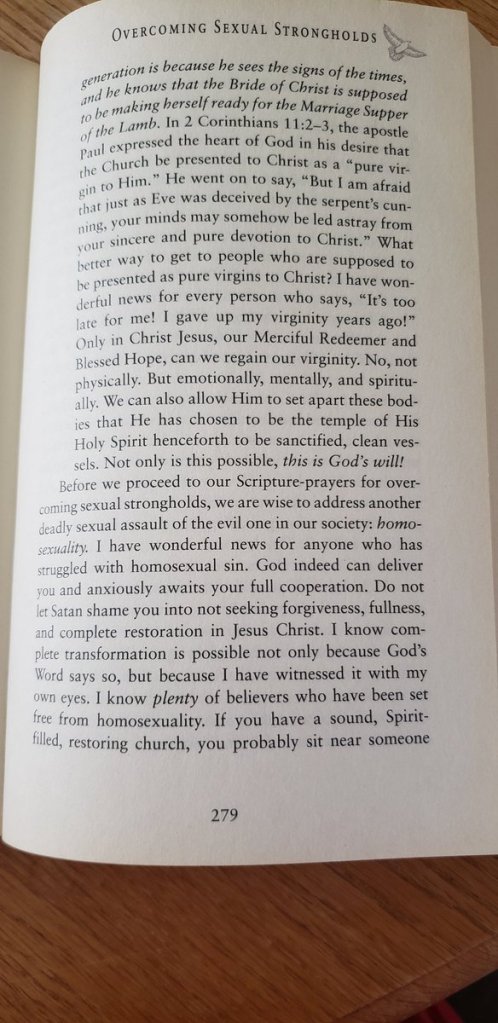
1:22 p.m.: A Twitter user named Carrie alerts Michelle Lesley to the fact that Beth has indeed addressed the topic of homosexuality in chapter 13 of her book, Praying God’s Word. (Unfortunately, Carrie later decides to delete her tweet.) Please note that Beth is not the one who pointed this out even though she had two weeks in which to do so.
Another Twitter user in the same thread posts a screenshot of p. 279 of the 2009 hard copy edition of Praying God’s Word, where Beth clearly calls homosexuality “a deadly sexual assault of the evil one,” a “sin,” something God can “deliver” someone from, and something that people should seek “forgiveness, fullness, and complete restoration in Jesus Christ” from. She says that “transformation” from homosexuality “is possible…because God’s Word says so,” and that she personally knows “plenty of believers who have been set free from homosexuality.”
(Keep in mind that for two weeks Beth knew she had written this biblical statement on homosexuality in her book, and revisit Beth’s comments above (under “July 2”). Why would any Bible teacher of 40 years who has correctly and biblically written about the sin of homosexuality and who says her “doctrine has not changed,” feel “hunted” and “trapped” when asked her views on homosexuality? If her doctrine truly has not changed, why wouldn’t she, herself, not a random Twitter user, have simply pointed to what she had written in her book?)
Other Twitter users begin tweeting this picture to Beth, asking if she still believes what she wrote in this book. No response from Beth.
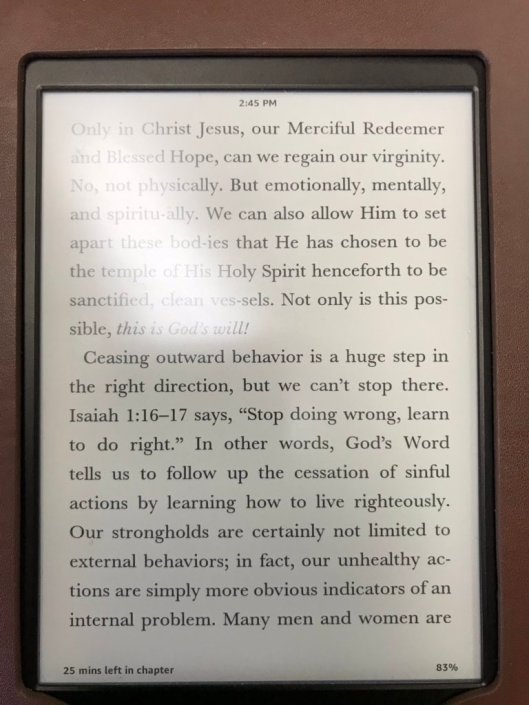
Twitter user, Logan, subsequently tweets to Michelle Lesley a screenshotof the 2009 Kindle version of chapter 13 of Praying God’s Word in which the entire section on homosexuality has been removed– six pages’ worth of material, amounting to half the chapter.
Other Twitter users begin tweeting this screenshot to Beth asking her to comment.
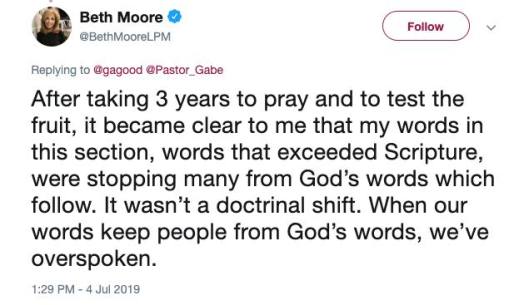
Thursday, July 4- Beth responds as to why the section on homosexuality was removed from later editions of Praying God’s Word:
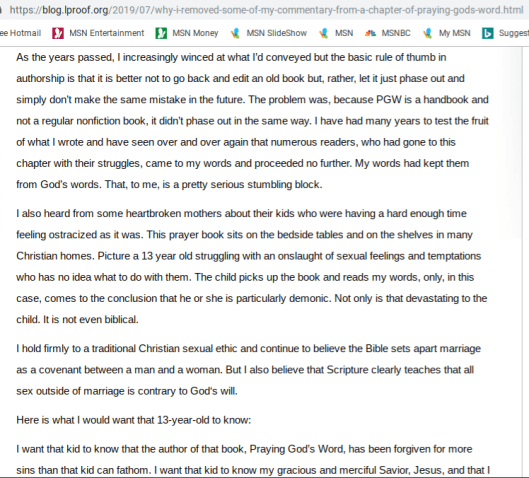
Beth says her clear and biblical statements about homosexuality being a sin that requires forgiveness and that God can deliver people from “exceed Scripture” “keeps people from God’s words” and that she “over spoke“.
Well-known theologian, author, and pastor, Dr. James White aptly sums up the situation with Beth Moore in a Facebook post. Notable excerpts:
Beth Moore has taken a pretty central role over recent months as the earthquake in cultural thinking has flowed through evangelicalism. She has shown herself more than willing to back the “woke” movement and is plainly promoting the development of “soft complementarianism” which is another term for “not quite yet fully cooked egalitarianism.” And it does not take a rocket scientist to figure out that if you are woke and pushing the “soft complementarian” perspective, there is another clear and obvious car in that social-justice train. It’s the homosexuality car.
So a few weeks ago a group of women teachers wrote an open letter to Beth Moore asking her for specific answers to specific questions…In any case, the questions were fair and, of course, perfectly understandable. No Christian teacher of any standing should be hesitant to take a stand on these issues.
But Beth Moore has chosen to not only ignore the open letters, but to impugn the character and motivations of those questioning her (a very common tactic, but one being utilized with consistency by those wearing the “progressive” label today). This has led others to look closely at her writings and to discover that a book she wrote many years ago has now been edited in its Kindle edition so as to remove a discussion about homosexuality.
But let’s think about what Mrs. Moore is saying here. To speak of homosexuality as a deadly sin is to “exceed Scripture.” To speak of deliverance and restoration from homosexual sin is to “exceed Scripture.” To claim that there have been many who have been set free from homosexuality is to “exceed Scripture.”
While she may wish to claim this did not involve a “doctrinal shift,” if you teach X is sin, but then conclude that X is not sin, or that to say X is sin is to “exceed Scripture,” that is a doctrinal shift…
I predict that within five years we will get a Rachel Held Evans/Jen Hatmaker/hundreds of others style article explaining how after prayerful consideration and growing in love for God’s people and getting to know so many wonderful LGBTQ+ brothers and sisters in the Lord, Beth Moore has come to understand that we dare not exceed Scripture and we must follow the Spirit’s lead to recognize the need for their full inclusion in the life and fellowship of the body, etc.
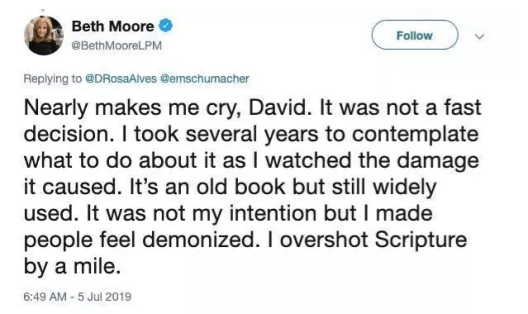
Friday, July 5- Commenting to a supporter as to why the section on homosexuality was removed from Praying God’s Word, Beth again declares that her biblical statements on homosexuality “overshot Scripture by a mile,” “made people feel demonized,” and “caused damage.”
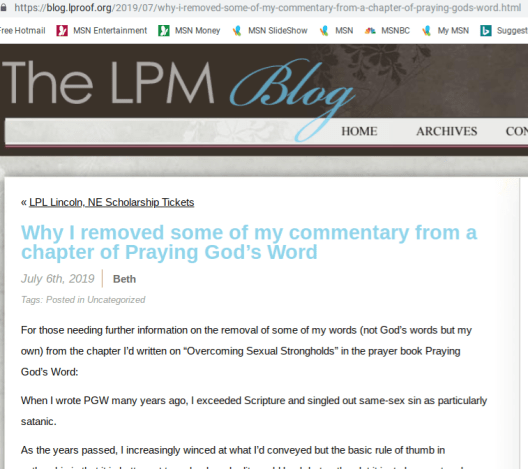
Finally, after two and a half weeks of avoidance, reluctance, personal attacks and unbiblical judgments toward the signers of the letter, and knowingly declining to point to what she had previously and biblically written about homosexuality, Beth makes the clearest statement to date on her views on sexuality:
I hold firmly to a traditional Christian sexual ethic and continue to believe the Bible sets apart marriage as a covenant between a man and a woman. But I also believe that Scripture clearly teaches that all sex outside of marriage is contrary to God‘s will.
She still does not plainly say, “Homosexuality is a sin that must be repented of,” (indeed, again, she does not use the word “homosexuality” or other synonymous terms in this statement) but it would be difficult for anyone to read this statement and believe there is “wiggle room” for Beth to publicly affirm homosexual activity (although she does not address same sex attraction, as the open letter asked her about in question #4, which does leave the door open for her to validate homosexual orientation, identification, lust, or anything short of sexual acts) . However, it is a good and biblical statement about sexuality in general.
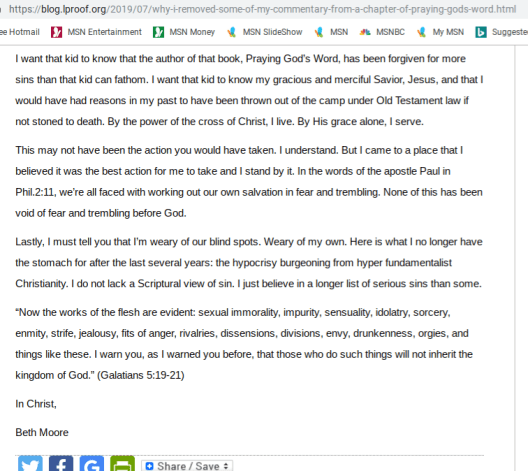
It should be noted that Beth ends this article with yet another subtle swipe at the signers of the letter and all those who have called her to account over the past two and a half weeks (and this portion is worded with enough “wiggle room” for Beth to say anyone’s interpretation of it is not what she meant):
Here is what I no longer have the stomach for after the last several years: the hypocrisy burgeoning from hyper fundamentalist Christianity. I do not lack a Scriptural view of sin. I just believe in a longer list of serious sins than some.
“Now the works of the flesh are evident: sexual immorality, impurity, sensuality, idolatry, sorcery, enmity, strife, jealousy, fits of anger, rivalries, dissensions, divisions, envy, drunkenness, orgies, and things like these. I warn you, as I warned you before, that those who do such things will not inherit the kingdom of God.” (Galatians 5:19-21)
Beth characterizes biblical Christians asking her simple questions about the Bible as “hypocrites” and “hyper-fundamentalist.” Beth does not make clear her definition of “hyper-fundamentalist,” so there is no way for those she is accusing of such to defend themselves. But labeling as “hypocrites” Christians who have simply asked her, a Bible teacher of forty years, whether or not she believes homosexuality is a sin, when her response has been to drag her feet for two and a half weeks until forced by evidence and circumstance to answer is the height of hypocrisy.
She further implies that she takes sin more seriously (“I just believe in a longer list of serious sins than some.”) than the signers of the letter and those calling her to account, which is, again, hypocritical since any Christian who takes sin seriously would not avoid answering a question about whether or not something is a sin for two and a half weeks. That is not taking sin seriously.
And, finally, she implies, with the citation of Galatians 5:19-21:
•that she believes all of the things in these verses are sins and that the signers of the letter do not,
•that the signers of the letter – by politely asking her whether or not she believes homosexuality to be a sin – have committed one or more of these sins (probably enmity, strife, jealousy, fits of anger, rivalries, dissensions, divisions, envy, if not others) and that she has not,
•and that the signers of the letter, since they are guilty of these sins “will not inherit the kingdom of God.” In other words, that we are not saved.
Dr. James White responds to Beth’s blog post with one of his own: Beth Moore Sort Of Explains…But Not Really, raising several additional important issues and questions.
Bible teacher and theologian, Justin Peters, concurs with Dr. White and adds his own concerns in his blog article: Beth Moore and Homosexuality(Actually posted on July 8.)
After publishing this blog post, Beth announces she will be taking a short break from Twitter, thereby disallowing anyone from using one of her “right channels” to ask her any questions about her blog post or other questions about homosexuality:
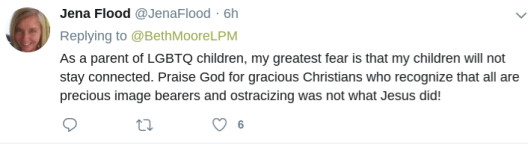
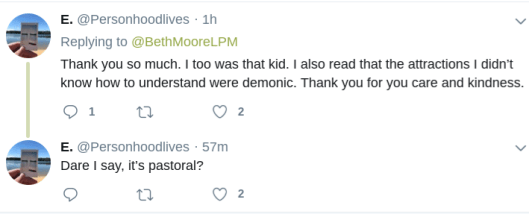
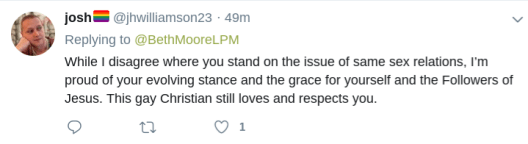
The fruit of Beth’s blog post immediately becomes evident. Here are just a few of the replies to her tweet alerting her followers to the release of the blog post:
These homosexual and homosexual-affirming followers of Beth do not have a fully-orbed biblical view of and/or practice regarding homosexual sin, and Beth isn’t calling them torepent and believe the gospel.
Monday, July 8- (Justin Peters’s blog post – mentioned above under July 6 – actually published.)
Monday-Wednesday, July 15-17- The Write Brilliant Conference, featuring and co-founded by Jonathan Merritt (cited in the open letter) is held. Beth is featured as a “Special Guest” speaker.
At the close of the conference, Jonathan Merritt posted this photo with Beth to Instagram and Twitter, calling Beth a “true friend,” “the real deal,” and a “sister“.
It is public, affectionate, and affirming partnerships and interactions like this one which are cited in the open letter as reasons for asking Beth to clarify her position on homosexuality.
Tuesday, July 16- Original signer of the letter, Elizabeth Prata, in her article Beth Moore deleted half her Kindle chapter: Breaking the Social Compact raises awareness that the amount of material on homosexuality removed from Praying God’s Word was far more extensive than many originally thought.
Wednesday, July 24- An episode of Beth’s TBN television show, which is sponsored by LifeWay, entitled Staying Afloat on the Fellow Ship – Part 4,is posted, in which Beth admits she has been looking into the arena of same sex attracted (SSA) Christianity (starting at 15:40).
Click the link above. Pertinent section starts at 15:40.
Though Beth’s words may not sound problematic to some, original signer of the letter, Elizabeth Prata, explains in her article Listen carefully to what she is saying in this video…, exactly why Beth’s remarks signal her trajectory toward acceptance of homosexuality:
In her latest lesson video on unity and fellowship, Moore used many phrases and code words that indicate her stance toward same sex attraction, homosexuality, and their attendant issues, is aligned with the aforementioned folks she was supposed to be ministering to in love by warning against these very things.
Moore makes it sound as if homosexuals are doing Jesus a favor by choosing celibacy. Homosexually attracted people are no different in their sin than…any other flavor of sexual sin…touting their “tremendous sacrifice” makes it seem as if they are.
I believe this video and Moore’s recent handling of the homosexuality issue means Moore seems to be readying herself to ‘come out’ as it were, of affirming homosexuals in some way as believers.
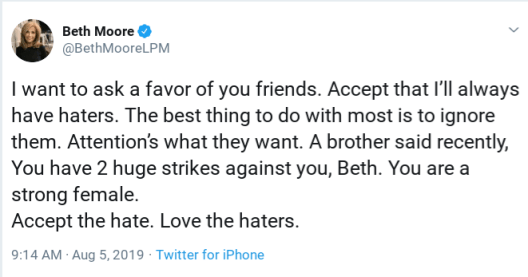
Monday, August 5- Beth returns to Twitter (after a one month hiatus) and picks up her slanderous attacks against the signers of the letter right where she left off.
Speaking for myself, I am grateful for Beth’s biblical statement on sexuality, but I pray she will be encouraged in the future to take as strong and passionate a stand against the pernicious sin of homosexuality as she has taken on sins like racism and sexual abuse. It has always and only been our desire to see her rightly and unashamedly proclaim the whole counsel of God to her followers. We pray she will do so.
There remain questions and important issues surrounding the sin of homosexuality that must be addressed. This article will be updated with any future developments.
1. Recalling that 2 Timothy was written as a letter, no chapter and verse markings, read how chapter two flows into chapter three (start around 2:22). What has Paul been discussing in chapter two and how does he transition into a new, yet related, line of thought in chapter three? Notice how 3:1 functions as a pivot point between the two trains of thought.
2. When are the “last days“? (1) What word does Paul use to describe the last days? (1)
3. Study 1-9, taking care to read 2-5 as one (long) complete sentence. Notice the set and subset of people Paul describes in this passage. What is the set described in 2-5 (notice the first two words of 2)? Are these verses generally speaking of Christians or non-Christians? Which words and phrases in these verses lead you to this conclusion? What is the subset (“For among them…”) of people described in 6-9? If Paul speaks of false teachers as being a subset of non-Christians, what does this imply about the spiritual condition of most false teachers?
4. How does verse 5(b) tell us to deal with the types of people described in 2-5? Does this include false teachers? Which words and phrases in verses 4b-6a lead us to this conclusion?
5. What do the phrases “lovers of pleasure rather than lovers of God” and “having the appearance of godliness, but denying its power” mean? Are these phrases describing lost people in general, or false teachers, or both?
6. Carefully examine verses 6-7. Why do you think the Holy Spirit intentionally specifies women in verse 6? Think about the women you know who have been “captured” by false teachers and how verses 6-7 describe them.
7. Look closely at 6-9. Who were Jannes and Jambres? (8- use your cross references, click here for more help). Who do the words “these men” (8) and “they” (9) refer back to (6)? Why do you think the Holy Spirit brought Jannes and Jambres to Paul’s mind when he was writing about false teachers? What are the similarities between these two men and the false teachers Paul is describing?
8. Keeping in mind that this is a letter written to a pastor, and to pastors today, why is it important for pastors to be aware of these things, and what sorts of practical actions should they take in response to these instructions and warnings?
9. Notice how verse 10 serves as another pivot point to a new line of thought. Describe the compare and contrast element Paul uses here between 1-9 and 10-17. Who/what is being compared?
10. Imagine you’re Timothy reading this letter. Make a list of the things in 10-17 that you would find encouraging as a pastor.
11. What can we learn about persecution from verses 11-13? Does God always “rescue” Christians from persecution?
12. Read verse 15 in light of 1:5, and explain the impact godly mothers and grandmothers can have on their children and grandchildren when they train them in the Scriptures.
13. Study verses 16-17. How do these verses refute the unbiblical idea that the words Jesus spoke during His earthly ministry (“red letters”) somehow carry more weight than the rest of Scripture? (Ex: “Jesus never mentioned homosexuality, so it must have been OK with Him.”) How do these verses refute the unbiblical argument people sometimes make about 1 Timothy 2:12 that, “That’s not God giving that command, that’s just Paul’s personal, human opinion.”?
14. Peek ahead to the first few verses of chapter 4, and notice how chapter 3, especially verses 16-17, feed into the the thoughts in chapter 4.
Homework
Review verses 4b-9, and consider a) how the Holy Spirit describes false teachers and the spiritual damage they do to the church, and b) how the Holy Spirit instructs us to “avoid such people”. Think about how this applies to individual Believers and the church today – the music we use in worship service or listen to on Christian radio, the materials we use in Bible study and Sunday School classes and for our own personal Bible study time, the evangelical celebrities we follow and share on social media and the ones quoted by our pastors and shared by our church’s social media pages, the conferences we attend or that our church hosts, etc.
Make a list of practical ways you and/or your church can obey verse 5’s instruction to “avoid such people” and pray for God to give you and/or your church leaders wisdom in this area.
Welcome to another “potpourri” edition of The Mailbag, where I give short(er) answers to several questions rather than a long answer to one question. I also like to take the opportunity in these potpourri editions to let new readers know about my comments/e-mail/messages policy. I’m not able to respond individually to most e-mails and messages, so here are some helpful hints for getting your questions answered more quickly. Remember, the search bar can be a helpful tool!
In these potpourri editions of The Mailbag, I’d also like to address the three questions I’m most commonly asked:
“Do you know anything about [Christian pastor/teacher/author] or his/her materials? Is he/she doctrinally sound?”
Any good info you can send in about tithing? Is it for NT believer? Are we in sin if we don’t?
Great question – and it’s one that a lot of Believers probably wonder about. For the long answer, check out my article To Tithe or Not to Tithe…(and don’t forget to click on the links in that article to the helpful resources I’ve included).
The short answer is no. Christians are not required by Scripture to tithe. The main Scripture that covers the principles for New Testament giving is 2 Corinthians 9:7:
Each one must give as he has decided in his heart, not reluctantly or under compulsion, for God loves a cheerful giver.
We are to give thoughtfully, decisively, generously, willingly, and gladly. Now, if you consider your finances and the needs of your church, you and ask God to help you make a wise decision about how much to give, and ten per cent is the prayerful conclusion you come to, then by all means, give ten per cent. If it’s fifty per cent or two per cent or 97 per cent or some other amount, give that. New Testament giving is about glad generosity of heart and godly decision-making, not rote fulfillment of a non-applicable Mosaic Covenant law.
Are you in sin if you don’t tithe? It depends on the reason you’re not tithing. If you’re not tithing (or giving) because you’re selfish and greedy and you don’t want to give anything to the church, then, yes, you’re sinning. If you’re not tithing because you’re barely scraping by and can only afford to give five per cent to the church, which you give with a joyful and generous heart, no, you’re not sinning. But for sure, if your pastor or someone else is attempting to coerce or compel you to tithe, he is putting you under the yoke of the law, he is violating 2 Corinthians 9:7, and he is in sin.
I received this question from several readers in connection with the publication of An Open Letter to Beth Moore (which you can still sign if you haven’t yet, ladies).
I don’t know what Beth’s position on abortion is. I Googled “Beth Moore abortion” and the closest thing I came up with was a tweet thread from 2016 that had something to do with the presidential election and whether or not Beth supported Hillary Clinton (it wasn’t 100% clear since some of the tweets have since been deleted or made private). Some questioned Beth in that thread about her stance on abortion since they believed she supported Clinton, but while Beth clearly said she did not support either candidate, unless I missed a tweet or it was deleted, she did not state what her position on abortion was.
If you want to know Beth’s position on abortion, you will have to ask her. Since she is Southern Baptist, you may wish to ask her if she agrees with the portion of Article XV of the Baptist Faith and Message (BFM2000– the SBC’s statement of faith) which states,
“We should speak on behalf of the unborn and contend for the sanctity of all human life from conception to natural death.”
It is possible Beth would be willing to give a pro-life answer since it is likely much more acceptable among her followers for her to stand against abortion than to stand against homosexuality. But since she has already demonstrated that she is unwilling to take a firm biblical stand on an issue when doing so might diminish her popularity, I imagine she will respond to questions about abortion the same way she responded to our questions about homosexuality: ignore the questions as much as possible, or answer them in an obfuscatory or cryptic manner when pressed.
As a woman, am I sinning by witnessing to a man?
Nope. Not under the auspices of 1 Timothy 2:12, anyway. What you’re doing is carrying out the Great Commission, Jesus’ mandate to all Christians. A couple of articles that explain more and that you might find helpful:
One of my loved ones says she hears God’s voice, still small voice, a new revelation from Him and so on. How can I search your website to get information on this?
May God bless you for wanting to help your loved one! I think these articles will help:
Wondering what kind of instruction you received to teach what [you] have on your website. I have studied the Scriptures for many years, but am disappointed that I did not spot some of the false and lacking “teachers” you have written about. I found you, thankfully, by following a rabbit trail regarding false teachers. Thanks.
Thanks for asking! The biblical instruction I’ve received:
•Sitting under good preaching and teaching at my own church
•Studying straight from the Bible itself (not workbook/DVD studies, etc.) during my daily Bible study time
•Listening to good sermons and Bible teaching online
•Reading good, solid theological books by doctrinally sound authors.
I have audited one or two online seminary classes, but I’ve never been enrolled in a seminary, nor do I have a seminary degree.
I’ve explained a bit more about how I got started learning discernment here. Many of the authors, pastors, and teachers I’ve listened to can be found in the sidebar to your left (Blogs and Podcasts I Follow and Links I Love) and at the Recommended Bible Teachers tab at the top of this page.
This is part of the reason I’m forever hounding women to put aside the “canned” studies and systematically study straight from the Bible for themselves and to get faithfully invested in a doctrinally sound church – it’s not only biblical, it works.
Biblical views on a wife making more than her husband financially?
To my knowledge, there is no passage in the Bible that explicitly prohibits a woman from having a larger salary than her husband’s, assuming that they are both employed in a manner that doesn’t violate biblical standards. (Readers- For the purposes of this question, let’s assume that neither spouse is neglecting his/her biblical duties to the marriage, children, or home by being employed in this season of his/her life.)
In other words, if they’re both employed full time and her position or field just happens to pay more than his position or field, that doesn’t violate any Scripture I’m aware of. Or there could be situations such as: a husband is ill or disabled and unable to work full time (or at all), or the husband has had to reduce his workload temporarily to care for an ill family member, go back to school, etc. However, if it’s a situation like the wife is making more money because the husband is a lazy bum who refuses to work enough hours (or at all) to support his family, that would be sinful on his part.
If there’s nothing unbiblical about the wife’s or the husband’s employment situation but it bothers one or both of them that her salary is larger, they should sit down, talk it out, and pray through the issue to discover and resolve the problem. I would also recommend setting up an appointment with their pastor or a biblical counselor for counseling (see Biblical Counseling Resources tab at the top of this page).
If you have a question about: a Bible passage, an aspect of theology, a current issue in Christianity, or how to biblically handle a family, life, or church situation, comment below (I’ll hold all questions in queue {unpublished} for a future edition of The Mailbag) or send me an e-mail or private message. If your question is chosen for publication, your anonymity will be protected.
Anybody who tells you the Christian life is all lollipops and unicorns is selling something. No reasonable person who is the slightest bit familiar with the New Testament or church history could honestly believe that. The New Testament church was born and baptized in blood – first the blood of Christ, and the blood of His martyred disciples ever since.
Anybody who tells you the Christian life is all lollipops and unicorns is selling something.
In the spirit, God blesses us with joy unspeakable and full of glory, the peace that passes all understanding, and the comfort of “Lo, I am with you always.” And that is much to be thankful for, because life in the robe of flesh would be unbearable without those blessings.
But as we walk this real, tangible, eat your veggies and brush your teeth phase of existence, Jesus isn’t just a pretty pink purse we pick up along the way to complement our life’s wardrobe. To put on Christ is to volunteer to wear a target on your back. And your front, come to think of it. Because when you unapologetically stand for Christ and the truth of His Word, you will not only face a full frontal attack from the world, you’ll also risk being stabbed in the back by those you thought were comrades in arms.
When you unapologetically stand for Christ and the truth of His Word, you will not only face a full frontal attack from the world, you’ll also risk being stabbed in the back by those you thought were comrades in arms.
Dealing with and responding to those attacks – that’s what spiritual warfareis. Not this modern, ridiculous, NAR-inspired version of “binding” Satan and bellowing commands into the air as though you have the power and the authority to boss the devil around (Even Michael the archangel wouldn’t go there.). We’re called to be good soldiers of Christ Jesus, not the Commander.
As good soldiers in the Lord’s army (yes sir!) real, biblical spiritual warfare is being protected and prepared in the spirit to righteously and courageously walk out biblical truth on the battlefield of whatever tangible circumstances God has placed you in. It’s understanding that those attacking you are not your real enemy – not the ones calling the shots. They’re soldiers, just like you. They’re either lost and ensnared by the devil, having been held captive by him to do his will (kind of a spiritual Stockholm Syndrome), or it’s friendly fire from someone in your unit who’s saved, but has somehow, momentarily mistaken you for the enemy.
But the wounds of warfare are painful and debilitating no matter who’s wielding the weapon. So for all of you ladies who have been persecuted by the world, attacked by family, abused by fellow church members, and abandoned by friends simply for holding fast to Christ and His Word and refusing to compromise, let these words of encouragement from the very One you cling to salve your soul…
For all of you ladies who have been persecuted by the world, attacked by family, abused by fellow church members, and abandoned by friends simply for holding fast to Christ and His Word and refusing to compromise, let these words of encouragement from the very One you cling to salve your soul…
There will never be a moment when we can cry out to Jesus from the depths of our desperation, “You have no idea what this is like – how badly it hurts!”. Yes, He does. Not just because He’s omniscient. Not just because He knitted you together in your mother’s womb and knows all the secrets of your heart. But because He walked that lonely and painful road Himself, as a man in the flesh, just like you.
He was despised and rejected by men, a man of sorrows and acquainted with grief; and as one from whom men hide their faces, he was despised, and we esteemed him not… …we esteemed him stricken, smitten by God, and afflicted… …He was oppressed, and he was afflicted… …By oppression and judgment he was taken away… …And they made his grave with the wicked…although he had done no violence, and there was no deceit in his mouth. From Isaiah 53
But I am a worm and not a man, scorned by mankind and despised by the people. All who see me mock me; they make mouths at me; they wag their heads; “He trusts in the Lord; let him deliver him; let him rescue him, for he delights in him!” Psalm 22:6-8
Many of them said, “[Jesus] has a demon, and is insane; why listen to him?” John 10:20
If the world hates you, know that it has hated me [Jesus] before it hated you. John 15:18
and coming to his hometown [Jesus] taught them in their synagogue, so that they were astonished, and said, “Where did this man get this wisdom and these mighty works?…And they took offense at him. But Jesus said to them, “A prophet is not without honor except in his hometown and in his own household.” Matthew 13:54,57
There may be times when you feel like everyone is against you. It’s hard to be hated. But hold on to this truth and don’t let go of it: Jesus loves you. He delights in you. He will never turn His face away from you.
I have loved you with an everlasting love; therefore I have continued my faithfulness to you. Jeremiah 31:3b
All the paths of the Lord are steadfast love and faithfulness, for those who keep his covenant and his testimonies. Psalm 25.10
I will rejoice and be glad in your steadfast love, because you have seen my affliction; you have known the distress of my soul, Psalm 31:7
May the Lord direct your hearts to the love of God and to the steadfastness of Christ. 2 Thessalonians 3:5
Jesus loves you. He delights in you. He will never turn His face away from you.
Jesus isn’t a lifeline that only reaches halfway across the rushing river. He is our rock. Our fortress. Strength. Sustenance. Stability. What He brings you to, He will bring you through, as the old saying goes. He’s not going to abandon you in the middle of your troubles or fail to provide grace and help when you need it. You can trust Him.
you whom I took from the ends of the earth, and called from its farthest corners, saying to you, “You are my servant, I have chosen you and not cast you off”; fear not, for I am with you; be not dismayed, for I am your God; I will strengthen you, I will help you, I will uphold you with my righteous right hand. Isaiah 41:9-10
Behold, God is my helper; the Lord is the upholder of my life. Psalm 54:4
So we can confidently say, “The Lord is my helper; I will not fear; what can man do to me?” Hebrews 13:6
Cast your burden on the Lord, and he will sustain you; he will never permit the righteous to be moved. Psalm 55:22
our Lord Jesus Christ, who will sustain you to the end, guiltless in the day of our Lord Jesus Christ. 1 Corinthians 1:7b-8
Jesus isn’t a lifeline that only reaches halfway across the rushing river. He is our rock. Our fortress.
In the world’s eyes, voluntarily suffering for the name of Christ is shameful, pitiable, foolish, and worthy of derision. In God’s economy, sharing in Christ’s sufferings is an honor and worthy of reward.
and when they had called in the apostles, they beat them and charged them not to speak in the name of Jesus, and let them go. Then they left the presence of the council, rejoicing that they were counted worthy to suffer dishonor for the name. Acts 5:40-41
Blessed are those who are persecuted for righteousness’ sake, for theirs is the kingdom of heaven. Blessed are you when others revile you and persecute you and utter all kinds of evil against you falsely on my account. Rejoice and be glad, for your reward is great in heaven, for so they persecuted the prophets who were before you. Matthew 5:10-12
[Moses] choosing rather to be mistreated with the people of God than to enjoy the fleeting pleasures of sin. He considered the reproach of Christ greater wealth than the treasures of Egypt, for he was looking to the reward. Hebrews 11:25-26
But rejoice insofar as you share Christ’s sufferings, that you may also rejoice and be glad when his glory is revealed. If you are insulted for the name of Christ, you are blessed, because the Spirit of glory and of God rests upon you…Yet if anyone suffers as a Christian, let him not be ashamed, but let him glorify God in that name. 1 Peter 4:13-14,16
In God’s economy, sharing in Christ’s sufferings is an honor and worthy of reward.
Perhaps one of the greatest comforts in the midst of the battle fatigue of spiritual warfare is God’s omniscience and justice. Not a single insult will be hurled at you that escapes His notice. None of the flak you’ve taken for Him will slip through the cracks and be forgotten. One day, whether here or hereafter, God will set everything right.
Behold, all who are incensed against you shall be put to shame and confounded; those who strive against you shall be as nothing and shall perish. You shall seek those who contend with you, but you shall not find them; those who war against you shall be as nothing at all. Isaiah 41:11-12
For the Lord will vindicate his people and have compassion on his servants. Psalm 135:14
You have seen the wrong done to me, O Lord; judge my cause. You have seen all their vengeance, all their plots against me. You have heard their taunts, O Lord, all their plots against me. The lips and thoughts of my assailants are against me all the day long. Behold their sitting and their rising; I am the object of their taunts.
You will repay them, O Lord, according to the work of their hands. You will give them dullness of heart; your curse will be on them. You will pursue them in anger and destroy them from under your heavens, O Lord. Lamentations 3:59-66
When he opened the fifth seal, I saw under the altar the souls of those who had been slain for the word of God and for the witness they had borne. They cried out with a loud voice, “O Sovereign Lord, holy and true, how long before you will judge and avenge our blood on those who dwell on the earth?” Revelation 6:9-10
One day, whether here or hereafter, God *will* set everything right.
As you suffer for the Name above all names and do battle for His cause, strengthen your hands for combat with His great and precious promises, which can never be broken. Rest in Jesus’ love for you. Know that He understands your pain and anguish. Trust Him to sustain you. Believe that He will honor and vindicate you. For the Lord is good; his steadfast love endures forever, and his faithfulness to all generations.
Which promises do you cling to in the midst of spiritual warfare?