

 Read 1 Timothy 2

Questions to Consider
1. Briefly review the theme or purpose of the book of 1 Timothy from lesson 1 (link above). Who is the ultimate Author of this book? Are the ideas and instructions in this book God’s ideas and instructions, or something Paul came up with on his own? Who was the original audience of this book?
2. You may be familiar with the little hermeneutical rule of thumb, “Whenever you see therefore in a verse, you need to find out what it’s there for.” “First of all, then,…” at the beginning of verse 1 serves the same purpose as “therefore” (in fact, some translations render that phrase as “therefore” instead of “first of all, then”). God, through Paul, is saying, “Because of all that stuff I told you in chapter 1, do what I’m about to tell you to do in chapter 2.” Review 1 Timothy 1 and/or lesson 2 (link above). What are the main issues addressed in chapter 1?
3. Make a “bullet point” list of each instruction given to Timothy and the church in chapter 2. Now make the connection between the two chapters – how can the church’s obedience to the instructions in chapter 2 fix the issues brought out in chapter 1?
4. Which group of verses is the focal point, or main idea, of chapter 2?
- 1-3
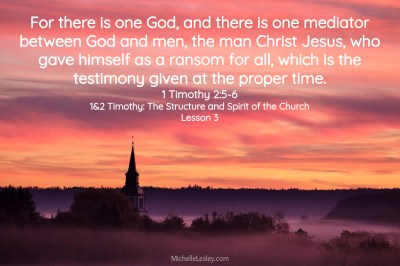
- 4-7
- 8-10
- 11-15
Read each of these groupings of verses and describe how each of them revolves around the idea that God desires to save people (4). Notice how the words, “I desire then” (8) and “likewise also” (9) point back to the focal passage. Why did God put the gospel smack dab in the middle of these instructions about how the congregation is to behave?
5. Why does Paul again cite his qualifications and credentials? (7)
6. Why does God want His church to pray for others, including kings and leaders? (1-2) What is the immediate desired outcome of this kind of prayer? (2) What is the long-term desired outcome of this kind of prayer? (3-4) Think about the political and cultural context surrounding the church at Ephesus. How could the church at Ephesus and the church today leading “a peaceful and quiet life, godly and dignified in every way” (2) lead to people getting saved (3-4)?
7. Does verse 8 mean that only men should pray when the church is gathered together? (Use your footnotes)
Questions 8-12 are drawn from lessons 15 and 14 (respectively) of my Imperishable Beauty study of biblical womanhood. If you have completed that study, you may wish to review your notes from those lessons.
8. Examine verses 9-10. Describe how women are not to adorn themselves and how they are to adorn themselves. Are things like braids, jewelry, and clothes intrinsically sinful, or is Paul giving cultural examples to illustrate a theological point he’s making? What is that point? What is it about the bent of women’s hearts that would cause God to give this instruction to women in the context of the home and the church, but not to give this instruction to men at all? How does it benefit the church for us to “wear”, or portray, godliness by adorning ourselves modestly and with good works?
9. Study verses 11-15. What is the first word of verse 11? Think about women’s social status and value in Paul and Timothy’s culture, and in many cultures since that time, even today. Why does the Holy Spirit instruct pastors to “let” women learn? What does this teach us about the responsibility God places on us as women to learn His Word? Would you categorize verse 11 as a “do this” or “don’t do this” verse?
10. Examine verse 12. Is this mainly a “do this” or “don’t do this” verse? What two things does the Holy Spirit say women are not to do in the gathering of the church body? What does He say women are to do? Think about God’s nature and character. Does He ever give instructions arbitrarily or just to spoil our fun? Why does God give us commands and instructions, generally speaking? Are the instructions in verse 12 good for women and for the church?
11. Take a look at 13-14. God kindly gives not one, but two reasons for His instructions in verses 11-12. What are those two reasons? How do they fall in line with God’s design for male headship and leadership across biblical history in the hierarchical structures He has set up?
12. Verse 15 can be a little cryptic to us today because we equate the word “saved” with salvation. Does verse 15 mean that women gain salvation by having children? How do we know it doesn’t? The NASB helpfully, and more accurately, renders this word as “preserved.” We don’t feel it much today, but think about the stigma women (particularly Jewish women) carried at the time this was written simply because they were daughters of Eve. Paradise was lost and the curse of sin entered the world because of a woman, many men thought, and they viewed and treated women accordingly. Yet who was chosen to bring the Messiah into the world? And following in her footsteps, a major way godly women can “save” or “preserve” the reputation, esteem, and value of womankind is to “continue in” what 3 godly character traits? (15) Because if they continue in those three godly character traits, they will be raising up a godly seed to the Lord (even if the children they bear aren’t perfect like Mary’s child was.) :0)
Homework
If you’d like to study more about modesty (9-10), check out these articles:
•Imperishable Beauty: Lesson 15- A Beautiful Portrayal of Biblical Womanhood in the Church
•The Mailbag: Potpourri (Calvinism, Baptism, Modesty…)
If you’d like to study more about the role of women in the church (11-15), check out these articles:
•Imperishable Beauty: Lesson 14- A Beautiful Position in the Church
•Jill in the Pulpit (1 Timothy 2:11-12)
•Order in His Courts: Silencing Women? (1 Corinthians 14:33b-35)
Suggested Memory Verse
Discover more from Michelle Lesley
Subscribe to get the latest posts sent to your email.

Reblogged this on Talmidimblogging.
LikeLike