Mailbag, Worship

The Mailbag: Potpourri (Boundaries… Submit vs. address sin?… Discernment- Who do you think you are?)

Welcome to another โ€œpotpourriโ€ edition of The Mailbag, where I give short(er) answers to several questions rather than a long answer to one question.

I like to take the opportunity in these potpourri editions to let new readers know about my comments/e-mail/messages policy. Iโ€™m not able to respond individually to most e-mails and messages, so here are some helpful hints for getting your questions answered more quickly. Remember, the search bar (at the very bottom of each page) can be a helpful tool!

Or maybe I answered your question already? Check out my article The Mailbag: Top 10 FAQs to see if your question has been answered and to get some helpful resources.


This comment was left on my article, Taking Offense:

Thank you for this biblical truth: โ€œJesusย taught usย toโ€ฆlove our enemies, do good to those who hate us, bless those who curse us, pray for people who abuse us, turn the other cheek, give to those who want to take from us, treat others the way we want to be treatedโ€. Are boundaries biblical then? Do we stick around when someone is pouring out non-stop criticism and verbally abusing us or talking behind our back? Family members can be the worst. People who are not following Jesus and who are consumed with darkness, hate people who are walking in the Light. I understand not taking offense, but in my experience, when I turn the other cheek to abusers, they keep abusing and hate you more. It is not good to allow them to sin against us because when their sin flows freely, it not only harms me but it harms them too. Thoughts?

Great question! It’s one Amy Spreeman and I have received numerous times over the past few years, so we’ve recorded a podcast mini-series on it!

Beautiful Biblical Boundaries- part 1 deals with the Scriptures and biblical precepts addressing boundaries. We discuss how and when to erect boundaries (and how and when not to). This episode is currently scheduled to drop next Wednesday, November 12.

In Beautiful Biblical Boundaries- part 2, we’ll answer listeners’ questions about boundaries in their own lives and relationships. This episode is currently scheduled to drop in about two weeks, on Wednesday, November 19.

Please note that the links above will not work until the dates specified.


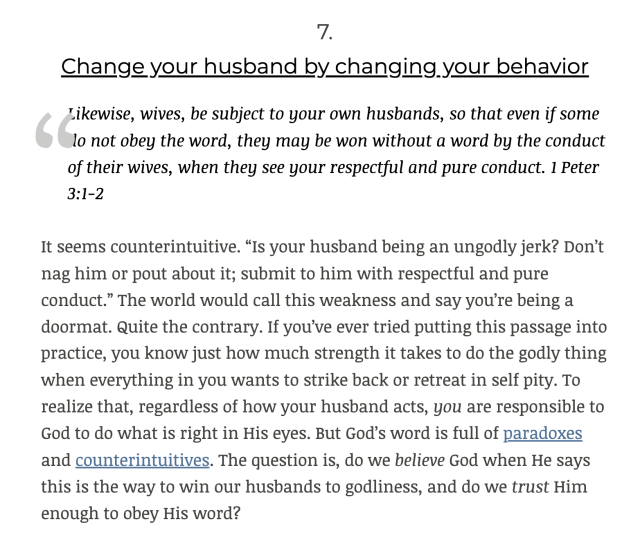
This comment was left on my article, Marriage: Itโ€™s My Pity Party and Iโ€™ll Cry if I Want To ~ 7 Ways to Take Your Focus Off Yourself and Put it Back onย Christ (By the way, yes, I realize that the length of the titles of some of my articles rivals those of many of the Puritans’ books and pamphlets. I’m OK with that.๐Ÿ˜€)

I have a question about number 7…

This article pertains to normal, relatively healthy, Christian marriages. In other words, not abusive marriages. If you are being abused, get yourself and your children to a safe place, and call the police, your pastor, or a loved one for help.

Of course, I agree that we should be subject to our husbands. However, are we not to call them out gently on their sin when they are acting like โ€œan ungodly jerkโ€ according to various verses such as Proverbs 27:5, Luke 17:3, Matthew 18:15, and Galatians 6:1? I guess Iโ€™m just confused because both commands seem to contradict each other.

This is another super question! The short answer is, “Yes,” but as Ecclesiastes 3:1,7 tells us, “there is a time for every matter under heaven…a time to be silent and a time to speak,” and in the moment when your husband is acting like “an ungodly jerk,” he’s apt to respond poorly to his sin being exposed and corrected, which just compounds his sin. (And frankly, we wives usually respond just as poorly in that moment when the shoe is on the other foot.)

In that moment, generally speaking, it’s usually a time to be silent, and, assuming he’s not asking you to sin, do whatever it is he’s gruffly or impatiently asking you to do with a gracious, kind, willing, and loving attitude and demeanor, as opposed to pouting and feeling sorry for yourself – which is the theme of the article (and also why #7 focuses on the “a time to keep silent” aspect of submission rather than the “a time to speak” aspect of addressing your husband’s sin).

Have you ever heard the phrase “killing someone with kindness”? God has an amazing way of taking our example of godly obedience, kindness, and refusing to retaliate, and using that to convict the other person of his sin. He does that Himself with us:

Or do you think lightly of the riches of His kindness and forbearance and patience, not knowing that the kindness of God leads you to repentance?

Romans 2:4

So, yes, there’s a time to speak and – approaching your husband the way you would want to be approached – kindly and humbly address his sin. That time is usually… later. Not in the moment.


What makes you confident in your ability to determine who is a true or false teacher of the Bible? Are you a theologian or do you have background in studying theology and the Bible? Just curious.

(I’ve distilled this question down from a much longer laundry list of complaints from a follower about a Facebook post in which I warned against false teacher Priscilla Shirer. It’s hard to tell from the wording in the brief excerpt above, but this was not a genuine, good faith question from someone desiring to grow in her discernment skills. It was tossed out in a snarky, accusatory, “Who do you think you are?” tone. My tone below, per Proverbs 26:5, is a biblically appropriate response to hers.)

The Bible makes me confident in my ability to determine who is a true or false teacher of the Bible. And if you’re a genuinely regenerated Christian, it should make you confident too.

Our authority as Christians comes from God’s Word, not from a seminary. You don’t have to go to seminary to be a discerning Christian (in fact, many seminaries are so rife with false doctrine that you’d better be discerning before you get there). If you think about it, none of the people who wrote the Bible’s teachings on false teachers and false prophets ever went to seminary, including the Bereans, whom God praised for their discernment.

Scripture tells us:

Beloved, do not believe every spirit, but test the spirits to see whether they are from God, because many false prophets have gone out into the world.

1 John 4:1


Examining teachers and comparing their teaching and behavior with Scripture is a command from God for Christians, not an option, and certainly not something for Christians to criticize and scorn other Christians for doing (as long as they’re doing it biblically, which I am).

So the question here is not why am I obeying God’s Word, testing this spirit against Scripture, and when she’s found to be a false teacher, warning other Christians about her. The question is, if you’re a Christian, why aren’t you? Why aren’t you studying your Bible so that you understand it, and can see how Shirer’s words and actions conflict with it? Why aren’t you warning others against her? I would be very concerned about that for my own spiritual life if I were you.

I hope this resource will answer any other objections to the Bible’s command for discernment that you may have.

I later added these remarks (slightly edited here) to the remainder of the commenters on that post:

I would encourage you younger ladies (especially those who have been commenting in the “Where do you get off?!?!” vein to me) to consider this:

“When one becomes so familiar with His Word you can spot a false teacher a mile away – I told my girls that when you walk close to God and His WORD you become sensitive to the clanging gong of false teachers.”

This quote is from a 70+ year old “Titus 2:3-5 woman” who has been walking with the Lord and a passionate student of God’s Word for over 50 years. And she’s right. And as a younger woman (I’m 56), I’m very thankful for the wisdom she just spoke into my life.

As I said, I’m 56. I have been a faithful member of decent churches since 9 months before I was born. I’ve been saved since I was 12. That means I’ve been walking with the Lord and studying His Word at church, a Christian high school and college, in other Christian organizations, and on my own for 44 years. Longer than many of you have been alive. Furthermore, I’ve been blogging and “doing discernment ministry” for over 17 years.

If you had a doctor with 44 years of training and 17 years of diagnostic experience and he gave you a diagnosis you didn’t like, would you immediately throw it back in his face with a sassy, disrespectful, “What qualifies YOU to say so?” or “What makes you so sure you’re right? MY opinion is…”. I doubt it. You might respectfully ask him some questions or request some resources to help you understand. You might even politely seek a second or third opinion, but you would not be so brash and arrogant to immediately assume he has no idea what he’s talking about and is just being mean to you, and you know better than he does.

I’m not saying this to toot my own horn or “look down on anyone’s youth” (that would be out of context, anyway), and I’m certainly not saying I’m without sin or never make mistakes. I’m saying there’s a reason Titus 2:3-5 specifies that older women are to train younger women. (Which implies that younger women should listen to older women instead of immediately dismissing us out of hand when we say something you don’t like – especially when it’s backed up with rightly handled Scripture and other mature, doctrinally sound Christians corroborate it.) Younger women do not have the same spiritual maturity, life experience, wisdom, and biblical training that older women have who have been walking with the Lord for decades. (I definitely didn’t have it when I was a younger woman!)

By all means, get a second opinion from rightly handled, in context Scripture. Politely ask questions. Do the research on your own. But stop being so reactionary and lashing out every time you hear something biblical that you don’t like. All you’re doing is showcasing your spiritual immaturity and ignorance of Scripture and your lack of self control. Or, worst case scenario, you’re bearing the fruit of someone who isn’t saved.

I’m far from perfect, but I didn’t just fall off the turnip truck and start slinging the label of “false teacher” around willy nilly. By God’s incredible grace, mercy, wisdom, and sanctification, I’ve been doing this a long time, and I know what I’m talking about – all glory to Him.


If you have a question about: a Bible passage, an aspect of theology, a current issue in Christianity, or how to biblically handle a family, life, or church situation, comment below (Iโ€™ll hold all questions in queue {unpublished} for a future edition of The Mailbag) or send me an e-mail or private message. If your question is chosen for publication, your anonymity will be protected.


Mailbag

The Mailbag: Husbands, pastors, and mentors- Which roles do they play in a Christian woman’s life?

Originally published January 20, 2020

I have three questions that are kind of related to each other:

1 Corinthians 14:35 says women should ask their husbands questions at home; how does this fit with women mentoring other women in Titus 2?

Where does a husbandโ€™s role end and where does the role of a godly older woman begin in terms of teaching younger women?

Are there areas where a pastorโ€™s authority trumps a husbandโ€™s authority?

Thank you for your help.

These are really awesome questions. I love it when women ask questions that demonstrate that they’re digging into Scripture and thinking deeply about the things of God. It’s so exciting to me!

(Before I begin answering, let me just stipulate, as I usually do in articles about marriage, that the following statements assume a normal, relatively healthy, average marriage, not abusive marriages, extremely aberrant marriages, etc. Also, it’s not my intent to leave out my single sisters, but the reader asked specifically about married women, so that’s how I’m answering the questions.)

So let’s take each question separately…

1 Corinthians 14:35 says women should ask their husbands questions at home; how does this fit with women mentoring other women in Titus 2:3-5?

The first thing we need to do when we’re addressing questions like this is to look at each of these passages in context. This is a very simple study skill that will clear up nearly all instances of supposed contradictions in Scripture.

Read 1 Corinthians 14:26-40. What is the venue for Paul’s instructions in this passage? In other words, is he telling people how to behave at home? At work? At the movies? Look at the key phrases in verses 26 (“when you come together”) and 28,33b-35 (“in church”). Paul is giving instructions for how an orderly worship service is to be conducted. He is not making a blanket statement that any time any woman wants to know anything about Scripture or God or life in general that the only person she can ever ask questions of is her husband. What he’s saying is that in order to avoid chaos in the worship service, women are to sit down and be quiet during the preaching and teaching, rather than interrupting to comment or ask questions (one of the reasons Paul says this is that the women in the Corinthian church were doing just that – interrupting the preaching and teaching with questions and comments). If you read further in chapter 14, you’ll notice he places similar restrictions on prophesying and speaking in other languages to prevent chaos and confusion during the worship service. I’ve discussed this passage in further detail in my article Rock Your Role ~ Order in His Courts: Silencing Women?

Now read Titus 2. What’s the main idea of this chapter? Is it the same as the main idea of 1 Corinthians 14 – instructions for an orderly worship service? No. Verse 12 gives a nice summary of chapter 2: “renounce ungodliness and worldly passions, and to live self-controlled, upright, and godly lives in the present age.” That’s what this chapter is about. “Titus, here’s what your church members (and you) are to do and how they’re to conduct themselves as they go about the business of living as Christians in this world and in community with one another.” The older women teaching and training the younger women in verses 3-5 is not taking place during the worship service, but as these women go about daily life with one another. Today, this kind of teaching and training takes place in women’s Bible study classes, women’s fellowship groups, and in one on one discipleship, not in, nor instead of, the gathering of the whole church for worship.

So as we can see when we examine the context of both passages, 1 Corinthians 14:35 and Titus 2:3-5 are not in conflict, they’re actually in harmony, addressing two distinct ways women are to conduct themselves in two completely different venues.

Where does a husbandโ€™s role end and where does the role of a godly older woman begin in terms of teaching younger women?

I don’t think it’s really that discrete and linear, i.e. the husband teaches this list of topics the wife needs to be taught about and the godly older woman teaches that list of topics she needs to be taught about, and never the twain shall meet. It’s a much more informal and “whatever is needful at the moment” type of thing. Additionally, it’s going to vary from marriage to marriage. Some women have unsaved husbands. Some women are newly saved with husbands who have been saved for decades. Some husbands and wives are very private about everything, some are very open to others. So the balance between who (husband or older woman mentor) teaches what, and how much, and when, is going to look different in every marriage.

I would just offer a few guidelines:

โ€ข After your relationship with Christ, if you’re married, your highest allegiance is to your husband. He should be your best friend and first confidant, not a woman who’s mentoring you (or even your mother, sister, or female best friend). He should never feel like he’s in competition for your time, interest, or affinity with the woman who’s mentoring you, or that you esteem her on the same (or, perish the thought, higher) level of loyalty or emotional intimacy with him. If you’ve gotten that close to your mentor, you’re too close. Turn your attention toward your husband.

โ€ข Along those same lines, always keep in mind that God instructs you to submit to your husband, not your mentor. The only time you should ever follow your mentor’s advice over your husband’s desires is if your husband is asking you to do something the Bible clearly calls sin and your mentor is advising you to obey Scripture instead. (But even in that case, you’re not really choosing your mentor over your husband, you’re choosing to obey God rather than to sin.)

โ€ข There are some things that are private between a husband and wife that shouldn’t be shared with anyone, including a mentor. Which things? Again, that’s going to vary from marriage to marriage, but a few no no’s might include the private details of your sex life, your finances, and anything your husband would be embarrassed for someone else to know. Talk with your husband and ask if there’s anything he would rather you didn’t share with your mentor.

Are there areas where a pastorโ€™s authority trumps a husbandโ€™s authority?

It really depends on what you have in mind when you ask that question.

If you’re talking about personal decisions made between a husband and wife, let’s say, for instance, whether or not to move to a certain part of town or whether or not the wife should take a part time job, it is not the pastor’s place to step in and overrule the husband’s decision, nor should the pastor have any expectation that the couple would obey any edicts he issues. If the couple goes to him for counseling or asks for his advice, he can certainly give it, but we never see any place in Scripture where a pastor has authority over another family’s decisions. The husband is responsible before God for leading his family, not the pastor.

But if you’re talking about a situation in the church, then yes, a pastor’s (or the elders’) authority – assuming he’s abiding by Scripture – trumps a husband’s authority, and pretty much every other church member’s authority as well. For example, a husband does not have the authority to walk up to the pastor and say, “I’m going to let my wife preach the sermon next Sunday,” or “My wife is going to take over this Sunday School classroom and use it as her personal office.”. If a husband were to say something like that, the pastor is well within his authority as shepherd of the church to say, “Oh no she’s not.”. The buck stops with the pastor when it comes to how the church runs, and he is responsible before God for making godly decisions for the church.

I’m aware that there are aberrant, fringe “churches” (many of them are some stripe of New Apostolic Reformation or extreme legalism/fundamentalism) out there in which the “pastor” has ultimate authority over every decision a family makes: where they live, how many children they have, what to name their children, whether and where each spouse should work, etc. If you’re in a so-called church like that, leave immediately and find a doctrinally sound church to join. A church doesn’t plunge to that depth of spiritual abuse without succumbing to other dangerous false doctrines along the way.


If you have a question about: a Bible passage, an aspect of theology, a current issue in Christianity, or how to biblically handle a family, life, or church situation, comment below (Iโ€™ll hold all questions in queue {unpublished} for a future edition of The Mailbag) or send me an e-mail or private message. If your question is chosen for publication, your anonymity will be protected.

Mailbag

The Mailbag: Husbands, pastors, and mentors- Which roles do they play in a Christian woman’s life?


I have three questions that are kind of related to each other:

1 Corinthians 14:35 says women should ask their husbands questions at home; how does this fit with women mentoring other women in Titus 2?

Where does a husbandโ€™s role end and where does the role of a godly older woman begin in terms of teaching younger women?

Are there areas where a pastorโ€™s authority trumps a husbandโ€™s authority?

Thank you for your help.

These are really awesome questions. I love it when women ask questions that demonstrate that they’re digging into Scripture and thinking deeply about the things of God. It’s so exciting to me!

(Before I begin answering, let me just stipulate, as I usually do in articles about marriage, that the following statements assume a normal, relatively healthy, average marriage, not abusive marriages, extremely aberrant marriages, etc. Also, it’s not my intent to leave out my single sisters, but the reader asked specifically about married women, so that’s how I’m answering the questions.)

So let’s take each question separately…

1 Corinthians 14:35 says women should ask their husbands questions at home; how does this fit with women mentoring other women in Titus 2:3-5?

The first thing we need to do when we’re addressing questions like this is to look at each of these passages in context. This is a very simple study skill that will clear up nearly all instances of supposed contradictions in Scripture.

Read 1 Corinthians 14:26-40. What is the venue for Paul’s instructions in this passage? In other words, is he telling people how to behave at home? At work? At the movies? Look at the key phrases in verses 26 (“when you come together”) and 28,33b-35 (“in church”). Paul is giving instructions for how an orderly worship service is to be conducted. He is not making a blanket statement that any time any woman wants to know anything about Scripture or God or life in general that the only person she can ever ask questions of is her husband. What he’s saying is that in order to avoid chaos in the worship service, women are to sit down and be quiet during the preaching and teaching, rather than interrupting to comment or ask questions (one of the reasons Paul says this is that the women in the Corinthian church were doing just that – interrupting the preaching and teaching with questions and comments). If you read further in chapter 14, you’ll notice he places similar restrictions on prophesying and speaking in other languages to prevent chaos and confusion during the worship service. I’ve discussed this passage in further detail in my article Rock Your Role ~ Order in His Courts: Silencing Women?

Now read Titus 2. What’s the main idea of this chapter? Is it the same as the main idea of 1 Corinthians 14 – instructions for an orderly worship service? No. Verse 12 gives a nice summary of chapter 2: “renounce ungodliness and worldly passions, and to live self-controlled, upright, and godly lives in the present age.” That’s what this chapter is about. “Titus, here’s what your church members (and you) are to do and how they’re to conduct themselves as they go about the business of living as Christians in this world and in community with one another.” The older women teaching and training the younger women in verses 3-5 is not taking place during the worship service, but as these women go about daily life with one another. Today, this kind of teaching and training takes place in women’s Bible study classes, women’s fellowship groups, and in one on one discipleship, not in, nor instead of, the gathering of the whole church for worship.

So as we can see when we examine the context of both passages, 1 Corinthians 14:35 and Titus 2:3-5 are not in conflict, they’re actually in harmony, addressing two distinct ways women are to conduct themselves in two completely different venues.


Where does a husbandโ€™s role end and where does the role of a godly older woman begin in terms of teaching younger women?

I don’t think it’s really that discrete and linear, i.e. the husband teaches this list of topics the wife needs to be taught about and the godly older woman teaches that list of topics she needs to be taught about, and never the twain shall meet. It’s a much more informal and “whatever is needful at the moment” type of thing. Additionally, it’s going to vary from marriage to marriage. Some women have unsaved husbands. Some women are newly saved with husbands who have been saved for decades. Some husbands and wives are very private about everything, some are very open to others. So the balance between who (husband or older woman mentor) teaches what, and how much, and when, is going to look different in every marriage.

I would just offer a few guidelines:

โ€ข After your relationship with Christ, if you’re married, your highest allegiance is to your husband. He should be your best friend and first confidant, not a woman who’s mentoring you (or even your mother, sister, or female best friend). He should never feel like he’s in competition for your time, interest, or affinity with the woman who’s mentoring you, or that you esteem her on the same (or, perish the thought, higher) level of loyalty or emotional intimacy with him. If you’ve gotten that close to your mentor, you’re too close. Turn your attention toward your husband.

โ€ข Along those same lines, always keep in mind that God instructs you to submit to your husband, not your mentor. The only time you should ever follow your mentor’s advice over your husband’s desires is if your husband is asking you to do something the Bible clearly calls sin and your mentor is advising you to obey Scripture instead. (But even in that case, you’re not really choosing your mentor over your husband, you’re choosing to obey God rather than to sin.)

โ€ข There are some things that are private between a husband and wife that shouldn’t be shared with anyone, including a mentor. Which things? Again, that’s going to vary from marriage to marriage, but a few no no’s might include the private details of your sex life, your finances, and anything your husband would be embarrassed for someone else to know. Talk with your husband and ask if there’s anything he would rather you didn’t share with your mentor.


Are there areas where a pastorโ€™s authority trumps a husbandโ€™s authority?

It really depends on what you have in mind when you ask that question.

If you’re talking about personal decisions made between a husband and wife, let’s say, for instance, whether or not to move to a certain part of town or whether or not the wife should take a part time job, it is not the pastor’s place to step in and overrule the husband’s decision, nor should the pastor have any expectation that the couple would obey any edicts he issues. If the couple goes to him for counseling or asks for his advice, he can certainly give it, but we never see any place in Scripture where a pastor has authority over another family’s decisions. The husband is responsible before God for leading his family, not the pastor.

But if you’re talking about a situation in the church, then yes, a pastor’s (or the elders’) authority – assuming he’s abiding by Scripture – trumps a husband’s authority, and pretty much every other church member’s authority as well. For example, a husband does not have the authority to walk up to the pastor and say, “I’m going to let my wife preach the sermon next Sunday,” or “My wife is going to take over this Sunday School classroom and use it as her personal office.”. If a husband were to say something like that, the pastor is well within his authority as shepherd of the church to say, “Oh no she’s not.”. The buck stops with the pastor when it comes to how the church runs, and he is responsible before God for making godly decisions for the church.

I’m aware that there are aberrant, fringe “churches” (many of them are some stripe of New Apostolic Reformation or extreme legalism/fundamentalism) out there in which the “pastor” has ultimate authority over every decision a family makes: where they live, how many children they have, what to name their children, whether and where each spouse should work, etc. If you’re in a so-called church like that, leave immediately and find a doctrinally sound church to join. A church doesn’t plunge to that depth of spiritual abuse without succumbing to other dangerous false doctrines along the way.


If you have a question about: a Bible passage, an aspect of theology, a current issue in Christianity, or how to biblically handle a family, life, or church situation, comment below (Iโ€™ll hold all questions in queue {unpublished} for a future edition ofย The Mailbag) or send me anย e-mail or private message. If your question is chosen for publication, your anonymity will be protected.

Mailbag

The Mailbag: Potpourri (Female missionaries, quantum physics, book recommendations…)

Welcome to another โ€œpotpourriโ€ edition ofย The Mailbag, where I give short(er) answers to several questions rather than a long answer to one question. I also like to take the opportunity in these potpourrri editions to let new readers know about my comments/e-mail/messages policy. Iโ€™m not able to respond individually to most e-mails and messages, so here are someย helpful hintsย for getting your questions answered more quickly.ย Remember, the search bar can be a helpful tool!


In the last Potpourri edition ofย The Mailbag,ย a reader asked if I could enlarge the font of my articles. I played around with several different fonts and sizes, and what you’re currently seeing is the best I can do to enlarge the font without throwing the layout of the whole page out of whack. Personally, I think it’s still too small, but I hope it has helped at least a little.


I am wanting to start a Bible study for my coworkers after work maybe once a week or every two weeks but I donโ€™t know where to start. Many of them are young women in their early twenties and either new in the faith or no faith at all. I want to start slowly so I donโ€™t overwhelm them but I have no idea the first step I should take. Do you have any resources for sound Bible studies for new believers or young women?ย 

Yes, I recommend you choose a book of the Bible, maybe a shorter one to start with, start at the beginning, and work your way through it with your ladies, teaching and discussing as you go. If you need some help in the beginning knowing what kinds of questions to ask or which issues in the text to focus on, you are more than welcome to use any of the studies I’ve written free of charge (see the “Bible Studies” tab at the top of this page), and even print them out if you like. Once you get a feel for teaching this way, I’m sure you’ll do fine on your own coming up with questions and pointing out important points in the passage.

You might want to start out with my study on Colossians since it’s fairly short and will give your group a good grounding in biblical Christology (who Jesus is, what He did, and why).

Another option might be for the group to choose a Bible reading planย (again, maybe one of the shorter ones to start off with), do the reading at home, and come together weekly to discuss the readings.

I don’t recommend “canned” book or DVD studies anymore. First of all, the overwhelming majority of them contain false doctrine. Studying the Bible itself sidesteps that problem altogether. Second, Christian women need to learn and practice the skill of picking up God’s Word and studying it for themselves. You have the unique opportunity with new Christians and non-Christians to start them off on the right foot of studying the Bible itself rather than getting them hooked on other people’s books. Below are a few more resources that might be helpful. Let me know how it goes!

Bible Study resource articles

The Mailbag: We Want Bible Study Answers

10 Simple Steps to Plain Vanilla Bible Study

Youโ€™re Not as Dumb as You Think You Are: Five Reasons to Put Down that Devotional and Pick Up the Actual Bible

10 Bookmarkable Biblical Resources for Christian Women

Rightly Dividing: 12 Doโ€™s and Donโ€™ts for Effective Bible Study

Bible Book Backgrounds: Why you need them and where to find them


What is your take on quantum physics and God?

Oh my! My take is thatย I really don’t know enough about quantum physics to speak intelligently on this. You might want to check out Answers in Genesisย or the Biblical Science Institute. The founder of BSI, Dr. Jason Lisle, is a doctrinally sound Christian who has a double-major bachelor’s degree in physics and astronomy with a minor in mathematics, and a Masterโ€™s degree and Ph.D. in astrophysics. He would be the one to ask.


Book Recommendations
I need some help from you readers on these!

Readers have written in requesting doctrinally sound recommendations of books on the following topics:

Theology books for teenagers
Neither of these are written specifically for teenagers, but they’re both written simply enough that teenagers shouldn’t have any trouble with them:
None Other by John MacArthur
Everyone’s a Theologian by R.C. Sproul

A whole Bible commentary
Here
are some you can try out for free.ย MacArthur’sย commentaries are excellent, as are Boice’s.

Explaining sex/where babies come from (8 year old level)
Clueless. My husband and I just explained it to our children verbally.

If you have a recommendation for a doctrinally sound book on any of these topics, please comment below with the title, and the author’s name and a link if possible. Thank you!


I read your blog regularly and havenโ€™t seen you write about a particular topic: Christian wives, especially mothers, working outside the home.ย 

The reader went on to answer her own question quite beautifully, I thought. I couldn’t say it any better, so here’s the rest of her e-mail:

As I have read and studied Titus 2:3-5 lately, as an older woman (62 this year), I was struck by this phrase, workers at home:

Older women likewise are to be reverent in their behavior, not malicious gossips nor enslaved to much wine, teaching what is good, so that they may encourage the young women to love their husbands, to love their children, to be sensible, pure, workers at home, kind, being subject to their own husbands, so that the word of God will not be dishonored. (emphasis mine)

Interestingly, our pastor is doing a series on evangelism. He has started out in a different place, sort of laying the groundwork. He is showing us particular passages in the Scriptures regarding practical things that Scripture says Christians can do to perhaps provide openings and help to overcome some of the unsaved personโ€™s natural enmity to the gospel. He preached on this passage because it says that women are to do/not do these things โ€œso that the word of God will not be dishonored.โ€ This has made this issue seem even more compelling to me. I know of Christian wives that are working outside the home, some against the counsel of godly people in their lives and even the wishes of their own husbands.

Lest you misunderstand me, I am not saying that a Christian woman should never work outside the home. Every Christian couple must decide together before the Lord how this looks in their own family. Obviously, a woman who has children in school all day, or grown children, or no children, has more leeway. If a husband is absolutely unable to work because of ill health, or whatever, I am sure there are some exceptions. But still the Scriptures teach that the Christian wifeโ€™s primary focus and attention is to be in her home, that the word of God will not be dishonored. I agree with what Grace to You wrote here.


Should women be missionaries?

Yes. Absolutely. In fact, we need more women – single and married – to serve as missionaries (more men, too). The only caveat is that women who serve as missionaries need to do so in a way that is in keeping with Scriptural principles of women’s roles in the church. (For example, female missionaries should not be pastoring churches on the mission field. A missionary’s job is to share the gospel with people and then disciple them in sound doctrine, and you don’t want to be teaching false doctrine through the act of preaching to men.) But there are oodles of mission opportunities that fit the bill.

It is my understanding that there is a great need for women missionaries to minister to women in countries whose cultures discourage or prohibit their women from interacting with men. A male missionary could not reach out to women in those countries, but a female missionary could be very effective.

My denomination, the Southern Baptist Convention, has a rich history of female missionaries and mission work, starting with our Women’s Missionary Union, celebrating its 130th anniversary this year. Our yearly offering for international missions is named after female missionary, Lottie Moon. Likewise, our annual North American missions offering is the Annie Armstrong offering, and my state convention collects the Georgia Barnetteย missions offering every year. You might enjoy reading about these female missionaries and others such as Amy Carmichaelย and Amy Medina.

There are many reputable missions organizations out there, but the two I’m most familiar with are the Southern Baptist Convention’s North American Mission Boardย and the International Mission Board, which, even if you’re not Southern Baptist could give you some ideas of the types of mission work out there and the countries needing missionaries.

If you’re thinking about becoming a missionary, set up an appointment with your pastor to talk it over. He can probably give you some great pointers and put you in touch with people and organizations that can help you.


If you have a question about: a Bible passage, an aspect of theology, a current issue in Christianity, or how to biblically handle a family, life, or church situation, comment below (Iโ€™ll hold all questions in queue {unpublished} for a future edition ofย The Mailbag) or send me anย e-mail or private message. If your question is chosen for publication, your anonymity will be protected.