1 John Bible Study

Am I Really Saved?: A First John Check Up ~ Lesson 2: Dealing with Sin

1 John Study

Am I Really Saved? A First John Check Up
Lesson 2: Dealing With Sin
Please Read: 1 John 1

Previous Lessons: 1

(Helpful Hint: Using the cross-references {footnotes to related verses} provided in your Bible or in the Bible Gateway links I’ve provided will be very helpful as you study.)

Examine yourselves, to see whether you are in the faith. Test yourselves. Or do you not realize this about yourselves, that Jesus Christ is in you?—unless indeed you fail to meet the test!
2 Corinthians 13:5

1 John 1:1-4

As we saw in our introductory lesson last week, in the opening verses of chapter 1, John places a great deal of emphasis on the fact that he was an eyewitness to the ministry and teaching of Christ.

  • What are some key words and phrases in verses 1-4 that show John was tangibly present with Jesus during His ministry?
  • Why would this eyewitness testimony have been important in terms of John’s credibility? As you read the rest of 1 John, do you believe John has the right and the credentials to make the claims he makes (in addition to being inspired by the Holy Spirit)?

1 John 1:5-10

If you’ve never studied 1 John before, one thing you might find interesting is that John, generally speaking, is a pretty black and white kind of guy. He sometimes uses words that draw a sharp contrast between one end of a spectrum and the other as he does here in the last half of the chapter.

  • What are the two contrasting words John repeatedly uses in the first half of this section?
  • What/Whom does “light” represent? “Darkness”?
  • What is the key word for the second half of this section?

Am I Really Saved? Checkpoint 1: Do I walk in the light or the darkness? (6-7)

6 If we say we have fellowship with him while we walk in darkness, we lie and do not practice the truth. 7 But if we walk in the light, as he is in the light, we have fellowship with one another, and the blood of Jesus his Son cleanses us from all sin.

  • What does it mean to “have fellowship” with God? What are some words we use, labels we claim, behaviors we display, or activities we participate in that “say we have fellowship with him”?
  • What does it mean to “walk in darkness”? Do you think you might be walking in darkness while claiming to be a Christian?
  • What label does John use for people who live a lifestyle of walking in darkness while they simultaneously claim to be Christians? Are they really born again?
  • What does it mean to “walk in the light as He is in the light”? Does this mean we will never sin? How does the end of verse 7 answer this question?
  • Verse 7 tells us two results of walking in the light as He is in the light. What are those results? How does it impact the church when its members walk in the light? When they walk in darkness?

Am I Really Saved? Checkpoint 2: Do I confess or deny my sin?

8 If we say we have no sin, we deceive ourselves, and the truth is not in us. 9 If we confess our sins, he is faithful and just to forgive us our sins and to cleanse us from all unrighteousness. 10 If we say we have not sinned, we make him a liar, and his word is not in us.

Most of us wouldn’t boldly stand up and say we’ve never sinned, but what about justifying our sin or denying that something is a sin when the Bible clearly says it is? Have you ever heard (or said) things like:

“I’m gay because God made me this way.”

“It’s just a little white lie.”

“It’s OK if we live together because we love each other and we’re married in God’s eyes.”

“God called me (a woman) to be a preacher.”

“I’ll respect my husband when he starts acting respectable.”

“She started it.”

  • Aren’t statements and actions like these saying “we have no sin”?
  • Verse 8 gives us two results of saying we have no sin. What are those two results? Verse 10 gives us two more results of saying we have not sinned. What are those two results?
  • What does it mean to “make him a liar”? (10) What do our actions say to others about God? What is another way to say “the truth is not in us” (8) and “his word is not in us” (10)? What implications do those phrases have for our lives?
  • Verse 9 gives us two results of confessing out sins. What are thse two results? How, and to whom should we confess our sins?

This week, we are examining our salvation with regard to the way we deal with sin in our lives. A person who is genuinely born again will still sin, but she will agree with the Bible about what constitutes sin. She will be grieved over her sin, confess it to God (and others when appropriate), ask forgiveness and cleansing, and will want to avoid that sin. Her greatest desire will be to walk in holiness and to be conformed to the image of Christ out of her love for Him.

An unsaved person cares nothing about holiness beyond her appearance to others. She might do and say “churchy” things, but her heart isn’t truly in it, because, not having been born again, she has no love for Christ. She will unrepentantly persist in her sin, even arguing that the Bible is wrong, outdated, or doesn’t apply to her when confronted with her sin.

Do you walk in repentance or persist in sin? Do you desire real, inward holiness or just the outward appearance of being a good person? Prayerfully examine your heart, asking God to make clear to you the way you regard your sin, and repenting of any sin He reveals. Thank Him for the foriveness He promises through the blood of Christ.

Additional Resources:

1 John 1– Matthew Henry’s Commentary

The Certainty of Sin, Part 1– John MacArthur

True or False? A Study in 1 John– at Naomi’s Table (lessons 5-6)

1 John Bible Study

Am I Really Saved?: A First John Check Up ~ Lesson 1: Introduction

1 John Study

Today, we’re taking a brief break from our regular Wednesday’s Word format. For the next (approximately) six to eight weeks, we’ll be studying the book of 1 John.

If you’ve ever wondered whether or not you’re really saved, think a loved one might be a false convert (someone who thinks she’s saved but isn’t), or are wondering about that “Christian” author who keeps promoting unbiblical ideas, you’ll find that 1 John has the answers to a lot of your questions.

So let’s dig in and get those questions answered. There’s just one ground rule- you must read the entire text of the chapter of 1 John we’re dealing with in each lesson. (Don’t freak out, though, the longest of the five chapters is chapter two, weighing in at a lightweight 29 verses.) This isn’t going to be a line by line study. We’re going to focus on the “Am I Really Saved?” check points in each chapter. So, you’ll need the entire chapter for context, plus, it’s a phenomenal book and I don’t want you to miss any of it. Ready?

Am I Really Saved? A First John Check Up
Lesson 1: Introduction
Please Read: 2 Corinthians 13:5; Matthew 7:21-23;
1 John 1:1-4, 5:13

Our relationship with Christ can be a hard one to quantify. It’s not like a big red “C” for “Christian” appears on our foreheads when we repent of our sin and trust Christ for salvation. We look the same, we talk the same, we live in the same place. We can’t even trust our feelings to validate that we’ve truly been born again.

So sometimes, we’re left wondering, “Am I really a Christian? How can I know for sure?” Those kinds of thoughts can produce a lot of anxiety. But God doesn’t want us to worry or live in constant fear that we don’t belong to Him. He’s very clear that He wants us to know for sure, one way or the other.

How can we know? Second Corinthians 13:5 tells us that we need to examine our hearts, test ourselves, to see whether we’re in the faith. As Christians, we use God’s word as a measuring stick for our salvation, not a prayer we once prayed, an emotional or spiritual “experience” we once had, baptism, church membership, being a “good person,” or external “Christiany” behavior, activities, or knowledge. Remember, Jesus said that there will be many people who claim to be Christians and look like Christians on the outside whom He will turn away from Heaven on the day of judgment because He does not know them as His own. So, maybe the people John was writing to had some of the same questions and anxieties about their salvation that we have about ours.

Background:

First John is the first and longest of three brief epistles, or letters, written by the apostle, John. You might remember John – along with his brother James – as one of the “sons of thunder,”or “the disciple whom Jesus loved.” Originally a fisherman, John became one of Jesus’ “inner circle” (with his brother James and Peter) of disciples. John was the longest living of the original twelve disciples, and is believed to be the only one of the twelve who was not martyred for his faith in Christ (though he was eventually exiled). John also wrote the gospel of John and the book of Revalation.

First John is classified as a “general epistle” and was probably written circa 90-95 A.D., toward the end of John’s life, to the churches he shepherded in Asia Minor. It is likely that these churches were encountering the heresy of gnosticism, which may have been why they needed a little refresher course in salvation, and which John seems to combat in this epistle. In 1 John 1:4 and 5:13, John personally explains two of his reasons for writing the epistle.

Questions to Consider:

1. In 1 John 1:1-3, which words and phrases indicate that John knew Jesus and was an eyewitness to His ministry? Why would his eyewitness testimony have been important to the churches he was writing to?

2. What were some of the things John witnessed and learned from Jesus that transformed Him from “Son of Thunder” fisherman to “John the Revelator” over the course of his life? (see the gospel of John)

3. Why was it important for John (and other New Testament writers) to actively combat false teaching rather than take a more passive approach such as simply praying for the false teachers?

4. Think back to your salvation experience. Do you believe you’re saved because you prayed a prayer, got baptized, or because you’re a good person? Reflect on Matthew 7:21-23. What impact does this passage have on you?

5. List some specific ways your relationship with Christ has, over time, changed the way you think, speak, act, regard others, and regard the Bible. Do you see evidence of your growth in Christlikeness?

6. If you prayerfully examine your heart (2 Corinthians 13:5) during this study and suspect that you might not truly be born again, what will you do? What Scriptures can you turn to for help?

Additional Resources:

1 John Summary at Blue Letter Bible

Book of 1 John at Got Questions

We Know: The Things Christians are Certain Of– A sermon series on 1 John by Dr. Hershael York

True or False? A Study in 1 John (Lessons 1-5) at Naomi’s Table

1 John Bible Study

New On-Line Bible Study

1 John Study


We’ve all been there. A moment of introspection hits and we wonder how we can know for sure that we’re really saved. We fall into sin and think in self-disgust, “How could someone who’s truly born again do something so awful?” Or maybe there’s that friend or loved one who’s been in church all her life and knows all the Bibley answers a Christian should give, but the fruit of her life tells a different story.

Second Corinthians 13:5 says…

Examine yourselves, to see whether you are in the faith. Test yourselves. Or do you not realize this about yourselves, that Jesus Christ is in you?—unless indeed you fail to meet the test!

…but Paul doesn’t describe to the Corinthians exactly what that test is. How do we test ourselves? What are the criteria for evaluating our relationship, or absence of a relationship, with Christ?

Fortunately, John steps in and lends a hand with his wonderful little epistle to the church, 1 John. Sprinkled throughout these five brief chapters are some thought-provoking check points for examining our hearts, our behavior, and whether or not we’re truly in Christ.

On Wednesday, July 22, we’ll start a weekly study of the book of 1 John, lasting approximately 6-8 weeks. Gather some friends or study alone, and please feel free to use these lessons for your small group, Sunday School class, or social media group. Let’s give ourselves a good spiritual check up and draw closer to the Lord!

Wednesday's Word

Wednesday’s Word ~ Philippians 3

phil 3 18


Philippians 3

Finally, my brothers, rejoice in the Lord. To write the same things to you is no trouble to me and is safe for you.

Look out for the dogs, look out for the evildoers, look out for those who mutilate the flesh. For we are the circumcision, who worship by the Spirit of God and glory in Christ Jesus and put no confidence in the flesh— though I myself have reason for confidence in the flesh also. If anyone else thinks he has reason for confidence in the flesh, I have more: circumcised on the eighth day, of the people of Israel, of the tribe of Benjamin, a Hebrew of Hebrews; as to the law, a Pharisee; as to zeal, a persecutor of the church; as to righteousness under the law, blameless. But whatever gain I had, I counted as loss for the sake of Christ. Indeed, I count everything as loss because of the surpassing worth of knowing Christ Jesus my Lord. For his sake I have suffered the loss of all things and count them as rubbish, in order that I may gain Christ and be found in him, not having a righteousness of my own that comes from the law, but that which comes through faith in Christ, the righteousness from God that depends on faith— 10 that I may know him and the power of his resurrection, and may share his sufferings, becoming like him in his death, 11 that by any means possible I may attain the resurrection from the dead.

12 Not that I have already obtained this or am already perfect, but I press on to make it my own, because Christ Jesus has made me his own. 13 Brothers, I do not consider that I have made it my own. But one thing I do: forgetting what lies behind and straining forward to what lies ahead, 14 I press on toward the goal for the prize of the upward call of God in Christ Jesus. 15 Let those of us who are mature think this way, and if in anything you think otherwise, God will reveal that also to you. 16 Only let us hold true to what we have attained.

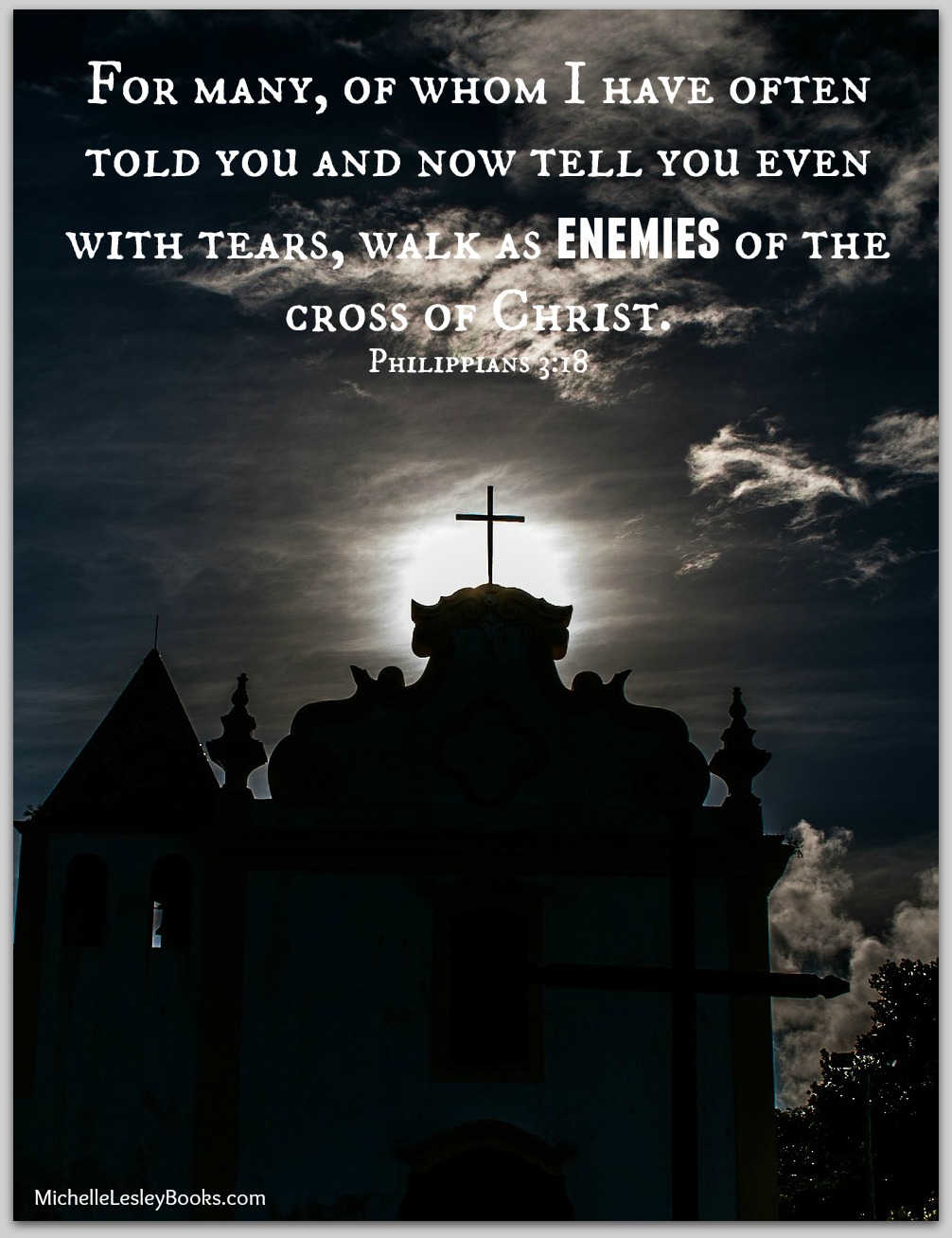
17 Brothers, join in imitating me, and keep your eyes on those who walk according to the example you have in us. 18 For many, of whom I have often told you and now tell you even with tears, walk as enemies of the cross of Christ. 19 Their end is destruction, their god is their belly, and they glory in their shame, with minds set on earthly things. 20 But our citizenship is in heaven, and from it we await a Savior, the Lord Jesus Christ, 21 who will transform our lowly body to be like his glorious body, by the power that enables him even to subject all things to himself.


The Holy Bible, English Standard Version Copyright © 2001 by Crossway Bibles, a division of Good News Publishers.


Questions to Consider:

1. What does Paul mean by “to write the same things to you…” in verse 1?

2. Who are “those who mutilate the flesh”? (2-3) How do verse 3, Deuteronomy 30:6 and Romans 2:29 work together? What does it mean to circumcise your heart? For the Jews, circumcision was an outward sign of belonging to God. What is an outward sign that Christians belong to Christ?

3. In verses 3-11 is Paul bragging about what a holy guy he is? What point is he trying to make about salvation and sanctification in light of the comments he has made about circumcision? How does this compare with what Jesus said about exterior holiness and good works in Matthew 7:22-23? Ephesians 2:8-9? Romans 3:27-28?

4. In verses 12-16, how does Paul describe his main goal for the remainder of his life? What does it mean to “hold true to what we have attained”? (16)

5. Why does Paul tell the Philippians to imitate himself and other godly Christians? (17) Whom is he trying to warn them away from imitating? (18-19) On whom and what does Paul tell us to focus? (20-21)

Wednesday's Word

Wednesday’s Word ~ 2 Samuel 9

2 sam 9 8

2 Samuel 9

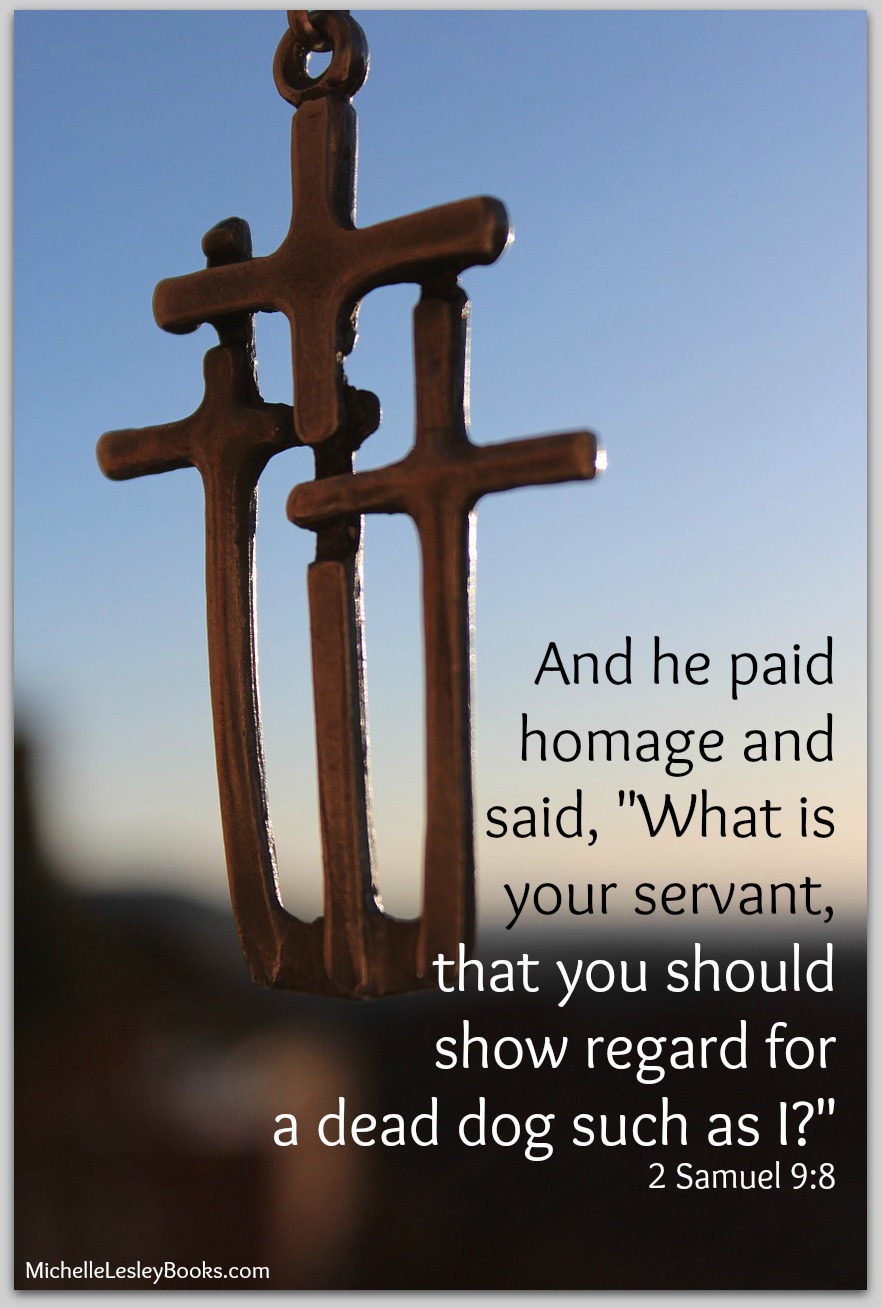
And David said, “Is there still anyone left of the house of Saul, that I may show him kindness for Jonathan’s sake?” Now there was a servant of the house of Saul whose name was Ziba, and they called him to David. And the king said to him, “Are you Ziba?” And he said, “I am your servant.” And the king said, “Is there not still someone of the house of Saul, that I may show the kindness of God to him?” Ziba said to the king, “There is still a son of Jonathan; he is crippled in his feet.” The king said to him, “Where is he?” And Ziba said to the king, “He is in the house of Machir the son of Ammiel, at Lo-debar.” Then King David sent and brought him from the house of Machir the son of Ammiel, at Lo-debar. And Mephibosheth the son of Jonathan, son of Saul, came to David and fell on his face and paid homage. And David said, “Mephibosheth!” And he answered, “Behold, I am your servant.” And David said to him, “Do not fear, for I will show you kindness for the sake of your father Jonathan, and I will restore to you all the land of Saul your father, and you shall eat at my table always.” And he paid homage and said, “What is your servant, that you should show regard for a dead dog such as I?”

Then the king called Ziba, Saul’s servant, and said to him, “All that belonged to Saul and to all his house I have given to your master’s grandson. 10 And you and your sons and your servants shall till the land for him and shall bring in the produce, that your master’s grandson may have bread to eat. But Mephibosheth your master’s grandson shall always eat at my table.” Now Ziba had fifteen sons and twenty servants. 11 Then Ziba said to the king, “According to all that my lord the king commands his servant, so will your servant do.” So Mephibosheth ate at David’s table, like one of the king’s sons. 12 And Mephibosheth had a young son, whose name was Mica. And all who lived in Ziba’s house became Mephibosheth’s servants. 13 So Mephibosheth lived in Jerusalem, for he ate always at the king’s table. Now he was lame in both his feet.


The Holy Bible, English Standard Version Copyright © 2001 by Crossway Bibles, a division of Good News Publishers.The Holy Bible, English Standard Version Copyright © 2001 by Crossway Bibles, a division of Good News Publishers.


Questions to Consider:

1. Who were Saul and Jonathan, and why did David want to show kindness to someone from the house of Saul? (v. 1)

2. The story of David and Mephibosheth is a type and shadow of Christ. How does David’s heart in this story remind you of Jesus’ heart? How do his actions remind you of Jesus’ actions during His earthly ministry?

3. If David is playing the part of Jesus, who does Mephibosheth represent in Jesus’ earthly ministry? How do David and Mephibosheth foreshadow or symbolize what Jesus did for sinners?

4. With what sort of attitude and countenance did Mephibosheth respond to David? (v. 6,8) What does this tell us about our heart attitude as we respond to Christ?

5. In verses 9-13, Mephibosheth, due to David’s kindness, ends up financially comfortable with servants to take care of him. Is this a promise to Christians today that we will be wealthy and comfortable in this life? How do you know? How might Philippians 4:19 and John 16:33 work with verses 9-13?