Sermon on the Mount Bible Study

The Sermon on the Mount ~ Lesson 4

Previous Lessons: 1, 2, 3

Matthew 5:13-20

Questions to Consider

1. Briefly review the Beatitudes in Lesson 3 (link above).

2. Read verses 13-16. Remember that when the Bible was written, there were no chapter and verse markings and no separation between sections. The passage we know as verses 1-12 flowed directly into verses 13-16.

Make the connection between the Beatitudes and 13-16. In what ways could 13-16 be considered the culmination of the Beatitudes? How does God shaping you into all the character qualities in the Beatitudes make you into, or equip you to be, the salt of the earth and the light of the world?

Do verse 13 and verses 14-15 describe the state of saltiness and light in the positive (“Be like this.”) or in the negative (“Do not be like this.”)? List the negative and/or positive statements about each. How could someone who claims to be a Christian lose her saltiness or her light? Is Jesus talking about false converts or genuine Believers who stray into a season of sin, or both? Why?

Carefully examine verse 16. Could this apply to saltiness as well as light? If a friend asked you what this verse meant, how would you explain it to her? What if your friend then directed your attention to 6:1-4, and said, “Aha! The Bible contradicts itself! 5:16 says to let others see your good works and 6:1-4 says not to practice your good works before others.”? How would you explain to her what these two passages mean and why they are different?

3. Read 17-20 in light of 1-16, and in light of the concept from our last lesson that Jesus preaching Sermon on the Mount and the Beatitudes probably evoked comparisons to Moses coming down from the mountain and giving the Ten Commandments.

What three word phrase do most of the Ten Commandments start with? How many of the Ten Commandments end with a blessing? Compare this with the Beatitudes. Which two word phrase does each Beatitude begin with? How many of the Beatitudes end with a blessing? Compare the hard edge specificity of the Commandments (lying, murdering, idolatry, etc.) with the more open ended, less specific Beatitudes (poor in spirit, merciful, etc.) Are the Ten Commandments stated in the negative or the positive? The Beatitudes?

Imagine you’re a law and order Pharisee with all of the above on your mind. You’ve been a “no no” guy all your life. You’re worried Israel might fall back into the sins that sent them into exile in the Old Testament. And now you’re listening to this new guy on the scene preach what sounds like it might be a softer and gentler, love and peace, “hippie” version of the Ten Commandments. You have questions for Jesus. What are those questions?

How does Jesus answer your questions in 17-20? Is He preaching license or that obedience to God does’t matter? Using your cross-references in this passage, what is Jesus trying to convey to the people and to the Pharisees about righteousness and obedience? What is the heart of the Law?

Some people incorrectly think 17-20 mean that New Testament Christians must keep the Old Testament civil laws (no shellfish or mixed fabrics, put a parapet around your roof, etc.) and ceremonial laws (feasts, festivals/holidays, etc.). How would you refute that idea? What are some other passages of Scripture you might bring to bear on this question? When Jesus originally spoke these words, was He talking to Christians under the new covenant or Jews under the old covenant?

How was Jesus the fulfillment of the Law and Prophets? How had legalism so corrupted Judaism that many of the Jews, scribes, and Pharisees were unable or unwilling to accept Jesus as the Messiah – the fulfillment and culmination of the old covenant?


Homework

Consider this thought:

The prevalent false teaching of Jesus’ day was legalism, and the false teachers (Pharisees) accused Jesus and His followers of antinomianism when they taught obedience to God and His Word. The prevalent false teaching today is antinomianism, and today’s false teachers accuse Jesus’ followers of legalism when they teach obedience to God and His Word.

Do you agree or disagree? Why? How can Christians avoid both legalism and antinomianism and follow Christ obediently from a heart of love?


Suggested Memory Verse
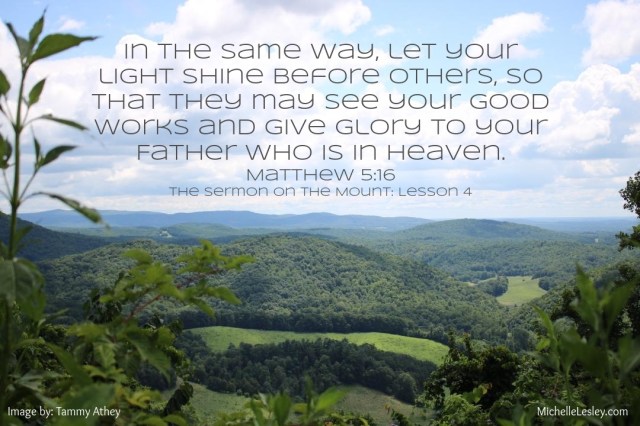
Each week, I’ll provide a suggested memory verse from that week’s study passage. I encourage you to copy, save, or screenshot it. Use it for your screensaver or wallpaper, your social media cover photo, or print it out and stick it somewhere you’ll see it often.

Sermon on the Mount Bible Study

The Sermon on the Mount ~ Lesson 3

Previous Lessons: 1, 2

Matthew 5:1-12

Questions to Consider

1. Briefly review the background to the Sermon on the Mount in Lesson 2 (link above).

2. Read Matthew 5:1-12. This passage is usually called “The Beatitudes”. How did it happen that Jesus had crowds (v.1) following Him? How did John the Baptist’s ministry (see Lesson 2, link above) help prepare the hearts of the people to hear the Beatitudes? What was the thrust of his message, and what is the thrust of the Beatitudes?

3. Carefully examine verses 3-12. Each Beatitude is written in a three part format. Identify and describe each of the three parts.

4. What word do verses 3-11 start with? What does it mean to be blessed? Who is doing the blessing, who is receiving the blessing, and how does being blessed impact a Christian’s life? (Hint: Use your cross references, and search the word “blessed” in a good concordance.)

5. Make a list of the middle part (the state of being or heart attitude) of each Beatitude (poor in spirit, merciful, etc.). What do each of these words or phrases mean? Use your cross-references and make every effort to define each term yourself first, but if you’re a new Christian or new to the Bible, here’s a little help if you get stuck (scroll down to “Related Topics”).

Read, examine, and consider all of the “middle parts” of the Beatitudes together as a unit. Write a 2-3 sentence synopsis of the middle parts. Are the Beatitudes like the spiritual gifts in that everybody gets at least one, but nobody gets all of them (ex: You’re a peacemaker, but I’m meek.)? Or art the Beatitudes more like the Fruit of the Spirit in that all Christians are supposed to embody everything on the list? Explain your answer. If you answered that the Beatitudes are like the spiritual gifts, list the Beatitudes that only some Christians are meant to embody, and explain why that Beatitude doesn’t apply to all Christians.

6. Make a list of the “third part” (the consequence or blessing) of each Beatitude (receive mercy, called sons of God, etc.). What do each of these words or phrases mean? (Use your cross-references.) Would you characterize these consequences as similar to one another, or very different from one another?

Read, examine, and consider all of the consequences of the Beatitudes together as a unit. Write a 2-3 sentence synopsis of the consequences. Do all of these consequences apply to all Christians who pursue holiness? Why or why not?

7. How many Beatitudes (3-12) are there? If I said to you, “In some ways, the Beatitudes are to the New Testament / New Covenant what the 10 Commandments were to the Old Testament / Old Covenant,” would you agree or disagree? Why? Consider the content, context, and audience of both Christ’s preaching of the Beatitudes and Moses delivering the 10 Commandments to God’s people. Compare the way God’s people in the Old Testament regarded the 10 Commandments with the way Christians regard the teachings contained in the Beatitudes. Think about these passages as you answer these questions. How might Jesus delivering the Sermon on the Mount have reminded the people that God had promised to raise up for them a prophet like Moses?


Homework

  • Once you have finished the lesson, you may wish to listen to this series of sermons on the Beatitudes by John MacArthur.
  • Use the Beatitudes as a prayer guide this week, asking God to increase your Christlikeness in the state of being / heart attitude parts, and thanking Him for blessing you with the consequences of each.

Suggested Memory Verse

Normally, in this section, I will provide you with a suggested verse from that day’s passage to memorize. But today, I want you to pick. Was there a certain verse that particularly impacted you, comforted you, or that deals with a heart attitude you’re praying God will grow you in? Work on memorizing that verse this week. If you’re more advanced in Scripture memory work, or if you just want to challenge yourself, consider memorizing verses 3-12.

Starting with our next lesson, all suggested memory verses will be superimposed on the image above. If you like everything to match (like I do!), you’re welcome to grab the image above and put this week’s memory verse (of your choosing) on it using a photo editor. (And if you’re really obsessive about matching – again, like I am – I’ll be using “Syncopate” font in grey.) Use it for your screensaver or wallpaper, your social media cover photo, or print it out and stick it somewhere you’ll see it often.
Sermon on the Mount Bible Study

The Sermon on the Mount ~ Lesson 2

Previous Lessons: 1

Matthew 1-4

Questions to Consider

1. Briefly review the the introductory questions and materials in Lesson 1 (link above).

2. Read Matthew 1-4. How do the events in these chapters lay the groundwork for Jesus to preach the Sermon on the Mount? What sort of overall context do chapters 1-4 provide for the Sermon?

3. As you read chapters 1-4, notice Matthew’s emphasis on prophecy fulfilled. Make a note of each fulfilled prophecy mentioned and think of them as points on Jesus’ “rรฉsumรฉ”. How do each of these fulfilled prophecies point to Jesus’ qualifications to fill the position of Messiah, thus giving Him the divine authority to deliver the Sermon on the Mount?

Besides these instances of fulfilled prophecy, list any other verses that demonstrate Jesus’ qualifications – as God, Messiah, holy, etc. – to authoritatively deliver the Sermon on the Mount. (Hint: Here are a few to get you started.)

4. Explain the various ways God protected and preserved Jesus’ life and safety in chapters 1-4 so that He would be able to fulfill His earthly ministry (chapter 5 and beyond).

5. Why, besides the fact that it fulfilled prophecy, was it necessary for John the Baptist (chapter 3) to “prepare the way of the Lord”? What were some of the things he did to herald and introduce Jesus’ coming, and how did this prepare the hearts of the people to receive Him? What was John’s message to the Pharisees and the people?

Carefully examine 3:7-10. Do any of these ideas or phrases sound familiar as something Jesus Himself later said? Use your cross-references and look up the passages in which Jesus said or taught the same things.

6. How were each of the following significant in laying the foundation for Jesus’ earthly ministry?

  • Jesus’ baptism
  • Jesus’ temptation in the wilderness
  • Jesus relocating to Capernaum
  • Jesus calling the disciples

Homework

Carefully examine 4:1-11. Which Scriptures does Satan quote to Jesus? Does he rightly handle those Scriptures or use them out of context to further his own agenda? Why is it wrong to use Scripture this way? How does Jesus combat Satan’s temptations and Bible twistings? What is significant about Jesus’ use of the phrase “It is written”? Think of a situation in your life in which you could use rightly handled, in context Scripture to fight temptation or to stand against false teaching. Find a way to put that into practice this week. Use Scripture like Jesus used Scripture, not like Satan used Scripture.

Sermon on the Mount Bible Study

The Sermon on the Mount: Lesson 1- Introduction

Welcome to our new study, The Sermon on the Mount!

What does Godโ€™s Word teach us about thinking biblically and developing Christian character? Jesusโ€™ Sermon on the Mount in Matthew starts off with a list of character traits God blesses (the Beatitudes), then fleshes out how to submit to Scripture in real life scenarios in order for the Holy Spirit to grow us in those godly character traits. For the next several weeks, we’ll be working our way through the Sermon on the Mount in Matthew 5-7.

Our lovely title pic for the study was designed by Tammy Athey. The photo is her own, captured in the beautiful mountains of North Carolina. Many thanks to all of those who worked so hard on your entries for our title pic contest. You ladies were very creative and did some outstanding work!ย 

There were too many entries to share all of them with you, but here are a few “honorable mentions”:

If you’re new to using my Bible studies, just a few housekeeping items and helpful hints:

The studies Iโ€™ve written (you can find all of them at the Bible Studies tab in the blue menu bar at the top of this page) are like โ€œtraining wheelsโ€. Theyโ€™re designed to teach you how to study the Bible for yourself and what kinds of questions to ask of the text so that, when you get the hang of it, you wonโ€™t have to depend on other peopleโ€™s books and materials โ€“ even mine โ€“ any more. To that end, I do not provide answersย for the study questions in the studies Iโ€™ve written.

My studies are meant to be extremely flexible and self-paced so that you can use them in the way that works best for you. You can do an entire lesson in one day or work on the questions over the course of the week (or longer). You do not need to feel obligated to answer all (or any) of the questions. If the Holy Spirit parks you on one question for several days, enjoy digging deep into that one aspect of the lesson. If He shows you something I haven’t written a question about that captures your attention, dive in and study it! Those are ways the Holy Spirit speaks to us through His Word. This is your time to commune with the Lord, not a school assignment or work project you are beholden to complete in a certain way by a certain deadline.

I will post a new lesson on the blog every Wednesday, so there is nothing to sign up for or commit to. Simply stop by the blog each week, or subscribe to the blog via e-mail to have the lessons delivered to your inbox.

I use hyperlinks liberallyThe Scriptures for each lesson will be linked at the beginning of the lesson and in the lesson questions. As you’re reading the lesson, whenever you see a word in a different color text, click on it, and it will take you to a Scripture, article, or other resource that will help as you study.

All of the studies Iโ€™ve written are suitable for groups or individuals. You are welcome to use them as a Sunday school or Bible study class curriculum (for free) with proper attribution.

You are also welcome to print out any of my Bible studies (or any article Iโ€™ve written) for free and make as many copies as youโ€™d like, again, with proper attribution. Iโ€™ve explained more about that in this article (3rd section).


Introduction to The Sermon on the Mount

Before we begin studying a book of the Bible, itโ€™s very important that we understand some things about that book. But even though we’re not going to be studying the whole book this time, we still need to knowโ€ฆ

Who the author was and anything we might be able to find out about him or his background.

Who the audience of the book is: Jews or Gentiles? Old Testament Israelites or New Testament Christians? This will help us understand the authorโ€™s purpose and approach to what heโ€™s writing.

What kind of biblical literature weโ€™re looking at. We approach books of history differently than books of wisdom, books of wisdom differently than books of prophecy, etc.

What the purpose of the book is. Was it written to encourage? Rebuke? Warn?

What the historical backdrop is for the book. Is Israel at war? At peace? In exile? Under a bad king? Good king? Understanding the historical events surrounding a piece of writing help us understand what was written and why it was written.

When the book was written. Where does the book fall on the timeline of biblical history? This is especially important for Old Testament books which are not always arranged in chronological order.

So this week, before we start studying the actual text of the Sermon on the Mount, we need to lay the foundation to understanding the book by finding the answers to these questions.

Read the following overviews of the book of Matthew, taking notes on anything that might aid your understanding of the book, and, particularly the Sermon on the Mount and answer the questions below:

Bible Introductions: Matthewย at Grace to You

Overview of the Book of Matthew at Reformed Answers

Summary of the Gospel of Matthewย at Got Questions

1. Who wrote the book of Matthew? How do we know this?

2. Approximately when was Matthew written? What is the geographical setting of the book of Matthew? Here are some maps (scroll down to โ€œMatthewโ€) that may be helpful as you study through the book of Matthew.

3. Who is the original, intended audience of the book of Matthew? Describe the historical setting (historic events, politics, sociology of the time, etc.) of Matthew.

4. Whichย genre of biblical literature is the book of Matthew: law, history, wisdom, poetry, narrative, epistles, or prophecy/apocalyptic? What does this tell us about the approach we should take when studying this book versus our approach to books of other genres?

5. What is the theme or purpose of the book of Matthew?

6. What are some of the major topics of instruction in the book of Matthew? How do these topics relate to the theme of Matthew?

7. What are some ways Matthew points to and connects to Jesus?

8. What else did you learn about Matthew or the setting of this book that might help you understand the Sermon on the Mount better?

Take some time in prayer this week to begin preparing your heart for this study. Ask God to grow you in holiness and in following the exhortations of Christ as we study together The Sermon on the Mount.

Sermon on the Mount Bible Study

New Bible Study Kickoff and Title Pic Contest

Happy Wednesday, Ladies!

Thank you so much for all of your helpful input regarding which Bible study you’d like to do next. We will be doing Forgiven to Forgive1 at a later date, but today, we’re kicking off our next study…

…..with a fun title pic contest!

What does Godโ€™s Word teach us about thinking biblically and developing Christian character? Jesusโ€™ Sermon on the Mount in Matthew starts off with a list of character traits God blesses (the Beatitudes), then fleshes out how to submit to Scripture in real life scenarios in order for the Holy Spirit to grow us in those godly character traits.

The Sermon on the Mountย will be an โ€œexpositorially topicalโ€ (an expository deep dive into a short segment of Scripture) study of Matthew 5-7, similar in format toย The Ten. We will examine the character traits God blesses in Christians and how God develops those traits in us as we walk with Him through the practical circumstances of life and as we develop a biblical worldview.

But before we get started studying, how about a little fun?

You’ve probably noticed that I design a title picture for each Bible study I write. Here are a few past title pics:

You can see the rest of them at the Bible Studies tab in the blue menu bar at the top of this page, if you like, to get a feel for my style and the general appearance I like my title pics to portray.

Y’all have sent in some beautiful and creative entries in our past title pic contests – indeed, the title pics for The Women of Genesis, Living Stones, and Imperishable Beauty were all designed by readers – so, once again, I wanted to get some of you involved in the design process for our new study.

Do you enjoy and have a knack for photo editing? Know someone who does? If so, I’m accepting submissions for title pictures for The Sermon on the Mount study. If your submission is chosen it will be used each week of the study, and you’ll be credited (name or website) by watermark. I’d love to be able to offer a huge cash prize, but, hey, we’re small potatoes here. This is just for fun and maybe a little publicity for your site, if you have one.

Contest Guidelines

โ˜™ย You must use images that don’t require attribution. Pictures you’ve taken yourself are fine, as are images from sources such as Pixabay, Pexels, Freely, Unsplash, StockSnap, or other free stock photo web sites. Please include the image source web sites you use along with your submission. (You cannot just grab and use any old picture off the internet. Photographers own their images and usually require permission, attribution, and often a fee, for their use.)

โ˜™ Title pics should be landscape (a horizontal rectangle) with a width of 1000-2000 pixels and proportionate height. I prefer JPG images, but PNG is fine, too, if necessary.

โ˜™ย Your title pic must contain the full title of the study: The Sermon on the Mount. (Be sure to double check your spelling).ย 

โ˜™ย If your submission is selected, I’ll be glad to watermark it with your website address (please submit your picture without any watermarks) if you have one, as long as your web site doesn’t conflict with my statement of faithย or my beliefs outlined in the Welcome tab.

โ˜™ย Deadline for submissions is 11:59 p.m. Monday, January 18, 2021.ย 

โ˜™ E-mail your title pic submission along with your full name, web site address (if any), and the source(s) you used for your image(s) to MichelleLesley1@yahoo.com. You are welcome to submit as many images as you like.

โ˜™ Please don’t be offended if your submission isn’t selected. If I peruse all the submissions and I’m just not “feeling it,” I may still elect to design one of my own.

โ˜™โ˜™โ˜™โ˜™โ˜™

Feel free to share this around with friends who have an interest in photo editing. If you want to take a whack at it for fun but don’t know where to start, play around with Be Funky, PicMonkey, or Canva and see which one works best for you.

Think about – maybe even read – the Sermon on the Mount and try to capture in your image the theme of what Jesus was teaching or what it might have looked or felt like to be in the audience Jesus preached it to.

Happy designing!


1For those who were hoping for the study on forgiveness, you’ll notice that the Sermon on the Mount in Matthew 5-7 does touch on that topic, so we will cover it, albeit briefly, as part of this study.