Christmas

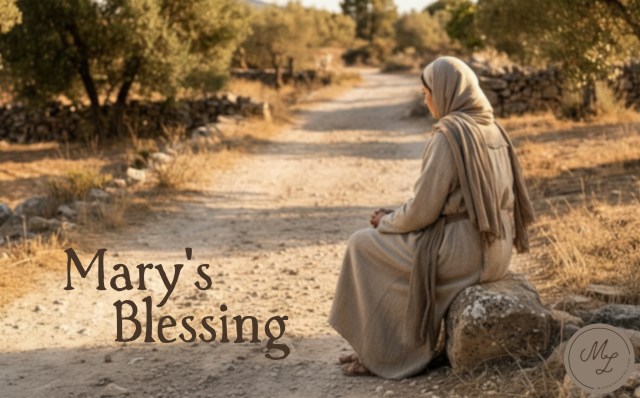
Mary’s Blessing

In the sixth month the angel Gabriel was sent from God to a city of Galilee named Nazareth, to a virgin betrothed to a man whose name was Joseph, of the house of David. And the virgin’s name was Mary. And he came to her and said, “Greetings, O favored one, the Lord is with you!” 

But she was greatly troubled at the saying, and tried to discern what sort of greeting this might be. And the angel said to her, “Do not be afraid, Mary, for you have found favor with God. And behold, you will conceive in your womb and bear a son, and you shall call his name Jesus. 

And Mary said to the angel, “How will this be, since I am a virgin?”
Luke 1:26-31

Mary was just an average, godly young woman, probably in her teens. She had kept herself sexually pure, and she had submitted herself to what was, undoubtedly, her parents’ choice of a husband for her.

Twice in this passage, Gabriel tells Mary she is “favored” by God. This is the same Greek word translated as “blessed” in Ephesians 1:6:

In love, He predestined us for adoption to Himself as sons through Jesus Christ, according to the purpose of His will, to the praise of His glorious grace, with which He has blessed us in the Beloved.
Ephesians 1:6

God blesses us by bestowing His grace upon us to bring us to the Savior, Jesus – for His own reasons, not based on any merit of our own. And God blessed, graced, and favored Mary to bring the Savior, Jesus, to her. For His own reasons, not based on any merit of her own.

God blessed, graced, and favored Mary to bring the Savior, Jesus, to her. For His own reasons, not based on any merit of her own.

And as incomprehensible to Mary as this news was, her response was not, “No, this can’t be,” but, “How will this be?”. Like Elizabeth before her, Mary believed God. 

Like Elizabeth before her, Mary believed God. 

But even as she believed God’s word to her, she must have had a million fears and questions: Would Joseph believe her? Would her parents believe her? Would anyone believe her? 

In that time, Old Testament law demanded that women be stoned to death for adultery, and for the average Israelite to believe a far fetched story -from a woman, no less- about her child being conceived by the Holy Spirit, well, that must have seemed about as likely to Mary as the virgin birth itself.

Maybe she feared for her life and her safety, but Mary still believed what God said and submitted herself completely to Him: “Behold, I am the handmaiden of the Lord; let it be to me according to your word.”

“I am Your slave, Lord. I’m at Your mercy, to do with as You will. Do whatever You want with me, to me, in me, and through me.” This should always be the prayer of every godly woman.

Next, God sends Mary to visit Elizabeth. 

And when Elizabeth heard the greeting of Mary, the baby leaped in her womb. And Elizabeth was filled with the Holy Spirit, and she exclaimed with a loud cry, “Blessed are you among women, and blessed is the fruit of your womb! And why is this granted to me that the mother of my Lord should come to me? For behold, when the sound of your greeting came to my ears, the baby in my womb leaped for joy. And blessed is she who believed that there would be a fulfillment of what was spoken to her from the Lord.”
Luke 1:41-45

In addition to finding a safe place to hide out from those who might seek to put her to death, Mary needed some good, old fashioned Titus 2 discipleship from a godly older woman. And just look at Elizabeth’s godliness!

Mary needed some good, old fashioned Titus 2 discipleship from a godly older woman. And just look at Elizabeth’s godliness!

Elizabeth could have been jealous of Mary. She could have bitterly rehashed all those years begging God for a child, and here, God just showed up and gave Mary a child without her even asking! And not just a child, but the Messiah. Mary got that honor, not her. That could have been Elizabeth’s attitude. But was it? Not a chance. 

Elizabeth was filled with the Holy Spirit. She was humble and honored that Mary would come to visit. She was joyful, and she blessed Mary. And most importantly, she reassured Mary with the truth of the word of God. Her words lined up with God’s word spoken to Mary by the angel:

  • Blessed are you among women
  • Blessed is the fruit of your womb
  • You are the mother of my Lord. 

“And blessed is she who believed that there would be a fulfillment of what was spoken to her from the Lord.”

Yet again, Elizabeth is such a wonderful example to us of how mature, godly women should think and behave. She shows us how to disciple younger women in kindness, humility, and joy, using Scripture and our God-given wisdom born of the experiences He has brought us through. And she and Mary both showcase the beauty of believing God even in the midst of unbelievable circumstances.

Elizabeth and Mary both showcase the beauty of believing God even in the midst of unbelievable circumstances.

And look at this amazing picture God paints for us in the next passage, contrasting the beauty of Elizabeth’s spiritual maturity and wisdom with Mary’s youthful innocence, awe, and wonder in worship:

Mary said,

My soul magnifies the Lord,
and my spirit rejoices in God my Savior,
for he has looked on the humble estate of his servant.
For behold, from now on all generations will call me blessed;
for he who is mighty has done great things for me,
and holy is his name.
Luke 1:46-49

This is personal. My soul, my spirit, my Savior. All generations will call me blessed. He has done great things for me. We can sometimes regard Mary as merely a conduit for bringing our Savior to us. But this was her life.

We can sometimes regard Mary as merely a conduit for bringing our Savior to us. But this was her life.

God sees us and knows us as His unique, one of a kind daughters, and He is our personal Father. Just as it was right and fitting for Mary to have this intimate moment worshiping her Father for what He had done in her life, and giving him all the glory, it is right and fitting for us to worship Him in quiet moments all alone, giving Him all the glory for what He has done in our lives.

But Mary knew that all of this wasn’t just about her, and as she continues to worship she expands her thoughts to include others:

And His mercy is for those who fear Him
from generation to generation.
He has shown strength with His arm;
He has scattered the proud in the thoughts of their hearts;
He has brought down the mighty from their thrones
and exalted those of humble estate;
He has filled the hungry with good things,
and the rich He has sent away empty.
He has helped His servant Israel,
in remembrance of His mercy,
as He spoke to our fathers,
to Abraham and to his offspring forever.
Luke 1:50-55

In this brief song of worship, Mary quotes from – or alludes to – several passages in Psalms, Isaiah, Habakkuk, and other Old Testament books. She knows who God is and what He has done for His people. She understands His nature and character. She knows His precepts, promises, and covenants. Mary was a woman of godly character, because she was a woman of the Word. 

God blessed Mary, and through her godly example she, in turn, blesses us. May God make us all worshipful women of the Word, like Mary.

God blessed Mary, and through her godly example she, in turn, blesses us. May God make us all worshipful women of the Word, like Mary.


Christmas

Elizabeth’s Gift

Originally published December 23, 2020

Sometimes I think that if Elizabeth’s story had happened back in the Old Testament, we’d spend much more time on it than we do and be much more amazed by it than we are. Instead, we kind of tend to regard her as a footnote in the Christmas story, overshadowed by the story of Jesus’ incarnation.

And I’m sure Elizabeth is totally fine with that. Like her own son said, “He must increase, but I must decrease.”

But Elizabeth’s story is a rich gift to Christ’s birth narrative, adding wonder and awe to the divine beauty of the tale. It is also God’s gift to us as Christian women, giving us a sister in Christ to look up to and learn from.

Elizabeth’s story is a rich gift to Christ’s birth narrative, adding wonder and awe to the divine beauty of the tale.

In the days of Herod, king of Judea, there was a priest named Zechariah, of the division of Abijah. And he had a wife from the daughters of Aaron, and her name was Elizabeth. And they were both righteous before God, walking blamelessly in all the commandments and statutes of the Lord. But they had no child, because Elizabeth was barren, and both were advanced in years.

Luke 1:5-7

Elizabeth was righteous before God. She walked blamelessly in all the commandments and statutes of the Lord. Like you and me, she wasn’t perfect. She still fell into sin. But because she loved the Lord, she repented, and strove to live her life to please Him.

But Elizabeth also knew sorrow. She and Zechariah had no child. She had been barren for all of her childbearing years, and now she was elderly – some scholars estimate at least 60 years old – and long past menopause.

If you or someone you know has ever experienced the heartbreak of infertility, you know just how painful that is. And in biblical times, culture added insult to injury in a lot of ways. It was assumed any infertility was a problem with the woman, when today we know that men can also be infertile.

Because children are a blessing from the Lord and the fruit of the womb is a reward, and because God sometimes closed the wombs of certain women in Scripture as a result of sin – it was often assumed that if you weren’t having children you were cursed by God, or your barrenness was some sort of punishment for sin.

And in addition to all of that, in that day and time, women were “low man on the totem pole” so to speak. They were regarded as less than men in practically every way- intelligence, abilities, worth, and so on. They couldn’t testify in court because their testimony wasn’t considered credible. And, maybe you’ve even heard of the daily prayer that Jewish men still say today, thanking God for not creating them a Gentile…a slave…or a woman.

So, practically the only way women of that time could achieve a modicum of respect and status in society was by marrying well and by having sons. And, though she did marry well, Elizabeth didn’t have any children.

Try to imagine being a woman of Elizabeth’s time, having all of that on your shoulders, and having virtually no power to do anything about it.

Do you think you might be a little bitter toward God?

“Lord, my husband’s a priest! We can’t go around having people think you’ve cursed us.”

“We’ve been serving You all these years, and all we’ve asked for is a baby. You
owe us.”

“You’re not going to give me the one thing I want most in life? Forget it – there are plenty of other gods to worship. I’ll go serve one of them.”

But not Elizabeth. Elizabeth just kept getting up day after day, trusting the Lord, serving the Lord, obeying the Lord.

Elizabeth just kept getting up day after day, trusting the Lord, serving the Lord, obeying the Lord.

And let’s not forget, we know the rest of the story. We know God is going to miraculously open Elizabeth’s womb and she’ll be the mother of John the Baptist. We know she’s going to be one of the first people to learn the good news of the Messiah. We know she’s going to be celebrated and famous across the world once her story gets into Scripture.

Elizabeth didn’t know that. For all those years faithfully following and trusting the Lord, she didn’t know any of that. For all she knew, she was going to die childless and in obscurity, quickly to be forgotten even by those who knew her. And yet she still chose to walk faithfully with the Lord.

Elizabeth was faithful to God because of who God is, not for what she could get out of Him. She served God to get more of God, not to get the goodies.

But look what happens next…

Now while [Zechariah] was serving as priest before God when his division was on duty, according to the custom of the priesthood, he was chosen by lot to enter the temple of the Lord and burn incense…And there appeared to him an angel of the Lord standing on the right side of the altar of incense…the angel said to him, “Do not be afraid, Zechariah, for your prayer has been heard, and your wife Elizabeth will bear you a son, and you shall call his name John.

Luke 1:8-9,11,13

Zechariah has the great honor of entering the temple and burning incense. Suddenly – a miracle! Gabriel, who stands in the very presence of God Himself, has brought the amazing news that Elizabeth – barren and past her time – is going to give birth to the forerunner of the Messiah.

And Zechariah doesn’t believe it.

But Elizabeth does

Thus the Lord has done for me in the days when he looked on me, to take away my reproach among people.

Luke 1:25

Elizabeth believed God.

In those days Mary arose and went with haste into the hill country, to a town in Judah, and she entered the house of Zechariah and greeted Elizabeth. And when Elizabeth heard the greeting of Mary, the baby leaped in her womb. And Elizabeth was filled with the Holy Spirit, and she exclaimed with a loud cry, “Blessed are you among women, and blessed is the fruit of your womb! And why is this granted to me that the mother of my Lord should come to me? For behold, when the sound of your greeting came to my ears, the baby in my womb leaped for joy. And blessed is she who believed that there would be a fulfillment of what was spoken to her from the Lord.”

Luke 1:39-45

The newly pregnant Mary comes for a visit. The Holy Spirit reveals to and through Elizabeth that the baby Mary is carrying is the Messiah. And, once again, in great humility, Elizabeth believes Him: “Who am I, that my Lord should come to me?” Elizabeth wondered.

Indeed – who are any of us, that our Lord should come to us?

Elizabeth did not seek out Jesus. He came to find her. So, we who were dead in our sins and trespasses did not seek Him. He came to us, to seek and to save that which was lost.

Now the time came for Elizabeth to give birth, and she bore a son. And her neighbors and relatives heard that the Lord had shown great mercy to her, and they rejoiced with her. And on the eighth day they came to circumcise the child. And they would have called him Zechariah after his father, but his mother answered, “No; he shall be called John.”

Luke 1:57-60

It’s a boy! What a joy-filled day it must have been. This wasn’t just any birth. It was God’s promise fulfilled. It was God’s mercy to Elizabeth, His blameless – yet not sinless – and undeserving child. It was God’s blessing to Elizabeth, His faithful servant. The same kind of mercy and blessings He shows us, His faithful, yet undeserving sons and daughters. The same way He fulfills His promises to us.

The time quickly came to circumcise and officially name the baby. Tradition dictated that he be named after Dad: Zechariah. But Elizabeth believed all that God had revealed about this baby to the point that she put her foot down, broke with tradition and insisted, along with her husband, that the baby be named John. It wasn’t about what she wanted. It wasn’t about what others thought was best. It was all about God, and what He wanted.

All of these unbelievable things happening to Elizabeth, yet Elizabeth believes God. Obeys God. Trusts God. She trusted and obeyed God all of those years when He said no, and she believed and obeyed Him after He said yes.

Elizabeth trusted and obeyed God all of those years when He said no, and she believed and obeyed Him after He said yes.

May we, as godly women, be daughters of Elizabeth: Believing God through the unbelievable. Trusting Him in times of uncertainty. Obeying Him in the face of opposition.

What a legacy this dear sister has left us.

What a gift.


Christmas

Elizabeth’s Gift

Sometimes I think that if Elizabeth’s story had happened back in the Old Testament, we’d spend much more time on it than we do and be much more amazed by it than we are. Instead, we kind of tend to regard her as a footnote in the Christmas story, overshadowed by the story of Jesus’ incarnation.

And I’m sure Elizabeth is totally fine with that. Like her own son said, “He must increase, but I must decrease.”

But Elizabeth’s story is a rich gift to Christ’s birth narrative, adding wonder and awe to the divine beauty of the tale. It is also God’s gift to us as Christian women, giving us a sister in Christ to look up to and learn from.

In the days of Herod, king of Judea, there was a priest named Zechariah, of the division of Abijah. And he had a wife from the daughters of Aaron, and her name was Elizabeth. And they were both righteous before God, walking blamelessly in all the commandments and statutes of the Lord. But they had no child, because Elizabeth was barren, and both were advanced in years.

Luke 1:5-7

Elizabeth was righteous before God. She walked blamelessly in all the commandments and statutes of the Lord. Like you and me, she wasn’t perfect. She still fell into sin. But because she loved the Lord, she repented, and strove to live her life to please Him.

But Elizabeth also knew sorrow. She and Zechariah had no child. She had been barren for all of her childbearing years, and now she was elderly – some scholars estimate at least 60 years old – and long past menopause.

If you or someone you know has ever experienced the heartbreak of infertility, you know just how painful that is. And in biblical times, culture added insult to injury in a lot of ways. It was assumed any infertility was a problem with the woman, when today we know that men can also be infertile.

Because children are a blessing from the Lord and the fruit of the womb is a reward, and because God sometimes closed the wombs of certain women in Scripture as a result of sin – it was often assumed that if you weren’t having children you were cursed by God, or your barrenness was some sort of punishment for sin.

And in addition to all of that, in that day and time, women were “low man on the totem pole” so to speak. They were regarded as less than men in practically every way- intelligence, abilities, worth, and so on. They couldn’t testify in court because their testimony wasn’t considered credible. And, maybe you’ve even heard of the daily prayer that Jewish men still say today, thanking God for not creating them a gentile…a slave…or a woman.

So, practically the only way women of that time could achieve a modicum of respect and status in society was by marrying well and by having sons. And, though she did marry well, Elizabeth didn’t have any children.

Try to imagine being a woman of Elizabeth’s time, having all of that on your shoulders, and having virtually no power to do anything about it.

Do you think you might be a little bitter toward God?

“Lord, my husband’s a priest! We can’t go around having people think you’ve cursed us.”

“We’ve been serving You all these years, and all we’ve asked for is a baby. You
owe us.”

“You’re not going to give me the one thing I want most in life? Forget it – there are plenty of other gods to worship. I’ll go serve one of them.”

But not Elizabeth. Elizabeth just kept getting up day after day, trusting the Lord, serving the Lord, obeying the Lord.

And let’s not forget, we know the rest of the story. We know God is going to miraculously open Elizabeth’s womb and she’ll be the mother of John the Baptist. We know she’s going to be one of the first people to learn the good news of the Messiah. We know she’s going to be celebrated and famous across the world once her story gets into Scripture.

Elizabeth didn’t know that. For all those years faithfully following and trusting the Lord, she didn’t know any of that. For all she knew, she was going to die childless and in obscurity, quickly to be forgotten even by those who knew her. And yet she still chose to walk faithfully with the Lord.

Elizabeth was faithful to God because of who God is, not for what she could get out of Him. She served God to get more of God, not to get the goodies.

But look what happens next…

Now while [Zechariah] was serving as priest before God when his division was on duty, according to the custom of the priesthood, he was chosen by lot to enter the temple of the Lord and burn incense…And there appeared to him an angel of the Lord standing on the right side of the altar of incense…the angel said to him, “Do not be afraid, Zechariah, for your prayer has been heard, and your wife Elizabeth will bear you a son, and you shall call his name John.

Luke 1:8-9,11,13

Zechariah has the great honor of entering the temple and burning incense. Suddenly – a miracle! Gabriel, who stands in the very presence of God Himself, has brought the amazing news that Elizabeth – barren and past her time – is going to give birth to the forerunner of the Messiah.

And Zechariah doesn’t believe it.

But Elizabeth does

Thus the Lord has done for me in the days when he looked on me, to take away my reproach among people.

Luke 1:25

Elizabeth believed God.

In those days Mary arose and went with haste into the hill country, to a town in Judah, and she entered the house of Zechariah and greeted Elizabeth. And when Elizabeth heard the greeting of Mary, the baby leaped in her womb. And Elizabeth was filled with the Holy Spirit, and she exclaimed with a loud cry, “Blessed are you among women, and blessed is the fruit of your womb! And why is this granted to me that the mother of my Lord should come to me? For behold, when the sound of your greeting came to my ears, the baby in my womb leaped for joy. And blessed is she who believed that there would be a fulfillment of what was spoken to her from the Lord.”

Luke 1:39-45

The newly pregnant Mary comes for a visit. The Holy Spirit reveals to and through Elizabeth that the baby Mary is carrying is the Messiah. And, once again, in great humility, Elizabeth believes Him: “Who am I, that my Lord should come to me?” Elizabeth wondered.

Indeed – who are any of us, that our Lord should come to us?

Elizabeth did not seek out Jesus. He came to find her. So, we who were dead in our sins and trespasses did not seek Him. He came to us, to seek and to save that which was lost.

Now the time came for Elizabeth to give birth, and she bore a son. And her neighbors and relatives heard that the Lord had shown great mercy to her, and they rejoiced with her. And on the eighth day they came to circumcise the child. And they would have called him Zechariah after his father, but his mother answered, “No; he shall be called John.”

Luke 1:57-60

It’s a boy! What a joy-filled day it must have been. This wasn’t just any birth. It was God’s promise fulfilled. It was God’s mercy to Elizabeth, His blameless – yet not sinless – and undeserving child. It was God’s blessing to Elizabeth, His faithful servant. The same kind of mercy and blessings He shows us, His faithful, yet undeserving sons and daughters. The same way He fulfills His promises to us.

The time quickly came to circumcise and officially name the baby. Tradition dictated that he be named after Dad: Zechariah. But Elizabeth believed all that God had revealed about this baby to the point that she put her foot down, broke with tradition and insisted, along with her husband, that the baby be named John. It wasn’t about what she wanted. It wasn’t about what others thought was best. It was all about God, and what He wanted.

All of these unbelievable things happening to Elizabeth, yet Elizabeth believes God. Obeys God. Trusts God. She trusted and obeyed God all of those years when He said no, and she believed and obeyed Him after He said yes.

May we, as godly women, be daughters of Elizabeth: Believing God through the unbelievable. Trusting Him in times of uncertainty. Obeying Him in the face of opposition.

What a legacy this dear sister has left us.

What a gift.


Mark Bible Study

Mark: Lesson 5

Previous Lessons: 1, 2, 3, 4

Mark 3:

Again he entered the synagogue, and a man was there with a withered hand. And they watched Jesus, to see whether he would heal him on the Sabbath, so that they might accuse him. And he said to the man with the withered hand, “Come here.” And he said to them, “Is it lawful on the Sabbath to do good or to do harm, to save life or to kill?” But they were silent. And he looked around at them with anger, grieved at their hardness of heart, and said to the man, “Stretch out your hand.” He stretched it out, and his hand was restored. The Pharisees went out and immediately held counsel with the Herodians against him, how to destroy him.

Jesus withdrew with his disciples to the sea, and a great crowd followed, from Galilee and Judea and Jerusalem and Idumea and from beyond the Jordan and from around Tyre and Sidon. When the great crowd heard all that he was doing, they came to him. And he told his disciples to have a boat ready for him because of the crowd, lest they crush him, 10 for he had healed many, so that all who had diseases pressed around him to touch him. 11 And whenever the unclean spirits saw him, they fell down before him and cried out, “You are the Son of God.” 12 And he strictly ordered them not to make him known.

13 And he went up on the mountain and called to him those whom he desired, and they came to him.14 And he appointed twelve (whom he also named apostles) so that they might be with him and he might send them out to preach 15 and have authority to cast out demons. 16 He appointed the twelve: Simon (to whom he gave the name Peter); 17 James the son of Zebedee and John the brother of James (to whom he gave the name Boanerges, that is, Sons of Thunder); 18 Andrew, and Philip, and Bartholomew, and Matthew, and Thomas, and James the son of Alphaeus, and Thaddaeus, and Simon the Zealot, 19 and Judas Iscariot, who betrayed him.

20 Then he went home, and the crowd gathered again, so that they could not even eat. 21 And when his family heard it, they went out to seize him, for they were saying, “He is out of his mind.”

22 And the scribes who came down from Jerusalem were saying, “He is possessed by Beelzebul,” and “by the prince of demons he casts out the demons.” 23 And he called them to him and said to them in parables, “How can Satan cast out Satan? 24 If a kingdom is divided against itself, that kingdom cannot stand. 25 And if a house is divided against itself, that house will not be able to stand. 26 And if Satan has risen up against himself and is divided, he cannot stand, but is coming to an end. 27 But no one can enter a strong man’s house and plunder his goods, unless he first binds the strong man. Then indeed he may plunder his house.

28 “Truly, I say to you, all sins will be forgiven the children of man, and whatever blasphemies they utter,29 but whoever blasphemes against the Holy Spirit never has forgiveness, but is guilty of an eternal sin”30 for they were saying, “He has an unclean spirit.”

31 And his mother and his brothers came, and standing outside they sent to him and called him. 32 And a crowd was sitting around him, and they said to him, “Your mother and your brothers are outside, seeking you.” 33 And he answered them, “Who are my mother and my brothers?” 34 And looking about at those who sat around him, he said, “Here are my mother and my brothers! 35 For whoever does the will of God, he is my brother and sister and mother.”


The Holy Bible, English Standard Version. ESV® Permanent Text Edition® (2016). Copyright © 2001 by Crossway Bibles, a publishing ministry of Good News Publishers.


Questions to Consider

1. In verses 1-6, we see again one of the major themes of Mark: Jesus’ lordship over the Sabbath. Take a moment to review question 6 from Lesson 4 (link above). What are the similarities and differences between Mark 2:23-28 and Mark 3:1-6? Look at these two passages in a physical Bible. What do you notice about their placement, or sequence, in the manuscript, despite the fact that some time elapsed between the two incidents? Why might Mark have organized his manuscript this way?

2. Why was guarding against profaning the Sabbath such a major issue for the Pharisees? (1-6) What might they have worried God would do if Jesus influenced Israel to (in the Pharisees’ eyes) break the Sabbath? What did Jesus mean by his question in verse 4? Why didn’t the Pharisees answer Jesus? (4-6) Sometimes we think of anger as being sinful. Here, we see Jesus get angry. Why was His anger not sinful? (5)

3. What was Jesus doing (8) that drew such large crowds to Him? (10, 20-21) Compare the crowds, and their reason for flocking to Jesus in verses 7-12, 20-21, with this passage. What was the reason Peter and Jesus’ true followers stuck with Him? Do you see any similarities between the crowds that came to Jesus in droves for miracles, yet turned away from His teaching, and the crowds that fill miracle-promising “churches” today, even though those “churches” do not preach the truth of the gospel? What does Jesus want us to come to Him for?

4. How did Jesus’ ability to heal, his lordship over the Sabbath, His ability to cast out demons, and His definitive teaching on forgiveness (28-29) demonstrate that Jesus was God and that His authority over the physical and spiritual realms was equal to God’s? How would the authority over demons that Jesus gave the disciples for this mission (15) have authenticated the message they were preaching? (14) Was the disciple’s primary objective to preach the gospel or cast out demons? (14)

5. You may wish to examine verses 22-30 alongside these parallel passages in Matthew and Luke for better understanding. What is the blasphemy against the Holy Spirit (also called the unpardonable sin)? What were the scribes accusing Jesus of? (22) In your own words, explain Jesus’ reasoning to them. (23-27) Why did Jesus say the scribes making these accusations would never be forgiven? (30)

6. Why might Mary and Jesus’ siblings have been looking for Him? (20-21, 31-32) Was Jesus dishonoring his mother or rejecting his siblings in favor of others? (33-35) What point was Jesus trying to make? Compare verses 31-35 with these passages. What do we learn from these Scriptures about the importance of our spiritual family? Think about religions that unbiblically venerate Mary and ascribe supernatural attributes to her. Would this passage seem to support those beliefs?


Homework

Think about your church family. Is there a brother or sister, or maybe even a spiritual “mother” or “father,” who has helped you in your walk with the Lord, encouraged you, been there for you, maybe even led you to Christ? Take a moment this week to touch base with that person and express your love and appreciation.


Suggested Memory Verse

For whoever does the will of God, he is my brother and sister and mother.”
Mark 3:35