Idolatry, Old Testament, Sunday School, Worship

Israel Is Exiled ~ Sunday School Lesson ~ 7-20-14

PicsArt_1405907394797

These are my notes from my ladies’ Sunday School class this morning. I’ll be posting the notes from my class here each week. Click here for last week’s lesson.

Through the Bible in 2014 ~ Week 29 ~ July 13-19
2 Chronicles 27-31, Isaiah 9-27, Micah, 2 Kings 16-18:8, Psalm 48
Israel is Exiled

2 Kings 17:1-20
Second Kings 17 is sort of the “Cliff Notes” version of Israel’s era of the kings. We have read about each king of Israel, all of whom “did what was evil in the sight of the Lord.” Second Kings 17 sums up the effect these evil kings had on Israel’s relationship with God and the consequences for their idolatry.

Israel’s Sin
The sin that brought God’s judgment upon Israel was idolatry. Israel participated in idolatry in two different ways, usually at the same time:

They worshiped false gods instead of the true God. (12,16-17)
As Israel got to know her pagan neighbors, she began to worship some of their false gods such as Ashera, Baal, Molech, and the stars and planets. This was expressly forbidden by God in the 10 Commandments and throughout the Old Testament. While other nations often worshiped many gods, Israel was to be holy and set apart to the one true God and serve only Him.

They worshiped the true God in false ways. (16, 1 Corinthians 14:40, 2 Corinthians 9:7, 1 Corinthians 5, 1 Timothy 2:12-14, 1 Timothy 3, Titus 1, 1 Corinthians 11:17-33)
You will recall the two golden calves Jeroboam had set up in the north and south for the people to worship. He wanted to keep the Israelites from traveling out of Israel into Judah to worship at the temple because he did not want the people to turn their loyalty back to the throne of David. So he took the worship and festivals God had set up for Himself and transferred them to these two calves. The calves were basically a stand in for God.

God was very specific about how, when, and where He was to be worshiped. When we studied Exodus and Leviticus, we saw hundreds of instructions about God’s house, the utensils, the men who served as priests and Levites, the offerings and sacrifices, cleansing rituals, and on and on. God requires that He be worshiped in certain ways. His ways. He did not leave it up to His people to worship Him freestyle.

Even today, God has given us specific instructions about worship that we are to obey. For example, He tells us that, in the church, all things are to be done decently and in order (1 Cor. 14), that we are to give our offerings cheerfully and not reluctantly or under compulsion (2 Cor. 9), that we are to discipline, not tolerate, unrepentant sin in the church (1 Cor. 5), that women are not to instruct or hold authority over men in the church (1 Tim. 2), the qualifications for pastors and elders (1 Tim. 3, Tit. 1), instructions about the Lord’s Supper (1 Cor. 11), and so many more things. Although God has given us freedom in some areas of worship, as long as they do not violate any specific instructions He has given us (music style, order of service, what we wear to church, etc.), He has not turned us loose to worship Him in any way we please. We must be careful not to do this as the Israelites did.

God’s Patience (1 Peter 3:20, 2 Timothy 4:1, 2 Peter 3:9, Romans 2:4, 2 Corinthians 6:2)
After Solomon died, Israel and Judah split into two separate kingdoms. In the 209 years between Solomon and the exile (931-722 B.C.), Israel had twenty kings, all of whom participated in and promoted idol worship among the people of Israel. During that time period, God sent at least seven prophets (Ahijah, Jehu, Elijah, Micaiah, Elisha, Amos, and Hosea) to warn Israel to turn back from her idolatry and the consequences if she would not. Two hundred and nine years. That’s a lot of chances God gave His people to repent and turn back to Him.

God has a track record of patience. First Peter 3:20 tells us “God’s patience waited in the days of Noah, while the ark was being prepared.” God stayed His hand of judgment for 120 years while Noah was building the ark, preaching repentance with every swing of the hammer. In His mercy, God was giving the people of Noah’s day a chance to repent and turn to Him before the flood, but none did, except Noah’s family.

In the same way, God has been patient with mankind for the last 2000+ years since He provided the way of salvation for us through Jesus.

Second Timothy 4:1 tells us that Christ will return to judge the living and the dead, but what’s taking Him so long?

Second Peter 3:9 says: “The Lord is not slow to fulfill his promise as some count slowness, but is patient toward you, not wishing that any should perish, but that all should reach repentance.”

He wants everyone to turn to Him in repentance, but we are not to take advantage of His patience and continue in sin. Romans 2:4 says, “Or do you presume on the riches of his kindness and forbearance and patience, not knowing that God’s kindness is meant to lead you to repentance?”

“For he says, ‘In a favorable time I listened to you, and in a day of salvation I have helped you.’ Behold, now is the favorable time; behold, now is the day of salvation.” (2 Corinthians 6:2). In the same way that Israel should have repented immediately because they didn’t know how long God’s patience with them would last, we must turn to Him now instead of later because we do not know when He is coming back. And once He does, it will be too late for those who have not put their trust in Christ.

God’s Judgment (18-20)
God’s time of patience with the ungodly always comes to an end. It happened with Noah, and here we see it happening with Israel. God’s judgment fell upon Israel. He allowed them to be torn apart by enemy nations, and, finally, exiled from the Promised Land to Assyria. Judah held out for a while with a few good kings, but eventually, she followed in Israel’s footsteps and was exiled to Babylon in 605 B.C.

But even in exile, there were those few faithful Israelites and Judahites whom God saved: Daniel, Nehemiah, Esther, Ezra, and many others whose names we don’t know. Today, despite persecution and rampant sin in the visible church, God is still preserving a remnant of Christians who are faithful, whom He will preserve when He brings the final judgment upon the earth. Until that time, the words of Jesus are just as relevant today as when He said them 2000 years ago:

“The time is fulfilled, and the kingdom of God is at hand; repent and believe in the gospel.” Mark 1:15

Discernment, Old Testament, Sunday School

A Non-Prophet Organization ~ Sunday School Lesson ~ 6-29-14

A Non-Prophet Organization


These are my notes from my ladies’ Sunday School class this morning. I’ll be posting the notes from my class here each week. Click here for last week’s lesson.

Through the Bible in 2014 ~ Week 26 ~ June 22-28
Proverbs 30-31, 1 Kings 12-21, 2 Chronicles 10-17
A Non-Prophet Organization

1 Kings 12:32-13:34

Setting the Scene (12:32-33)
Solomon has died, and Israel has been divided into two parts: the Southern Kingdom, consisting only of the tribe of Judah, and the Northern Kingdom, Israel, consisting of the other ten tribes. Solomon’s son, Rehoboam, is king of Judah. Solomon’s former servant, Jeroboam, is king of Israel.

Jerusalem, where the temple is located, is in Judah. Jeroboam (king of Israel) figures that if his people continue traveling to Jerusalem for feasts and sacrifices, they will eventually turn their loyalty back to the the kingly lineage of David (12:26-27) and he’ll lose both his kingdom and his head. So, in order to keep the people inside the borders of Israel and control them, he makes a couple of golden calves (which somebody should have remembered turned out bad the last time that was tried {Exodus 32}) for them to worship at either of two convenient locations, Bethel, in the south, and Dan in the north. Jeroboam, leading the way, had the Israelites simply transfer their feasts and sacrifices that they would have offered to God to these golden calves.

Prophet #1 (13:1-10)
Since we aren’t told the names of either of the prophets in this chapter, we’ll just call them Prophet #1 and Prophet #2. This section is about Prophet #1.

948px-Jean-Honoré_Fragonard_-_Jeroboam_Offering_Sacrifice_for_the_Idol_-_WGA08049

In Flagrante Delicto (1-3) 
The Latin phrase, in flagrante delicto, literally means “in blazing offense.” In the American justice system, it means that someone was caught in the act of committing a crime. And, there’s no better way to describe Jeroboam here, standing by the altar, the offensive sacrifice blazing away, when God confronts him about his sin through the prophet.

Normally, when a prophet has a word from the Lord for someone, we see him speaking directly to that person, but here, we actually see Prophet #1 speaking to an altar. Why? Scripture doesn’t say. But, since Jeroboam was standing right there, he got the message.
Prophet #1 prophesied that a new king, Josiah, would come out of David’s line, and slaughter the pagan priests on their own altars. Since Josiah was not to come for about 300 more years, God gave a miraculous sign that He had spoken. The altar was torn down and the ashes “desecrated” (if it’s possible to further desecrate ashes of an idolatrous sacrifice) by pouring them on the ground.

Hypocrisy (4-7)
As soon as Prophet #1 had finished speaking, Jeroboam reached out to kill him, and God protected the prophet by shriveling up Jeroboam’s hand. But, when Jeroboam saw God’s word fulfilled in the altar being torn down and the ashes scattered, he quickly changed his tune. He stopped trying to kill the prophet. And whom did he entreat to heal him? Not the golden calves, but God. Next, he invited the prophet back home for supper and a reward. It sort of looks like he repented. Did he? As we’ll see later in the chapter, he did not.

Jeroboam changed his actions, but so did God. God went from an expression of wrath to an expression of mercy in a heartbeat. When man changes his actions, but not his heart, it’s called hypocrisy. When God changes His actions because of His heart, it’s called grace. Common grace for the sinner, saving grace for the penitent. He did it at the cross, and He does it for each person who will repent and put his faith in Christ.

So, one minute Jeroboam is trying to kill the prophet and the next, he’s being hospitable and wants to reward him. With such a quick turnaround, you have to wonder if he was trying to lure the prophet back home to kill him. We can’t know for sure, but even if God hadn’t forbade him from accepting, it would seem he was wise to decline.

Thanks, but no thanks (8-10)
Contrast the lengths of self denial the prophet went to (“if you give me half your house, I will not…) in order to stay true and obedient to God, and the lengths of disobedience and betrayal of God that Jeroboam went to (12:25ff) to indulge his desire to stay in power. Prophet #1 could have had it made, but his love for the Lord was greater than his love for stuff. It was time to hit the road.

Dueling Prophets (13:11-32)

Prophet #2 and his false prophecy (11-19)
We don’t really know anything about Prophet #2 either, except that he lived in Bethel near one of the golden calf altars. We don’t know why he went out so urgently after Prophet #1 or why he wanted Prophet #1 to come back home with him, and we certainly don’t know why he lied to Prophet #1 to get him to disobey the Lord. It’s ok to try to guess what might have motivated Prophet #2, but we have to remember that anything we come up with will be just that, a guess. Where God’s word does not speak definitively, we cannot speak definitively.

The discernment factor (14-19, Numbers 23:19, Proverbs 30:6, 2 Corinthians 11:14-15, Galatians 1:6-9) 
Prophet #1 gives us a valuable lesson in the importance of comparing to God’s word everyone and everything that claims to be to speaking for God. Prophet #1 certainly knew that

“God is not man, that he should lie,
or a son of man, that he should change his mind.
Has he said, and will he not do it?
Or has he spoken, and will he not fulfill it?” Numbers 23:19

God does not contradict His word. If we “hear” from the Lord, or someone gives us a “word from the Lord” or says “God says/wants/thinks…,” it must be in line with Scripture, or it is not truly from the Lord. Whenever we hear preachers, teachers, friends, etc., saying things like that, we need to ask ourselves, “Where does God’s word say that (in context)?” If God’s word doesn’t say it, we need to throw it out. We must be careful not to add to God’s word or believe those who do. Another verse in this week’s reading says:

Do not add to [God’s] words,
lest he rebuke you and you be found a liar. Proverbs 30:6

How quickly Prophet #1 turned from obedience (8-9) to disobedience (19). It can be easy to discern between good and evil in a worldly situation (such as the one Prophet #1 faced when dealing with Jeroboam). It’s easy to discern that it’s wrong to do worldly things: get drunk, use a prostitute, steal, etc. It can be much more difficult when we’re in a Christian or church situation (such as the Prophet #1’s situation with Prophet #2). Evil is there, but Paul tells us:

Satan disguises himself as an angel of light. So it is no surprise if his servants, also, disguise themselves as servants of righteousness. 2 Corinthians 11:14b-15a

We can’t take at face value (as Prophet #1 did) that a book or a pastor or a speaker is doctrinally sound just because it bears the label “Christian.” There are servants of Satan inside the church and they look like, and call themselves, “Christians.” We must compare what they say and teach to the word of God and get rid of them if they contradict it. Galatians 1 tells us people who preach a different gospel are “accursed,” damned. We are to rebuke and (if they don’t repent) remove these people from the church and have nothing to do with them. Don’t buy their books, don’t follow them on Facebook or watch them on TV. Have nothing to do with them.

1 kings 13 - 28 he found his carcase in the way
Prophet #2 and his true prophecy (20-25) 
Why would God speak through Prophet #2 when he had just blasphemed Him? God also spoke through Balaam’s donkey and through Saul. God chose many vessels to speak for Him, some clean, and some dirty. His way is to get His message across despite the vessel.

Both prophets sinned. But why did God seem more concerned with Prophet #1’s eating and drinking disobedience than with Prophet #2’s lie attributed to God? Why didn’t God also punish Prophet #2? Most likely because the part about not eating/drinking/stopping, and going home a different way (9) was part of his prophecy, a behavioral picture of the way God had rejected Jeroboam. Prophet #1’s prophecy was also very public, and had large scale, national implications. With great power comes great responsibility. Prophet #2’s sin was on a very small, one on one scale, not that that makes it any less a sin. Also, we don’t know that God didn’t punish him at some later, unrecorded time.

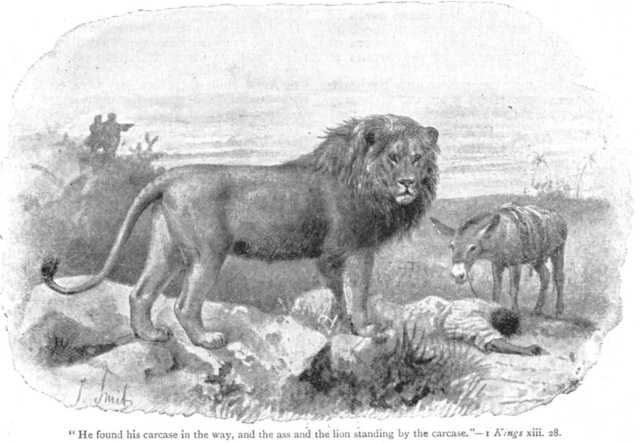
This time, Prophet #2 was truly speaking for the Lord, and his prophecy came true. Prophet #1 was attacked by a lion and died without honor, a disgrace.

A change of heart? (26-32)
Did Prophet #2 regret and repent of what he had done when he saw what happened to Prophet #1 and realized God’s word had come true? Had it not been for Prophet #2’s lies, Prophet #1 would have gotten safely home. Prophet #2 certainly seemed sorrowful, mourning Prophet #1’s death and requesting to be buried with him. He also supported and admitted the truth of God’s word that Prophet #1 had spoken to the altar.

Unhappily ever after (33-34, 2 Corinthians 7:10)
Second Corinthians 7:10 tells us:

For godly grief produces a repentance that leads to salvation without regret, whereas worldly grief produces death.

Think about Prophet #2’s remorse. Think about the remorse of Jeroboam earlier in the chapter, and consider these two verses. Which one do you think was experiencing “godly grief”? “Worldly grief?” While it certainly seems that Prophet #2 was exhibiting the “godly grief” this verse speaks of, we know from verses 33-34 that Jeroboam exhibited “worldly grief” back in the first part of the chapter with Prophet #1. He momentarily changed his behavior, but his heart did not change. He continued in sin and was ultimately destroyed.

Forgiveness, Hell, Justice, Old Testament, Salvation, Sin, Sunday School

Follow Up Week ~ Sunday School Lesson ~ 6-1-14

sunday school

These are my notes from my ladies’ Sunday School class this morning. I’ll be posting the notes from my class here each week. Click here for last week’s lesson.

Through the Bible in 2014 ~ Week 22 ~ May 25-31
Psalm 131, 138-139, 143-145, 127, 111-118, 37, 71-72, 94, 119:1-88; 1 Chronicles 26-29; 1 Kings 1-4; 2 Chronicles 1

Follow Up Week

Last week, we had a lot of great questions that I didn’t feel we had the opportunity to discuss thoroughly enough. This week we’re going to take an in depth look at three of those questions.

Follow Up: Zeruiah
Last week, we saw David repeatedly refer to Joab and Abishai as “sons of Zeruiah,” and a question arose as to what he meant by that. Was it an insult? An identifier? Here, briefly, is some clarifying information:

Zeruiah was David’s sister (1 Chronicles 2:15-16). Her sons were Abishai– one of the chiefs of David’s mighty men (1 Chronicles 11:20), Joab– commander of  David’s army, and Asahel (Asahel was murdered by Abner, commander of Saul’s army (2 Samuel 2:8), at the battle of Gibeon (2 Samuel 2:18-24). Abishai and Joab later took revenge on Abner for killing their brother (2 Samuel 3:24-30).)

images


Abishai, Joab, and Asahel were brothers and also David’s nephews. Therefore, calling them “sons of Zeruiah” may have had one of several meanings:

1. “Sons of Zeruiah” was just another way of saying “my nephews.” It is possible that this was to distinguish them from other men close to David who had the same names. (For example, in this week’s reading, we saw a man named Shimei (1 Kings 1:8, 4:18) who was a different person from the Shimei we studied about last week.) Adding such an identifier to someone’s name was common in biblical times before surnames were in general use (eg. Joshua son of Nun, Joseph of Arimathea, Jesus of Nazareth, etc.)

2. It is possible David had a close relationship with Zeruiah and had great respect for her. Perhaps when David called his nephews “sons of Zeruiah” he was reminding them to live up to their mother’s good character.

3. It is possible David had a contentious relationship with his sister and had little respect for her. Perhaps when David called his nephews “sonsof Zeruiah” when annoyed with them, he was implicitly saying, “What else can you expect when they had a mother like that?”

Since the Bible provides very little information on Zeruiah, we can’t definitively say why David would use this phrase; we can only speculate. Click here for more information on Zeruiah.


scales of justice

Follow Up: Shimei, David, and Solomon
Last week, we studied the story of Shemei cursing David, and David’s subsequent sparing of his life (2 Samuel 16, 19). This week, we saw the death of David and Solomon’s accession to the throne (1 Kings 1-2). We also saw David, from his deathbed, give instructions to Solomon regarding Shimei, and we saw how Solomon carried them out (1 Kings 2). Was David sinning by going back on his word to Shimei? Let’s take a look.

Two Different Justice Systems
In order to understand the dynamics of the situation between Shimei and David and Shimei and Solomon, we first have to step outside our 21st century United States understanding of “the justice system” and step back in time into the Old Testament monarchial justice system.

The American System:
In the American justice system, justice supersedes leadership and is a separate entity from leadership. We have the judicial branch of government (courts, judges, jails, lawyers, etc.) and the executive branch of government (the President, state governors, etc.). They each have their own powers and responsibilities, and, for the most part, are separate from, and not dependent on, one another. For example, if someone is acquitted of a crime during one person’s presidency, he cannot later be convicted of that same crime solely because someone else becomes President and thinks he should be convicted. (Obviously, there are exceptions and corruptions to this system, but, generally speaking, in a nutshell, this is how it is supposed to work.)

Old Testament Israel’s System: 
In Israel (and other monarchial or dictatorial nations), there was no separation of powers. Legislative (making the laws), judicial, and executive powers all resided in one man: the king. And, the rules could change every time a new king took over. Your verdict, conviction, and sentence lasted only as long as the reign of the king who handed them down unless the next king chose to honor those decisions. This is one of the reasons the death penalty and maiming (cutting off someone’s had for stealing, for example) were more prevalent during those times. If you were the king and wanted to make sure someone was punished long term and that your verdict would not be overturned, death or maiming were your main options.

Shimei’s Sentence (1 Kings 2:8-9, 2 Samuel 19:23, 1 Kings 2:36-46)
As we saw in this week’s reading in 1 Kings 2:8-9, David did not put Shimei to death himself or during his own reign. Additionally, because of the way Israel’s justice system worked, it would have been impossible for David to swear to Shimei that he would never be put to death, because David had no control over what the next king would do. David’s oath was only good for the duration of his own reign. Thus, he did not break the oath he made to Shimei in 2 Samuel 19:23.

David did, however, take full advantage of Israel’s system of justice, the fact that Solomon had made no such oath to Shimei and the fact that Solomon was his son and would be likely to do as he asked. In 1 Kings 2:8-9, David didn’t come right out and tell Solomon to execute Shimei, but he hinted pretty strongly at it.

Solomon, perhaps wishing to honor the spirit of David’s oath to Shimei in 2 Samuel 19, while still carrying out David’s desire in 1 Kings 2 that Shimei be punished, did not condemn Shimei to immediate death, but, rather, put him under “house arrest” (1 Kings 2:36-37). Shimei could not leave Jerusalem or he would be executed, but as long as he stayed in Jerusalem, he was free to live his life as he wished. Shimei agreed to this (2:38) and made an oath to the Lord that he would obey (2:43). Shimei could have lived out the rest of his life peacefully in Jerusalem if he had just abided by the rules of his sentence. He broke the rules; he knew the consequences (2:39-46).


deathbed-2

Follow Up: Can a Christian be forgiven for a sin he commits on his deathbed and doesn’t have the opportunity to repent for before dying? Will he go to hell for this? 
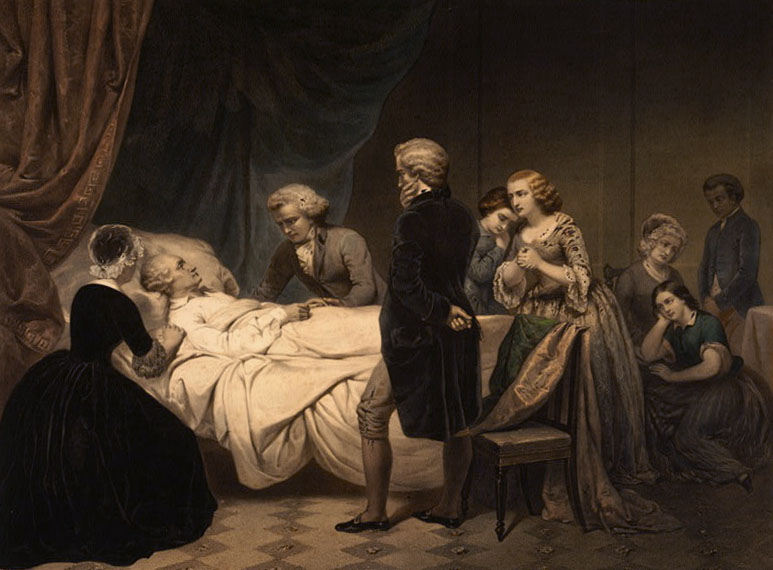
This question arose last week as we briefly touched on David’s deathbed instructions to Solomon regarding Shimei. Although it doesn’t appear that David was actually sinning in that particular case, this question is a very good one that I wanted to address more fully because it has application for all of us since we all sin and will all die one day. In order to answer this question, we need to take a look at several things regarding sin, forgiveness, and salvation.

The soteriology of the question (John 10:26-29, Romans 8:1-2, 33-39, 1 John 2:1-2) 
Soteriology is the field of theological study that deals with salvation: what it is, what it isn’t, and how it happens. We know that in order for a person to be saved and spend eternity in Heaven he must turn from his sin (repent), and place his faith in the death, burial, and resurrection of Christ on his behalf as payment for his sin.

John tells us that, for those who have truly been born again, no one is able to snatch them out of Christ’s or the Father’s hand. This includes Satan. Romans tells us (8:33-34) no one has the authority to condemn or to bring charges against God’s elect, because God is the one who has justified them and He has already said there is no condemnation for those who are in Christ Jesus (8:1-2). Satan no longer has the authority even if we sin, to drag us off to hell, and God has promised that he will not condemn us to hell if we are in Christ. And if/when we do sin, 1 John tells us that Christ has already stepped in between us and the wrath of God as our advocate, offering His righteousness on our behalf.

Bottom line: If you have truly been born again, God’s got you and there’s not anyone or anything that has the authority to change that.

The hamartiology of the question (Hebrews 10:11-14): 
Hamartiology is the study of sin. We sin before we’re Christians. We sin after we’re Christians. We will never be completely free from temptation and the effects of sin this side of Heaven. The truth is, unless you are capable of knowing every single sin in your life (Remember all those sins you committed when you were three? Neither do I.) and you die immediately after repenting of the last one, you’re going to die with unconfessed sin in your life. That’s pretty much every Christian. We sin so much that there are sins we don’t even realize or remember we’ve committed. How can you repent of something you’re not even aware of? So, no, a true Christian will not go to hell for failing to repent of an individual sin committed right before death.

As the old hymn says, “Jesus paid it ALL.” Hebrews tells us that Jesus died “once for all”– one time to pay for all sin, from the creation of the world until its destruction at the end of time. When we come to Christ for salvation, while we may repent of individual sins that are heavy on our hearts, what we are really doing is confessing that we are, and repenting for being, a sinner. If we had to repent of every individual sin no one could ever be saved because no one could remember all the sins he’s ever committed. For those who are in Christ, every sin in our entire lives, from birth to death, is forgiven.

Daily repentance and forgiveness:
So, if the sins we have forgotten about, and the sins we aren’t aware of, and the sins we don’t have a chance to repent for before dying are all forgiven anyway, why is any other sin any different? Why do we need to repent of our sin and ask for forgiveness every day when we pray?

Obedience (Matthew 6:12):
We do it out of obedience. Jesus tells us in the Lord’s Prayer to daily ask God to forgive us for sinning. So, we do.

Awareness and thankfulness (Psalm 32:1-2)
When we spend time in prayer daily repenting of our sin it reminds us of the greatness of God and His grace in forgiving our sin. It humbles us by reminding us of the great cost of our sin. It reassures us of God’s love and mercy towards us. It gives us an opportunity to give Him praise and thanks for forgiving us.

Restored relationship (1 John 1:6-9)
When we have unconfessed sin in our lives, it creates a rift (of our own making) between us and God. When we confess our sin to God and ask Him to cleanse us from it, that sin is no longer a hindrance to clean, unfettered communion with God.

If we say we have fellowship with him while we walk in darkness, we lie and do not practice the truth. But if we walk in the light, as he is in the light, we have fellowship with one another, and the blood of Jesus his Son cleanses us from all sin. If we say we have no sin, we deceive ourselves, and the truth is not in us. If we confess our sins, he is faithful and just to forgive us our sins and to cleanse us from all unrighteousness.

Obedience, Old Testament, Sovereignty of God, Sunday School

David and God’s Big Picture ~ Sunday School Lesson ~ 5-11-14

sunday school

These are my notes from my ladies’ Sunday School class this morning. I’ll be posting the notes from my class here each week. Click here for last week’s lesson.

Through the Bible in 2014 ~ Week 19 ~ May 4-10
1 Chronicles 13-18, 2 Samuel 5:11-9, Psalm 1-2, 15, 22-25, 47, 68, 89, 96, 100-101, 105, 132, 29, 33, 36, 39, 50, 53, 60, 75
David and God’s Big Picture

2 Samuel 7/1 Chronicles 17
This passage is the institution of the Davidic covenant: God’s promise to establish the throne of David forever through the eventual birth and reign of Jesus. God, in His sovereignty, had a plan that David was part of. A plan with farther reaching impact than just David’s life. But God’s call on David’s life was the same as His call on our lives: to love and serve Him faithfully wherever He has put us.

crown-and-thorns

2 Samuel 5:12
Right from the beginning of David’s reign, he recognized two very important things about his life that we should also recognize:

1. God is sovereign (1 Samuel 16:1-13, 1 Peter 2:9).
It was God who had made David king over Israel, not anything intrinsically worthy in David himself. Remember that when God chose David to be king back in 1 Samuel 16, David was just a shepherd in his late teens or early 20s. Nothing special. Just an average guy. In fact, God told Samuel not to pay attention to outward signs of “specialness” in David’s older brothers. He had his own reasons for choosing David.

In the same way, when God calls us out of darkness and into His marvelous light (1 Pet.) for salvation, it’s not because there’s anything intrinsically good in us. In fact, everything’s bad about us because we are drenched in sin. But for His own reasons, whatever they are, God has called us out to save us.

2. David’s life was not his own (1 Corinthians 6:19-20, Matthew 20:28)
The second half of this verse does not say that “David knew… that the Lord had…exalted his kingdom” so David would be happy or comfortable or have a life of purpose. God established David’s kingdom “for the sake of His people Israel.” While God certainly blessed David along the way, God is about God. His main objective is His plans, His purposes, and His glory, not our happiness and contentment. This, of course, doesn’t mean He doesn’t care about us individually—far from it!

blurry-sky-cross1 Corinthians tells us our lives are not our own because we were bought with a price (the blood of Christ). We no longer belong to Satan, slaves of our sinful natures, living to gratify our own desires, pawns in his plan of trying to thwart God’s will. We belong to God to use as He sees fit for His plans and purposes.

One of the pitfalls of the American mindset is that it has taught us to focus on ourselves as individuals, often to the exclusion of what is good for our neighbors, our community, our state, nation, and world. We think in terms of “my rights,” “my enjoyment,” and “How will this affect me?” (Just so you know, I’m not a communist or a socialist when it comes to government. I’m just talking about this “me-centered” mentality.) This crosses over into our Christian lives. We often get so focused on our own lives, what we think God is or isn’t doing in them or with them, and how whatever He is doing is affecting us personally, that we forget that God has a huge plan for the entirety of human history and the universe. Whatever He’s up to right now may be about someone else, not you or me. We need to be more aware of God’s “big picture.”

As with David, God gives us our authority and circles of influence for the good of others, to bless them and serve them, even as Jesus came, not to be served but to serve, and to give His life for others (Matt. 20). The good news is that when we are on board with this, we get something much better than fleeting things like earthly happiness and comfort. We get eternal joy, peace, and a glimpse of the glory of God as we obey and cooperate with His plan.

You can’t always get what you want (2 Samuel 7:1- 7, 1 Samuel 13:14)
Because our lives are not our own, cooperating with God’s big picture plans sometimes means that we don’t get to do what we want to do, even if what we want to do is good and godly.

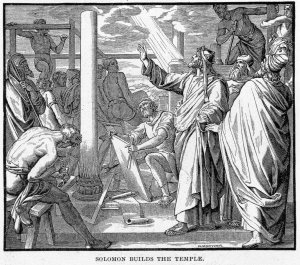
www-St-Takla-org--110--Solomon-Builds-the-Temple-3David was a “man after God’s own heart.” He loved the Lord and wanted to thank and honor Him by building Him a temple. What he wanted to do was an honorable and worshipful thing, and the motives of his heart were pure. But that was not the role God wanted David to play in the unfolding of His plan, nor was it the right time. The person God wanted to fulfill that part of His plan, at a later time, was Solomon.

As we discussed last week, seeking godly counsel is an important part of making godly decisions. David did this by consulting Nathan, the prophet. However, praying and asking for God’s guidance and wisdom is also essential before taking on something like building a temple, and both David and Nathan neglected to do so.

Graciously, even though they hadn’t come to God, God came to Nathan and explained things. God pointed out that in all this time, He had never asked anyone to build Him a permanent house. God had been just fine in a tent up to this point, and would be just fine until He decided it was time for Solomon to build the temple.

Sometimes, even if something is godly and part of God’s plan, He wants someone else to do it.

But you can always get what you need (2 Samuel 7:8-17, Luke 2: 26-33)
What David needed and what we need, is to be faithful and obedient to God wherever He has placed us. This doesn’t mean God will necessarily have us in the same place all our lives (though He might). After all, He took David from shepherd to warrior to king. But David served God faithfully in each of those positions for as long as God had him in those positions.

Ultimately, the role God wanted David to play in His plan was to be the king through whom God initiated the Davidic Covenant. Though David sought to build God a house, it was God who would build David a house (11, Luke 2). It would be an eternal house, first through his descendants who would be temporal kings, and, finally, through the Messiah, Jesus, who would reign forever and whose kingdom would know no end.

David’s Response (2 Samuel 7:18-29)

Humility (18-20)
David was overwhelmed by the fact that, though he wanted to do something big for God, God was going to do something big through him.

Exaltation (21-24)
David again recognized that it was God’s sovereignty that brought all this about, not his own awesomeness (21). He praised God’s greatness, holiness, and superiority to all else (22). He recounted God’s mighty deeds of the past and how He glorified Himself through His chosen people, Israel (23-24)

I’m in! (25-29)
David didn’t express doubt or hesitate to jump in with both feet. He didn’t whine that what he really wanted to do was build the temple. He embraced God’s plan obediently and joined in thankfully and wholeheartedly.

David glorified God for His “macro” plan (25-26) – the coming of the Messiah and everything leading up to it – and also for His “micro” plan (27-29) – realizing that if he cooperated with God’s plan, he and his family would be blessed along the way. Notice that David (29) did ask for God to bless his house and descendants, but not for personal/family gain. He asked that God would bless his family to fulfill and cooperate with God’s plan.

When God places us in any situation, whether blessing or hardship, our response should mirror David’s. We should be obedient to God, never stepping outside of His word to pursue things He doesn’t want for us, even if they seem godly. And, with humility and praise, we should embrace God’s plan, cooperating with Him joyfully.

What about all the non-Davids? (Exodus 12:37, Mark 7:37, 1 Thessalonians 4:9-12)
Sometimes when we read the Bible, we come to stories like David, Moses, Joshua, Noah, and Paul, and we can get the impression that God calls everyone to do great big things for Him as part of his plan. We tend to forget that when the Israelites left Egypt, there were likely 1.5 to 2 million of them. And only one Moses. By David’s time, there were likely several million Israelites. And only one David. What about the millions of Israelites who were born, grew up, got married, went to blue collar jobs every day, and died, having the-israelites-withoutlived lives of quiet faithfulness to God but never having had God make a covenant with them or being called to kill a giant or part a sea? Did God love them less? Value their love for Him less?

Why does God use some people in big, visible, fame-creating ways, and some in invisible ways? The answer, as is often the case when we’re dealing with God is, “I don’t know.” That’s one of the things that makes Him God and us not God. It’s his business, not ours. We trust that He does all things well (Mark 7) and that when He says that we are to “live quietly, and to mind your own affairs, and to work with your hands” (1 Thess. 4), He means it, and that lives of quiet faithfulness are precious in His eyes.


God has a plan. All of us who are His children have a part to play in that plan. Our part, whether big and visible or quiet and invisible, is to love and trust Him more each day and live obediently and faithfully wherever He places us.

Christian women, Faith, Old Testament, Salvation, Sunday School, Women

Rahab: From Floozy to Faithful ~ Sunday School Lesson ~ 3-30-14

sunday school

These are my notes from my ladies’ Sunday School class this morning. I’ll be posting the notes from my class here each week. Click here for last week’s lesson.

Through the Bible in 2014 ~ Week 13 ~ Mar. 23-29
Joshua 1-24
Rahab: From Floozy to Faithful

rahab-scarlet-thread

By faith Rahab the prostitute did not perish with those who were disobedient,
because she had given a friendly welcome to the spies.
Hebrews 11:31


Background- Joshua 1
Joshua 1 sets the stage for the story of Rahab and the spies. Moses had recently died, and God “promoted” Joshua to take his place. It was finally time for the Israelites to enter and take possession of the Promised Land. As God “installed” Joshua into his new position, He reminded Him:

  • Stay true to My word and you’ll be successful in what I command you to do.
  • Be strong and courageous (4 times in ch. 1); I will never leave you nor forsake you.
  • Here is the extent of the land I promised. I will keep my promise.

Cities had to be conquered, and first on the agenda was Jericho. Joshua began planning for the conquest by readying the people and by gathering intelligence about the city.

Joshua 2

Gathering Intel (1-2, 9-11, 24)
Do you remember one of the first stories we studied in which Joshua played a major role? He was one of the two spies in Numbers 13-14 who brought back a good report about taking the land of Canaan. I wonder if Joshua was thinking about that incident here, forty years later.

Joshua sent two spies, compared to the twelve who went to spy out Canaan, of which he was a part. Jericho was a much smaller area than Canaan, only two were needed, and a larger group would have been more easily discovered. Interestingly, unlike the story of Joshua and Caleb, we never discover the names of these brave spies who risked their lives and their reputations to bring back a good and faithful report. What did they find out and report back to Joshua about Jericho? (v. 9-11,24)

The Hiding Place (1-6)
Why would two nice, godly Jewish boys hide out in a prostitute’s house? Why not a nice, clean hotel? Well, first of all, they generally didn’t have hotels as we know them back then. When people traveled, they brought tents with them and camped out, stayed with friends or relatives, spent the night in the town square (Gen. 19:2), etc. And, sometimes, if it was immoral men traveling without their families, a prostitute’s house was a preferred option for a night’s lodging.

Rahab’s house would have been the perfect place for the spies 212wall_sketchto hide. They were foreigners, they were travelers, and it wouldn’t have been abnormal for them to be surreptitious (covering or disguising themselves) when entering and leaving her house. Plus, Rahab had men arriving and departing at all hours. Since she was a prostitute, many of the townspeople may have avoided her and her clientele, so it was probably the best option available for the spies.

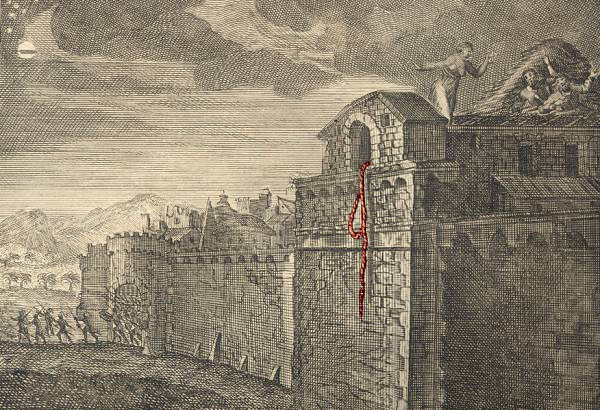
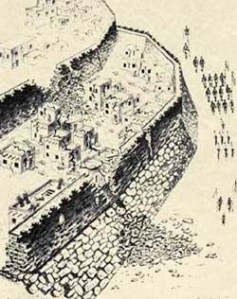
Rahab’s house was built into the city wall. At that time, kings of various cities/countries would regularly attack each other, so many cities were built like fortresses with tall, thick walls around them and gates that could be opened or closed. The back wall of Rahab’s house was also the city wall and had a window the spies could escape from. After the gates had been shut, there would have been no other way to get out of the city.

The Faith of the Spies (24)
The main focus of this story is, rightfully, on Rahab’s faith. But, what about the faith of the spies? These men, out of faithfulness to God, and loyalty to Joshua and Israel could have been tortured and killed had they been discovered. They stayed in the home of an unclean prostitute, which was a BIG deal. (Think back over all the clean/unclean laws we just studied.) They followed the instructions of someone who was: a) a woman, b) a prostitute, c) an enemy and an pagan, and d) had no military/spy experience of her own that we know of. (Although, perhaps, in her profession, she was skilled in hiding men who were being hunted down by people on the warpath). They found an impossibly heavily fortified city. There was no human way to successfully attack it. And still, they were confident in their trust that God would somehow keep them safe and give Israel the city.

The Faith of Rahab (9-13, Romans 1:19-20, 2:14-15)
Rahab was a pagan. How could she have had faith in God? How did she even know about Him? The Bible tells us that ALL human beings have a basic knowledge of God in two ways: through creation (Rom.1) and through our consciences (Rom.2).

But Rahab knew some other things, too. She knew how God treated His children and His enemies. She had heard what God had done at the Red Sea (10)—how God had protected His children and destroyed the Egyptians. She knew how God had defeated the kings of Sihon and Og (10). She knew that out of all the gods she had ever heard of, this One was the real thing- God of heaven and earth. She knew, and she was afraid. Her fear and her defection prove her faith. If she had not believed in who God was, and that He was able to do all these things she would have had no reason to be afraid, nor would she have helped the spies and aligned herself with them against her own people.

Rahab became so convinced in her mind that God was indeed who He had shown Himself to be that she gambled everything on it. Think of what the king would have done to her if she had turned out to be wrong and had gotten caught. At the very least, she would have been killed. but as a traitor, she certainly would have been made and example of. She probably would have been publicly tortured to death, and maybe her family too. This was no small thing she did. She bet her life on a God she didn’t know. That’s the faith that saved her and led her to hide the spies and her other actions. The actions did not save her, it was the overwhelming belief in God which drove those actions.

Two Different Faiths Then (John 4:22, Luke 10:21, Deuteronomy 32:39)
There is a qualitative difference between the faith of the spies and the faith of Rahab. As Jesus said to the woman at the well, “You worship what you do not know; we worship what we know, for salvation is from the Jews.” (John 4)

The spies were God’s people. They knew Him personally. They were born into God’s house and grew up as obedient sons. They were chosen by Him and belonged to Him. They had seen Him work as eyewitnesses. They had, and knew, His word. They would have been like the older brother in the prodigal son story if he had been faithful.

Rahab, on the other hand, had none of that. She was the prodigal. She did not know God personally, but only, as an outsider, by reputation. She likely knew nothing of God’s love and promised blessings for obedience, but only of His wrath towards sinners. She was not born into God’s house; she was a pagan. She was not an obedient son; she was a woman, and as sinful a woman as she could be. She was not chosen by God and did not belong to Him. She was an outcast. She had no idea what God might do next. All she knew was that she didn’t want to die.

The spies knew. God had laid it all out for them. They were obeying God, not out of fear, but out of love.

Two Different Faiths Now
Rahab’s faith versus the spies’ faith reminds me of unchurched people coming to Christ versus churched people coming to Christ. We “spies” who were raised in church by Christian families grew up knowing all the Bible Stories, all the whys and wherefores of Jesus and salvation. It is the blessing of a godly heritage.

Rahab, like the unchurched, lived her whole life not knowing God, just doing what sinners do. When she finally heard about Him, all she had was the basics, and, knowing only that He was “Lord of Heaven and earth” (Luke) and “able to kill and make alive” (Deut.), she flung herself unashamedly on His mercy—which, at the time, she probably wasn’t sure would catch a woman like her—all because she wanted to live instead of die.

The Object and Outcome of Our Faith (Joshua 6:17, 22-25, Matthew 1:5, James 2:25)
But no matter our background or how we come to faith in Christ—Rahab or spies, unchurched or churched—the object of our faith is what matters, and the object of our faith is Christ. And because the object of our faith is the same, the outcome of our faith is also the same.

What was the outcome of this whole scenario for the spies? For Rahab? They were saved despite the destruction all around them. After it was over, they all lived in the Promised Land together. Rahab and her family became part of God’s family just like the spies were. She even got to be one of Jesus’ great, great…grandmothers (Matt.), was commended in the “Hall of Faith” (Heb. 11, above), and was cited as an example of good works giving evidence of our faith (Jas.).

God loves the prostitute just like He loves the good little girls. He sent His precious Son to save both of us and to display us as trophies of His grace.

Additional Resources
The Walls of Jericho by Answers in Genesis