Basic Training, Evangelism

Basic Training: The Great Commission

For more in the Basic Training series, click here.

Have you ever heard the phrase “The Great Commission“? Do you know what it means? If not, you’re not alone…
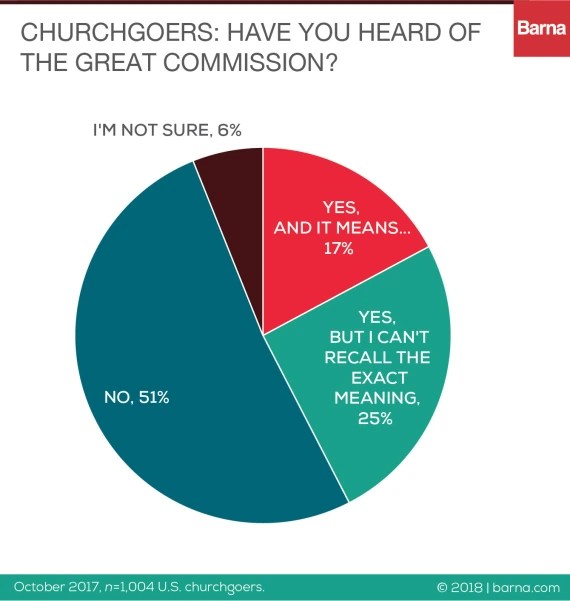
photo courtesy of barna.com

The Barna Group recently conducted a study asking churchgoers if they had previously “heard of the Great Commission.” In their report, 51% of Churchgoers Don’t Know of the Great Commission the results of the study were summarized thusly:

“…half of U.S. churchgoers (51%) say they do not know this term. It would be reassuring to assume that the other half who know the term are also actually familiar with the passage known by this name, but that proportion is low (17%). Meanwhile, ‘the Great Commission’ does ring a bell for one in four (25%), though they can’t remember what it is. Six percent of churchgoers are simply not sure whether they have heard this term ‘the Great Commission’ before.”

Now, if you know anything about statistics, you know how important it is to structure your questions carefully and get a representative sampling of the population you’re surveying in order to get the most accurate results. What does “churchgoer” mean? Is it possible people have never heard the term “The Great Commission” simply because churches don’t use this particular phrase any more? It’s important to take things like this into consideration because it affects the results of the survey. (You can find out more about Barna’s structuring process for this study at the end of the article linked above.) But even if the numbers of the Barna survey aren’t exact, I think it’s safe to say there are a lot of people out there in churchland who aren’t familiar with The Great Commission.

Just for fun, let’s see what the results would be if we surveyed readers of my blog:

The Great Commission refers to some of Jesus’ final words to the disciples before His ascension and is cited from Matthew 28:18-20:

And Jesus came and said to them, ‘All authority in heaven and on earth has been given to me. Go therefore and make disciples of all nations, baptizing them in the name of the Father and of the Son and of the Holy Spirit, teaching them to observe all that I have commanded you. And behold, I am with you always, to the end of the age.’

With these words Jesus commissioned the eleven remaining disciples to go out into the world and carry on His mission. Since every Christian is a disciple, or follower, of Christ, this is our commission from Him as well. Let’s examine what it says.

All authority in heaven and on earth has been given to Me.
Before commissioning his disciples, Jesus reminds them that everything He’s about to say is founded on and imbued with His authority. Jesus alone has the divine authority to establish the church and to dictate the way in which His church is to be set up and to grow.

We 21st century Christians would do well to keep forefront in our minds and hearts the authority of Christ over His church. There is no need for churches to “cast vision” or come up with mission statements. Christ is the head of the church and has already given us His vision for it. The Great Commission is His mission statement for the church.

Go therefore
“Therefore” in this little phrase refers back to what Christ has just said about His authority. In other words, because all authority in heaven and on earth has been given to Me, I am telling you to go.

“Go” is a very generic verb in English. We can “go” into the kitchen or we can “go” to the moon or we can “go” out and conquer the world. We can “go” anywhere from our own personal microcosm to the edges of the known universe. And that is the same sense the Greek word πορεύω captures: as you “go your way,” as you “go forth,” as you “walk”, as you “pursue the journey on which [you have] entered.” Wherever life takes us, whether it’s across the street or across the world, we go as ambassadors of Christ, carrying the good news of the gospel with us.

All nations
Revelation 7:9 tells us that God will save people from “every nation, from all tribes and peoples and languages.” So that’s who we share the gospel with as we go our way. Everybody. Regardless of where they’re from, what they look like, or how they talk. We are not to withhold the gospel from anyone, and we’re to make sure the church is proactively carrying the gospel to every populated geographical location on earth.

Make disciples…teaching them to observe all that I have commanded you
Notice the language Jesus uses here. He doesn’t say “make converts” or “make Christians”. He says “make disciples.”

Think about what the disciples did while Jesus was on earth. First, they answered His call to follow Him. Then, they began the journey of following Him wherever He went. He trained and equipped them day and night. They loved Him and worshiped Him. They imitated the things He did and said. They carried on His work after He ascended. Jesus is saying to the disciples, and to us, “Replicate yourselves. Make more like you.”

That means that the Great Commission starts with sharing the gospel with a lost person, but it doesn’t end there. There’s more to our mission than just evangelism. We are to train and equip Christians to follow Jesus daily, to love and worship Him, to imitate Him in obedience, and to carry on His work.

Baptizing them in the name of the Father and of the Son and of the Holy Spirit
After salvation, baptism is the first step a new Christian takes on the road of discipleship. It is not optional. Baptism publicly identifies a person – to the church and to the world – as a Christian, and is a personal pledge to follow Christ obediently all the days of one’s life.

Being baptized “in the name of the Father and of the Son and of the Holy Spirit” carries several layers of meaning.

💧Again, pay careful attention to the language in this phrase. Jesus does not say “in the nameS” – plural. He says, “in the name” – singular. This is a boldly Trinitarian statement directly from two of its members: Jesus, who spoke these words to the disciples, and the Holy Spirit, who breathed them out through the pen of Matthew. This is God Himself telling us who He is. Jesus spoke these words to good Jewish boys who were born and bred on the shema: “Hear, O Israel: The Lord our God, the Lord is one.” There was to be no confusion for new Believers back then, Believers today, or to the onlooking world, as to who these Christians are following. They are not following three different gods. They are following the one true God in three Persons: God the Father, God the Son, and God the Holy Spirit – the whole ball of wax.

💧Names meant far more in biblical times than they do to us today. We see God changing people’s names – Abram to Abraham, Jacob to Israel, Simon to Peter, etc. – when He commissioned them for a new mission or phase of life. Being baptized “in the name of” the Father, Son, and Holy Spirit echoes that tradition of God changing people’s names. You are no longer your own, you are Christ’s. You are no longer “Sinner”, you are “Saint”. You no longer go forth in your own name, but in the name of the Father, Son, and Holy Spirit as their emissary, endowed with the power and authority of God to live for Him and to proclaim the gospel to a lost and dying world.

💧Because Christians are, by definition, Trinitarians, and because baptizing a Believer is commissioning her to go forth into the world as a representative of Christ, it’s appropriate for pastors to take this verse literally when performing a baptism and verbalize its words: “I baptize you in the name of the Father, and of the Son, and of the Holy Spirit.”

Basic Training: Baptism

And behold, I am with you always, to the end of the age.
What a sweet promise, both to the disciples and to us today. Obediently following Christ in our daily lives, sharing the gospel, and making disciples can be lonely, exhausting, and discouraging at times. But we don’t have to do it alone, and we don’t have to do it in the flesh. Christ is with us and He knows all too well how hard it can be. God has given the Holy Spirit to indwell and empower Believers to live for Him and to carry out The Great Commission.

Additional Resources

What is the Great Commission? at Got Questions

The Great Commission by John MacArthur

The Great Commission by Burk Parsons

Wednesday's Word

Wednesday’s Word ~ John 14

10986473_948035321904069_479617570637935784_n

John 14

Let not your hearts be troubled. Believe in God; believe also in me. In my Father’s house are many rooms. If it were not so, would I have told you that I go to prepare a place for you? And if I go and prepare a place for you, I will come again and will take you to myself, that where I am you may be also. And you know the way to where I am going.” Thomas said to him, “Lord, we do not know where you are going. How can we know the way?” Jesus said to him, “I am the way, and the truth, and the life. No one comes to the Father except through me. If you had known me, you would have known my Father also. From now on you do know him and have seen him.”

Philip said to him, “Lord, show us the Father, and it is enough for us.” Jesus said to him, “Have I been with you so long, and you still do not know me, Philip? Whoever has seen me has seen the Father. How can you say, ‘Show us the Father’? 10 Do you not believe that I am in the Father and the Father is in me? The words that I say to you I do not speak on my own authority, but the Father who dwells in me does his works. 11 Believe me that I am in the Father and the Father is in me, or else believe on account of the works themselves.

12 “Truly, truly, I say to you, whoever believes in me will also do the works that I do; and greater works than these will he do, because I am going to the Father. 13 Whatever you ask in my name, this I will do, that the Father may be glorified in the Son. 14 If you ask me anything in my name, I will do it.

15 “If you love me, you will keep my commandments. 16 And I will ask the Father, and he will give you another Helper, to be with you forever, 17 even the Spirit of truth, whom the world cannot receive, because it neither sees him nor knows him. You know him, for he dwells with you and will be in you.

18 “I will not leave you as orphans; I will come to you. 19 Yet a little while and the world will see me no more, but you will see me. Because I live, you also will live. 20 In that day you will know that I am in my Father, and you in me, and I in you. 21 Whoever has my commandments and keeps them, he it is who loves me. And he who loves me will be loved by my Father, and I will love him and manifest myself to him.” 22 Judas (not Iscariot) said to him, “Lord, how is it that you will manifest yourself to us, and not to the world?” 23 Jesus answered him, “If anyone loves me, he will keep my word, and my Father will love him, and we will come to him and make our home with him. 24 Whoever does not love me does not keep my words. And the word that you hear is not mine but the Father’s who sent me.

25 “These things I have spoken to you while I am still with you. 26 But the Helper, the Holy Spirit, whom the Father will send in my name, he will teach you all things and bring to your remembrance all that I have said to you. 27 Peace I leave with you; my peace I give to you. Not as the world gives do I give to you. Let not your hearts be troubled, neither let them be afraid. 28 You heard me say to you, ‘I am going away, and I will come to you.’ If you loved me, you would have rejoiced, because I am going to the Father, for the Father is greater than I. 29 And now I have told you before it takes place, so that when it does take place you may believe. 30 I will no longer talk much with you, for the ruler of this world is coming. He has no claim on me, 31 but I do as the Father has commanded me, so that the world may know that I love the Father. Rise, let us go from here.


The Holy Bible, English Standard Version Copyright © 2001 by Crossway Bibles, a division of Good News Publishers.


Questions to Consider:

1. Who is speaking, and who is being spoken to in this chapter?

2. What does it mean that “no one comes to the Father except through” Jesus? (verse 6) What does this mean for followers of religions which exclude Jesus or do not have a correct, biblical understanding of who Jesus is?

3. Some people say that Jesus was only a man and never claimed to be God. Does this chapter support or refute this idea? Which verses would back up your answer?

4. Does verse 14 mean that God will give you anything you ask for in prayer as long as you say the phrase “in Jesus’ name” when you ask for it? What does it mean to ask for something in Jesus’ name?

5. According to verses 15, 21, 23, and 24, what is the evidence that someone truly loves Christ as she claims to?

Church, New Testament, Sunday School

The Last Supper~The Lord’s Supper ~ Sunday School Lesson ~ 11-16-14

Last Supper

These are my notes from my ladies’ Sunday School class this morning. I’ll be posting the notes from my class here each week. Click here for last week’s lesson.

Through the Bible in 2014 ~ Week 46 ~ Nov. 9-15
Matthew 26-28, Mark 14-16, Luke 22-24, John 13-21
The Last Supper ~ The Lord’s Supper

Last week we took a look at the last act of Jesus’ public ministry, the woes to the Pharisees. Today, we’re studying the last act of His private ministry to His disciples–the Last Supper, and with it, the institution of the Lord’s Supper for the church.

Mark 14:12-16
It was time for the annual celebration of Passover. As you will recall, the Passover pointed to Christ and was fulfilled in Christ. As the Passover celebrated God’s people being released from the bondage of slavery to Egypt, the Lord’s Supper celebrates Jesus releasing the Christian from bondage to the slavery of sin. As the Passover lamb was slaughtered and the blood applied to the wooden doorposts so death would not come to that house, Jesus, the Lamb of God, was slaughtered and bled on a wooden cross, so that if His blood is applied over the doors of our hearts, we will not suffer eternal death.

That’s why, as Christians, we now observe the Lord’s Supper instead of the Passover. For us, the Passover has been fulfilled in Christ. But for the disciples, on that night, it had not yet been fulfilled. So they began by celebrating the last Passover and ended by observing the first Lord’s Supper. It was a bridge between the old covenant and the new.

Peter and John (they’re mentioned by name in Luke 22:8) went into town, found the man whose house they were to use, and began to prepare the Passover meal. From the notes on verse 12 in my MacArthur Study Bible*:

After the lamb was slaughtered and some of its blood sprinkled on the altar, the lamb was taken home, roasted whole, and eaten in the evening meal with unleavened bread, bitter herbs, charoseth (a paste made of crushed apples, dates, pomegranates, and nuts, into which they dipped bread), and wine.

Luke 22:14-20
The end of the Passover (14-18)
This passage begins with the last Passover. Jesus will not partake of the Passover again until Heaven, after His death, burial, and resurrection have fulfilled it. Here, Jesus brings the old (Law) covenant and Passover to a close. For the last time, the first of the four cups of Passover, the cup of thanksgiving, is passed around. It is an appropriate time for the disciples to look back and give thanks to God for His good Law, and His love, kindness, care, and patience with His covenant people. It is also a time to look forward and give thanks -although the disciples don’t yet understand it- for the sacrifice Christ is about to make to atone, not only for their sin, but for the sin of all those who will come to trust in Him.

A New Meal (19-20)
With the breaking and blessing of the bread, a new ordinance is born for the church, the Lord’s Supper. The bread represents Christ’s body. (It does not actually or materially become Christ’s literal flesh, and the wine does not become His literal blood, as the false teaching of transubstantiation posits. Christ’s words are a metaphor, the same as when He said, “I am the door,” or “I am the bread that comes down from Heaven.”) He breaks it, as his physical body will soon be broken. He breaks it for his disciples, as his physical body will be broken for all future disciples. He gives the broken bread to His disciples -they did not take it themselves or earn it- as Christ gives life to Christians without any work on our part to earn or merit it.

In verse 20, Jesus likewise gave His disciples what had been the third cup of Passover, the cup of blessing. And what a blessing it was! Christ’s blood, shed for the remission of our sins. It represented the new covenant of grace– trusting in Christ’s death, burial, and resurrection as payment for our sin for right standing with God, rather than looking ahead to Messiah with the keeping of ceremonial Law.

1 Corinthians 11:23-34
Flash forward a couple of decades from the upper room to the church at Corinth. This church had allowed sin to corrupt their observance of the Lord’s Supper so much that Paul said (20) could no longer rightfully be considered “the Lord’s” supper. In verses 23-34, he sets about to instruct them on the proper way to come to the Lord’s table. Because this is an instruction to the church, we also draw upon this passage to learn how we should conduct the Lord’s Supper today.

A few implicit things to understand
First Corinthians is a letter to the church at Corinth. The church consisted of baptized Believers. Paul was not instructing lost people on receiving the Lord’s Supper. Lost people partaking in the Lord’s Supper would not have made any sense (then or now) because it was the celebration of the new covenant between God and His new covenant people, Christians. Lost people are not part of that new covenant. Their participation in the Lord’s Supper is sort of like an unmarried man and woman hooking up and having sex versus a man and woman getting married and then celebrating and consumating their marriage covenant by having sex.

The Lord’s Supper is not a lucky charm or magic wand that takes care of spiritual problems. Partaking of the bread and wine (or juice) will not save anyone who is unsaved. It is also not some sort of spiritual “booster shot” that imparts righteousness, grace, forgiveness, or holiness to the person who partakes, nor does it somehow supernaturally protect a person from demons or life’s negative circumstances. Neither does it prove that a person who claims to be a Christian is actually saved. It is simply an outward celebration of salvation by those who have already been saved.

Because the Lord’s Supper is a church ordinance, it is to be celebrated by the gathered body of the church (not at home {unless the church is meeting in a home} or somewhere else by individuals, families, groups of friends, etc.) and presided over by the pastor and elders or deacons of the church. Since it is not salvific and does not impart any kind of spiritual “good luck” there is no need to partake of it outside the meeting of the church body. It is a church celebration.

23-26– Paul sums up the gospels’ accounts of the institution of the Lord’s Supper by Jesus, relating that it commemorates Christ’s death for His people, and reminding us that it is a celebration of the new covenant of God with Believers through Jesus. He also says that when we, as a body of Believers, celebrate the Lord’s Supper, it is a picture of the gospel to the lost, so that they might come to know Christ as Savior.

27-32– We are not to underestimate the seriousness and solemnity of the Lord’s Supper. Once again, I think the notes on these verses in my study Bible* say it better than I could:

“In an unworthy manner” means ritualistically, indifferently, with an unrepentant heart, a spirit of bitterness, or any other ungodly attitude.

To come to the Lord’s Table clinging to one’s sin does not only dishonor the ceremony, but it also dishonors His body and blood, treating lightly the gracious sacrifice of Christ for us. It is necessary to set all sin before the Lord, then partake, so as not to mock the sacrifice for sin by holding on to it…

When believers do not properly judge the holiness of the celebration of Communion, they treat with indifference the Lord Himself- His life, suffering, and death…The offense was so serious that God put the worst offenders to death, an extreme but effective form of church purification. (Keep in mind, these are Believers, not lost people, we’re talking about, here.)

Believers are kept from being consigned to hell, not only by divine decree, but by divine intervention. The Lord chastens to drive His people back to righteous behavior and even sends death to some in the church to remove them before they could fall away.

The Lord’s Supper is a big deal. We are not to be flippant about it. Christians are to approach His table in reverence, awe, and gratitude for the extreme sacrifice God made through Christ to rescue us from hell. While it is not for unbelievers to participate in, it is a beautiful picture of the gospel to them, and a reminder to us -as individuals and the body of Christ- of just how much our sin and reconciliation to God cost Jesus. As often as we do it, let’s do it in remembrance of Him.


If you’d like to read more about the Lord’s Supper and the ins and outs of observing it in the church today, check out Joe Thorn’s excellent series of articles (they are brief and easy to understand), The Lord’s Supper:

For Sinners
Open or Closed?
Fencing the Table
A Means of Grace
Only in the Assembly
Sip It, Don’t Dip It
How Often?
Wine or Welch’s?

*Quotes taken from The MacArthur Study Bible, English Standard Version, Crossway Publishers, Wheaton, Illinois, 2010.

Wednesday's Word

Wednesday’s Word ~ Matthew 28

10671419_771108452935926_7529311326555323822_n

Matthew 28:

Now after the Sabbath, toward the dawn of the first day of the week, Mary Magdalene and the other Mary went to see the tomb. 2 And behold, there was a great earthquake, for an angel of the Lord descended from heaven and came and rolled back the stone and sat on it. 3 His appearance was like lightning, and his clothing white as snow. 4 And for fear of him the guards trembled and became like dead men. 5 But the angel said to the women, “Do not be afraid, for I know that you seek Jesus who was crucified. 6 He is not here, for he has risen, as he said. Come, see the place where he lay. 7 Then go quickly and tell his disciples that he has risen from the dead, and behold, he is going before you to Galilee; there you will see him. See, I have told you.” 8 So they departed quickly from the tomb with fear and great joy, and ran to tell his disciples. 9 And behold, Jesus met them and said, “Greetings!” And they came up and took hold of his feet and worshiped him. 10 Then Jesus said to them, “Do not be afraid; go and tell my brothers to go to Galilee, and there they will see me.”

11 While they were going, behold, some of the guard went into the city and told the chief priests all that had taken place. 12 And when they had assembled with the elders and taken counsel, they gave a sufficient sum of money to the soldiers 13 and said, “Tell people, ‘His disciples came by night and stole him away while we were asleep.’ 14 And if this comes to the governor’s ears, we will satisfy him and keep you out of trouble.” 15 So they took the money and did as they were directed. And this story has been spread among the Jews to this day.

16 Now the eleven disciples went to Galilee, to the mountain to which Jesus had directed them. 17 And when they saw him they worshiped him, but some doubted. 18 And Jesus came and said to them, “All authority in heaven and on earth has been given to me. 19 Go therefore and make disciples of all nations, baptizing them in the name of the Father and of the Son and of the Holy Spirit, 20 teaching them to observe all that I have commanded you. And behold, I am with you always, to the end of the age.”


The Holy Bible, English Standard Version Copyright © 2001 by Crossway Bibles, a division of Good News Publishers


Questions to Consider

1. What is the purpose of the book of Matthew? Which genre(s) of biblical literature (prophecy, epistle, narrative, wisdom, etc.) is the book of Matthew? What is the historical backdrop for this book?

2. What is the setting for Matthew 28? Briefly describe the events that led up to this chapter. How might the events of this chapter have been different if the women and the disciples had understood and/or believed Jesus the numerous times He told them He would die and rise again?

3. Compare and contrast the way the angel presented himself to the guards (unbelievers) (2-4) with the way he presented himself to the women (believers) (5-7) and the reaction to the angel by the guards (4) and by the women (8). What did the angel tell the women that he didn’t tell the guards? Why didn’t the angel tell the guards not to be afraid, or explain to them what was happening? What was the women’s reaction to encountering Jesus? (9-10) Did the guards get to see Jesus? Why is it good and right for unbelievers to be fearful and hopeless when encountering God, but for Believers to be joyful and reassured when encountering God?

4. Who was the guards’ employer – the Roman government or the chief priests? Yet, to whom did the guards report back after the resurrection? (11) What does 11-15 tell us about how deeply enmeshed the leaders of God’s people had become with pagans? Apply these passages to this relationship between the Jewish leaders and the Roman leaders. What does all of this teach you about your own life? Do you have any yokings (close partnerships or intimate relationships) with unbelievers that you need to reevaluate?

5. Notice the sequence of 16-20: Obedience (16) >> Nearness to Jesus (17a) >> Worship (17) >> Being sent out and used by God to further His Kingdom (18-20). How does this demonstrate the principle of “faithful in little, faithful in much“? What if one of the disciples had decided not to go to the mountain (16)? What would he have missed as a result of his disobedience? How does obedience to Christ draw us nearer to Him, which then fuels our worship of Him? Why should ministry work always be founded on worship?

Why was it important for Jesus to announce His authority (18) before commissioning the disciples (and by extension, all future disciples, including us today)? Does anyone else – pope, pastor, priest, etc. – have the authority to create, establish, or declare the mission of the church and individual Christians? What is the mission of the church and individual Christians? (18-20) Are you carrying out this mission? Is your church?

New Testament, Sanctification, Sunday School

Persecution 101 ~ Sunday School Lesson ~ 10-19-14

persecution101

These are my notes from my ladies’ Sunday School class this morning. I’ll be posting the notes from my class here each week. Click here for last week’s lesson.

Through the Bible in 2014 ~ Week 42 ~ Oct. 12-18
Matthew 8:14-11:30, 12:22-14:36, Luke 8:1-9:17, 11, Mark 4-6, John 6
Persecution 101

Last week we took a look at this pattern:

God—>God calls and trains His people—>God’s people minister the gospel to others

We saw it across various contexts of the Bible: the “macro,” or overall theme from Old Testament to New, the “micro,” or the way God works in our personal lives, and the “messianic,” or the way this pattern applied to Jesus’ own life. This week’s reading was another example of this pattern, the “ministerial,” or the way it applied to Jesus’ and the disciples’ ministry.

In this week’s reading we saw that Jesus’ ministry started with Jesus, Himself. Next He called out and trained His disciples through many parables and healings. Today, we will be looking at the passage where He sends them out to minister the gospel to others. In His final training session before Jesus sends out the twelve, He wants to make sure they’re ready for what they’re about to face.

Matthew 10:16-39

Go Ye Therefore- 5-13 (10:7-8, 5-6, Mark 1:14-15, Isaiah 35:5-6)
Jesus is sending out the disciples. What is He sending them out to do? Verses 7-8 tell us that their ministry was two-fold: first, they were to preach, just as Jesus did (Mark 1):

the kingdom of God is at hand; repent and believe in the gospel.

Second, they were to perform various signs and wonders. Notice that the signs and wonders are secondary to the message of the gospel. Wasn’t the gospel enough? What was the purpose of the miracles? When Jesus perfomed miracles, the miracles were both a fulfillment of prophecy (Is.) to help the Jews to understand that He was the promised Messiah, and they also authenticated His message of the gospel to the gentiles and others who weren’t familiar with the prophecies. Street cred, in other words– if He can do that, what He says must be true, and we’d better listen. The miracles the disciples were to perform were to serve the same purpose– to point to Jesus as the Messiah and to give credibility to the gospel message.

Who were the disciples sent to? Jesus told them not to go to the Samaritans (half Jew, half gentile, as we studied last week) or the gentiles, but “rather to the lost sheep of the house of Israel.” Why? Because He didn’t love gentiles and want them to hear the gospel? Not at all. We saw last week that He had already been to a Samaritan village to preach the gospel. And, of a Roman centurion (a gentile) whose servant He healed, Jesus said, “Truly, I tell you, with no one in Israel have I found such faith,” and went on to say- to an audience of Jews- that there were many gentiles who would make it to Heaven while many Jews would not.

Jesus sent the disciples to the Jews because that was the order God had ordained- first the Jews, then the gentiles. Why?

1. His promise was to the Jews, not the gentiles. God had promised that the Messiah would come through the Jews and to the Jews. All of Jewish history and ceremony had been pointing to this moment in time. God had been laying the ground work through types and shadows and prophecy for millenia. It was only right that Messiah should be revealed to them first.

Imagine if you’ve been promising your child since the day he was born that when he turned 16 you’d buy him a car. Over the years you talked about it together, looked at pictures, visited car lots, and finally picked out the perfect one. Then, on the day of your son’s 16th birthday, you run into a random 16 year old on the street and buy him a car first. Even if you immediately thereafter drove your son to the car lot to buy him his car, would that be the right way to do things?

2. At this point in history -Jesus’ earthly ministry through the birth and spread of the church- we’re looking at very rapid Kingdom growth. Teachers and preachers are going to be needed, like, fast, to shepherd these thousands of new Christians, most of whom are clueless gentiles.

If you work at a computer company and you’re launching a completely new type of software that you want to make accessible to as many people as possible as fast as possible, are you going to hire field representatives who have a professional background in computers or someone who’s never used a computer before?

Same idea here. The Jewish people already had a background in “messiah-ology.” Once saved, they could be up and running as teachers and pastors much faster than your average gentile.

Good News, Bad News- 14-25 (John 3:19)
God is sending out His people (the disciples) to tell His people (the Jews) that He has kept His promise and sent Jesus, the long awaited Messiah. Plus, they’re going to heal a bunch of people and do other miracles. What Jew in his right mind wouln’t be overjoyed at this awesome news, right?

So, what’s all this stuff about the disciples being hated and persecuted and charged with criminal activity? That’s not the way people usually respond to someone who’s bringing them good news. But God’s news isn’t good news when you don’t love God, and these Jews didn’t. That’s why Jesus referred to the people He was sending the disciples to as “lost sheep.” They were just as lost as any gentile.

1. They loved darkness rather than light (Jn.). The good news of the gospel is bad news when you love your sin and don’t want to give it up, because the gospel requires us to forsake our sin -all of it- actually admit that we’re scum, and fling ourselves on the mercy of Christ for forgiveness. It’s only by the gift of God’s grace that we’re able to do that.

2. They wanted the idol-messiah they had fashioned in their minds, not the Messiah of Scripture. Many in Israel were expecting and/or hoping for a messiah who would come in, conquer Rome, sit on David’s throne, re-establish the theocracy of Israel, and bring them back to prominence and prosperity. In other words, just like the woman at the well from last week, they wanted the temporal stuff, not the eternal. A Christ who would set them free from Rome and poverty, not a Christ who would set them free from sin.

That’s why, to many people the disciples preached to, the good news was bad news.

Fear Not- 26-39
Jesus is delivering a pretty sobering message here. When the disciples preach the gospel (now, and in the early church era), they’re going to be: shunned (14), turned over to the courts (17), flogged (17- and they’re not too far from seeing this happen to Jesus), dragged in front of kings and governors (17), betrayed to the enemy by family members (21), hated by all (22), fleeing for their lives (23), slandered (25), executed (28), and alienated from their closest family members (35-36). That’s a tough row to hoe, but Jesus wants them to understand that what many of the Jews are expecting -Messiah will re-establish the kingdom of Israel and bring peace (34)- isn’t reality, and when they tell people that, things are going to get ugly. He hasn’t come to bring earthly peace, instead, standing with Christ will be the hardest thing they’ve ever done.

But what is their response to this persecution supposed to be? Are they to give up, retaliate, cower? No, Jesus tells them to do two things:

1. Don’t be afraid of them (26). The worst thing they can do is kill you. If you’re going to be afraid of something, fear God and fear denying Him (28).

2. As long as you’ve got breath in your body, you preach the gospel. You preach it loud and you preach it long (27). Do. not. stop. no matter what.

Why? Because God loves you. He values you. He’s going to take care of you. And He’s in control.

The Demands of Discipleship Today
There are Christians today in countries like North Korea, Syria, Iraq, Nigeria, and other areas, who understand all too well what Jesus was warning the disciples about. They experience the same things on a daily basis. Those of us born in America have very little grasp of just how blessed we are to be able to worship God openly, freely, and without much real persecution.

But the times, they are a-changin’. Fast.

If you’ve been paying attention to the news over the last couple of years, you’ve seen stories about the Bible, prayer, and Christianity being systematically removed from and prohibited in public places. We’ve seen Christian bakers, photographers, and t-shirt company owners sued for declining to provide their services for homosexual “weddings,” rallies, and other events. Just last week, we saw Houston officials subpoena sermons and other materials from pastors in an effort to bully them into silence about their homosexual agenda.

Real persecution is coming to America at breakneck speed. And in the same way that the disciples were persecuted by both gentiles and the “lost sheep of Israel”, we will face persecution by both the world and those who claim the name of Christ, but actually follow a messiah-idol of their own making. Those of us who stand with the true Christ of Scripture and His word will be shunned and rejected by our closest family members- even those who claim to be Christians. We will be hated and slandered. We will be arrested, prosecuted, and even executed by both lost people and church people.

But Christ’s message to us is the same as it was to the twelve. Keep preaching the gospel. Preach it loud, preach it long, and preach it with your dying breath. Love Me more than your family, more than your reputation, more than your very life, because I care for you. How could we fail to stay true to Him after all He has done for us?