This article is kept updated as needed.

I’ve noticed that false doctrine is not just restricted to sermons, conferences, and Bible studies, but that I have to watch out for it in the contemporary Christian music (CCM) I listen to as well. Are there any CCM groups, artists, or songs I should avoid? Can you recommend any specific doctrinally sound artists or groups?
You’re absolutely right that we need to be careful about what we listen to that wears the label “Christian.” There is a lot of beautiful, doctrinally sound, theologically rich music of all genres out there, and there’s a lot of junk as well.
I’d like to offer a couple of caveats before diving into the answer for this question:
1. I plead extreme ignorance when it comes to CCM. With rare exception, it’s not a genre I enjoy, I don’t listen to it, and the worship service I attend uses “traditional” (mostly hymns) music, so I’m not often exposed to it. I’m all in favor of doctrinally sound CCM for those who like that genre, it’s just not my personal cup of tea or an area I research.
So, in this article I’m going to tell you what little I know, point you to people and resources better equipped to answer this question, and lean heavily on you discerning CCM listeners for help (more on that in a bit).
2. There is lousy theology in every genre of music. There are lousy hymns, lousy Christian rap, lousy CCM, lousy gospel, lousy Southern gospel, etc. This question was asked specifically about CCM, so that’s what the answer is going to focus on. It’s not a debate about hymns or exclusive psalmody versus CCM.
3. Depending on music from currently popular musicians is a lot like depending on Bible studies from currently popular evangelical authors. The majority of them aren’t doctrinally sound, and even the few that are seem to be apostatizing at an alarming rate. My recommendation to churches? Either go back to using tried and true doctrinally sound hymns, sing the Psalms, or find some talented musicians and lyricists in your own (doctrinally sound) church and put them to work writing songs for your worship service.
Why is it important to be discerning about Christian music? Because the music we use in church and listen to at home teaches us theology, and it sticks in our memories (which is why a lot of Scripture memory programs set Bible verses to music to help with memorization). You probably couldn’t recite verbatim a quote from last Sunday’s sermon, but I’ll bet you know the lyrics of a lot of songs by heart. It’s important that those lyrics contain good theology.
It’s imperative for churches to be discerning about the CCM they use in worship. If Jane Churchmember hears a CCM song in church and likes it, she’s likely to Google the song (probably right there in church- I’ve done it!), find out who sings it, and begin following that artist. Worship pastors who use CCM have a responsibility to vet the artists who perform the songs they select for the worship service to make sure they’re not sending Jane into the arms of a heretic. Additionally, music costs money, and you don’t want your church’s offerings supporting false doctrine.
Now, every time I address the subject of being discerning about worship music and that churches should not use worship music from heretical sources (such as Bethel, Hillsong, and Elevation, see below) someone who’s defending using music from these heretical sources will invariably pipe up with this well worn canard1:
Well, [insert name of hymn writer here] wrote lots of perfectly biblical hymns, but he had some theological problems too, and you’re not recommending we get rid of all of his hymns.
Well, first of all, maybe we should more closely examine the theology of some of our most prolific hymnists and stop using their music because of what they believed. Quick – off the top of your head, name the three we should start with…
…And that’s what separates the errant hymnist from Bethel, et al. Most Christians, even those who prefer hymns over CCM, could probably not name three people who wrote hymns, let alone tell you anything about their theology. But if you ask the average Christian to name three top Christian artists, she could rattle them off in a second.
Most hymn writers have been dead for up to hundreds of years. They don’t have Facebook pages you can follow, nobody’s playing their stuff on KLOVE, they’re not on tour to promote their latest album, they don’t have thousands of followers worldwide, and their music is in the public domain, so your church isn’t financially supporting them or their work. If you wanted to follow their errant theology, you’d have to hit the books to research and study it. Contemporary musicians’ theology is only a click away on YouTube, social media, live streamed concerts and conferences, and on their web sites. Nobody is following dead hymnists’ false doctrine, but hordes are following contemporary musicians’ heresy.
🔴Artists to Avoid
Cory Asbury
Audrey Assad (Catholic)
Ray Bolz (homosexual)
Bethel Music
Lauren Daigle
Elevation Music
Charity Gayle
Amy Grant (homosexuality affirming)
Hillsong
Jesus Culture
Kari Jobe
Jennifer Knapp (homosexual)
Brandon Lake (close ties with Bethel, Maverick City Music {see below})
Matt Maher (Catholic)
Maverick City Music (woke, homosexuality affirming, partners with Elevation)
Nichole Nordeman (Nichole has extensive ties to a plethora of false teachers and was recently very vocal in her support of Jen Hatmaker’s embrace of homosexuality in the church.)
Michael Tait
Phil Wickham (in the NAR camp, close ties to Bethel)
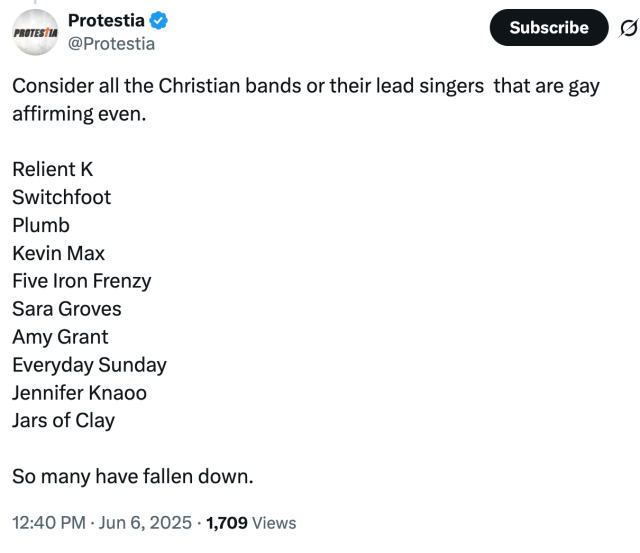
And anyone else who closely associates with any of the above (performing together, co-writing songs, Bethel Music produces their albums, etc.)
Let’s Talk About the Worship Music at the [Charlie Kirk] Memorial Service… with Dawn Hill
🟡Artists I Don’t Proactively Recommend (i.e. Use Caution or Avoid)
Casting Crowns has toured with Hillsong. Hillsong – not CC – pulled out of their 2022 tour due to the scandals with Brian Houston.
CityAlight is the music ministry of St. Paul’s Anglican Church, which occasionally allows women to preach and has a few ties to Hillsong (covering Hillsong songs, also this video was recorded at Hillsong studios, see info. section).
Selah member, Todd Smith, is the husband of Angie Smith.
Shane and Shane uses mostly Bethel, Hillsong, and Elevation music (along with music by other problematic artists) in their Worship Initiative ministry. They have also performed with Bethel.
Doctrinally Sound Artists:
The Corner Room
Keith and Kristyn Getty*
Hymnology
Indelible Grace Music
Brian Sauvé
Sovereign Grace Music
*(January 2021- Keep an eye on the Gettys. They’re still doctrinally sound as far as I know, but over the past couple of years, they have been platforming some biblically problematic personalities at their events. Jon Harris discusses this on the Russell Fuller reveals more, The Getty’s invited who?, & SEBTS prof. takes on The Gospel Coalition episode of Conversations that Matter, ~28:04)
There are probably many others that belong on all three of these lists, but those are the only names I personally know to give you.
Owen Strachan recently made some recommendations of songwriters, though they’re not all contemporary, on Twitter: (others also responded with suggestions, click here to see):
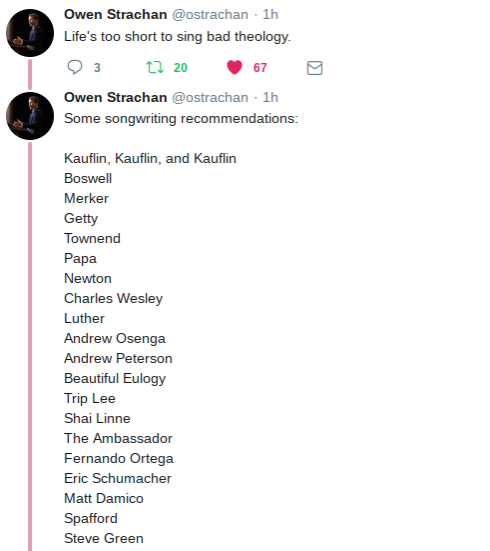
(I’m not familiar with all of these, but in case you need their first names to look them up: Bob Kauflin, Stuart Townend, Matt Papa, John Newton, Martin Luther, Horatio Spafford.)
You will, of course, need to vet for yourself the theology and associations of any musician or group you decide to follow. It’s not quite the same as vetting a teacher or pastor, but several of the principles in my article Is She a False Teacher? 7 Steps to Figuring it Out on Your Own can be adapted for vetting musicians. Additionally, I would recommend three things when deciding whether or not to listen to someone:
1. Look up the lyrics of about half a dozen of her latest songs and examine the lyrics against Scripture. It’s helpful to look at the words in front of you without hearing the music so you can really think about them without being emotionally influenced by the music. Are they biblical?
2. Look to see who the artist associates with and admires. The easiest way to do this is to check their Facebook and Twitter feeds. Do you see scads of re-tweets and shares of posts from false teachers? Is she on tour with, co-writing songs with, or having her albums produced by a musician you know should be avoided?
3. Go to the artist’s web site, and examine her statement of faith (if she has one) and the venues she’ll be playing. Does she frequently play at places like Bethel? Lakewood? The Potter’s House? Is she the worship leader at a lot of conferences featuring false teachers? You might also want to look at her bio to see if she mentions her home church. If she’s a member of a church headed up by a false teacher, that’s definitely a red flag.
Below you’ll find some helpful additional resources relating to specific songs, artists, and the CCM industry. I’d also like to solicit the help of you discerning listeners of CCM:
Are there CCM songs or artists you would recommend avoiding due to biblically demonstrable sin or false doctrine? Please comment below with the exact name of the artist/song, the reason to avoid said artist/song, and a link(s) providing lyrics and/or objective support for your reason.
Unsubstantiated accusations will not be published.
Are there doctrinally sound artists you would recommend? Please comment with the name of the artist (and preferably a link to his/her web site) below.
1From my article The Mailbag: Should Christians Listen to Reckless Love?
Additional Resources
Why Your Church Should Stop Playing Bethel, Hillsong, Elevation, and Jesus Culture
The Mailbag: “I Speak Jesus,” Charity Gayle, and How to Vet Christian Music
Let’s talk about the worship music at the memorial service… at The Lovesick Scribe
The Discernment in Music Archive at Faithful Stewardship
Sound in Worship by Justin Rea
Christian Music Review from Reformed Fellowship Church
Worship Song Ratings by Sandy Simpson
What’s So Bad About Christian Radio by Gabe Hughes
Psalms, Hymns, and Spiritual Songs: Putting Popular Church Music to the Test by Gabe Hughes
In Response to Putting Popular Church Music to the Test by Gabe Hughes
Psalms, Hymns, and Spiritual Songs (vol. 2) by Gabe Hughes
Once Again, Critiquing the Most Popular Praise and Worship Songs by Gabe Hughes
Let’s Talk About the Worship Music at the [Charlie Kirk] Memorial Service… with Dawn Hill
If you have a question about: a Bible passage, an aspect of theology, a current issue in Christianity, or how to biblically handle a family, life, or church situation, comment below (I’ll hold all questions in queue {unpublished} for a future edition of The Mailbag) or send me an e-mail or private message. If your question is chosen for publication, your anonymity will be protected.