Women of Genesis Bible Study

The Women of Genesis: Lesson 18- Rebekah

Previous Lessons: 1, 2, 3, 4, 5, 6, 7, 8,ย 9, 10, 11, 12, 13, 14, 15, 16, 17

๐Ÿ“–๐Ÿ“–๐Ÿ“–๐Ÿ“–๐Ÿ“–

Read Genesis 24

๐Ÿ“–๐Ÿ“–๐Ÿ“–๐Ÿ“–๐Ÿ“–


Questions to Consider

1. Review lesson 17 (link above) and briefly set the scene for chapter 24. Who are the main characters? What events have recently transpired? Approximately how old is Isaac in chapter 24? (v.67)

2. Why didn’t Abraham want Isaac to marry a Canaanite woman? (3) Why did Abraham tell the servant notย (6,8) to take Isaac back to his native land? (7) Think in terms of the Abrahamic Covenant and Abraham’s concept of possessing the land. What might the future ramifications of possessing the Promised Land (Canaan) have been if Isaac had intermarried with a Canaanite and had descendants who were partially Canaanite? What might have happened if Isaac had gone back to Abraham’s native land and stayed there- would Abraham’s lineage still have had a physical presence (possession) in the Promised Land after he died?

3. What impact would all of the issues in #2 have had on Rebekah when she married into this family?

4. What can we learn about marriage and betrothal customs of the time from this chapter? What else can we learn about Mesopotamian culture, such as hospitality, gender roles, authority and submission, etc.?

5. How do Abraham, Isaac, the servant, Rebekah’s family, and Rebekah each demonstrate their trust in God in this chapter? How does God demonstrate His trustworthiness in each of their situations?

6. Examine Rebekah’s words and actions in this chapter and write a brief character sketch of her. What are some ways she sets a good (or bad?) example for you as a Christian woman today?

7. How does this chapter showcase God’s sovereignty over our personal lives as well as over history?


Homework

Examine the decision-making process, and list the steps the servant took, to determine whether or not Rebekah was the right choice. (12-14) Does this serve as an instruction to Christians today on how to make godly decisions? Are we to pray for a sign or for wisdom to make godly decisions? Are we to expect God to verbally tell us what to do, or depend on His fully sufficient written Word for guidance? Do you have an upcoming decision to make? My articleย Basic Training: 8 Steps to Finding Godโ€™s Will for Your Lifeย may be helpful.


Suggested Memory Verse

And they blessed Rebekah and said to her,
โ€œOur sister, may you become
thousands of ten thousands,
and may your offspring possess
the gate of those who hate him!โ€
Genesis 24:60

Women of Genesis Bible Study

The Women of Genesis: Lesson 13- Sarah

Previous Lessons: 1, 2, 3, 4, 5, 6, 7, 8,ย 9, 10, 11, 12

๐Ÿ“–๐Ÿ“–๐Ÿ“–๐Ÿ“–๐Ÿ“–

Read Genesis 17:1-18:15

๐Ÿ“–๐Ÿ“–๐Ÿ“–๐Ÿ“–๐Ÿ“–


Questions to Consider

1. Briefly review lessons 11 and 12 (links above).

2. Read Genesis 16:16ย and 17:1. How many years passed between the birth of Ishmael and the appearance of the Lord in 17:1?

3. Compare 17:1-8 with Genesis 15:1-6. Write out the stipulations of the Abrahamic Covenant. Think further ahead into Old Testament history (Exodus-ish). What is God laying the foundation for here with Abraham? How does Abraham serving as the “cornerstone” as it were, of the nation of Israel point ahead to Christ as the cornerstone of Christianity?

4. What was the sign that a person was under the Abrahamic Covenant? (17:9-14) What were the “policies and procedures” regarding circumcision in this passage? Are Christian men today required by Scripture to be circumcised? What is the New Testament sign that a person is in Christ and under the new covenant of grace?

5. Why do you think both the covenant and the sign of the covenant were male-centric? Why didn’t God make the covenant with Abrahamย and Sarah? Why circumcision, which was specifically male-only, instead of something like ear-piercing which could have also been performed on females?

6. Why did God change Abram’s name to Abraham (17:5), and Sarai’s name to Sarah (17:15)?ย  What did their former and new names mean? Why didn’t God change Hagar’s name?

7. Compare and contrast Abraham’s reaction to the news of Sarah’s impending pregnancy (17:15-18) to Sarah’s reaction to this news (18:10-12). How were their reactions similar? How were they different? How did God respond to Abraham’s reaction? (17:19-21) To Sarah’s? (18:13-15) From God’s individualized responses to each of them, what can you infer about the differences between Abraham’s and Sarah’s thoughts and concerns about the upcoming pregnancy? Why do you think God picked the name Isaac for their son? (see footnote on 17:9, Genesis 21:5-7)

8. Examine more closely Sarah’s response to the news of her impending pregnancy in 18:11-15. Recall or review (lesson 11) Sarah’s failure to trust God. How does her initial reaction here againย demonstrate that she did not believe Godโ€™s word, or trust Godโ€™s character to keep His promise?

9. Verse 18:12 begins with the word “So”, indicating that the reason Sarah reacted the way she did was because of the information in verse 11. What circumstances (11) were Sarah’s reaction (12) based on? Did she have more faith in the her circumstances and her own personal experience, or in God and His Word? In that moment, was her faith rightly or wrongly placed? Examine Hebrews 11:11. Even though Sarah initially failed to trust God and wrongly placed greater faith in her circumstances and experiences, did her heart, her faith, and her trust remain that way?

10. Carefully examine 18:1-10. What can we learn about the customs of Middle Eastern hospitality at that time? What were some of Sarah’s duties and appropriate behaviors in welcoming guests according to her culture?

11. Review the verses in this passage that specifically talk about Sarah. What else can we learn about her character or her faith that set a good, or bad, example for us as Christian women today?


Homework

“Is anything too hard for the Lord?” Even though Sarah’s initial reaction to God and His Word was one of unbelief and distrust, God brought her along and grew her into someone who was commended for her faith in Hebrews 11 (often called the “roll call of the faithful” or “the Hall of Faith”).ย  Think back over your walk with the Lord. Can you think of a Scripture you once rejected in disbelief or rebellion that you now embrace and obey? A life situation in which God grew your faith in Him? What circumstances, Scriptures, or people did God use to bring you along from unbelief to belief, disobedience to obedience, distrust to trust? Spend some time in prayer thanking God for growing you through that situation.


Suggested Memory Verse

Is anything too hard for the Lord? At the appointed time I will return to you, about this time next year, and Sarah shall have a son.
Genesis 18:14

Women of Genesis Bible Study

The Women of Genesis: Lesson 10

Previous Lessons: 1, 2, 3, 4, 5, 6, 7, 89

๐Ÿ“–๐Ÿ“–๐Ÿ“–๐Ÿ“–๐Ÿ“–

Read Genesis 13-15

๐Ÿ“–๐Ÿ“–๐Ÿ“–๐Ÿ“–๐Ÿ“–


Questions to Consider

1. Briefly review lesson 9 (link above) about Sarah. Other than 13:1, this week’s passage does not mention Sarah. But as you read 13-15, read it understanding that, even though she is not mentioned, Sarah is experiencing all these things in some form or fashion because she’s married to Abraham. So, we learn from 13:1 that Sarah again had to pack up and move. In 13:2-7, we learn that Sarah was wealthy and likely managed a large household. Write down what else you can – carefully and reasonably – surmise about Sarah from chapters 13-15.

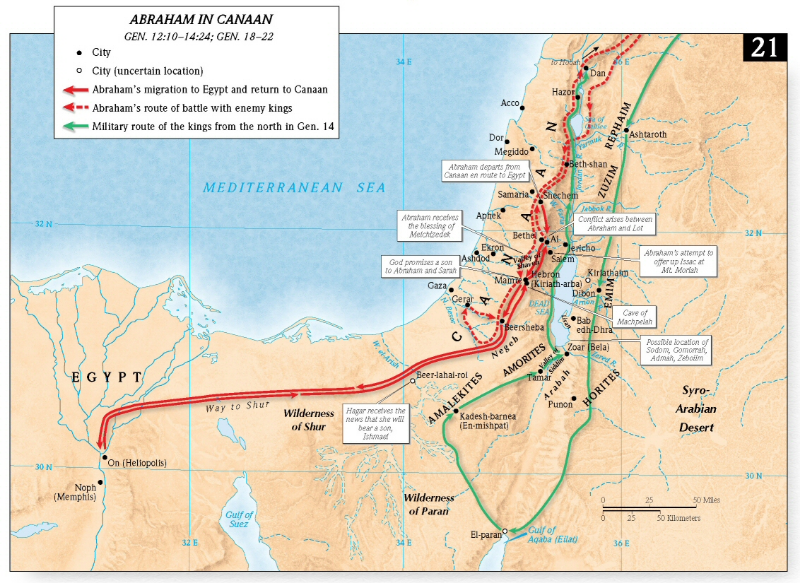
2. What/where was “the Negeb“? (13:1)? Trace Abraham’s, Sarah’s, and Lot’s trip from Egypt (13:1) back to “between Bethel and Ai” (13:2) on the map below. Find the remainder of the locations mentioned in 13-15 on the map.

3. Read Proverbs 3:5-6. How do we see Abraham trusting God and God directing Abraham’s paths in chapter 13? Canaan, where Abraham settled (13:12), eventually became known as what? How does chapter 13 demonstrate God’s sovereignty?

4. What does chapter 13 teach us about making wise and godly decisions? Can you look back on an incident in your life where you had to trust the Lord and make the wisest, most God-honoring decision you could? How did God “direct your paths” in that situation?

5. List all of the things God promised Abraham in chapters 13-15. Can you find the passages of Scripture where these promises came true?

6. Examine the instances in chapters 13-15 where Abraham worshiped the Lord. How would you characterize his worship? What caused him to worship?

7. Compare 15:6 to Romans 4 and Galatians 3. What does the Holy Spirit want New Testament Believers to understand about faith from Abraham’s example?

8. Compare and contrast Abraham’s interaction with God in chapter 15 about what God was promising him to Zechariah’s interaction with God about what God was promising him. How were Abraham’s and Zechariah’s reactions to God’s promises similar? How were they different? How and why did God react differently to Abraham’s questions than to Zechariah’s questions?


Homework

Compare Genesis 14:17-24 with Hebrews 7. How is Melchizedek a type of Christ? Why would the writer of Hebrews (14:13) refer his audience back to Melchizedek as an illustration of Christ as eternal high priest?


Suggested Memory Verse

And [Abram] believed the Lord, and he counted it to him as righteousness.
Genesis 15:6

Women of Genesis Bible Study

The Women of Genesis: Lesson 9- Sarah

Previous Lessons: 1, 2, 3, 4, 5, 6, 7, 8

๐Ÿ“–๐Ÿ“–๐Ÿ“–๐Ÿ“–๐Ÿ“–

Read Genesis 11:27-12:20

๐Ÿ“–๐Ÿ“–๐Ÿ“–๐Ÿ“–๐Ÿ“–


Questions to Consider

1. What facts can we glean about Sarah from this passage? What was her original name? (11:29) Who were her family members? (11:27-29, 31) Where was she originally from, and where did she move to? (11:28,31) What was her physical condition (11:30) and why is this “backstory” being given to us? (12:7) What was Sarah’s physical appearance like? (12:11,14)

Click for larger view

2. We can learn more about Sarah from other passages of Scripture. What does the name Saraiย (see footnote) mean? What was Sarah’s familial relationship to Abraham? How old did Sarah live to be? How does Paul use Sarah as an allegorical example in Galatians? How does Hebrews describe Sarah’s faith? How does Peter hold Sarah up as a godly example to Christian women? Overall, how does the Holy Spirit frame and describe Sarah’s character in the New Testament? Does this mean her thoughts and behavior were always flawless?

3. Consider that Sarah, though sinful and imperfect in many ways, is spoken of by the Holy Spirit in the New Testament as a woman of faith and godly character, and an example to be looked up to by Christian women. Does this bring you comfort and reassurance as a sinful and imperfect, yet faithful, follower of Christ? What are some ways you can set a godly example for other Christian women even though you sometimes stumble into sin? How will God speak of your faith and character at the end of your life?

4. While the events in Genesis 11-12 are told from Abraham’s perspective, Sarah, his wife was right there with him, experiencing those same events. Consider the following parts of the story from Sarah’s perspective:

Barrenness (11:30):ย In a patriarchal society in which women established status largely by bearing sons, what might Sarah have thought about being barren?

Traveling and relocating (12:1-9): Examine the map above. Strange lands she’d never been to before. Strange and possibly hostile people. How far would Sarah and her family have had to travel? What might have been some of Sarah’s concerns for her family?

God’s promises and instructions (12:1-3,7): What questions might Sarah have had about her role in God’s promises to Abraham, how her barrenness would affect God’s promise for offspring, and how it would all play out once God’s promises were fulfilled?

Trusting, obeying, and worshiping God (12:1-9): In instructing Abraham, God was also instructing Sarah, as his wife, to obey and follow Him. What were some ways Sarah would have had to obey God? How could she have served as a helper to her husband? How would she have needed to trust God? How would trusting and obeying God have led to worship for Sarah, right alongside her husband? (7,8) How might Sarah’s relationship with God have grown through this experience?

5. Examine 12:10-20. Summarize the story in your own words. What did Abraham ask Sarah to tell the Egyptians in verse 13? Why? Was this true? What can we learn from this story about honesty, deception, and half truths? How did Abraham’s deception put Sarah in danger? In what way did Abraham put his own needs ahead of Sarah’s well-being? How might Abraham’s actions have damaged his relationship with his wife?

6. Compare Abraham’s trust in God in 12:1-9 with his lack of trust in God in 12:10-20.

7. In what ways did Sarah have to trust God and trust her husband in 12:1-9? In what ways did she have to trust God and trust her husband in 12:10-20? Was Abraham acting in a trustworthy way in both of these instances? Why or why not?

8. Have you ever had to trust God through a situation in which your husband, parent, or someone else you depended on, wasn’t acting trustworthy? What did this teach you about God and His trustworthiness and dependability?

9. True or false: “In some ways and at some times Sarah may have had to trust God even more than Abraham did.”? Why?


Homework

How can trusting God through a difficult time lead you to worship Him? Describe a trial you’ve been through and how you trusted God in the midst of it. Take some time to worship God for the specific ways He carried you through that trial: how He provided for you, comforted you, strengthened you, and encouraged you.


Suggested Memory Verse

Then the Lord appeared to Abram and said, โ€œTo your offspring I will give this land.โ€ So he built there an altar to the Lord, who had appeared to him.
Genesis 12:7