

Women of Genesis Bible Study

The Women of Genesis: Lesson 14- Lot’s Wife and Daughters

Previous Lessons: 1, 2, 3, 4, 5, 6, 7, 8,ย 9, 10, 11, 12, 13

๐Ÿ“–๐Ÿ“–๐Ÿ“–๐Ÿ“–๐Ÿ“–

Read Genesis 18:16-19:38

๐Ÿ“–๐Ÿ“–๐Ÿ“–๐Ÿ“–๐Ÿ“–


Questions to Consider

1. Genesis 18:16 begins with the phrase, “Then the men set out from there“. When you begin to study a passage of Scripture that starts with a transitional phrase like this, it’s important to find out about the back story you’re dealing with. Briefly review lesson 13 (link above) or Genesis 18:1-15. “Then” means what you’re about to read is the next thing that happened in a succession of events. What event happened first? Who are these “men” verse 16 speaks of, and where is the “there” they set out from? What have we previously learned about Sodom?

2. Examine 18:17-19. Why did God decide to reveal to Abraham what He was about to do to Sodom and Gomorrah? Look closely at Abraham’s negotiation with the Lord inย  18:22-33. What might have been a secondary reason God revealed His plans for Sodom to Abraham? What was God trying to reveal about Himself to Abraham or teach Abraham through this interaction?

3. Compare Abraham’s persistence in 18:22-33 to the parable of the persistent widow. What do both of these passages teach us about persisting in prayer? About God’s attitude toward His children who “pester” Him? Doesย what we’re persisting in prayer about, or why we’re persisting about it matter (ex: kingdom-mindedly praying for someone’s salvation vs. greedily praying for an exorbitant car)?

4. Read this articleยน about the customs of ancient Middle Eastern hospitality between travelers and hosts. It would have been shameful for Lot to have allowed the men to stay in the square for the night and not to have hosted them lavishly. How does this knowledge of Lot’s culture help you better understand the things he said and the ways he acted in 19:1-10?

5. Even understanding the intense nature of his culture’s hospitality, was Lot’s offer of his daughters in 19:6-8 right? Compare Lot’s behavior in this passage with what you know the Bible says about parenting. Was Lot putting being a godly father first or man’s opinion of him (regarding his hospitality) first? What does the Bible say about holding to cultural rules or laws above holding to God’s law? How do you think Lot’s behavior impacted his daughters’ trust in him, their belief that he would protect them, and their respect for him?

6. Put yourself in Lot’s wife’s shoes and examine his behavior in 19:1-10 in light of these Scriptures. Do Lot’s actions lead you to trust his judgment? To feel secure and protected? To respect him?

7. Examine 19:12-14, and consider a) the evil the men of the city have already committed, and b) the fact that God is about to destroy the city for its wickedness. What kind of men had Lot chosen as husbands for his daughters? What perspective on these men might Lot’s daughters have had?

8. Lot was told to take his wife and daughters to safety (15), “but he lingered,” (16) most likely for the same reason his wife looked back at Sodom (26). Notice verse 26 says she was behind Lot. She was following him literally in that moment, but she was also following him as the leader of her family. He lingered. She looked back. Why? What impact had living in Sodom had on their spiritual lives?

9. How is God showing mercy to Lot’s family and saving them, Himself, from His wrath against sin, a picture of the gospel? What do we learn about God’s judgment and wrath toward sin from this story?

10. Read 19:30-38. Has God said anything thus far in Genesis that would have led Lot’s daughters to believe that dying childless would have been the end of the world? Recall how important it was to a woman’s standing in her culture at that time to bear children. In what ways did Lot’s daughters follow in his footsteps by bowing to culture above bowing to God? How did the immorality of the culture they were raised in influence their actions?

11. What do you know from Scripture about the Moabites and the Ammonites? Consider the far-reaching impact of the sin of Lot’s daughters.


ยนThis link is an endorsement of this particular article only. I do not endorse this site in any way in which it deviates from my beliefs as outlined in the Statement of Faith and Welcome tabs at the top of this page.

Homework

In today’s study we saw examples of both Lot and his daughters conforming to culture rather than conforming to godliness. The Bible tells us we are not to be conformed to this world, and that friendship with the world is enmity toward God. Have you ever put cultural expectations, political correctness, popularity, or being on the cutting edge ahead of being obedient to Christ? Have you repented of that sin? Write a paragraph or two about how you could have handled the situation in a godly way, staying true to Christ and His commands.


Suggested Memory Verse

Far be it from you to do such a thing, to put the righteous to death with the wicked, so that the righteous fare as the wicked! Far be that from you! Shall not the Judge of all the earth do what is just?
Genesis 18:25

Women of Genesis Bible Study

The Women of Genesis: Lesson 13- Sarah

Previous Lessons: 1, 2, 3, 4, 5, 6, 7, 8,ย 9, 10, 11, 12

๐Ÿ“–๐Ÿ“–๐Ÿ“–๐Ÿ“–๐Ÿ“–

Read Genesis 17:1-18:15

๐Ÿ“–๐Ÿ“–๐Ÿ“–๐Ÿ“–๐Ÿ“–


Questions to Consider

1. Briefly review lessons 11 and 12 (links above).

2. Read Genesis 16:16ย and 17:1. How many years passed between the birth of Ishmael and the appearance of the Lord in 17:1?

3. Compare 17:1-8 with Genesis 15:1-6. Write out the stipulations of the Abrahamic Covenant. Think further ahead into Old Testament history (Exodus-ish). What is God laying the foundation for here with Abraham? How does Abraham serving as the “cornerstone” as it were, of the nation of Israel point ahead to Christ as the cornerstone of Christianity?

4. What was the sign that a person was under the Abrahamic Covenant? (17:9-14) What were the “policies and procedures” regarding circumcision in this passage? Are Christian men today required by Scripture to be circumcised? What is the New Testament sign that a person is in Christ and under the new covenant of grace?

5. Why do you think both the covenant and the sign of the covenant were male-centric? Why didn’t God make the covenant with Abrahamย and Sarah? Why circumcision, which was specifically male-only, instead of something like ear-piercing which could have also been performed on females?

6. Why did God change Abram’s name to Abraham (17:5), and Sarai’s name to Sarah (17:15)?ย  What did their former and new names mean? Why didn’t God change Hagar’s name?

7. Compare and contrast Abraham’s reaction to the news of Sarah’s impending pregnancy (17:15-18) to Sarah’s reaction to this news (18:10-12). How were their reactions similar? How were they different? How did God respond to Abraham’s reaction? (17:19-21) To Sarah’s? (18:13-15) From God’s individualized responses to each of them, what can you infer about the differences between Abraham’s and Sarah’s thoughts and concerns about the upcoming pregnancy? Why do you think God picked the name Isaac for their son? (see footnote on 17:9, Genesis 21:5-7)

8. Examine more closely Sarah’s response to the news of her impending pregnancy in 18:11-15. Recall or review (lesson 11) Sarah’s failure to trust God. How does her initial reaction here againย demonstrate that she did not believe Godโ€™s word, or trust Godโ€™s character to keep His promise?

9. Verse 18:12 begins with the word “So”, indicating that the reason Sarah reacted the way she did was because of the information in verse 11. What circumstances (11) were Sarah’s reaction (12) based on? Did she have more faith in the her circumstances and her own personal experience, or in God and His Word? In that moment, was her faith rightly or wrongly placed? Examine Hebrews 11:11. Even though Sarah initially failed to trust God and wrongly placed greater faith in her circumstances and experiences, did her heart, her faith, and her trust remain that way?

10. Carefully examine 18:1-10. What can we learn about the customs of Middle Eastern hospitality at that time? What were some of Sarah’s duties and appropriate behaviors in welcoming guests according to her culture?

11. Review the verses in this passage that specifically talk about Sarah. What else can we learn about her character or her faith that set a good, or bad, example for us as Christian women today?


Homework

“Is anything too hard for the Lord?” Even though Sarah’s initial reaction to God and His Word was one of unbelief and distrust, God brought her along and grew her into someone who was commended for her faith in Hebrews 11 (often called the “roll call of the faithful” or “the Hall of Faith”).ย  Think back over your walk with the Lord. Can you think of a Scripture you once rejected in disbelief or rebellion that you now embrace and obey? A life situation in which God grew your faith in Him? What circumstances, Scriptures, or people did God use to bring you along from unbelief to belief, disobedience to obedience, distrust to trust? Spend some time in prayer thanking God for growing you through that situation.


Suggested Memory Verse

Is anything too hard for the Lord? At the appointed time I will return to you, about this time next year, and Sarah shall have a son.
Genesis 18:14

Women of Genesis Bible Study

The Women of Genesis: Lesson 12- Sarah and Hagar

Previous Lessons: 1, 2, 3, 4, 5, 6, 7, 8,ย 9, 10, 11

๐Ÿ“–๐Ÿ“–๐Ÿ“–๐Ÿ“–๐Ÿ“–

Read Genesis 16

๐Ÿ“–๐Ÿ“–๐Ÿ“–๐Ÿ“–๐Ÿ“–


Questions to Consider

1. Briefly review lesson 11 (link above) since it is basically part 1 of the lesson on chapter 16. Refresh your memory on Sarah’s “trust issues” with God.

2. Read verses 1-6 from Hagar’s perspective. What was Hagar’s station in life? (1) The ESV renders Hagar’s position as “servant”, but to our 21st century mindset, it might be more helpful to use the NIV and CSB’s renderingย of “slave”.

3. As a slave, what rights would Hagar have had over her personhood? Over her own body? Was Hagar asked if she wanted to sleep with Abraham or serve as a surrogate? Examine Genesis 30:1-8. In a “surrogacy by slave” situation, the baby was considered by society and the family to be whose child, the slave’s or the wife’s? Did Hagar have any rights to her own son? What are some thoughts or emotions Hagar may have experienced as she went through this situation?

4. When we read a story like this one, it’s very important that we understand the culture of the time. Imagine hearing this story on tomorrow night’s newscast. A man and his wife buy a female slave. The wife gives the slave to the husband for him to forcibly impregnate, with the plan that the resulting child will belong to the couple. It sounds like a TV crime drama on human trafficking, and, indeed, if this happened today in America, the husband and wife would both be criminally liable for their actions. In what ways can viewing this story through our current worldview help us to see the sin involved in what Abraham and Sarah did to Hagar? In what ways can a 21st century perspective lead us to misunderstand this story? How does understanding Abraham’s, Sarah’s, and Hagar’s culture, and the way it would have viewed slavery and slave surrogacy, help us to understand this story correctly? Does culture or era change whether or not something is a sin?

5. In Sarah’s and Hagar’s culture, the main way women achieved status, and were viewed as blessed and successful by society, was by bearing children, particularly sons. How does this piece of cultural information help you understand both Sarah’s and Hagar’s reactions in verses 4-6?

6. In lesson 11, we looked at how Abraham, as a godly husband, should have responded in verse 2. Did Abraham lead his wife in a godly way in verse 6? How could he have led her in a godly way? How did Hagar react to Sarah’s harsh treatment? (6)

7. Read verses 7-16. How many times is the phrase “angel of the Lord” used? Who is the angel of the Lord? Many theologians consider this appearance of the angel of the Lord to be a Christophany. What evidence do you see in this passage that might point to that conclusion?

8. What character trait did Hagar seem to be lacking in verse 4? How might her obedience to God’s instruction to her in verse 9 have grown her in that aspect of her character? Compare verses 9-10 to James 4:10.

9. Examine the end of verse 11 and the footnote. What does the name Ishmael mean? Compare this with what Hagar calls God in verse 13, and the name of the well in verse 14 (see footnotes). What would all of these descriptions of the character of God have meant in Hagar’s life? What does it mean in your life that God hears and sees you?

10. Compare and contrast Hagar’s trust and obedience to the Lord in 7-16 to Sarah’s distrust and disobedience to the Lord in 1-6.

11. Compare verses 7-16 with Luke 1:26-38, and make a list of any similarities you see. How does Hagar’s story point us ahead to Christ?


Homework

Read my articleย 5 Ways to Face Tests and Trials Biblicallyย and apply it to either Sarah’s or Hagar’s (or both) situation in chapter 16. What was God’s purpose for the test she went through? What were some opportunities she had to obey God in her situation? What would her words and actions have been like if she had trusted God more?


Suggested Memory Verse

So she called the name of the Lord who spoke to her, โ€œYou are a God of seeing,โ€ for she said, โ€œTruly here I have seen him who looks after me.โ€
Genesis 16:13

Women of Genesis Bible Study

The Women of Genesis: Lesson 11- Sarah and Hagar

Previous Lessons: 1, 2, 3, 4, 5, 6, 7, 8,ย 9, 10

๐Ÿ“–๐Ÿ“–๐Ÿ“–๐Ÿ“–๐Ÿ“–

Read Genesis 16:1-6

๐Ÿ“–๐Ÿ“–๐Ÿ“–๐Ÿ“–๐Ÿ“–


Questions to Consider

1. Briefly review lessons 9 and 10 (links above) about Sarah and what brought her to this place in her life in chapter 16. Compare and contrast Sarah’s position in life to Hagar’s position in life.

2. How old was Abraham when God first called him and promised to make him a great nation? How old was he when Ishmael was born? So, approximately how many years had he and Sarah been trying to conceive? (3)

3. What do Sarah’sย wordsย in verse 2, “the Lord has prevented me from bearing children” tell us about her belief in God’s sovereignty and control over her situation? What do herย actions in the remainder of verse 2 and 3 tell us about her belief in God’s sovereignty and control over her situation? Whose sovereignty did she really trust, God’s or her own? If Sarah trusted that God was the One who had closed her womb, why did she not trust that God would open it?

4. Think back to the promises of offspring God made to Abraham, of which Sarah was aware. Note the repeated phrase, “I will…” in all of God’s promises. Did God, at any time, ask Sarah or Abraham for their help in accomplishing these things? Did God know about Sarah’s barrenness? Did He ever suggest a surrogate mother for the offspring He promised? Whose idea was using Hagar as a surrogate? Was this an idea Sarah got from God or from her surrounding culture?

5. Think about Sarah’s relationship with God and her response to His promises. How did Sarah’s actions demonstrate that she did notย believe God’s word,ย trust God’s character to keep His promise, nor accept andย submitย to God’s timetable?

6. Compare Sarah’s plan to give Hagar to Abraham, and the problems that resulted, to Genesis 2:24. Has plural marriage or fathering children through adultery ever been pleasing to God? As a godly husband, how should Abraham have responded to Sarah’s plan? Howย didย he respond? (2,4)

7. Compare and contrast the influence Sarah had over Abraham (2-4) with the influence Eve had over Adam (Genesis 3:6-12). Was either woman, in these two incidents, a good steward of the influence God gave her? Why or why not? Was either man a good steward of the headship of his home God gave him? Why or why not?

8. What were some of the negative consequences of Sarah’s actions for herself, for Abraham, and for Hagar? (4-6) Would these things have happened if Sarah had obediently trusted God to keep His promise instead of taking matters into her own hands?

9. How does the story of God promising a long awaited son to a woman unable to conceive foreshadow the incarnation of Christ? What are some things that might have happened if Mary had taken matters into her own hands instead of trusting and obeying God?


Homework

Sarah’s words told one story about her belief in God’s sovereignty, but her actions told another story. Think about the situations in your life right now. Do youย believe God’s Word,ย trust God’s character to keep His promises in His Word, andย accept andย submitย to God’s timetable? Write down one way your actions could better line up with what you profess to believe, and implement it over the next week.


Suggested Memory Verse

So she called the name of the Lord who spoke to her, โ€œYou are a God of seeing,โ€ for she said, โ€œTruly here I have seen him who looks after me.โ€
Genesis 16:13

Women of Genesis Bible Study

The Women of Genesis: Lesson 10

Previous Lessons: 1, 2, 3, 4, 5, 6, 7, 89

๐Ÿ“–๐Ÿ“–๐Ÿ“–๐Ÿ“–๐Ÿ“–

Read Genesis 13-15

๐Ÿ“–๐Ÿ“–๐Ÿ“–๐Ÿ“–๐Ÿ“–


Questions to Consider

1. Briefly review lesson 9 (link above) about Sarah. Other than 13:1, this week’s passage does not mention Sarah. But as you read 13-15, read it understanding that, even though she is not mentioned, Sarah is experiencing all these things in some form or fashion because she’s married to Abraham. So, we learn from 13:1 that Sarah again had to pack up and move. In 13:2-7, we learn that Sarah was wealthy and likely managed a large household. Write down what else you can – carefully and reasonably – surmise about Sarah from chapters 13-15.

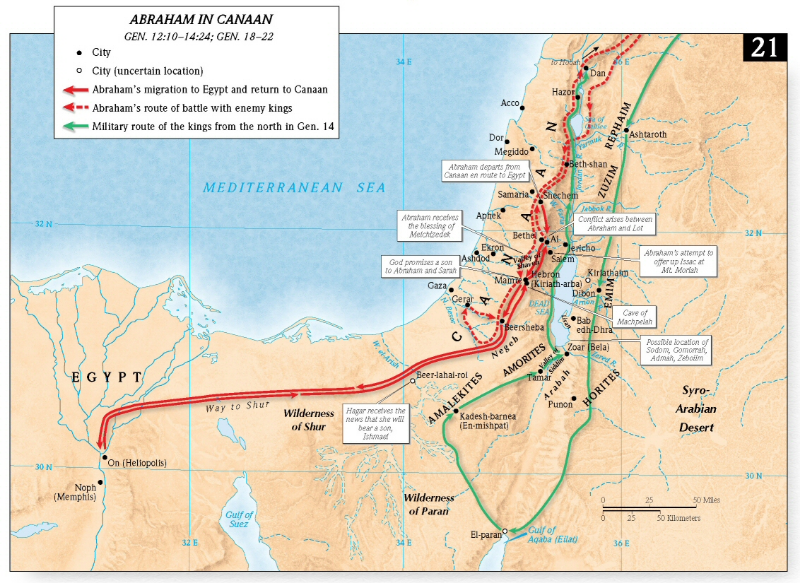
2. What/where was “the Negeb“? (13:1)? Trace Abraham’s, Sarah’s, and Lot’s trip from Egypt (13:1) back to “between Bethel and Ai” (13:2) on the map below. Find the remainder of the locations mentioned in 13-15 on the map.

3. Read Proverbs 3:5-6. How do we see Abraham trusting God and God directing Abraham’s paths in chapter 13? Canaan, where Abraham settled (13:12), eventually became known as what? How does chapter 13 demonstrate God’s sovereignty?

4. What does chapter 13 teach us about making wise and godly decisions? Can you look back on an incident in your life where you had to trust the Lord and make the wisest, most God-honoring decision you could? How did God “direct your paths” in that situation?

5. List all of the things God promised Abraham in chapters 13-15. Can you find the passages of Scripture where these promises came true?

6. Examine the instances in chapters 13-15 where Abraham worshiped the Lord. How would you characterize his worship? What caused him to worship?

7. Compare 15:6 to Romans 4 and Galatians 3. What does the Holy Spirit want New Testament Believers to understand about faith from Abraham’s example?

8. Compare and contrast Abraham’s interaction with God in chapter 15 about what God was promising him to Zechariah’s interaction with God about what God was promising him. How were Abraham’s and Zechariah’s reactions to God’s promises similar? How were they different? How and why did God react differently to Abraham’s questions than to Zechariah’s questions?


Homework

Compare Genesis 14:17-24 with Hebrews 7. How is Melchizedek a type of Christ? Why would the writer of Hebrews (14:13) refer his audience back to Melchizedek as an illustration of Christ as eternal high priest?


Suggested Memory Verse

And [Abram] believed the Lord, and he counted it to him as righteousness.
Genesis 15:6