Christian women, Idolatry, Sanctification, Women

Little Women

I’d rather have Jesus than men’s applause
I’d rather be faithful to His dear cause
I’d rather have Jesus than worldwide fame
I’d rather be true to His holy name

We sang this lovely hymn in church the other day, and it was perfect timing. For the past couple of weeks, I’ve been thinking about women I’ve known across the years, women I’ve known of (but not personally) across the years, and the woman I’ve known best across the years, me. And I’ve been thinking about how and where we find our worth, fulfillment, and contentment and where we should find it: in Christ.

I don’t know about you, but one of the sins I constantly struggle against is coveting. It’s a sin we don’t think about very much. A private one that, often, nobody knows about except God and me.

Coveting is a sin we don’t think about very much. A private one that, often, nobody knows about except God and me.

And you know what I covet? What I think we all covet? Men’s applause. Worldwide fame. Or, at least, fame in my little corner of the world.

When we were children in Sunday school, coveting was sometimes explained to us as “wanting for ourselves what someone else has.” Her new doll. His fancier bike. It’s a decent kid-level definition, but in the same way that Jesus reminded us that the root sin of murder is hate and the root sin of adultery is lust we need to mature in our understanding of coveting, and realize that it also has a root sin: discontentment. Sometimes, it’s discontentment with what we have (greed), and sometimes it’s discontentment with who we are.

And who are we?

As Believers, we are children of the God of the universe who, despite our sin and rebellion against Him, loved us enough to lay down His own life to rescue us. He listens to us. He accepts us. He provides for us. And don’t even get me started on Heaven.

And if contemplating all that isn’t enough, the Bible tells us to be content. So why aren’t we? Why woud we rather have Jesus and men’s applause, and worldwide fame?

Because, as John Calvin so aptly put it, “Man’s nature, so to speak, is a perpetual factory of idols.” Our sinful flesh is always looking to gratify itself rather than glorify God. Any time our hearts say, “God’s not enough. I want more,” we’re committing idolatry, because whatever the “more” is, it’s other than God and lesser than God, and we’re seeking it instead of seeking God. And, as women, one of the biggest “more” idols we seek is feeling good about ourselves, or feeling worthy of love and acceptance.

Our sinful flesh is always looking to gratify itself rather than glorify God.

But instead of looking to Christ and letting Him define for us a right perspective of ourselves, we hit the crack pipe of the praise of men. It’s fast. It’s cheap. It’s easy. And the high is nearly instantaneous.

Instead of looking to Christ and letting Him define for us a right perspective of ourselves, we hit the crack pipe of the praise of men. It’s fast. It’s cheap. It’s easy. And the high is nearly instantaneous.

How? Allow me to introduce you to some frenemies of mine:

Mother and Daughter Hugging

Marla MegaMom- Marla lives for and through her kids. Their successes are her successes. Their failures, her failures. She subtly or overtly pressures her kids to achieve because if they fail she’s afraid others won’t see her as a good mom. And being a failure as a mom means being a failure in life.

Woman Singing

Dina Diva- Dina literally seeks the applause of others. She’s the top church soloist and the star of every Christmas production. She’s a public speaker or an instrumentalist or an actress, anything that can be done on a stage. Dina doesn’t feel good about herself unless people are clapping for her.

woman-164299_640-1978279293

Veronica Victim- Poor Veronica. Everything in her life is always going wrong at home, at work, at church, with friends, with her health, with her car, with her dog. Nobody understands just how hard Veronica has it, so she makes it her life’s mission to let people know. In every story she tells, Veronica is the victim, and somebody else (or everybody else) is the bad guy. Please feel sorry for Veronica, because that’s the only way she can feel better about herself.

woman_angel_costume_kindlephoto-8131448

Helen the Heroine- Helen is Veronica’s cousin. In every story Helen tells, she’s the heroine, the paragon of virtue, the one who did everything right – short of severing a limb – to make everything work out, and somebody else is the bad guy. Helen is divorced and the bad guy is usually her ex-husband, but she’s versataile enough to apply her story telling skills to situations at work, church, with friends, etc. Helen thinks if you don’t see her as a heroine, she’s worthless.

super-woman-halloween-adult-costume-aef98eb9
Photo courtesy of CostumeCollection.com.au

Sally Superwoman- Sally does everything, and she does it superbly. She’s employee of the year at work and world’s best wife and mom at home. She’s a gourmet cook, flawlessly recreates every cake and craft on Pinterest, and her house looks like a photo shoot for Better Homes and Gardens. Other women know she’s got it all together, so she keeps all her plates spinning at a furious pace, because if one of them fell where would she be?

MP900178801

Popular Polly- Polly is everybody’s friend. She’s one of the sweetest people you’ll ever meet with never a cross word for, or about, anybody. She agrees with (or at least doesn’t obviously disagree with) whatever is being said by the person she’s talking to at the moment, so it can be hard to pin down what she really believes. When someone unfriends/unfollows Polly on social media, she takes it personally, wondering what she did wrong. She only likes herself if enough other people like her.

reading-216862_640

Know It All Nettie- Maybe she’s got multiple degrees, or maybe she’s just well read, but Nettie is an expert. In everything. She sees it as her calling to educate people, starting a lot of sentences with, “Well, actually…” and rarely asking questions that would reveal her lack of knowledge on a subject. Ignorance is a weakness in Nettie’s mind, and she wants to be seen as strong.

MP900427741_kindlephoto-8317786

Maisy the Martyr- Whenever there’s a request for helpers at church, someone to pull overtime or fill in for a co-worker, volunteers at the soup kitchen, the fulfillment of the smallest need of her family, Maisy will be there, working tirelessly. She secretly gets angry when no one recognizes her for all her hard work or when people take advantage of her, but she’s afraid to say no because she’s afraid people will be upset with her, and what kind of person would she be then?

Woman Doing Sit-ups

Let’s Get Physical Phyllis- Whether she’s one to wear revealing clothes so all the men stare or she’s an organic, vegan workout queen, or she’s a clotheshorse, Phyllis is all about one thing: her body and how it looks. Did a construction worker whilstle at her today? A co-worker compliment her outfit? If not, maybe Phyllis had better lose a few more pounds or get that plastic surgery she’s been considering. After all, if people stop looking, she’s nothing.

man-315069_640

Man-datory Maude- Maude always has a man. Always. Preferably an awesome one, but even a mediocre or lousy man is better than no man at all. Why? It’s tangible proof somebody wants her. Otherwise, how will people be able to see she’s a worthwhile person?

MP900289528

Take Charge Tallulah- Follow? You must be joking, darling. Tallulah was born to lead and plays second fiddle to no one. She’s the chair of every committee she’s on, and always the one to round up the worker bees and start doling out orders. No points for second place. If you’re not first, you’re last. Tallulah needs the submission of others to feel self confident.

Are you one of these women? Or, if you’re as Sybil as I am, maybe you’re all of these women to one extent or another. Little women, all. Little, because Maisy, Helen, Sally, and all the rest are coveting and settling for crumbs of approval from others when God is offering them the whole bakery of His delight in them. Little, because they’re zeroing in on one tiny aspect of their lives to earn the praise of men instead of lifting their eyes to the broad expanse of Heaven and focusing on the Christ who loves them and has set them free to rest in His acceptance of them through His shed blood.

There’s nothing wrong with eating right or being friendly, or serving, singing, or teaching. Those are all good things. But just as God can take the most evil things and use them for good, we, because of our sinful nature, have a tendency to take good things and use them for evil. And evil isn’t too strong a word when we’re talking about taking the good gifts and talents God has given us and using them to pursue idolatry.

Just as God can take the most evil things and use them for good, we, because of our sinful nature, have a tendency to take good things and use them for evil.

So what can we do? Romans 12:21 tells us, “Do not be overcome by evil, but overcome evil with good.” When that evil coveting of praise and notoriety rears its ugly head:

  • Overcome it by confessing your coveting and idolatry and asking God to forgive you for it.
  • Overcome it by asking God to help you do everything for His glory, so that men will praise Him and make His name famous instead of yours.
  • Overcome it by letting go and saying no. If you’re Dina, it’s OK to let somebody else have the leading role. If you’re Maude, it’s OK to stay home on date night. If you’re Veronica and someone asks how you’re doing, it’s OK to smile and say, “Fine.”
  • Overcome it by preaching the gospel to yourself. Remember how big God is, how small and weak you are and the lengths of love that He went to to save you anyway. Not because of who you are, but because of who He is. Rest in that, and praise and thank God for it.

And let’s have no more of these little women.

Christian women, Church, Discernment, Sanctification, Women

Sacrificing Truth on the Altar of Tone

Ladies, do you believe in woman’s intuition? Do you have it? I’m not talking about premonitions– having a feeling that some future event is going to take place- I mean intuition. Being able, for example, to sense from a friend’s tone of voice that she’s having a bad day, noticing from the body language of two people who are “just friends” that romance is brewing beneath the surface, or discerning the tension between two people who are seemingly cordial to one another.

wonder-woman-552109_1280

Maybe men have this “super power” too, but I’ve noticed it more with women. I believe it might have something to do with the way God has hard wired us. Nothing against men here (y’all are awesome in your own masculine way), but we women generally tend to be more sensitive to and concerned about other people’s feelings, we listen “between the lines,” and we hear and analyze tone of voice more. It’s one of the great things about the way God has created us that helps us as we nurture, comfort, and care for others.

But lately, I’m noticing that this “super power” of ours can also be a super problem.

Our sensitivity to tone (of voice, of writing, someone’s demeanor, etc.) is a hindrance rather than a help to us when we refuse to evaluate the content of what someone is saying to us simply because his manner of speaking, writing, or behavior has offended our sensibilities. This is especially harmful when that content is biblical truth.

Our sensitivity to tone is a hindrance rather than a help to us when we refuse to evaluate the *content* of what someone is saying simply because his manner of speaking, writing, or behavior has offended our sensibilities.

I have recently observed several instances of this, all involving women who, at best, found it difficult (with some outright refusing) to put aside their feelings of offense at the writer’s or speaker’s tone in order to compare the content of his speech or writing to Scripture to see if it might be true. (And, by the way, the speech and writing I’m referring to here are sermons, commentary, and articles, not someone writing or speaking to these women personally.) I can sympathize. It’s happened to me plenty of times.

Often, when we hear a fellow Christian put biblical truth bluntly in black and white and it rubs us the wrong way, our first reaction is to quote part of Ephesians 4:15 and chastise him for failing to “speak the truth in love.” But is that the only point of Ephesians 4? Let’s take a look at it in context:

And he gave the apostles, the prophets, the evangelists, the shepherds and teachers, to equip the saints for the work of ministry, for building up the body of Christ, until we all attain to the unity of the faith and of the knowledge of the Son of God, to mature manhood, to the measure of the stature of the fullness of Christ, so that we may no longer be children, tossed to and fro by the waves and carried about by every wind of doctrine, by human cunning, by craftiness in deceitful schemes. Rather, speaking the truth in love, we are to grow up in every way into him who is the head, into Christ, from whom the whole body, joined and held together by every joint with which it is equipped, when each part is working properly, makes the body grow so that it builds itself up in love.

Ephesians 4:11-16 (emphasis mine)

When I was in elementary school, one of the reading comprehension tasks we were often assigned was to find the “main idea” of a piece of writing. So, what is the “main idea” of this passage in Ephesians 4? I’ll even make it multiple choice (my favorite!).

Is the main idea of the passage:

a) Teachers and preachers should speak the truth in love so that they will not offend anyone.

b) A discussion of the different types of leadership roles in the church.

c) Christian leaders are to equip church members to grow to spiritual maturity which builds spiritually healthy and unified churches.

While the passage touches on some of the ideas in a and b, the main point is c. We’re to grow up. We are to listen to preachers, teachers, and writers who rightly handle God’s word, even if we come across one every now and then who steps on our toes with his demeanor or tone.

And it’s important to remember that just because our feelings are hurt doesn’t necessarily mean the other person sinned or did anything wrong. Sometimes you and I take things the wrong way because we’re not listening, we’re not understanding, or because we’re incorrectly reading our own hurts and past experiences into what the other person is saying. And none of that is her fault.

Sometimes the reason we’re offended is because the other person is speaking or writing simply and directly without wrapping her words in fourteen pillows of feelings-coddling. (Believe it or not, this is the way people used to speak all the time before feelings became such an idol in our culture. You could just say things without all the caveats.) We’ve grown so used to everyone walking on egg shells and tiptoeing around everyone’s feelings when we write and speak, lest anyone be “triggered,” that when someone simply says what she has to say without beating around the bush, we take offense that she hasn’t bent over backwards in her wording to make sure our feelings haven’t been hurt. And that’s not her fault, either.

And finally, sometimes we think -or claim– our feelings have been hurt by the other person’s tone, when, really what’s happening is that the Holy Spirit is convicting us, or we know she’s right in what she’s saying but we’re too proud to admit it. And those things aren’t her fault, either.

Just because someone says something and you get offended doesn’t automatically mean she’s at fault. Sometimes the fault is yours.
Just because someone says something and you get offended doesn’t automatically mean she’s at fault. Sometimes the fault is yours.

Look, I know it’s hard. There are people out there who offend me sometimes, too, but persevering through the offense will grow us into mature women of Christ and make our churches healthier.

Statistically speaking, more women regularly attend church these days than men. And when I say “more,” I mean 61% women to 39% men. Can you imagine the impact it would have on the health of our churches if all of those women were pursuing spiritual maturity through biblical truth and sound doctrine?

Instead, we are often like a little girl in a burning building. The fireman is vehemently insisting that the little girl come with him to escape, and she refuses to move because he hasn’t said it nicely enough.

We are often like a little girl in a burning building. The fireman is vehemently insisting that the little girl come with him to escape, and she refuses to move because he hasn’t said it nicely enough.

Ladies, I say this to all of us (including me) in love, because true love is desiring what’s best for someone:

It’s time for us to grow up. It’s time to stop taking our dollies and stomping home from the playground in a huff every time somebody speaks or writes strenuously. It’s time to stop crying about our hurt feelings, put on our big girl panties and be women.

It’s time to stop taking our dollies and stomping home from the playground in a huff every time somebody speaks or writes strenuously. It’s time to stop crying about our hurt feelings, put on our big girl panties and be *women*.

Discerning women. Berean women. Women of God’s word. Women who can handle having our feathers ruffled and come out on the other side stronger for it.

9283e86a7bd7185b880df318c7681846

Too often, we make the mistake of equating a soft tone of voice and a sweet disposition with “love”.  But many of the people who speak with this kind of “love” are not speaking the truth. They are smooth talking, charismatic con men selling snake oil for our souls.

Too often, we make the mistake of equating a soft tone of voice and a sweet disposition with “love”.  But many of the people who speak with this kind of “love” are not speaking the truth.

If we’re not careful, we can become people who “will not endure sound teaching, but having itching ears they will accumulate for themselves teachers to suit their own passions, and will turn away from listening to the truth and wander off into myths” (2 Timothy 4:3-4), or “weak women, burdened with sins and led astray by various passions, always learning and never able to arrive at a knowledge of the truth” (2 Timothy 3:6b-7), or even “children unwilling to hear the instruction of the Lord; who say…“Do not prophesy to us what is right; speak to us smooth things, prophesy illusions,” (Isaiah 30:9-11).

We forget that our Master, the perfect embodiment of love, didn’t always speak softly and act politely when the gospel was at stake. Because there are things out there that are much more important than our feelings, and biblical truth is one of them.

There are things out there that are much more important than our feelings, and biblical truth is one of them.

Additional Resources

Discernment: What’s Love Got to Do with It?

Christian women, Faith, Old Testament, Salvation, Sunday School, Women

Rahab: From Floozy to Faithful ~ Sunday School Lesson ~ 3-30-14

sunday school

These are my notes from my ladies’ Sunday School class this morning. I’ll be posting the notes from my class here each week. Click here for last week’s lesson.

Through the Bible in 2014 ~ Week 13 ~ Mar. 23-29
Joshua 1-24
Rahab: From Floozy to Faithful

rahab-scarlet-thread

By faith Rahab the prostitute did not perish with those who were disobedient,
because she had given a friendly welcome to the spies.
Hebrews 11:31


Background- Joshua 1
Joshua 1 sets the stage for the story of Rahab and the spies. Moses had recently died, and God “promoted” Joshua to take his place. It was finally time for the Israelites to enter and take possession of the Promised Land. As God “installed” Joshua into his new position, He reminded Him:

  • Stay true to My word and you’ll be successful in what I command you to do.
  • Be strong and courageous (4 times in ch. 1); I will never leave you nor forsake you.
  • Here is the extent of the land I promised. I will keep my promise.

Cities had to be conquered, and first on the agenda was Jericho. Joshua began planning for the conquest by readying the people and by gathering intelligence about the city.

Joshua 2

Gathering Intel (1-2, 9-11, 24)
Do you remember one of the first stories we studied in which Joshua played a major role? He was one of the two spies in Numbers 13-14 who brought back a good report about taking the land of Canaan. I wonder if Joshua was thinking about that incident here, forty years later.

Joshua sent two spies, compared to the twelve who went to spy out Canaan, of which he was a part. Jericho was a much smaller area than Canaan, only two were needed, and a larger group would have been more easily discovered. Interestingly, unlike the story of Joshua and Caleb, we never discover the names of these brave spies who risked their lives and their reputations to bring back a good and faithful report. What did they find out and report back to Joshua about Jericho? (v. 9-11,24)

The Hiding Place (1-6)
Why would two nice, godly Jewish boys hide out in a prostitute’s house? Why not a nice, clean hotel? Well, first of all, they generally didn’t have hotels as we know them back then. When people traveled, they brought tents with them and camped out, stayed with friends or relatives, spent the night in the town square (Gen. 19:2), etc. And, sometimes, if it was immoral men traveling without their families, a prostitute’s house was a preferred option for a night’s lodging.

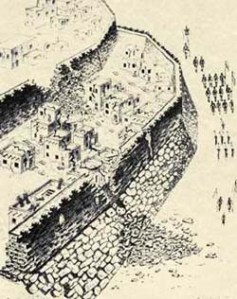
Rahab’s house would have been the perfect place for the spies 212wall_sketchto hide. They were foreigners, they were travelers, and it wouldn’t have been abnormal for them to be surreptitious (covering or disguising themselves) when entering and leaving her house. Plus, Rahab had men arriving and departing at all hours. Since she was a prostitute, many of the townspeople may have avoided her and her clientele, so it was probably the best option available for the spies.

Rahab’s house was built into the city wall. At that time, kings of various cities/countries would regularly attack each other, so many cities were built like fortresses with tall, thick walls around them and gates that could be opened or closed. The back wall of Rahab’s house was also the city wall and had a window the spies could escape from. After the gates had been shut, there would have been no other way to get out of the city.

The Faith of the Spies (24)
The main focus of this story is, rightfully, on Rahab’s faith. But, what about the faith of the spies? These men, out of faithfulness to God, and loyalty to Joshua and Israel could have been tortured and killed had they been discovered. They stayed in the home of an unclean prostitute, which was a BIG deal. (Think back over all the clean/unclean laws we just studied.) They followed the instructions of someone who was: a) a woman, b) a prostitute, c) an enemy and an pagan, and d) had no military/spy experience of her own that we know of. (Although, perhaps, in her profession, she was skilled in hiding men who were being hunted down by people on the warpath). They found an impossibly heavily fortified city. There was no human way to successfully attack it. And still, they were confident in their trust that God would somehow keep them safe and give Israel the city.

The Faith of Rahab (9-13, Romans 1:19-20, 2:14-15)
Rahab was a pagan. How could she have had faith in God? How did she even know about Him? The Bible tells us that ALL human beings have a basic knowledge of God in two ways: through creation (Rom.1) and through our consciences (Rom.2).

But Rahab knew some other things, too. She knew how God treated His children and His enemies. She had heard what God had done at the Red Sea (10)—how God had protected His children and destroyed the Egyptians. She knew how God had defeated the kings of Sihon and Og (10). She knew that out of all the gods she had ever heard of, this One was the real thing- God of heaven and earth. She knew, and she was afraid. Her fear and her defection prove her faith. If she had not believed in who God was, and that He was able to do all these things she would have had no reason to be afraid, nor would she have helped the spies and aligned herself with them against her own people.

Rahab became so convinced in her mind that God was indeed who He had shown Himself to be that she gambled everything on it. Think of what the king would have done to her if she had turned out to be wrong and had gotten caught. At the very least, she would have been killed. but as a traitor, she certainly would have been made and example of. She probably would have been publicly tortured to death, and maybe her family too. This was no small thing she did. She bet her life on a God she didn’t know. That’s the faith that saved her and led her to hide the spies and her other actions. The actions did not save her, it was the overwhelming belief in God which drove those actions.

Two Different Faiths Then (John 4:22, Luke 10:21, Deuteronomy 32:39)
There is a qualitative difference between the faith of the spies and the faith of Rahab. As Jesus said to the woman at the well, “You worship what you do not know; we worship what we know, for salvation is from the Jews.” (John 4)

The spies were God’s people. They knew Him personally. They were born into God’s house and grew up as obedient sons. They were chosen by Him and belonged to Him. They had seen Him work as eyewitnesses. They had, and knew, His word. They would have been like the older brother in the prodigal son story if he had been faithful.

Rahab, on the other hand, had none of that. She was the prodigal. She did not know God personally, but only, as an outsider, by reputation. She likely knew nothing of God’s love and promised blessings for obedience, but only of His wrath towards sinners. She was not born into God’s house; she was a pagan. She was not an obedient son; she was a woman, and as sinful a woman as she could be. She was not chosen by God and did not belong to Him. She was an outcast. She had no idea what God might do next. All she knew was that she didn’t want to die.

The spies knew. God had laid it all out for them. They were obeying God, not out of fear, but out of love.

Two Different Faiths Now
Rahab’s faith versus the spies’ faith reminds me of unchurched people coming to Christ versus churched people coming to Christ. We “spies” who were raised in church by Christian families grew up knowing all the Bible Stories, all the whys and wherefores of Jesus and salvation. It is the blessing of a godly heritage.

Rahab, like the unchurched, lived her whole life not knowing God, just doing what sinners do. When she finally heard about Him, all she had was the basics, and, knowing only that He was “Lord of Heaven and earth” (Luke) and “able to kill and make alive” (Deut.), she flung herself unashamedly on His mercy—which, at the time, she probably wasn’t sure would catch a woman like her—all because she wanted to live instead of die.

The Object and Outcome of Our Faith (Joshua 6:17, 22-25, Matthew 1:5, James 2:25)
But no matter our background or how we come to faith in Christ—Rahab or spies, unchurched or churched—the object of our faith is what matters, and the object of our faith is Christ. And because the object of our faith is the same, the outcome of our faith is also the same.

What was the outcome of this whole scenario for the spies? For Rahab? They were saved despite the destruction all around them. After it was over, they all lived in the Promised Land together. Rahab and her family became part of God’s family just like the spies were. She even got to be one of Jesus’ great, great…grandmothers (Matt.), was commended in the “Hall of Faith” (Heb. 11, above), and was cited as an example of good works giving evidence of our faith (Jas.).

God loves the prostitute just like He loves the good little girls. He sent His precious Son to save both of us and to display us as trophies of His grace.

Additional Resources
The Walls of Jericho by Answers in Genesis