

You’ve probably heard it a million times, just like I have. The old “counterfeit money” illustration about discerning false doctrine and false teachers. If you’re not familiar, it goes a little something like this:
When training tellers to detect counterfeit bills, banks don’t have them study counterfeit money. Tellers are trained to become so familiar with authentic bills that when a counterfeit bill comes their way, they immediately detect it.
This, we’re told, is THE way to learn to discern false doctrine or spot a false teacher – not by being warned about them by name or description (i.e. studying counterfeit money), but only by knowing our Bibles well (i.e. studying authentic bills).
Unless that illustration is being used as a subtle way to say, “Hey, stay away from those mean old discernment bloggers!” it’s a decent illustration, as far as it goes. It’s correct, but not complete.
And if we base our understanding of discernment on this illustration rather than on what Scripture actually teaches about discernment, we’re going to get it wrong. Scripture tells us pastors are to preach sound doctrine AND ALSO rebuke those who contradict it.
The overseer must be…holding fast the faithful word which is in accordance with the teaching, so that he will be able both to exhort in sound doctrine and to reprove those who contradict.
Titus 1:7a, 9
Rebuking, sounding the alarm, and warning against false teachers and false doctrine is one of the biblical qualifications for pastors. In other words, if a pastor doesn’t warn against false teachers and false doctrine, (i.e. doesn’t warn you and train you about counterfeits) he’s only doing half his job and is disqualified.
Likewise, saying that the only way bank tellers learn about counterfeits and counterfeiters is by handling real money is untrue. When there’s a counterfeiter on the loose, the police alert banks and businesses. There are “Wanted:” posters with the suspect’s name, picture, and M.O., if available.
The media run news stories with surveillance video and descriptions of the counterfeit bills. The police want to get the word out so banks, businesses, and citizens won’t be fooled and taken advantage of, and so the criminal can be caught and brought to justice.
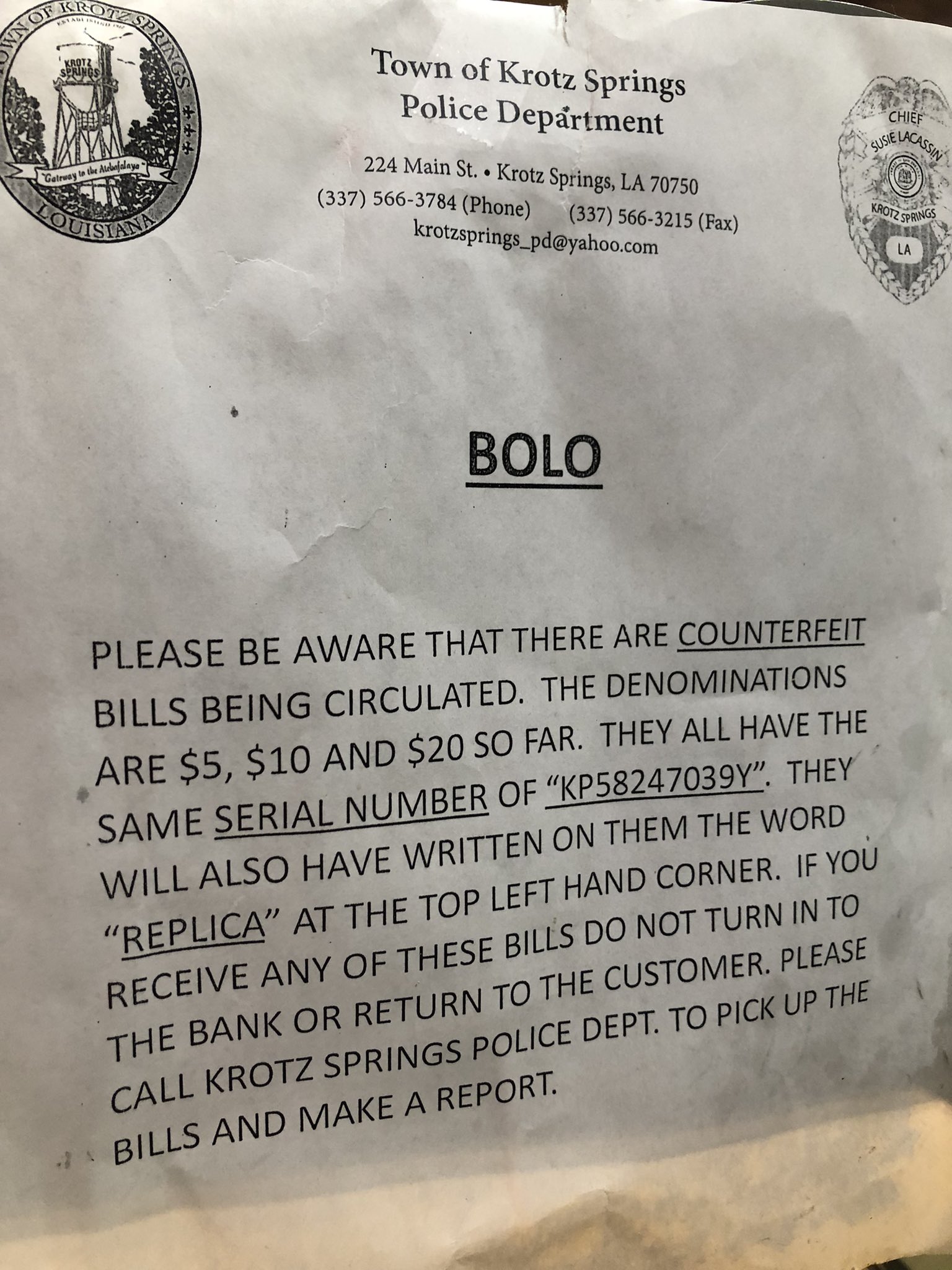
Providentially, not long ago, I spotted this “be on the lookout” (BOLO) warning from the police department of a small town near me. It was posted near a store’s cash register, where all the clerks could see it and be ready when counterfeit bills came their way.
It’s imperative that we study our Bibles and know them well. That knowledge of Scripture is like a filter that can catch all sorts of bad teaching before it has a chance to take root in our brains. But it’s only half the story. We also have to be familiar with the counterfeit teachings and teachers prevalent in evangelicalism today, and warn our churches, friends, and loved ones about them.
This is the complete picture of discernment given to us in Scripture. So, yeah, use the counterfeit money illustration to your heart’s content, but make sure you tell the whole story.
Discover more from Michelle Lesley
Subscribe to get the latest posts sent to your email.

Well said, Michelle! I pray all local churches will supply a “Wanted” poster to warn their flocks of false teachers. (Updated frequently)
Sisters, talk with those in your care to see who else they are learning from besides the local church. Especially the aged and widows need extra vigilance. They have lots of time on their hands and sometimes trust anyone wearing the Christian label.
LikeLike
I’ve always been puzzled by the “tellers only study the real money” teaching in Christian groups. I’m in my late 60’s and worked in banks when I was younger and that was simply not true. Whenever a counterfeit bill was found by a teller, it was passed around and examined by all of us – they totally used the fake bill as a teaching tool, pointing out to all of us ALL the small and not-so-small errors on it, and details that were missing from it. It was held up next to the real ones and examined. I can’t imagine banks skipping those lessons today, and I assume it’s still done the same way, and the real way it’s done actually makes a much better analogy for how we should be examing counterfeit teachings. Put them out there for everyone to see and to examine, and point out the errors, so they can see what’s wrong with them in light of the real scriptural teachings.
LikeLike
Well said, Susan! :0)
LikeLike