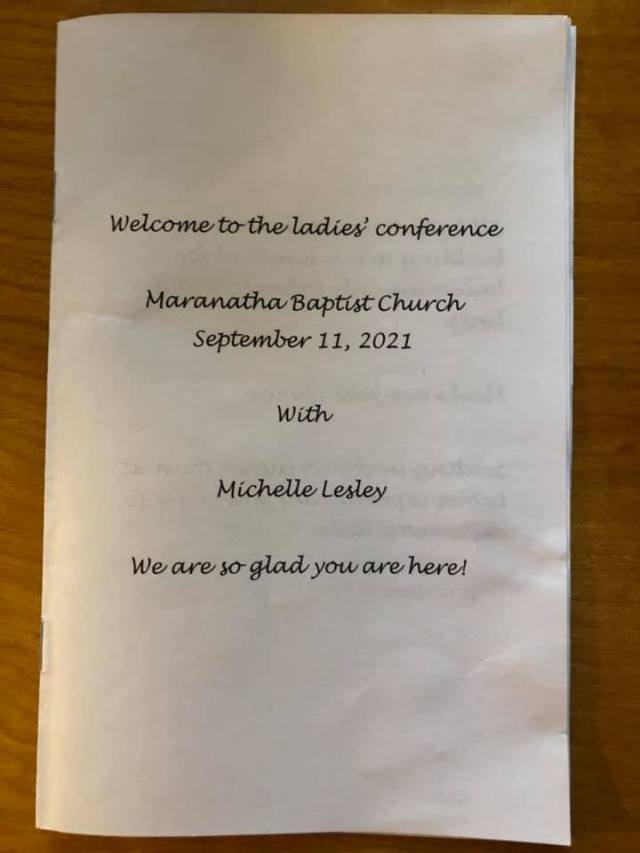
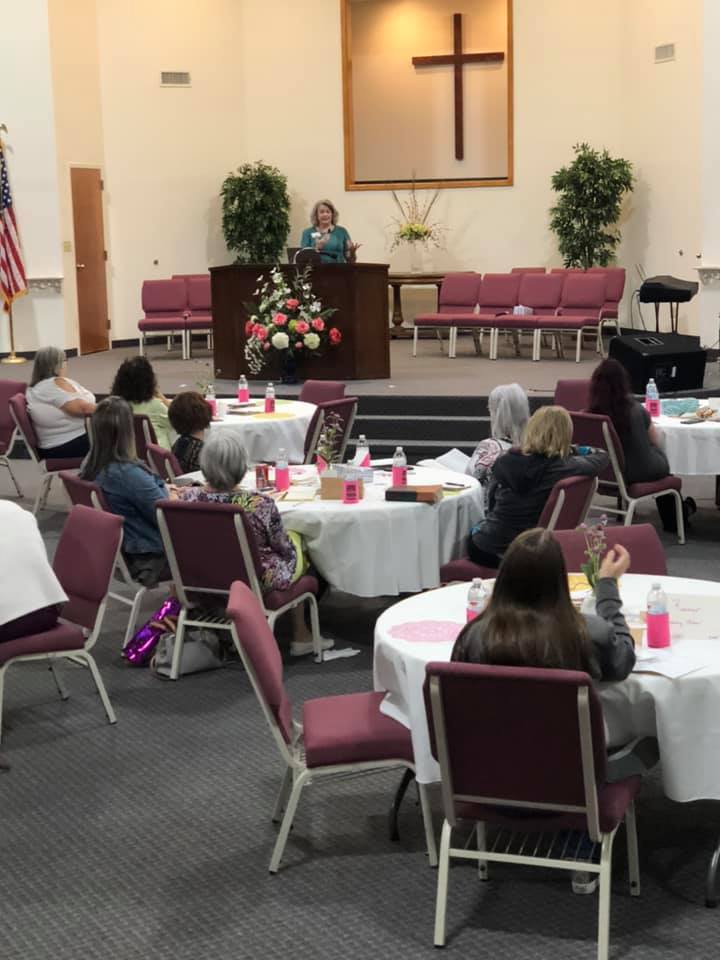
It was such a joy to be with the ladies in the Nashville, Arkansas area again at Maranatha Baptist Church’s 2021 women’s conference.
When I first saw this sign, there was a beautiful herd of cows behind it, but by the time I had a chance to take pictures, they had moooved on to greener pastures!
Last year at MBC’s conference, I spoke on biblical womanhood. This year, we tackled the topic of discernment in session one: Discernment 101: Learn to Discern. How can we tell the difference between the biblical and the cheap, unbiblical knock off? We looked at some scriptural and practical ways. Modesty seems to be a current kerfuffle in evangelicalism, so dressing our bodies while addressing our hearts was the order of business for session two. Next was a delicious chicken salad lunch (with some out of this world cookies for dessert!). And, wow, did these ladies have some smart and insightful questions in our final Q&A session!
If you like, you can listen to the audio from these teaching sessions at MBC’s Sermon Audio page as soon as they’re posted. (The modesty session was a condensed version of the three part podcast series on modesty Amy and I recorded earlier this year on A Word Fitly Spoken.)
Hostess gifts
One of the things traveling for speaking engagements has taught me is a deeper appreciation and longing for graciousness, generosity, and hospitality, which all seem to flow so naturally from the many pastors and women’s ministry directors I’ve worked with. Those are not things at which I feel I excel, but I aspire for God to grow me in those areas. My hosts, Margaret and Tom, as well as Pastor Bruce, and everyone at MBC were so kind and treated me like a queen.
Benjamin keeping us on the road.
And last, but not least, see this guy? This is my second to youngest (19) son Benjamin. Some of you may have heard me mention on the podcast (A Word Fitly Spoken), that Benjamin is our producer, which he does out of the goodness of his heart and on top of a nearly full time job, plus church responsibilities and activities. This young man insisted on taking off work to spend two full days driving me to and from the conference and serving as my handler during the trip. I didn’t have to lift a finger for anything, and had everything I needed, thanks to him. I hope I’m not embarrassing him, but I’m just so grateful to God for blessing us with such a fine, godly young man for a son.
I had an awesome trip to Arkansas, and it was such an honor to teach the lovely ladies of Nashville. Many thanks to Margaret, Tom, Pastor Bruce, and all the hard-working men and women of Maranatha Baptist Church for your sweet hospitality and for putting on such a wonderful conference. I highly recommend this warm and welcoming church to anyone in southwest Arkansas who is looking for a doctrinally sound body of Believers to join.
If your church or organization is ever in need of a speaker for a women’s event, I’d love to come share with your ladies as well. Click herefor more information.
1. Go back to lesson 3 (link above) and review your answer to the first part of question 5, Israel’s pattern of sin and repentance in 2:16-23. How does today’s passage fit this pattern? How does today’s passage fit the theme verse of Judges (21:25), “In those days there was no king in Israel. Everyone did what was right in his own eyes.”?
2. Read 12:8-15. Notice again (as we saw in lesson 4, link above) the copious details God gives us about some judges, like we’re about to see with Samson, and the sparse details He gives us about other judges, like Ibzan, Elon, and Abdon. Why do you think there’s such a discrepancy? Is this an indicator that some judges were more important or more faithful than others? Why not? Think about the things you do to serve the Lord. Do you do them for recognition and accolades, or simply because you love Him?
3. Read 13:1-7. How does verse 1 set the scene for the story of Samson? What was Manoah’s wife’s name? Why doesn’t the Bible tell us?
Who are some other women in the Bible you can think of who were barren, or functionally barren, and then conceived miraculously? How do all of these women’s miraculous conceptions serve as a type and shadow of Mary’s miraculous conception of Jesus? Particularly compare “Mrs. Manoah’s” conception story to Mary’s. What similarities do you see? What differences?
Did any of the other women who conceived miraculously, including Mary, receive the same instructions Mrs. Manoah did in verses 4-5? What is a Nazirite? What were the requirements of a Nazirite vow? (Hint: check your cross references on verse 5, then click here). Why do you suppose God set Samson apart as a Nazirite, but none of the other judges?
What does God mean in verse 5, that Samson shall “begin” to save his people? Think about the judges we’ve already studied, and keep this in mind as we continue to study Judges. Are any other judges described as beginning to save their people? Compare this statement about Samson to the angel’s statement about Jesus in Matthew 1:21. How does Samson’s mission point ahead to Jesus’ mission?
What was the first thing Mrs. Manoah did after the angel ascended? Why?
4. Read 13:8-14. Mrs. Manoah had an unbelievable story to tell. Did Manoah believe his wife? (8, 11) Did Manoah believe God? (8, 12) Compare Manoah’s response to the news that his barren wife would have a son to Zechariah’s response to the news that his barren wife would have a son. Why did Zechariah bear an even greater responsibility than Manoah to believe the Lord about this?
5. Read 13:15-20. Is it possible this appearance of the “angel of the Lord” (16) was a Christophany? Give specific evidence from this chapter and its cross references to support your answer.
Why wouldn’t the angel tell Manoah his name? (18 – Check your cross references. You may also need to do a little more digging on the significance of names and greetings in Old Testament culture.) Is there a connection between “wonderful” in verse 18 and “wonders” in 19?
What is the significance of Manoah and his wife falling “on their faces to the ground”? (20)
6. Read 13:21-25. Why did Manoah think he and his wife would die? (22) Explain how Mrs. Manoah’s explanation (23) was a good example of a wife giving wise, godly counsel to her husband. Explain Manoah’s wisdom in listening to her here and throughout today’s passage. How did Mrs. Manoah exemplify being a helper fit for her husband? How was she, as Proverbs mentions, a good thing, the crown of her husband, prudent, and more precious than jewels?
7. Carefully examine each action of Manoah and of Mrs. Manoah, as well as their words in 13:6-24. What evidence do you see that Mrs. Manoah was a godly wife, and that she submitted to her husband? What evidence do you see that Manoah was a godly husband who loved his wife? How can you tell they desired to be parents who honored and obeyed God in their parenting?
8. What does today’s passage teach us about the nature and character of God?
Homework
Back in Judges 10, we saw that the judge Jair had 30 sons who rode on 30 donkeys, and in today’s passage, 12:14 tells us Abdon had 70 sons and grandsons who rode on 70 donkeys. This might strike us as a weird little factoid to include about these judges, but is there any significance to it? What’s up with these donkeys? Grab a good commentary, study Bible, or internet search engine, and see what you can find out. Share your findings in the comments if you like.
What lessons did you learn from Manoah and his wife about having a godly marriage? How can you apply what you’ve learned to your own marriage?
I’m flip-flopping the blog schedule a tad this week. Enjoy this week’s Throwback Thursday – on Tuesday!
Originally published August 12, 2009
Thirty three per cent of clergy and thirty six per cent of laymen report having visited a sexually explicit web site. Christianity Today survey, August 2000
The divorce rate of born-again Christians (32%) is higher than that of atheists and agnostics (30%). Barna Research Group 20081
Twenty per cent of women who have abortions are born-again or Evangelical Christians. The Alan Guttmacher Institute, 1996
We rarely find substantial differences between the moral behavior of Christians and non-Christians. George Barna, Founder, Barna Research Group
You are the salt of the earth; but if the salt has become tasteless, how can it be made salty again? It is no longer good for anything, except to be thrown out and trampled under foot by men. Jesus, Matthew 5:13
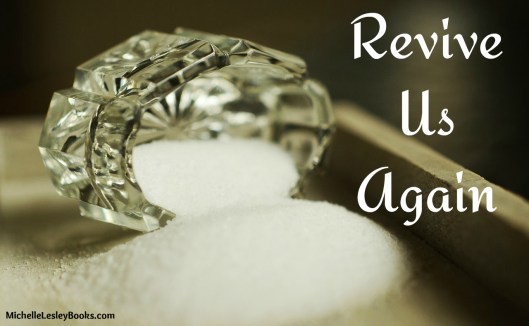
Once upon a time, when I was a little girl, my parents took my sister and me to visit some of our elder relatives. For the evening meal, the lady of the house set a beautiful, formal table, complete with lovely crystal salt cellars at each place.
Having attended approximately zero formal dinners in my decade-long, casual dining existence, I had never seen a salt cellar. Since it happened to be sitting next to my goblet of unsweetened iced tea, I presumed it was my own personal sugar bowl.
I was puzzled as to why the spoon was so tiny, but forged ahead in an attempt to sweeten my tea with spoonful after spoonful…of salt. After one swig, I realized my mistake, but to maintain decorum, I did my best to eat my meal while taking an occasional small sip of the tea-flavored salt water. It was a long dinner.
I have never been so thirsty for a fresh drink of water before—or since—that moment.
We, the body of Christ, are supposed to be salt. Look around. How are we doing? By and large, instead of the church making the world thirsty for the Living Water, we have become so worldly ourselves that we are in danger of losing our savor altogether.
The Western church, the American church, the local church, maybe even your church—is in desperate need of revival. Not a revival meeting. Revival.
Revival is not a special event to win the lost. It is a time when God’s people, both individually and corporately, humble themselves, cry out to God in repentance and return to a fresh, empowered, obedient love relationship with Him.
Aren’t you tired of seeing statistics like the ones at the beginning of this article? Tired of the church having so little impact on a lost and dying world? Tired of simply going through the motions in your spiritual life and at church? Have you ever, as I have, taken a step back, looked at your walk and your worship, and said, “There’s got to be more to the Christian life than this”?
There is more. Much more. God desires that we have a full, exciting, vibrant, dynamic relationship with Him. But it’s going to cost us. It will cost our pride, our time, our repentance, our obedience, and our priority. It will require that we become dissatisfied and uncomfortable with the status quo of complacency.
I think we’re up for the challenge.
Turn away my eyes from looking at vanity, and revive me in Your ways. Psalm 119:37
1Take these statistics with a “grain of salt”. :0) Not everyone who claims to be a “born-again Christian” in a poll actually is one, the divorce stat has subsequently been proved false, etc. The idea is that the world has infiltrated the church, and the church has embraced the world, and therefore, the behavior of way too many professing Christians is worldly.
I’m out of pocket this week, so you get a catch up week!
Catch up on any lessons you might be behind on, go back and do any of the homework you may not have had time for, review your memory verses, or if you’re already caught up, you could even read ahead in Judges a little. It’s your week to use as you see fit. Happy studying!
“Can you recommend a book on how to submit to my husband?”
“What’s a good book on biblical womanhood?”
“I’m going through [difficult life circumstance]. Can you suggest a good book on how I can cope with that?”
I’ll bet if someone did a study to find out which demographic of people reads the most books, it would be Christians. Christians are readers – there’s no denying that – and that’s a good thing.
It always makes my heart smile when a reader asks if I can recommend a good (read: biblical, and by a doctrinally sound author) book on a particular area of sanctification or a life issue she’s struggling with. That tells me she wants to learn what the Bible says and obey it. And that is no small thing in evangelicalism today.
Hear me: Reading good, doctrinally sound books is a good thing.
But – just as with any other good thing – too much of a good thing isn’t the best thing. And letting a good thing veer out of its lane isn’t the best thing.
If you dedicate twelve hours every day to prayer, you’ll never get to the laundry, the bills, the cooking, and the cleaning. If the baby is running a fever and you exegete a chapter of the Bible instead of giving her some medicine or taking her to the doctor, you’re misapplying your Bible study time.
And, while it may not be quite as obvious, we can sometimes face the same challenge with good books.
In my experience there are two general dilemmas that motivate today’s Christian to seek out a good book.
The first is: “I don’t know what the Bible says about _____ topic. I need a book that will teach me so I can correctly understand what Scripture says about it.” For example, a few weeks ago in a Mailbag article, I answered a lady who wanted to know about the eternal destiny of unborn babies who die. Among other resources, I recommended John MacArthur’s book which explains the Scriptures and theology related to that topic.
The second dilemma is: “I know Scripture teaches that Christians are supposed to _____. How do I carry that out in my day to day life?” Or, “I have this difficult situation in my life. What specific things do I do to navigate or handle it in a godly way?” For example, “How do I submit to my husband?” or, the lady from the aforementioned Mailbag article might have asked, “What should walking through the grief of losing a child look like in my daily life?”
The first dilemma is easy and appropriate to plug a book into. The second? Not so much.
Why? Because in the second dilemma we’re asking good books to get out of their lane and perform a task they’re not suited to perform: sanctification. When you’re trying to drive a nail into a board, a hammer is the proper tool for the job, not a screwdriver. You can bang on the nail with the screwdriver, and you might even drive the nail into the wood a millimeter or two, but the bottom line is, you need a hammer. That doesn’t make hammers good and screwdrivers bad, it just means you use the appropriate tool for the job at hand.
And in cases of, “Where does the rubber of Scripture meet the road of my unique, individual life?” the right tool for the job at hand – the method God has prescribed in His Word – is not reaching for a book written by man, it’s God’s sanctifying work in your heart and life. And that’s a big pot of gumbo with a lot of different ingredients in it:
Studying your Bible
Prayer- for help, for wisdom, for guidance, for strength
Obedience to the Word
Faith, trust, and utter dependence on God
Getting good counsel from godly friends and loved ones, your pastor, or spiritually mature women in your church
And the final ingredient that goes into the pot? Action. Step out on faith in God and His Word to help you and guide you, and just do it. Try. Figure it out as you go.
If you want to learn how to ride a bicycle, you’re eventually going to have to stop reading books about bicycles and get on one and ride. Feel that balance and coordination of muscle movements in your own body. Learn by doing.
And, guess what? You’re going to fall down a few times. You’re going to try things that don’t work. You’re going to sin (and repent and be forgiven). And you’ll learn and grow from that. Falling is part of the learning and growing process of sanctification.
for the righteous falls seven times and rises again, Proverbs 24:16a
The steps of a man are established by the Lord, when he delights in his way; though he fall, he shall not be cast headlong, for the Lord upholds his hand. Psalm 37:23-24
I think we believe that success is in not falling. It’s not. It’s in getting back up and learning mastery of the skill.
The Bible never says we won’t fall. It says that when we do, God is holding our hand, and He’ll help us get back up.
But learning and growing and falling can be a messy, frustrating process that takes a long time. And what we want is a fast, streamlined formula that bypasses the mess and gives us guaranteed results. And, without even realizing it, we can fall into the mindset of thinking that the right book will be the magic bullet to solve our problem. We want a book to tell us what to do to keep from falling – and we think that’s mastery or success. But it isn’t. Mastery and success come from doing, from going through the process. We want a book to tell us how to get the right answer to our problem, but while the right answer is important, the growth, maturing, and mastery of going through the process is more important to our spiritual growth.
…work out your own salvation with fear and trembling, for it is God who works in you, both to will and to work for his good pleasure.
Philippians 2:12b-13
And it’s not just that walking through the process of working out your own salvation with the Lord and His Word rather than reaching for a book is the way God has prescribed, it’s that God’s way is far superior to reaching for a book, because God’s way is divinely powered by the Holy Spirit.
When you pick up a book written by a human being, it can give you practical tips and good advice and maybe even point you to some passages of Scripture you should study. But the Bible doesn’t just tell us what to do and give us some good ideas, it is actually, literally transformative as we are reading it.
For the word of God is living and active, sharper than any two-edged sword, piercing to the division of soul and of spirit, of joints and of marrow, and discerning the thoughts and intentions of the heart.
Hebrews 4:12
The Holy Spirit moves in and around and through His Word as you’re reading it to supernaturally work to conform your heart and mind to the image of Christ. That’s something you can’t get from any other book, no matter who wrote it or how doctrinally sound it is.
And one of the most amazing things about the Holy Spirit’s supernatural work through His Word is that it’s personal. Books, by definition, have to be “one size fits all” – generally applicable to a wide audience. They can’t tell you what submitting to your husband in your marriage in your life circumstances is going to look like at 10:17 a.m. next Tuesday. But Scripture can, as God uses it to sanctify you.
But there’s one other aspect of the knee jerk, “I need a book” mindset that we need to be really careful about.
If, every time there’s an issue in our lives, our reflex reaction is to get on social media and ask for book recommendations instead of turning to the Word, prayer, and godly counsel, is that not a subtle, functional denial of the sufficiency of Scripture?
All Scripture is breathed out by God and profitable for teaching, for reproof, for correction, and for training in righteousness, that the man of God may be complete, equipped for every good work. 2 Timothy 3:16-17
His divine power has granted to us all things that pertain to life and godliness, through the knowledge of him who called us… 2 Peter 1:3a
When the Bible says it will make us complete, equipped for every good work and all things that pertain to life and godliness, that’s exactly what it means: Every. All. We do not need other books in order to handle life’s situations in a godly way. And every Believer who came along before Christian books were a thing is proof of that. Good books aren’t a bad thing, and they can be helpful, but the Bible says it is sufficient – all we need – for anything that comes our way.
But when we reach for a book before we reach for the Bible, aren’t we saying with our actions, “The Bible’s not enough. I need more. I need something better.”?
I can’t answer that for you and you can’t answer that for me, but it’s a good thing to ask ourselves and answer honestly before God.
Good, solid, doctrinally sound books aren’t the bad guy. They can be wonderfully helpful and encouraging. But let’s make sure we’re submitting to God’s prescribed methods of sanctification, esteeming and depending on God’s supernatural work in our hearts through His Word, and not accidentally eroding the sufficiency of Scripture.
Let’s be people of the Book, before we’re people of the books.