Mailbag

The Mailbag: Potpourri (Female officiant, JMac attack, Google 101…)


Welcome to another “potpourri” edition of The Mailbag, where I give short(er) answers to several questions rather than a long answer to one question. I also like to take the opportunity in these potpourrri editions to let new readers know about my comments/e-mail/messages policy. I’m not able to respond individually to most e-mails and messages, so here are some helpful hints for getting your questions answered more quickly. Remember, the search bar can be a helpful tool!


I noticed you’ve written lists of recommended teachers and false teachers. Just curious if you could help in the same way with Contemporary Christian music and artists.

I took a stab at that in my article False Doctrine in Contemporary Christian Music. I will add any CCM artists I stumble across in the future that I think need to be warned against or recommended, but I’m afraid that article is going to be the extent of any “list” of doctrinally sound or unsound Christian musicians. It’s not an issue I research much, and CCM isn’t a music genre I enjoy listening to. I’m really more of a podcast gal. I would, however, highly recommend the Additional Resources I’ve listed at the end of that article as well as the comments section.


I was recently invited to a wedding where the officiant will be a female “pastor”. I’m not close to the bride, but I honestly can’t bear the thought of attending even if we were close. Your thoughts, please?

This is really less of a biblical question than it is an etiquette question. Fortunately for all of us, I have read a lot of Miss Manners in my day :0)

Since you’re not close to her, that makes things a lot easier than if it were a family member or close friend. If the invitation contains an RSVP card, you can just send it back with “regrets” or “will not attend” (or whatever) marked and not say anything else about it.

If it’s a situation like she’s a co-worker you see face to face frequently and she asks point blank if you’re coming, you could say something, like “I’m so sorry, but I have a conflict that prevents me from attending.” It’s not necessary to go into any further detail.

If she’s pushy and presses you about it, you could either say something like, “I’m sorry, it’s personal,” or you could kindly, gently, and briefly get into the actual theology of why a woman shouldn’t be serving in the position of pastor, explain that this conflicts with your beliefs as a Christian, and that you wouldn’t feel comfortable attending. Ask God to give you wisdom as to what is the best approach with this particular person.

Just bear in mind, a social invitation isn’t a subpoena and it’s really nobody’s business why you won’t be attending.


Can a church use Hillsong or Bethel/Jesus Culture music in the worship service as long as the lyrics of the particular songs that are selected don’t conflict with the Bible?

If I were queen of the evangelical world and it were up to me to make a binding law about this, my answer would be no. No church would use any music by any heretical organization or doctrinally unsound musician. I briefly addressed my reasons for this in my article False Doctrine in Contemporary Christian Music:

It’s imperative for churches to be discerning about the CCM they use in worship. If Jane Churchmember hears a CCM song in church and likes it, she’s likely to Google the song (probably right there in church- I’ve done it!), find out who sings it, and begin following that artist. Worship pastors who use CCM have a responsibility to vet the artists who perform the songs they select for the worship service to make sure they’re not sending Jane into the arms of a heretic. Additionally, music costs money, and you don’t want your church’s offerings supporting false doctrine.

I think the principles and Scriptures in this article generally apply to this question as well: Four Reasons Why It Matters Who We Share, Pin, and Re-Tweet


Today on Facebook, I saw a post saying John MacArthur is a false teacher. Can you enlighten me please? After being part of your blog and being more discerning of who I read, I’m bummed. I even purchased the John MacArthur ESV Study Bible on your recommendation and also read the Grace To You blog.

Let me start by saying this: Just because someone (including me) says a certain teacher is a false teacher doesn’t mean you should automatically believe her.

I can assure you that John MacArthur is not a false teacher. In fact, he is one of the finest and most doctrinally sound teachers out there today, and I highly recommend him. But you shouldn’t just blindly take my word for that any more than you should just blindly take the word of the Facebook post you saw that says he is a false teacher. You shouldn’t believe anything in Christianity because a person says so, but because the Bible says so. Every Christian should be discerning about every sermon she listens to, every book she reads, and every pastor or teacher she follows, including the pastor at her own church. We must each practice biblical discernment for ourselves, comparing everything to rightly handled Scripture and discarding anything that doesn’t match up to what the Bible says in context.

I’m not familiar with the Facebook page you mentioned by name in your e-mail, but my guess is that it is a group that incorrectly and unbiblically believes that Reformed theology (or Calvinism) is false doctrine. John MacArthur is a Calvinist, so naturally they believe he is a false teacher. They’re judging his sound doctrine by their own false doctrine. That’s what people who hold to false doctrine do. Extreme anti-Calvinists believe Calvinists are false teachers, New Apostolic Reformationists believe doctrinally sound cessationists are false teachers, Catholics believe that Protestants are false teachers, and so on. It helps to know what kind theology (or false theology) someone is coming from when he labels a person as a false teacher.

I would encourage you to do the biblical work of discernment for yourself. Compare John MacArthur’s materials to Scripture and be convinced by God’s written Word whether or not you should follow him.

Here are a couple of articles I think you will find helpful on this issue:

Clinging to the Golden Calf: 7 Godly Responses When Someone Says You’re Following a False Teacher

Is She a False Teacher? 7 Steps to Figuring it Out on Your Own


You had this Google result that talks about Kelly Minter supporting gay marriage:

I have searched the Internet and your website and I can’t find it. I’m thinking of doing her Bible study on Nehemiah but don’t want to do it if this information is true so I need to see her exact quote myself in order to decide.

This is the first time I’ve received a question like this, but it concerns me that a lack of understanding of how Google works might lead someone to think I’ve said something I haven’t, and if there are others out there who are drawing the same kinds of conclusions as this reader just because they need a little help understanding the mechanics of Google, I’m glad to give a little tutorial.

It looks like you may have Googled something like “Does Kelly Minter support homosexual marriage?” but didn’t click on my article that popped up.
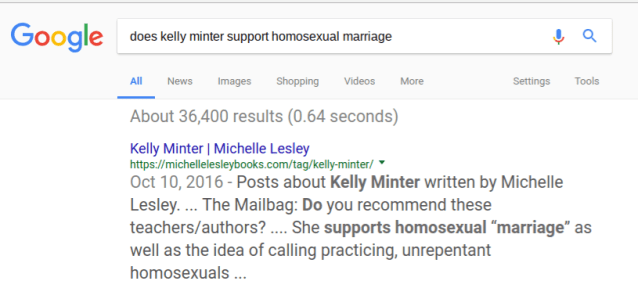
(Here’s the top result I got when I Googled the phrase “Does Kelly Minter support homosexual marriage”.)

When you Google something, Google pulls the key words from your search and that’s what it displays in boldtype in the result. You have to click on the article and read it to get the full picture.

Here is the direct link to my article that contains information about Kelly Minter. My article doesn’t say Kelly Minter supports homosexual marriage, but there is another teacher in the article who does. Your Google result pulled Kelly Minter’s name from the section on her and the “supports homosexual marriage” phrase from the section on Rachel Held Evans.

To my knowledge, Kelly Minter does not support homosexual marriage, however, I would still urge you not to use her materials for the reasons given in the article. Just because someone doesn’t support homosexual marriage doesn’t mean everything else she’s teaching is biblical, and this is certainly the case with Kelly Minter. Her materials would be detrimental to your spiritual growth. I would strongly recommend that you simply pick up the Bible and study it for yourself rather than relying on someone else’s book.

You might find the “Popular False Teachers” tab, “Recommended Bible Teachers” tab, and “Bible Study” tab (all at the very top of this page) helpful.


If you have a question about: a Bible passage, an aspect of theology, a current issue in Christianity, or how to biblically handle a family, life, or church situation, comment below (I’ll hold all questions in queue {unpublished} for a future edition of The Mailbag) or send me an e-mail or private message. If your question is chosen for publication, your anonymity will be protected.

Sanctification, Sin

6 Reasons to Recapture Righteous Anger

Do you ever get the sense that anger is a problem in the church these days? It’s more apparent if you’re on social media, but even if you’re not you’ve probably seen Christians acting in anger in your church and Christian groups you belong to. Maybe even among your Christian family and friends.

In the evangelical social construct today’s Christian women have built and immersed themselves in where “being nice” is the highest attribute we can attain to, anger – any anger whatsoever – is usually seen as sin. The antipode of the sweet, effervescent, always-positive, don’t-rock-the-boat church ladies we’re “supposed” to be.

In the evangelical social construct today’s Christian women have built and immersed themselves in where “being nice” is the highest attribute we can attain to, anger – any anger whatsoever – is usually seen as sin.

Time to pick up the biggest rocks we can find and smash that pretty pink stained glass window, ladies.

The problem with anger in the church is not anger itself, but that Christians get angry about the wrong things instead of the right things, and act on that anger – sometimes even anger over the right things – in the wrong way. There are many things Christians should be angry about. Indeed, if Christians got angry about the things we’re supposed to get angry about and acted on that anger in a biblical way, the church would be better – and more Christlike – for it. But what are the right and godly reasons for getting angry and acting on that anger?

If Christians got angry about the things we’re supposed to get angry about and acted on that anger in a biblical way, the church would be better – and more Christlike – for it.

1.
Anger Is an Attribute of God

No character trait God exhibits can ever be considered intrinsically sinful because God is holy and perfect. God displays anger numerous times in the Bible, yet we know God is without sin. Therefore, we know that the emotion of anger itself is not a sin. It can’t be, or that would make God a sinner, and, by definition, not God. God’s anger demonstrates for us that there are times and situations in which anger is holy and good, and that there are godly ways to act on that anger.

God’s anger demonstrates for us that there are times and situations in which anger is holy and good, and that there are godly ways to act on that anger.

2.
Imago Dei

People are made in the image of God. The creation reflects – albeit dimly and sinfully – the Creator. No one has to teach us how to feel anger or love or justice or desire. Those things are just there, hard wired into us from the womb simply because we’re image bearers. Our sin nature is where the train jumps the tracks with those attributes, because sin causes us to apply those attributes to the wrong objects (loving an idol, desiring someone else’s spouse) and to express those attributes in wrong ways (vengeance, abuse).

3.
Multi-Tasking Attributes

God is simultaneously perfect in love, power, wrath, kindness, compassion, anger, justice, mercy, grace, patience, and all His other attributes. When we see Him pouring out His wrath, that doesn’t mean His attributes of love and compassion have disappeared. When God executes judgment, that doesn’t mean He has ceased to be a merciful and patient God. All of God’s attributes are 100% present and potent all of the time. And – though filtered through our sinful flesh – the same is true for Christians. Expressing anger over the right things in a godly way does not cancel out the fact that you’re also loving, kind, patient, peaceful, or joyful. God created us to reflect His nature by simultaneously exhibiting His attributes in a godly way.

God created us to reflect His nature by simultaneously exhibiting His attributes in a godly way.

4.
Symbiotic Anger

How can we know whether we’re getting angry over the right things or the wrong things? It is right and good to be angry over the things that anger God – idolatry, the defaming of His name, false doctrine, sin in the church, people who harm or take advantage of the innocent and vulnerable, dishonesty, cruelty, deception, the failure to do what is right – first and foremost when we see these sins in our own hearts and lives, but also against others who perpetrate these sins. But we may not be angry for sinful reasons such as pride, selfishness, impatience, self-righteousness, inflexibility, greed, hate, bigotry, lust, and personal preferences. What the Bible shows God getting angry about we should be angry about, too.

What the Bible shows God getting angry about we should be angry about, too.

5.
Anger Versus Sadness

A few months ago on social media, I mentioned an incident in which a male member of a certain church sinfully took advantage of several female members of that church. Without exception, every Christian woman (and many of the men) who commented on the incident made the statement (or some variation of it), “That’s so sad.” There are many aspects of a sinful situation over which it’s appropriate to feel sad. It was right to feel sad for this man’s completely innocent wife and children, as well as his victims and the church, who all suffered as a result of his sin. Jesus wept over the effect sin had on His beloved Jerusalem and the rift that sin created between God’s people and Himself. But, interestingly, both Matthew and Luke show us an instance of Jesus’ sorrow over sin immediately preceding or followed by an instance of Jesus’ anger over sin. It’s fine to feel sad for the people who innocently suffer as a result of someone else’s sin. It’s godly to grieve over the general effects and ultimate consequences of sin. But don’t stop there. We should also be angry at sin and at those who blaspheme the name of God and harm others by committing sin. The biblical instances of God being angry over sin and those who perpetrate it far outnumber the instances of God grieving over the effects of sin. Sadness is good, but it shouldn’t replace godly anger toward sin.

Sadness over sin is good, but it shouldn’t replace godly anger toward sin.

6.
Harness the Wild Stallion

Up until now, we’ve mostly been looking at the emotion of anger, but the emotion of anger usually leads to action. The fact that the emotion usually leads to action doesn’t mean the emotion always should lead to action. Sometimes it shouldn’t lead to action at all. Sometimes it shouldn’t lead to action right away. Sometimes it shouldn’t lead to action from you, but from a more appropriate person.

But most of the time, if you’re experiencing righteous anger over the right things, that godly anger should motivate you to take godly action using godly methods. And one of those godly methods is understanding the difference between letting the wild stallion of anger tear madly around the corral and putting a bit and bridle in its mouth to harness and guide all of that energy into plowing a field or pulling a wagon. Venting your anger to a friend might make you feel better temporarily, but it does nothing to fix the problems created by the sin you’re angry about. Harness your anger with the fruit of the Spirit and use that anger as a tool to energize and motivate you to help the victims of sin, call the sinner to repentance, set up a plan to prevent this sin from happening again, and repair the damage done by sin.

How often do you become righteously angry over sin? When you hear a false teacher twist God’s Word, do you blow it off as no big deal? Does it faze you at all when church members refuse to submit to your pastor’s biblical leadership? Do you lend an ear when your best friend verbally eviscerates her godly husband to you?

Ladies, there are things WORTH getting angry about. Righteous anger is not a bad, unloving, or unladylike thing.

Ladies, there are things worth getting angry about. Righteous anger is not a bad, unloving, or unladylike thing. If someone intentionally hurt your child, you would come unglued because you love him so much. What does it say about our love for the Lord when we defend people who mock Him, give the benefit of the doubt to those who defame Him, or yawn apathetically when people rebel against Christ and His Word? When someone blasphemes the name of the holy God of the universe, the Savior who willingly endured the cross for your sin, why wouldn’t you get angry about that? When someone attacks, betrays, or perpetrates evil upon a fellow image bearer – especially if that person is a brother or sister in Christ – you are right to be angry at both the sin and the sinner.

Anger over sin and evil is good and holy. God exhibits anger over sin and evil, and we, as His image bearers, should share His indignation. When Christians are angry over the right things and use that anger to fuel a godly response to sin it makes the church more biblically healthy and grows it to greater Christlikeness.

When Christians are angry over the right things and use that anger to fuel a godly response to sin it makes the church more biblically healthy and grows it to greater Christlikeness.

Uncategorized

Our Next Bible Study…And a Contest!

Happy Wednesday, Ladies! I hope you all enjoyed our study of the book of Mark. I’m not starting a new study today for a couple of reasons:

1) To allow a bit more time to catch up for those who might be behind in Mark.

2) I wanted to do something a little different to kick off our new study, the title of which is…


The Women of Genesis
☙☙☙☙☙☙☙☙☙☙☙

Over the next few months, we’ll read through the entire book of Genesis, stopping along the way to give special attention to women like Eve, Sarah, Rachel, and others. We’ll examine their roles in biblical history, how their stories point us to Christ, and what we can learn from them as Christian women, wives, or mothers today.

Here’s where you (or maybe a friend) come in…

You’ve probably noticed that I design a title picture for each Bible study I write. Here are a few past title pics:

(You can see the rest of them at the Bible Studies tab, if you like.)

And as I was contemplating a title pic for The Women of Genesis, I thought it might be fun to get some of y’all involved in the design process.

Do you enjoy and have a knack for photo editing? Know someone who does? If so, I’m accepting submissions for title pictures for The Women of Genesis study. If your submission is chosen it will be used each week of the study, and you’ll be credited (name or web site) by watermark. I’d love to be able to offer a huge cash prize, but, hey, we’re small potatoes here. This is just for fun and maybe a little publicity for your site, if you have one.

Contest Guidelines

☙ You must use images that don’t require attribution. Pictures you’ve taken yourself are fine, as are images from sources such as Pixabay, Pexels, Freely, Unsplash, StockSnap, or other free stock photo web sites. Please include the image source web sites you use along with your submission. (You cannot just grab and use any old picture off the internet. Photographers own their images and usually require permission, attribution, and often a fee, for their use.)

Title pics should be landscape (a horizontal rectangle) with a width of 640-1500 pixels and proportionate height. I prefer JPG images, but PNG is fine, too, if necessary.

☙ Your title pic must contain the full title of the study: The Women of Genesis.

☙ If your submission is selected, I’ll be glad to watermark it with your web site address (please submit your picture without any watermarks) as long as your web site doesn’t conflict with my statement of faith or my beliefs outlined in the Welcome tab.

☙ Deadline for submissions is 11:59 p.m. Monday, November 6, 2017. 

E-mail your title pic submission along with your full name, web site address (if any), and the source(s) you used for your image(s) to MichelleLesley1@yahoo.com.

☙ Please don’t be offended if your submission isn’t selected. If I peruse all the submissions and I’m just not “feeling it,” I may still elect to design one of my own.

Feel free to share this around with friends who have an interest in photo editing. If you want to take a whack at it for fun but don’t know where to start, play around with Be Funky, PicMonkey, or Canva and see which one works best for you. Think about the book of Genesis and try to capture the feeling of the title, The Women of Genesis, in your image.

Happy designing!