
Pop Theology, Prayer

Pop Theology ~ The Bottle

Pop Theology- the bottle


Dear Pop Theology-

I keep seeing Christian pages post this video, but I was wondering, does this bottle prayer thing match up with what the Bible says?

Signed,

Praying for an Answer

Well, what about it, Pop? Could you give us any reasons why this might not be a biblical way to learn about prayer?
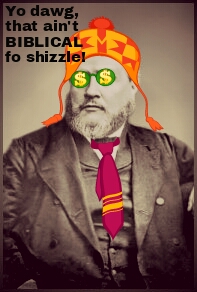
Spurgeon dawg

Lemme lay it down for ya homies:

1. No one has the right to put words in God’s mouth. When you hear someone say, “God says _____,” the only thing that blank can safely be filled in with is Scripture. Otherwise, you’re turning God into a ventriloquist’s dummy and making Him say what you want Him to say. (Deuteronomy 18:21-22, Ezekiel 22:28, Jeremiah 14:13-16).

The truth is, things DON’T always become clear to us on this side of Heaven. Talk to a woman whose husband has abandoned her, or someone in chronic pain, or a parent who has lost a child in an accident. There are things in this life that are painful, dark, and confusing, and no where in Scripture does it say that God owes us an explanation for them or that things will “become clear.”

Did you notice the gentleman in the video didn’t use a single Bible verse to back up his “God says____,” or “Things will become clear,”  statements? That’s because he can’t. Scripture doesn’t teach this. It’s just his opinion.

What Scripture DOES promise Christians is that, even in the darkest times, Christ will never leave us nor forsake us (Hebrews 13:5), that God can use even the worst difficulties for the good (Romans 8:28), that even our Master learned obedience through suffering (Hebrews 5:8), and that when we trust God (regardless of whether or not we get what we want), He will keep us in perfect peace (Isaiah 26:3).

2. Where does Scripture say that “in order for Him to really begin to do the work that YOU want done” you have to “take the limitations off”? It doesn’t. Prayer isn’t about us maneuvering and manipulating God to get Him to do what we want Him to do. Prayer is about US getting on the same page with GOD’S agenda. Us submitting to His will. Us trusting Him regardless of the outcome. It’s not about the work that we have to do (and no matter how holy it might sound, all the “ya gotta…ya gotta…ya gotta” stuff in this video is work) to force God’s hand. The gentleman in the video makes it sound like everything rests on YOU and that if you’ll just pray hard enough, long enough, and with enough faith, everything will work out the way you want it to.

And if things don’t work out, guess whose fault it is? Yours. Because you didn’t have enough faith, or you didn’t pray long enough, or whatever. That’s a Word of Faith false teaching. It is not what the Bible teaches.

The Bible says that God is in the Heavens and does whatever He pleases (Psalm 115:3), that His ways and thoughts are higher than ours, not the same as ours (Isaiah 55:8-9), and that when we pray, we don’t have to feel anxious. Prayer is to produce peace (Philippians 4:6-7), not worry over whether we’ve said the right things or said them long enough (Matthew 6:7-8). Even our perfect, sinless, holy Jesus, when He prayed in Gethsemane before going to the cross, said “NOT My will, but Yours, be done.” (Matthew 26:39).

3. Watch this video again, paying attention to HOW the liquid in the bottle becomes clear. Who, in this analogy, initiates the action? You. Who does all the work? You. (You take off the lid, you put the bottle in the sink, you turn on the water, you make sure the bottle is in the right place, you readjust the bottle to make sure you’re getting the result you want, you decide when it’s clear enough.) So who gets the glory if everything works out the way you want it to? You.

God says He will not share His glory with another (Isaiah 48:11), and that HE is the one who wills and works for His good pleasure (Philippians 2:13).

Ladies, if you want to know how to pray, a video like this featuring a guy who dares to speak for God outside of, and in conflict with, Scripture and doesn’t offer a single Bible verse to teach you about one of the most important aspects of the Christian life is not the way to go.

Don’t believe somebody just because what he says makes you feel good and he has a cool visual aid. Instead, if we want to know how to pray, we need to go straight to the horse’s mouth. That’s what the disciples did when they wanted to know how to pray (Luke 11:1-4), and here’s what Jesus told them in Matthew 6:7-13:

And when you pray, do not heap up empty phrases as the Gentiles do, for they think that they will be heard for their many words. Do not be like them, for your Father knows what you need before you ask him. Pray then like this:

“Our Father in heaven,
hallowed be your name.
Your kingdom come,
your will be done,
on earth as it is in heaven.
Give us this day our daily bread,
and forgive us our debts,
as we also have forgiven our debtors.
And lead us not into temptation, but deliver us from evil.

If that was good enough for Jesus, it should be good enough for us. Ya feel me?

Prayerfully,

Pop


Uncategorized

Jonah- Lesson 7: Redeemer

Hope you’re enjoying our rerun of the Jonah Bible study. Here is lesson 7.

Michelle Lesley's avatarMichelle Lesley

Jonah 1:17-2:7


Well, Jonah had finally belly-flopped right into his brick wall.  No more running.  If he wanted any chance at living, he had no choice but to fling himself at the foot of  God’s throne, own up to everything, and beg for mercy.  And that’s just what he did.  Once he caught his breath, that is.  And in order to do that, he needed a self-contained underwater breathing apparatus, circa the Iron Age.  Which God graciously provided.

Now, a lot has been written about just what kind of fish or aquatic mammal this was that swallowed Jonah.  There’s been speculation that it was this kind of whale or that kind of shark, or that maybe it was some kind of unknown sea creature.  There are scientists who say that the story of Jonah couldn’t possibly be true because there isn’t a whale or fish alive today that’s anatomically…

View original post 712 more words

Old Testament, Sunday School

Hezekiah: Who Are You Going to Believe? ~ Sunday School Lesson ~ 8-3-14


Hezekiah
Photos courtesy of: Stickerish.com, WUTT on YouTube.com, and Amazon.com

These are my notes from my ladies’ Sunday School class this morning. I’ll be posting the notes from my class here each week. Click here for last week’s lesson.

Through the Bible in 2014 ~ Week 31 ~ July 27- Aug. 2
Isaiah 44-66, 2 Kings 18:9-21:26, Psalm 46, 80, 135
Hezekiah: Who Are You Going to Believe?

2 Kings 18:1-8
This first part of the chapter sets the stage for everything we subsequently learn about and from Hezekiah. Even though he had a despicable, idolatrous example for a father (King Ahaz), Hezekiah somehow turned out to be a godly man and king. Could it have been the way his mother raised and taught him? Possibly. (The Zechariah mentioned in v. 2, is not the prophet in the book of the same name.) It could also have been one of the priests or Levites brought in to train him as part of his childhood education. Scripture doesn’t tell us specifically, but we should never discount the importance of a godly mother or teachers, and we should strive to take hold of every opportunity we have to impact children’s lives for Christ.

At any rate, Hezekiah was off to a good start. Notice that this passage talks much more about Hezekiah’s relationship with the Lord than his actions for the Lord. It says, “he did what was right in the eyes of the Lord” (3), “he trusted in the Lord,” (5). He held fast to the Lord, did not depart from the Lord, and kept the Lord’s commandments (6). “And the Lord was with him.” (7)

His actions followed his faith: he tore down idol worship paraphernalia, rebelled against the king of Assyria, and struck down the Philistines.

9-12
This passage continues to set the stage by reminding us that during the first few years of Hezekiah’s reign in Judah, the king of Assyria captured Samaria (capital of Israel) and carried Israel away to Assyria because they had rebelled against God.

13-16 (2 Chronicles 20:12)
Sennacherib (king of Assyria after Shalmaneser, who had captured Israel) wasn’t wild about Hezkiah rebelling against him, so he attacked Judah and captured all the stronghold cities except Jerusalem (the capital), which was next on the hit list.

What was godly, faithful Hezekiah’s response. Did he pray? Seek out Isaiah or another prophet or priest for godly counsel? No. Here, Hezekiah showed us an example of what we are not to do. Before, we read that Hezekiah did what was right in God’s eyes. Here, he simply reacted to his circumstances in the way that was right in his own eyes, the way that was most expedient and practical. It was exactly what his father and others before him had done when they became vassals of Assyria or other kings. Instead of following in their footsteps, he would have done better to pray as his predecessor Jehoshaphat did:

“O our God, will you not execute judgment on them? For we are powerless against this great horde that is coming against us. We do not know what to do, but our eyes are on you.” (2 Chron.)

What determines our response?
When we face an impossible situation like Hezekiah did, we have two options: we can let our circumstances dictate our response, or we can let God’s word dictate our response. Hezekiah didn’t consult God’s word. So, since he didn’t know what God would have him do in this situation, his only remaining option was to let circumstances dictate his response.

17- 37 (Isaiah 30:7, 10:5-6)
What happened? The 11 tons of silver and 1 ton of gold that Hezekiah sent Sennacherib, king of Assyria weren’t good enough for him. So Senaccherib sent his goon squad over to make Judah an offer it couldn’t refuse.

The Rabshakeh (commander) did his best to demoralize and talk Hezekiah’s men into surrendering. Notice that he didn’t really have to lie to them very much. Much of what he said was actually true:

Egypt was weak and would be of no help in fighting off Assyria (21,24). In fact, Isaiah had already told them this (Is. 30).

Even if Assyria herself supplied Judah with horses for battle, Judah was still too weak to defeat even the weakest of Assyria’s troops, so Egypt certainly wouldn’t be of any help. (23-24)

Whether the Rabshakeh knew it, or was just boasting and stumbled on the truth, Assyria was to be God’s arm of wrath against his people (25). Judah knew this because Isaiah had already told them (Is. 10)

From man’s point of view, and in his own flesh, Hezekiah would lose this battle and the people would be carried off to captivity in Assyria (29-32).

The false gods of the other nations had not been able to save them from Assyria (33-35).

But the truth was mixed with falsehood and fallible human wisdom:

The Rabshakeh didn’t know that the places of idol worship that Hezekiah had torn down were to false gods, not the true God. (22)

God might have been against Judah, but he wasn’t with Assyria (25).

The Lord is trustworthy and able to defeat any enemy (30, 32b, 35).

Hezekiah’s officials delivered the message to him. Would he believe the Rabshakeh? Would he react the way he did last time?

19:1-7
Hooray for Hezekiah! This time, he responded the right way. The first thing he did was to grieve before God and head to His house to pray (1). The second thing he did was to send his staff to Isaiah to seek God’s word. (2-4).

And what was God’s word? Do not be afraid; this dude’s going down. (6-7)

8-13
The Rabshakeh left and went back home only to find Sennacherib fighting with one kingdom and under impending attack from another. So, just to let Hezekiah know he hadn’t forgotten about him, Sennacherib sent another threatening message: “I may be busy right now, but I’m still coming for you. And don’t forget– none of the gods of these other countries saved them and your God isn’t going to save you.”

Hezekiah had a choice to make. Who was he going to believe, the Rabshakeh or God? The Rabshakeh had said a lot of stuff that was true. He even said that God had sent him. It would have made sense to listen to him, do what he said, and surrender.

14-34
But that’s not what Hezekiah did. He again turned to the Lord in prayer. While he was praying, Isaiah heard from the Lord, who reiterated and expanded on his earlier promise: God would defeat Assyria in this battle, and would even give Hezekiah a sign that confirmed His word.

35-37 Even though it seemed reasonable to believe Sennacherib, and even though he had talked about God sending him, Hezekiah chose to believe God’s word. He believed God’s word even though the situation seemed impossible. Even though he was scared. Even though it didn’t make sense.

Who are we going to believe?
God calls us to do the same thing as believers. We encounter a lot of situations these days in which people say things that seem to be reasonable, might even be true, and tell us they come to us in the name of the Lord:

“Pastors” and “theologians” who tell us that evolution or homosexuality or abortion or female pastors/teachers (of men) are OK with God, or that the Bible isn’t infallible.

Christians who tell us about trips to Heaven they have taken or “God told me ______” even when it conflicts with Scripture.

But no matter how strong the evidence might appear to be or how convincing the argument, it all comes down to this question:

Who are we going to believe?

Are we going to believe fallible, sinful human beings, or are we going to believe God’s word, even when it’s hard, even when we don’t fully understand it?

For Christians, SCRIPTURE ALONE is our final authority for what to believe, think, and do. It doesn’t matter what we (or someone else) have personally experienced, what our feelings or opinions are, what science says, what conventional wisdom says, or what political correctness says. God’s word stands, and let the chips fall where they may.

Sanctify them in the truth; your word is truth. John 17:17

This God—his way is perfect; the word of the Lord proves true; he is a shield for all those who take refuge in him. Psalm 18:30


Uncategorized

Jonah- Lesson 6: God’s Way, Without Delay

Here’s lesson 6 in our rerun of the Jonah Bible study.

Michelle Lesley's avatarMichelle Lesley

Jonah 1:10-17

Sometimes when we read Bible stories, we tend to forget that these were real, flesh and blood people, just like us.  They were living out all these events just like we live our own lives—in the moment—with no fore-knowledge of what was going to happen next. 

The fact that Jonah was a prophet did not mean that he could see into the future about every event in his own life.  So, it’s worth reminding ourselves here that when Jonah told the sailors to pick him up and throw him into the sea, everyone involved probably assumed he was going to die.  They had no idea it was lunch time and Moby Dick was looking for an all you can eat buffet.  All they knew was that it was a bad storm and they were out in the middle of the sea.  Not a prime survival situation.

The sailors…

View original post 692 more words