Mailbag

The Mailbag: Potpourri (Christian online platforms…Home church…”I lost my temper”…Send in your pix!)

Welcome to another โ€œpotpourriโ€ edition of The Mailbag, where I give short(er) answers to several questions rather than a long answer to one question.

I like to take the opportunity in these potpourri editions to let new readers know about my comments/e-mail/messages policy. Iโ€™m not able to respond individually to most e-mails and messages, so here are some helpful hints for getting your questions answered more quickly. Remember, the search bar (at the very bottom of each page) can be a helpful tool!

Or maybe I answered your question already? Check out my article The Mailbag: Top 10 FAQs to see if your question has been answered and to get some helpful resources.


I wanted to ask your opinion on which web host would be suitable to use for an online business? I have an online store and I currently use WIX, however, I recently found out they monetarily fund and support LGBTQ events and such. I don’t want our money going to support that. I did a lot of research and prayed, but I can’t for the life of me find a provider that is conservative. I know there will most likely be things I don’t agree with with pretty much any worldly web hosting company, but where do I draw the line? Is God okay with paying a web host who uses their funds to support anti-Biblical issues? I’m convicted of continuing to use WIX and I don’t want to continue with them. I originally left ETSY for the same reason. I just don’t know where to move my website! I would need an e-commerce provider too since I sell stuff. If you don’t mind me asking, who do you use? I see your website is Word Press, but I know you need a host for that too.

(Readers, if you have any suggestions of conservative and/or Christian blog or e-commerce platforms, please leave a comment at the end of this article.)

I completely sympathize with your dilemma. I don’t like my money going to support sinful causes like perversion, abortion, liberal politics, etc., either. You’re right, I do use WordPress for the blog, but they host it themselves. I don’t have a separate host, and I don’t do e-commerce, so I’m afraid I don’t have any practical suggestions there.

You’re correct, pretty much everything you pay for, whether it’s an online platform, the gas you put in your car, your pooch’s favorite dog food, even the device you’re reading this on right now, is owned or produced by a secular company that’s donating to or financing something that’s biblically objectionable. Even most so-called “Christian” companies probably support people or ministries that aren’t doctrinally sound. In practical terms, finding a company to patronize that doesn’t contribute to something unbiblical is almost as unlikely as finding a mermaid or a unicorn.

I can’t tell you where to draw the line – that’s a conclusion you (and your husband, if you’re married) will have to come to through prayer and listening to your biblically informed conscience – with each company you consider, but I think you may find some of the principles in my article The Mailbag: Should Christians Participate in Boycotts? to be helpful.

“Is God okay with paying a web host who uses their funds to support anti-Biblical issues?” Well, consider this – It’s not precisely the same thing as buying a product or service from a private company, but Jesus paid the temple tax, and we know from His clearing of the temple, His many rebukes of the scribes and Pharisees, and the fact that the temple leadership had Jesus crucified that He was well aware of the evil that tax money ended up supporting. And when the Pharisees asked Jesus, “Is it lawful to pay taxes to Caesar or not?” while their motive was to trap Jesus, the basis of this particular question they chose was probably similar to the basis of your question (not saying you’re a Pharisee – please don’t misunderstand): “Should God’s people give money to a pagan who does ungodly things?”. And Jesus’ answer was that they should pay their taxes. Like I said, it’s not exactly the same thing because taxes are an obligation and blog platforms are not, but it is something to study and consider.

Pray about it, trust God to guide you, and don’t sin against your conscience. You may also want to take a look at the principles for decision-making in my article Basic Training: 8 Steps to Finding Godโ€™s Will for Your Life.


My husband and I live in Canada. When the government placed our small town under lockdown due to COVID, not one church here remained open. Now that things have opened back up slightly, we are hesitant to join ourselves to a church that might, at any given time, close their doors at the whim of our government officials. Additionally, there are very few churches in our area and we have doctrinal concerns about all of them. But this leaves us without a church home.

We have started meeting together on the Lord’s Day with nearly 30 other like-minded brothers and sisters. We fervently seek the Lordโ€™s wisdom and guidance and do not want to be disobedient in any way. We want to please the Lord in our worship together. My husband and I never conceived of starting a church, we just wanted to obey our Lord in continuing to gather as the church body when the โ€œchurch institutionโ€ failed us. Iโ€™m desperate for guidance and have no idea where to turn to for help.

Well, sister, I’ve got good news for you. You do have a church home. You have a home church church home. When the church started out in the book of Acts, it existed in the form of groups of like-minded believers who met together in homes, often in secret, hiding from a persecutory government. The church is not the building, but the body of Believers meeting together in person for the study and preaching of the Word, baptism, the Lord’s Supper, prayer, worship, fellowship, and practicing the “one anothers”. In many parts of the world home churches are still the normal expression of the church due to persecution, and as persecution continues to increase, so will the underground church.

I’ve never started a church either, but let me see if I can point you to some resources that can help:

First, go to the Searching for a new church? tab in the blue menu bar at the top of this page. Next:

  • Carefully comb through every single church search engine listed there to make absolutely sure you haven’t overlooked a doctrinally sound, established church within achievable driving distance of your house. (Home churches can be very susceptible to false doctrine, so you want to make every effort to join yourself to an established, doctrinally sound church if at all possible.)
  • If there simply does not exist an established, doctrinally sound church you can get to (even if it may not be terribly convenient) each week, scroll down to the “Church Planting” section, get in touch with Grace Advance, explain your situation, and ask them for help. Church planting is what they do, and I’m certain they can give you better guidance than I can.
  • As you’re going through this process of getting in touch with Grace Advance and following their counsel, read through all of the information under What to look for in a church (especially the links in the second paragraph of Six Questions for a Potential Church), so the men leading your home church understand, and perhaps can begin codifying a doctrinal statement on these issues for your home church. It may also be helpful to visit the websites of churches you know to be doctrinally sound and read through their statements of faith (sometimes called “doctrinal distinctives,” “what we believe,” “what we teach,” “constitution and by-laws,” etc.).

May God richly bless you and your church.


I recently lost my temper with a store employee and made a scene over something very stupid. It is a large corporate store and not one I frequent often, but this young woman is most likely from my surrounding area, and thus, I feel like I did not treat a neighbor well. I have prayed and asked God to forgive me for shaming His name and for treating another person badly for something that was not her fault. What else can I do? I feel terrible. I let my emotions overcome me, and it was completely unbecoming of a Christian woman.

Wow, praise God.

No, seriously…this is something to praise God for. Praise God that He convicted you of this sin. That’s one of the evidences that you’re a Believer and that the Holy Spirit is working in your life. Praise God that your heart is tender to that conviction and you want to do what’s pleasing to Him. Another evidence that you’re a Believer. Praise God that through Christ’s sacrifice on the cross, He has indeed forgiven you for this sin and you stand righteous before Him. (You do need to accept and believe His forgiveness if that’s part of the reason you’re still feeling terrible.)

I would suggest you go back to the store, locate the employee, repent to her and ask her forgiveness. I would also suggest taking a small “peace offering,” like a gift card to a local coffee shop or maybe a batch of brownies you’ve made. You could also include a tract or a small gospel booklet. Frame your apology to her in a gospel-centered way, and, hopefully, this will turn into a witnessing encounter.


This last one isn’t a question submitted by a reader, but rather a request from me! :0)

If you or your women’s Bible study group are working through one of my Bible studies, I’d love it if you’d send me a picture of yourself or the group studying or discussing it. And if you could somehow include the title image for the study (see below) in the picture – maybe with everybody gathered around the image on a screen, or everybody holding it up on their phones, or print out a copy of the image and hold it up, or something like that – that would be fantastic. (These pictures will probably be shared on my blog and/or social media, so make sure everybody in the picture is OK with that.)

You can email the pictures to me here.

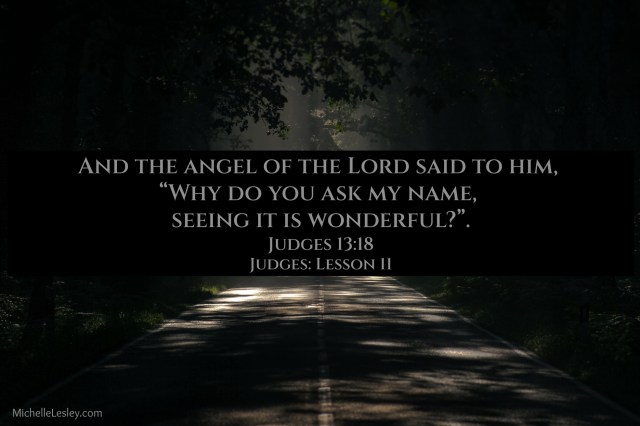
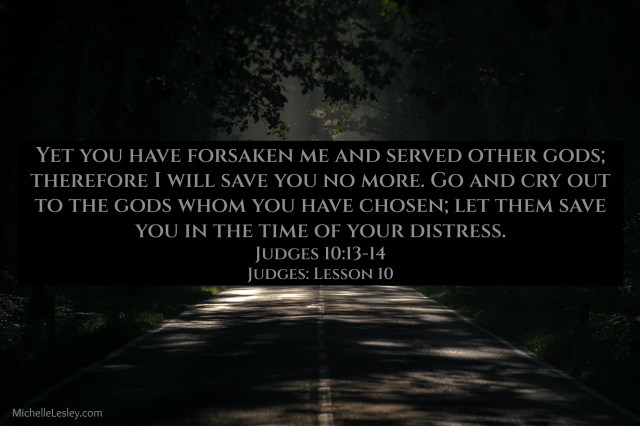
These are the title images from some of my studies. You can find them at the top of each lesson:

You can always find all of my Bible studies at the Bible studies tab in the blue menu bar at the top of this page.

Thank you!


If you have a question about: a Bible passage, an aspect of theology, a current issue in Christianity, or how to biblically handle a family, life, or church situation, comment below (Iโ€™ll hold all questions in queue {unpublished} for a future edition of The Mailbag) or send me an e-mail or private message. If your question is chosen for publication, your anonymity will be protected.

Judges Bible Study

Judges ~ Lesson 11

Previous Lessons: 1, 2, 3, 4, 5, 6, 7, 8, 9, 10

Read Judges 12:8-13:25

Questions to Consider

1. Go back to lesson 3 (link above) and review your answer to the first part of question 5, Israel’s pattern of sin and repentance in 2:16-23. How does today’s passage fit this pattern? How does today’s passage fit the theme verse of Judges (21:25), “In those days there was no king in Israel. Everyone did what was right in his own eyes.”?

2. Read 12:8-15. Notice again (as we saw in lesson 4, link above) the copious details God gives us about some judges, like we’re about to see with Samson, and the sparse details He gives us about other judges, like Ibzan, Elon, and Abdon. Why do you think thereโ€™s such a discrepancy? Is this an indicator that some judges were more important or more faithful than others? Why not? Think about the things you do to serve the Lord. Do you do them for recognition and accolades, or simply because you love Him?

3. Read 13:1-7. How does verse 1 set the scene for the story of Samson? What was Manoah’s wife’s name? Why doesn’t the Bible tell us?

Who are some other women in the Bible you can think of who were barren, or functionally barren, and then conceived miraculously? How do all of these women’s miraculous conceptions serve as a type and shadow of Mary’s miraculous conception of Jesus? Particularly compare “Mrs. Manoah’s” conception story to Mary’s. What similarities do you see? What differences?

Did any of the other women who conceived miraculously, including Mary, receive the same instructions Mrs. Manoah did in verses 4-5? What is a Nazirite? What were the requirements of a Nazirite vow? (Hint: check your cross references on verse 5, then click here). Why do you suppose God set Samson apart as a Nazirite, but none of the other judges?

What does God mean in verse 5, that Samson shall “begin” to save his people? Think about the judges we’ve already studied, and keep this in mind as we continue to study Judges. Are any other judges described as beginning to save their people? Compare this statement about Samson to the angel’s statement about Jesus in Matthew 1:21. How does Samson’s mission point ahead to Jesus’ mission?

What was the first thing Mrs. Manoah did after the angel ascended? Why?

4. Read 13:8-14. Mrs. Manoah had an unbelievable story to tell. Did Manoah believe his wife? (8, 11) Did Manoah believe God? (8, 12) Compare Manoah’s response to the news that his barren wife would have a son to Zechariah’s response to the news that his barren wife would have a son. Why did Zechariah bear an even greater responsibility than Manoah to believe the Lord about this?

5. Read 13:15-20. Is it possible this appearance of the “angel of the Lord” (16) was a Christophany? Give specific evidence from this chapter and its cross references to support your answer.

Why wouldn’t the angel tell Manoah his name? (18 – Check your cross references. You may also need to do a little more digging on the significance of names and greetings in Old Testament culture.) Is there a connection between “wonderful” in verse 18 and “wonders” in 19?

What is the significance of Manoah and his wife falling “on their faces to the ground”? (20)

6. Read 13:21-25. Why did Manoah think he and his wife would die? (22) Explain how Mrs. Manoah’s explanation (23) was a good example of a wife giving wise, godly counsel to her husband. Explain Manoah’s wisdom in listening to her here and throughout today’s passage. How did Mrs. Manoah exemplify being a helper fit for her husband? How was she, as Proverbs mentions, a good thing, the crown of her husband, prudent, and more precious than jewels?

7. Carefully examine each action of Manoah and of Mrs. Manoah, as well as their words in 13:6-24. What evidence do you see that Mrs. Manoah was a godly wife, and that she submitted to her husband? What evidence do you see that Manoah was a godly husband who loved his wife? How can you tell they desired to be parents who honored and obeyed God in their parenting?

8. What does today’s passage teach us about the nature and character of God?


Homework

  • Back in Judges 10, we saw that the judge Jair had 30 sons who rode on 30 donkeys, and in today’s passage, 12:14 tells us Abdon had 70 sons and grandsons who rode on 70 donkeys. This might strike us as a weird little factoid to include about these judges, but is there any significance to it? What’s up with these donkeys? Grab a good commentary, study Bible, or internet search engine, and see what you can find out. Share your findings in the comments if you like.
  • What lessons did you learn from Manoah and his wife about having a godly marriage? How can you apply what you’ve learned to your own marriage?

Suggested Memory Verse

Judges Bible Study

Judges ~ Catch Up Week

Previous Lessons: 1, 2, 3, 4, 5, 6, 7, 8, 9, 10,

Iโ€™m out of pocket this week, so you get a catch up week!

Catch up on any lessons you might be behind on, go back and do any of the homework you may not have had time for, review your memory verses, or if youโ€™re already caught up, you could even read ahead in Judges a little. Itโ€™s your week to use as you see fit. Happy studying!

Judges Bible Study

Judges ~ Lesson 10

Previous Lessons: 1, 2, 3, 4, 5, 6, 7, 8, 9,

Read Judges 10-12:7

Questions to Consider

1. Go back to lesson 3 (link above) and review your answer to the first part of question 5, Israel’s pattern of sin and repentance in 2:16-23. How does today’s passage fit this pattern? How does today’s passage fit the theme verse of Judges (21:25), “In those days there was no king in Israel. Everyone did what was right in his own eyes.”?

2. Read 10:1-5. Notice again (as we saw in lesson 4, link above) the copious details God gives us about some judges, like Gideon, and the sparse details He gives us about other judges, like Tola and Jair. Why do you think thereโ€™s such a discrepancy? Is this an indicator that some judges were more important or more faithful than others? Why not? How might this help us understand, especially in light of todayโ€™s evangelical celebrity culture, that neither fame nor obscurity are a measure of a Christianโ€™s faithfulness to the Lord or effectiveness in the work of Kingdom?

3. Read 10:6-16. Why does God consider idolatry such an egregious sin for His people? How is idolatry the opposite of glorifying God? How is idolatry harmful for those who practice it?

Compare 10:10 with 10:15-16. Did Israel put away their idols and worship God when they first cried out to Him? Compare this to the “godly grief” and “worldly grief” over sin in 2 Corinthians 7:8-11. Have you ever exhibited worldly grief over your sin instead of godly grief? What was the result?

What was the point God was making to Israel in 10:11-14? In today’s world, even many professing Christians would say that God was being harsh and unloving in what He said because of His tone and His words. Is this true? Explain why what God said to Israel in these verses was, in fact, loving. What did it lead Israel to do in 10:15-16?

4. Read 10:17-11:28. Explain in your own words what is going on here. (Use your cross-references for help.) Why did the king of the Ammonites say he was making war on Israel? (11:13) Did he have his facts straight? (11:14-23) How long ago had all of this taken place? (11:26)

Compare 11:24 with 10:11-14. Try to see this potential war and the battle for land through the eyes of both the Ammonites and the Israelites, who viewed their gods / their God as the commander in chief of their military – the one who led them into battle, gave them victory over the enemy, and gave the conquered land into their hands. What is the message of today’s passage about God’s supremacy over all other gods? His power compared to their power? How should this realization have caused Israel to remain faithful to God? How might this realization have converted some of the Ammonites and other pagans to faith in the one true God?

5. Read 11:29-40. Describe in your own words what is happening in this passage. The heading for this passage is “Jephthah’s Tragic Vow”. Why was his vow tragic? Does it seem from the text that it occurred to him that a family member might be first to come out?

Did God approve of human sacrifice? Did God approve of people breaking their vows to Him? How could Jephthah have handled this entire situation in a godly way instead of in the way he handled it?

The text of this passage supports the theory held by some theologians that Jephthah did not actually slay his daughter, but instead offered her as a “living sacrifice,” never to marry and have children, but to serve the Lord full time in the temple for the remainder of her life. Read these articles: Did Jephthah sacrifice his daughter to the Lord? and Jephthah’s Daughter and see what you think. Is the evidence stronger for Jephthah slaying his daughter or for dedicating her to serve in the temple?

If Jephthah slew his daughter, compare his sacrifice with Abraham’s near-sacrifice of Isaac. Were there any similarities between these two events? How were they different? Why do we consider Abraham’s willingness to sacrifice Isaac to be heroic, but Jephthah’s sacrifice of his daughter to be sinful and tragic? How does Abraham’s sacrifice point to Christ’s sacrifice for us, but Jephthah’s sacrifice was more akin to sacrificing children to false gods?

If Jephthah dedicated his daughter as a “living sacrifice” to serve full time in the temple, compare her service and her sacrifice to God’s call to Christians to offer our bodies as a living sacrifice.

6. Read 12:1-7. Shades of lesson 8 (link above)! Why is Ephraim always getting perturbed at not being called up to join in the battle du jour?

7. Think about some of the “shining knight” types of heroes and “happily ever after” victories outside the book of Judges, for example: Moses leading Israel out of slavery after the ten plagues, David defeating Goliath, Solomon building the temple, Elijah and the defeat of the prophets of Baal. Compare these to some of the “dark heroes” and “tarnished victories” we’ve seen (and will continue to see) in Judges so far. Deborah – a woman. Jael – the glory for the victory goes to a woman. Jephthah – the son of a prostitute (in a culture in which family pedigree was crucial). Jephthah’s sacrifice of his daughter and battle with his fellow Israelites after defeating the Ammonites. How does this add to the feeling of the heaviness, darkness, and pervasiveness of sin that permeates the book of Judges?


Homework

We’ve noted before that God always preserves a remnant of those who are faithful to Him. A least a few Israelites must have been faithful to the Lord during the time described in 10:6-16. How do you survive these times of crushing oppression – knowing you’re not guilty of the sin that brought it on – if you’re an Israelite who’s faithful to the Lord? Put yourself in that godly Israelite woman’s sandals, yet with access to today’s Scriptures. Which passages do you turn to for comfort and strength? Which of God’s attributes do you meditate on? How do you pray?


Suggested Memory Verse

Judges Bible Study

Judges ~ Lesson 9

Previous Lessons: 1, 2, 3, 4, 5, 6, 7, 8,

Read Judges 9

Questions to Consider

1. Go back to lesson 3 (link above) and review your answer to the first part of question 5, Israel’s pattern of sin and repentance in 2:16-23. How does today’s passage fit this pattern? How does today’s passage fit the theme verse of Judges (21:25), “In those days there was no king in Israel. Everyone did what was right in his own eyes.”?

2. Briefly review lesson 8 (link above) to set the scene for this weekโ€™s passage.

3. Read 1-2. Who were Jerubbaal and Abimelech? (1) Was Gideon’s son supposed to rule over the people? (2) Who was supposed to rule over them? Before you read any farther in chapter 9, think about this: The book of Judges is a case study of what happens when people reject God’s authority over their lives in favor of their own authority over their lives. How has that worked out in Judges so far? How do you think that’s going to work out for Abimelech and the people of Shechem in Chapter 9?

How did that work out for you before you got saved? Consider that every time you sin, even as a Christian, you are rejecting God’s authority (His commands in His Word) in favor of your own (“I’ll do what I want.”). How does that work out for you, even as a Christian?

4. Read 3-21. Who was Baal-berith? (4) Explain (16-20) the parable Jotham told in 7-15. What was the message he was trying to get across to the people of Shechem and to Abimelech? Had the people of Shechem “dealt well with Jerubbaal and his house and have done to him as his deeds deserved”? (16)

Compare Jotham’s courage and actions (16-21) to his father Gideon’s courage and actions. Consider Jotham’s (21) and Gideon’s actions to protect themselves and minimize danger to themselves at the hands of evil men while / after doing the right and godly thing. Does this indicate cowardice or prudence? Why?

5. Read 22-57. Summarize, in your own words, the plot line of this story. How does God’s justice bookend (23-24, 57) this story and point to God as the perfectly just judge? How does this story drive home the point that God should have been the One to rule over the people? That they should have submitted to His rule and authority instead of trading it for their own rule and authority?

The “Tower of Shechem” (46) and the “strong tower” of Thebez (51) were reinforced, military towers. Many fortified cities of the time built these towers for the exact purpose we see in this passage – so that, if the city were under siege, its leaders (and often the majority of the town, see verses 49, 51), could lock themselves into it and, hopefully, survive the onslaught. Those inside the tower had the advantage of height and could shoot (arrows) or throw things (53) down onto the enemy. Those attacking the tower had the disadvantage of being exposed in an open area. How does this knowledge help you better understand passages like these?

Compare 52-54 – Abimelech’s shame over a woman killing him – with God crediting women – Deborah and Jael – instead of Barak, with the victory over Sisera (lesson 5, link above). Does Abimelech’s shame help you get even more of a sense that the story of Deborah is not a “girl power” story but a “man up” story?

What was the “curse of Jotham ” (20) mentioned in verse 57?

6. “Bible trivia” question: Where else in Scripture is the event in 52-54 described, and why is it mentioned there? (Check your answer here.)


Homework

Verse 23 says that “God sent an evil spirit”. Does this indicate that God somehow approves of evil or that God instigates sin or forces people to sin? Consider how evil Abimelech and the leaders of Shechem already were and how many evil spirits were already hard at work in their lives and this situation. How can you tell from the text that this particular evil spirit mentioned in verse 23 was not inciting anything that was against the will of Abimelech or the men of Schechem?

Look up the cross-references for verse 23. Since God is completely sovereign over every aspect of the universe, can evil spirits (demons) go anywhere or do anything without God permitting them to do so? Think about all of the demons that must be at work in the world today. Are any of them acting outside of God’s control? Upon comparing verse 23 and its cross-references, can you see how these references to God “sending” an evil spirit are simply pulling back the curtain a bit on the spiritual realm to give us a glimpse of how God specifically uses a particular evil spirit in a particular situation?


Suggested Memory Verse