
Mailbag, Prayer

The Mailbag: Help! Our ladies’ prayer meeting is a disaster!

I am married to a pastor of a small SBC church. Every Sunday evening I have a 30-minute prayer time for the ladies of the church. It feels like a disaster! Women ramble on and on with “prayer requests” that really seem to be either gossip or current news events. When it comes time to actually pray, I’m the one who is praying and everyone else is completely silent. Recently, the women were so out of control with talking that they didn’t even notice when I said it was time to pray, so I canceled the prayer meeting until further notice.

I know praying together as sisters couldn’t be a bad thing, but what do I do if it seems like no one else is actually praying? Am I giving up too soon? And just to be clear I’ve tried different “formulas” for the meeting (having specific scriptures that we pray, having a specific theme for the prayer, etc.).

Oh dear sister, I’m so sorry for your frustration! I have led a few ladies’ prayer groups myself, and I know it isn’t easy. If I could offer you one word of encouragement, though – your ladies are showing up! One of my dilemmas was having ladies who didn’t see prayer as important enough to even come to a prayer meeting. You’ve got them there – that’s a huge hurdle that’s out of your way.

But once you’ve got them there, what do you do with this gaggle of gals? Let’s see if we can figure that out together.

A few things I’m surmising from your e-mail:

First, I’m guessing you’re a sweet, younger lady and that at least some of the ladies in your group are 10+ years older than you are. (Even if I’m wrong, I’m going to go with this for a minute because there are probably some ladies reading this who are in that dynamic.)

Trying to lead ladies who are older than you are can be intimidating, especially when you have the added pressure of your husband being the pastor – you want to reflect well upon him and not be the cause of any issues he would have to deal with. If your personality is very easy going and less assertive, that’s going to add to the challenge and result in things like the ladies ignoring you when you say it’s time to start praying.

Another dynamic that’s probably affecting your group is that at least some of the ladies are there mainly because you’re the pastor’s wife, and they either feel a sense of duty to be there or they want to support you with their presence because they love you, or both. Neither of which are bad things, because it’s getting them to show up (and, hey, a little love and support never hurts, right?). But it may mean that prayer isn’t the primary reason some of them are there.

The way you describe the ladies’ talking, behavior, and “prayer requests” leads me to believe that they probably don’t know how to pray in a corporate prayer meeting, especially one that’s not an “organ recital” (all the prayer requests revolve around people who are sick, having surgery, etc.). Sadly, this is pretty typical for SBC churches in my experience.

The extensive conversing may also signal that these ladies are starved for meaningful fellowship with one another.

So taking all of that into consideration, here are a few thoughts I had:

🙏 I think taking a hiatus was a good idea. It will give you time to regroup and reorganize your approach. My counsel would be that as long as you have ladies who are willing to attend, it’s too soon to give up (assuming, of course, that your husband is in agreement with that).

🙏 Set aside a block of time to talk this through with your husband and ask his advice. Just by virtue of being a man, he has a different perspective than you do, and probably has some helpful ideas and suggestions. As your pastor, he likely has additional insight on the ladies in your group, as well as some leadership strategies and experiences that could be beneficial to you.

🙏 When you start the group up again, you might want to consider, if it’s possible, having your husband lead for a couple of months. It’s just a fact of life that people act differently around pastors than they do around others. My guess is that your ladies will sit quietly and attentively for your husband. If you can develop that habit in them over the course of a couple of months, it will be easier for you to step in with more confidence and assertiveness when you resume leading the group.

🙏 Find an older godly lady who has experience teaching and leading women’s classes and ask her to mentor you. 

🙏 If that older godly lady is one of your church members, and you and she are both willing, maybe it would work for her to lead the group for, say, six months to a year while you attend as a participant. That could be helpful in two ways: a) You could learn by observing her leadership, and, b) You could model for the other ladies what it should look like to be a participant in this group, and they could learn from your example.

🙏 It sounds like these ladies need to be discipled regarding what prayer is and how to do it. Instead of immediately diving back into praying when you start the group back up, consider taking a few months to study prayer together first. You’re welcome to use any of my articles on prayer (I’d recommend this one and this one in particular.) Or, you could take them through my Bible study: Sweet Hour of Prayer: Learning to Pray from the People of Scripture. And be sure to check the bookstores at GTY and Ligonier.

🙏 It also sounds like your ladies need more structure and guidance. One thing you might want to do is dispense with the verbal sharing of prayer requests as it’s traditionally done and restructure that aspect of the meeting. There are several different ways you can do this:

⇒ You decide the prayer focus (praying for the lost, missionaries, revival, an upcoming church event, etc.) for each week. Write down specific things to pray for – nearly verbatim, if you have to – on an index card or piece of paper and hand one to each lady as she comes in. For example, if you’re praying for missionaries, give the name of the missionary and a few needs he has.

⇒ Homework assignments. At the end of each meeting, tell the ladies what the prayer focus will be for the next week, give each one a card with a different aspect of that topic, ask her to be praying about it during the week and to come prepared to pray aloud about it at the next meeting. For example, if you’re going to be praying about VBS next week, the cards might say things like leaders, teachers, students, gospel presentation, safety, etc.

⇒ “Conversation prayer“. This works really well with children and people who are inexperienced with corporate prayer. Basically, what you’re doing is replacing prayer request time with praying for the request as it’s mentioned. You open with a brief prayer. After that, the floor is open for anyone to pray about anything they would ordinarily have mentioned as a prayer request. The only catch is, they have to keep it to three sentences, max (You’ll want to stress this rule and remind them of it often). This keeps the prayer time from being dominated by long-winded people, and it introduces an idea others can build on in prayer which encourages more people to participate. Additionally, it takes the pressure off of those who are nervous about praying out loud. For example, one person might pray, “Lord, please comfort and strengthen Sally in the death of her husband,” which might prompt the next person to pray, “Please provide for her material needs now that she’s without George’s income,” and the next: “Please show us ways we can minister to Sally.” There are going to be long silences at first. That’s OK. Wait it out. When it’s time to wrap up, you lead the closing prayer.

⇒ Guided conversation prayer. Same as conversation prayer, but more structured. You choose a few areas of prayer focus and let the ladies know what they are before the prayer time begins. Open in prayer, introducing the first topic. The floor is now open for anyone to pray up to three sentences on that topic (and, of course, people can pray more than once if they want to, but only three sentences at a time). When it’s time to move on, announce the next topic or pray a brief prayer introducing it.

⇒ Small group prayer. If you have enough people, break them into groups of 2-4, and assign each group a topic to pray about. When the groups start getting quiet, hand them another topic to pray about. (Be sure you’re giving them plenty of time to pray, though. I’ve been in prayer meetings using this method where the leader hops from one topic to the next so fast that the first person in the group doesn’t even finish praying before the topic is changed.) For a 30 minute meeting and groups of 2-4, I’d recommend no more than 3-4 topics for each group.

🙏 If you think lack of fellowship might be a factor in the ladies’ behavior, there is nothing wrong with making the last “prayer meeting” of each month a low key fellowship – a “three weeks on, one week off” kind of thing – where they have the unprogrammed space to just sit and talk (and snack – gotta have snacks!). Fellowship is vital to the life of the church, and, believe me, as they get to know each other better and bear one another’s burdens, they will bring more things to the table to pray about during the three weeks of prayer meetings.

🙏 Most importantly, you pray. Pray for patience and confidence as you lead. Pray for each of the ladies in your group. Pray that God will grow them in maturity in prayer. Pray that He will help everyone stay focused. Pray that those who are timid will be emboldened and that God will rein in those who have a tendency to dominate. Prayer is an area of spiritual growth, and only God can produce that growth. Ask Him to.


If you have a question about: a Bible passage, an aspect of theology, a current issue in Christianity, or how to biblically handle a family, life, or church situation, comment below (I’ll hold all questions in queue {unpublished} for a future edition of The Mailbag) or send me an e-mail or private message. If your question is chosen for publication, your anonymity will be protected.
Basic Training, Prayer

Basic Training: 8 Things You Need to Know about Prayer

For more in the Basic Training series, click here.

When I was a little girl, I remember one of my Sunday School teachers saying, “Prayer is just talking to God.” With all the complex, confusing, convoluted, and even conflicting resources out there today on prayer, that sounds rather simplistic to our adult ears, but it’s still the best definition of prayer I’ve ever heard. Prayer is, indeed, simply talking to God.

And, along with studying God’s word and being a faithful member of a local church, it’s one of the three legs of the stool we call sanctification, or growth in Christ. Yet prayer is the leg that tends to be most neglected in our churches, our families, and our personal walk with the Lord.

Why is that? Why don’t we want to sit down and just talk – no frills, no weird machinations, just talk – to the most interesting, powerful, loving, and kind Being in the universe? If you received an invitation to sit down and chat with the President, your favorite celebrity, or a long lost loved one, you’d jump at the chance, right? I would, too. So what is it about our broken brains and hardened hearts that causes us to say, “Nah, not today,” to a simple monologue with our King? Those broken brains have learned some unbiblical things about prayer, and those hardened hearts have some ungodly attitudes toward prayer.

1. We don’t NEED God enough
Western Christians are pretty prosperous and self-sufficient people. We don’t have to cry out to God to provide food so we don’t starve. We have jobs and grocery stores. We don’t have to pray that we won’t be arrested for reading our Bibles or going to church, because that’s not happening where we live (yet). Except in the most dire of circumstances, we don’t have to plead with God to heal. We have doctors, hospitals, and medicine. Don’t get me wrong, those are all tremendous blessings, but one of the pitfalls of being blessed is that we start trusting in the blessing rather than trusting in the Blesser. And when that happens, we tend to pray less often and more superficially. Daily prayer is part of our battle to be dependent on God.

2. We’re idolaters
My husband’s uncle used to say, “You do what you want to do.” In other words, you spend your time and resources on the things you value most. I’m a Type A personality: workaholic, git ‘er done, ain’t got time to die. One of the reasons I neglect my own prayer time is that I don’t want to take time out of my busy schedule to stop and do nothing but pray. When I operate that way, I’m demonstrating that I don’t want to pray- that I love something else more than I love obeying God and spending time with Him. That’s idolatry.

3. We don’t trust God and His prescribed methods
When we’re in need, when we want to commune with God, when we want to grow in holiness, God’s way is for us to pray. Not climb the highest mountain or offer some amazing sacrifice or fulfill a bunch of items on a checklist- pray. But, to our fleshly hearts, this just doesn’t compute. It’s not enough. We’ve got to conjure up our own efforts and do something worthy of God acting on our behalf. Our hearts don’t trust God enough to simply take Him at His word, bring all of our requests to Him, and believe that He will take care of us. We don’t pray because we don’t trust God to follow through on His Word.

4. “Fervency” in prayer is qualitative, not quantitative
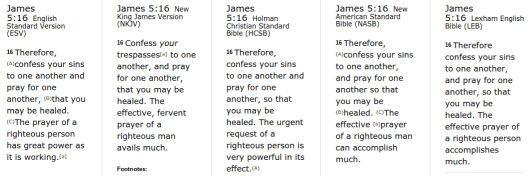
Sometimes we get it into our heads that being “fervent” in prayer means we have to constantly voice that prayer over and over in order to get God to give in and do what we want Him to do. But God’s provision isn’t dependent on our prayers. He truly does know what we need before we ask. In other words, you could stop praying right this minute for that thing you desperately want, and never pray about it again, and God is not going to forget that that’s what you want, or move it to a lower priority level on His prayer-answering list, or punish you by denying your request simply because you stopped praying about it. There are things God blesses us with that we’ve never spent a moment praying for. There are things we stop praying for that God finally gives us years later. And there are things we pray constantly for that God says “no” about. God is going to do what is best for you and what brings Him the most glory, and that doesn’t hinge on whether you pray about that specific thing every day or not. “Fervency” doesn’t mean repetition. It means an intense trust and dependence on God to do what is right in His eyes in response to your prayer. Sometimes it helps to examine a few good translations side by side:

5. Prayer isn’t a letter to Santa Claus
Back in the stone age of my childhood there used to be this thing called the Sears catalog. It was kind of like Amazon, but on paper. Every year, a few months before Christmas, they would publish their “Wish Book” edition that had all the toys in it. My sister and I would go through that catalog and circle all the things we wanted for Christmas and then hand it back to my parents, hoping that, this year, we’d get everything we asked for (and we asked for practically everything).

If this is how you approach prayer, you’re doing it wrong. God is not looking for you to provide Him with a list of stuff your greedy little heart desires so He can wrap it up in a bow and leave it under your tree. He’s not a wish-fulfillment center.

6. Weird stuff and unbiblical beliefs- knock it off
♦ Prayer is not a two-way conversation. We talk to God through prayer. He talks to us through His all-sufficient Word. Yes, while you’re praying, the Holy Spirit may remind you of Scripture that’s relevant to what you’re praying about, or bring to mind someone you should pray for, or you might think of a way you can help or bless someone, but prayer is not a dialogue. You don’t say your piece and then sit there and wait for God to say something back. That’s often called listening prayer or contemplative prayer, and it’s unbiblical. Likewise soaking prayer, sozo prayer, etc. In fact, if you see the word “prayer” preceded by an adjective not found in Scripture, it’s most likely not biblical.

♦ Prayer doesn’t require any special accessories. You don’t need to draw a circle to stand in, build a “war room,” blow a shofar, stroke a prayer cloth, or lay your hands on a prayer list, picture, object, etc. Scripture doesn’t tell us to do any of these things, and many of them are patently unbiblical.

♦ Prayer is not about you doing something, it’s about humbly beseeching God to do something. Nowhere in Scripture does God say that the purpose of prayer is for us to assert any power over anything through our words. He does not give us the authority to “bind” Satan, demons, or anything else, or “decree” or “declare” anything as though we could make something happen by doing so. These are false and unbiblical teachings of the heretical Word of Faith and New Apostolic Reformation movements.

7. Watch your language
♦ Having a “private prayer language” (speaking in “tongues”) as it is practiced today has zero basis in Scripture. None. When the disciples point blank asked Jesus to teach them to pray, there wasn’t a single “honda shonda” in His instructions, and nothing in Scripture says your prayers will be more meaningful to you or more likely to be heard by God if they’re in gibberish than if they’re in your native, real language.

♦ If you grew up fundie or old school, you might feel like you have to use “King James” lingo when you pray. You don’t. If you want to use “thee’s” and “thou’s” when you pray, you can, but you don’t have to. You can use the same vocabulary – respectful and pure speech, of course – you’d use when talking to a friend or loved one.

♦ If you’re tacking the phrase “in Jesus’ name” on to your decreeing and declaring and binding and rebuking as some sort of way to harness the power of God into making your words a reality, you’re taking God’s name in vain because you’re doing the same thing witches and pagans do when they use incantations and cast spells. “In Jesus’ name” isn’t the Christian version of “abracadabra.” To pray in Jesus’ name means to pray that what God wants – not what we want – will be done.

8. It isn’t about getting what we want. It’s about God getting what He wants.
We tend to think of prayer as a means to an end that centers around us. It’s a time to tell God what we want and need and for Him to fulfill those wants and needs, and that’s that. But is that how God thinks about prayer? God tells us to come to Him, to present our requests to Him, ask Him for daily bread, forgiveness, give thanks to Him, and a number of other things. But we also know that He is sovereign. He already knows what we need and what’s best for us, and He does what He pleases. So if God knows better than we do what we need, and if He’s going to do whatever He wants anyway, why bother praying, right?

We say things like that because we think the point of prayer is to get God to do what we want Him to do. But it’s not. The point of prayer is for God to get us to do what He wants us to do. He wants us to pray, not because He needs a “honey do” list, but because coming back to Him time and time again in prayer teaches us to depend on Him and trust Him. It strengthens our understanding of His power and sovereignty. It grows us in humility and submission. It conforms our will and our wants to His. It reminds us of our sin and the cross. It keeps us from taking God’s blessings for granted as we thank and praise Him. It helps us to want what God wants more than what we want.

Ultimately, prayer is not about what we want God to do for us. It’s about what He wants to do in us. So bow your head and close your eyes and make that daily time communing with the Lord your highest priority. God working through prayer to conform you to the image of Christ? That’s not something you want to say, “Nah, not today,” to.


Additional Resources

Prayer

After this Manner, Therefore Pray

Can We Talk?

Listening to God Without Getting All Weird About It by David Appelt

Praying Backwards by Bryan Chapell