Judges Bible Study

Judges ~ Lesson 16

Previous Lessons: 1, 2, 3, 4, 5, 6, 7, 8, 9, 10, 11, 12, 13, 14, 15,

Read Judges 20

Questions to Consider

1. Go back to lesson 3 (link above) and review your answer to the first part of question 5, Israel’s pattern of sin and repentance in 2:16-23. How does today’s passage fit this pattern? How does today’s passage fit the theme verse of Judges (21:25), “In those days there was no king in Israel. Everyone did what was right in his own eyes.”?

2. Chapter 20 is a continuation of the story that began in chapter 19. Briefly review lesson 15 (link above) to refresh your memory.

3. Read 1-6. What does it mean that the men of Israel assembled “to the Lord”? (1) Why had the Levite dismembered his concubine and sent her body parts to each of the tribes of Israel?

No doubt what the men of Gibeah did to the concubine was heinous (5), but how did they have access to her in the first place? (Notice the Levite leaves out that part of the story.) What has the Levite’s sin of using his concubine – someone vulnerable and weaker than himself, someone he should have been protecting – as a piece of expendable property to protect himself led to? Trace this story back to its roots: explain how this entire story would have turned out differently if the Levite had played the man and defended and protected the concubine. Go even further back: would this story have even taken place if the Levite had followed God’s plan for marriage and was the husband of one wife instead of committing adultery with the concubine? How does this demonstrate the principle that sin begets sin?

Contrast the way the Levite treated this woman with a) the way God loves and values women and b) the way God wants men, especially husbands, to treat, love, and value women / their wives.

4. Read 8-17. Consider all the evil and sin we’ve seen one or more of God’s people commit in the book of Judges thus far. Has it been mostly “vertical” (directly against God) sin or mostly “horizontal” (directly against other people) sin? Which is worse? We’ve reached the climax of the book of Judges. Israel at long last sees the depravity of sin and is moved to action. What sin finally moves them – their own vertical sin of idolatry or someone else’s horizontal sin against the concubine, the Levite, and the community? Why is it easier to see and rightly respond to someone else’s sin rather than our own sin? Why do we often see horizontal sin as worse than vertical sin? How did the Israelites not see that their outrage and grief over the men of Gibeah’s sin was nothing compared to God’s outrage and grief over their sin of idolatry? How is it God’s grace to us to show us our sin against Him by letting us see one person’s sin against another?

Did Israel immediately go in and destroy the whole tribe of Benjamin? What was Israel’s initial demand? (13a) What was Benjamin’s response? (13b) What happened – how did things escalate – as a result of Benjamin’s covering for the men of Gibeah’s sin, refusing to hold the men accountable, and refusing to deal with sin in the camp in a biblical way? How does this compare to church discipline situations today? What effect does it have on a church when sin in the camp is ignored, covered up, and not dealt with in a biblical way? In what ways do we often put practical concerns ahead of doing things God’s way in situations like these?

5. Read 18-28. How many times did Israel inquire of the Lord in this passage? Compare their first (18), second (23), and third (26-28) inquiries. Why and how did each inquiry intensify? Were they demonstrating a worldly sorrow or a godly sorrow over their sin? Does this scenario remind you of this passage? How?

Verse 18 is the first place we’ve seen God present (see question 4 in lesson 15, link above) with His people in quite a long time. What has been standing between Israel and God, and what is the first thing He deals with when He “shows up”? Explain why sin is always the first thing that has to be dealt with and biblically resolved in any church’s or individual’s relationship with God.

Consider what happens to Israel in 18-28 in light of what Hebrews 12:5-11 says about discipline. How did God apply painful discipline to Israel in 18-28? Were they “trained by it,” and did this discipline “yield the peaceful fruit of righteousness” for them?

6. Read 29-48. Revisit the second part of question 4. What did Benjamin lose – practically / temporally and spiritually – by covering for the men of Gibeah’s sin, refusing to hold the men accountable, and refusing to deal with sin in the camp in a biblical way? Who actually defeated Benjamin? (35)

7. What did this chapter teach you about sin, sinners, and the nature and character of God?


Homework

Think about the most outrageous sin someone has committed against you or that you’ve seen committed against another person. Now compare that sin, and your grief and outrage over it to your own sin against God. How is it God’s grace to us to show us our sin against Him by letting us see or experience one person’s sin against another? How is our sin against God exponentially worse than one person’s sin against another? List three ways this should inform how you think about your own sin against God, and three ways this should inform how you think about others’ sin against you. Is there any way you’ve been sinning against God that you need to repent of? Is there anyone you need to forgive for sinning against you?


Suggested Memory Verse
Judges Bible Study

Judges ~ Lesson 15

Previous Lessons: 1, 2, 3, 4, 5, 6, 7, 8, 9, 10, 11, 12, 13, 14,

Read Judges 19

Questions to Consider

1. Go back to lesson 3 (link above) and review your answer to the first part of question 5, Israel’s pattern of sin and repentance in 2:16-23. How does today’s passage fit this pattern? How does today’s passage fit the theme verse of Judges (21:25), “In those days there was no king in Israel. Everyone did what was right in his own eyes.”?

2. Read 19:1. (You may wish to briefly review lesson 14 for these questions, link above.) Which “days” does “in those days” refer to? What is a concubine? What is the position of the man in this verse? Why is it significant to the theme of Judges that this man was a Levite? Where else have we recently seen a Levite as a central character in a story in Judges?

Notice the repetition (see lesson 14, link above) of the phrase and the concept โ€œwhen there was no king in Israel”. Who is traditionally considered the author of Judges (see lesson 1, link above)? How does this phrase explain to the author’s contemporaries a) that the events in Judges took place prior to the monarchy (the period of the kings of Israel – Saul, David, etc.) they were currently living in, b) that the anarchy of Judges necessitated the monarchy, and c) the contrast between the anarchy during the time of Judges and the law and order during the monarchy? For us as readers, how does this phrase and concept lay the groundwork, and introduce us to the need for the monarchy?

3. Read 19:2-30. Compare and contrast the genuine hospitality of the Levite’s father-in-law (3-9) with the hypocritical hospitality of the old man (20-21, 22-24) with the anti-hospitality of the worthless fellows (22,25). In what ways does this display of various degrees of hospitality inform your view of what Christian hospitality should look like in your life? Which man/men best points us to the way God welcomes us strangers in? Why?

How does the concubine’s unfaithfulness, and the husband going to bring her back, paint a picture of Israelโ€™s unfaithfulness and God as Redeemer? How does it point us to our own sin and straying and God sending Christ to pursue us, redeem us, and restore us to Himself? Continuing this line of thought, how does the fact that the unfaithful woman in this story is a concubine impact or reflect on the fact that the church – Believers – are the bride of Christ? What is the difference in status, rights, and privileges between a concubine and a wife as it relates to our standing in Christ?

How does this passage move from the Levite (recall from lesson 14, link above, the duties of the Levites) being a picture of God as Redeemer of His Bride in 1-21 to a picture of what God would never do to His Bride in 22-30?

How are the actions of the Levite, the old man, and the worthless fellows in 22-30 reflective of the theme of Judges and the opening concept of this chapter “there was no king in Israel”?

God reveals throughout Scripture a special love, care, and compassion for the most vulnerable, such as women and children, widows and orphans, the sojourner, and the poor. He teaches us that the strong are to protect and provide for the weak. Explain how the Levite’s (especially as a “man of God”) (25), the old man’s (24), and the worthless fellows’ (22,25) behavior toward a sojourner (22) and women (24,25) demonstrates just how far their hearts were from the heart of God. Did they protect and provide for these vulnerable people, or did they sacrifice the vulnerable to protect and provide for themselves?

Think about how “there was no king in Israel” allowed for the behavior of these men, and how there was, functionally, “no King of Kings in Israel,” which led to the heart attitude of these men (which resulted in their behavior). How does what we believe inform what we do?

What are some modern day examples – inside and outside the visible church – of the strong sacrificing the weak and vulnerable to protect or provide for themselves, and how does this demonstrate just how far the heart of the “strong” is from the heart of God? How would these passages apply? How does what we believe inform what we do?

What do you think was the Levite’s purpose in dismembering and disseminating his concubine? (29-30) (Check your answer in lesson 16 next week, or peek ahead to chapter 20.)

4. In most passages of Scripture, God is present with His people. Heโ€™s giving a command, speaking through a prophet, the passage describes His thoughts and actions, etc. Weโ€™ve even seen God present in this way in previous passages in Judges. Where is God in Judges 19? Do you feel the weight of His absence in this passage? Are the false beliefs and sinful actions we see in this passage the cause or the result of God taking a step back from these people?

5. Think about the motif of light versus darkness in the Bible. How does the depth of sin and darkness in today’s passage starkly contrast the brilliance of the light of Christ?


Homework

Who established the system of judges over Israel? Was the system of judges successful (i.e. Israel flourished in her faith in God, her economy, victory over her enemies, agricultural bounty, etc.)? Whose fault was it that the system of judges failed and needed to be replaced? Think of some other systems and scenarios throughout the Bible that God set up as good, but were ruined by man’s sin. (Hint to get you started.) Does the failure of these systems mean that God was a failure or that He did not foresee what would happen when He established these systems? How do you know this? How do all of these failed systems point to the one system that has not failed and will not fail? What is that system and why will it not fail? How does the infallibility of this system help us understand that those who are genuinely saved cannot lose their salvation?


Suggested Memory Verse

Judges Bible Study

Judges ~ Lesson 14

Previous Lessons: 1, 2, 3, 4, 5, 6, 7, 8, 9, 10, 11, 12, 13,

Read Judges 17-18

Questions to Consider

1. Go back to lesson 3 (link above) and review your answer to the first part of question 5, Israel’s pattern of sin and repentance in 2:16-23. How does today’s passage fit this pattern? How does today’s passage fit the theme verse of Judges (21:25), “In those days there was no king in Israel. Everyone did what was right in his own eyes.”?

2. Read chapter 17. Was this the same Micah who wrote the book of Micah? How do you know?

Remember the old “What’s wrong with this picture?” puzzles? This chapter seems like the Bible version of that. How many sins can you spot in this passage? Which of the Ten Commandments are being broken?

Is it possible to dedicate something to the Lord and simultaneously dedicate that thing to idolatry? (17:3) To worship the one true God via idol worship? How is this an example of syncretism? Explain why “syncretism” is just a fancy word for “idolatry”. How does syncretism violate the first two Commandments?

Explain the syncretism taking place in 17:7-13. Imagine you’re Micah’s godly, doctrinally sound friend and he says 17:13 to you. How would you correct his false theology from Scripture? (Challenge yourself: First try correcting him using any applicable Old or New Testament Scripture. Then try correcting him using only the Old Testament Scriptures/events/teachings he would have had access to or should have known (Genesis 1 – Judges 16).)

Why do you think 17:6 was inserted into this story?

3. Read 18:1-6. How is the purpose of 18:1 different from the purpose of 17:6 in today’s passage?

Carefully examine the interaction between the Levite and the men from Dan in 18:3-6. Generally speaking, what were the duties of the Levites? Was this Levite doing his job as Scripture commanded? Did the men from Dan know this? (18:3) What should they have done to the Levite (and Micah, for that matter)? What did they do instead (18:5)?

Explain how enlisting the priest of an idol to inquire of the Lord was also an example of syncretism. How does this compare to professing Christians of today who consult false teachers for a “word of knowledge” or “prophecy” over their lives, attend “churches” headed up by false teachers, “worship” God using music created by heretics, etc.?

4. Read 18:7-31. Examine and summarize the actions and beliefs of the men of Dan throughout chapter 18.

  • What did they do in 18:5?
  • What did they believe in 18:6, 10?
  • What did they believe in 18:14-20 and what did they do 18:14-20 as a result of that belief?

Explain how idolatry and unbiblical theology led the men of Dan, and lead us, to sinful actions. How does what we believe about God impact what we do?

Do you think the men of Dan and the Levite were consciously, proactively, and objectively choosing to do wrong (idolatry), or do you think they were deceived and spiritually blind, thinking that their syncretism was good and pleasing to the Lord? Perhaps a mix of both? Ultimately, does it matter? Either way, they were sinning, right? How does this apply to professing Christians today who think they are actually worshiping the one true God, the God of the Bible, through false and unbiblical “Christian” systems like Catholicism, Mormonism, Word of Faith (prosperity gospel), and New Apostolic Reformation?

Really let Micah’s statement in 18:24 sink in. Compare it to these verses. What was Micah’s heart, hope and faith set on? Who were Asaph’s and Peter’s heart, hope, and faith set on?

5. Notice how idolatry not only permeates, but bookends (17:3-4, 18:30-31) today’s passage. How did the idolatry snowball from one woman purposing to make a household idol to an entire tribe of Israel worshiping that idol? Think about this in terms of how your own personal sin and unbiblical beliefs can impact not only you, but your family, friends, church, workplace, and community.

6. If Micah, the Levite, and the men of Dan had been committed to God and His Word, in what ways would this story be different?

7. In most passages of Scripture, God is present with His people. He’s giving a command, speaking through a prophet, the passage describes His thoughts and actions, etc. We’ve even seen God present in this way in previous passages in Judges. Where is God in Judges 17-18? Do you feel the weight of His absence in this passage? Are the false beliefs and sinful actions we see in this passage the cause or the result of God taking a step back from these people?


Homework

Can you think of any modern day examples of syncretism? What about churches offering yoga or “Christian yoga” classes? Churches that participate in Kwanzaa? Churches that use music from heretical sources? Christians who consult psychics, use horoscopes, or practice mindfulness? Think about the way you worship God and walk out your Christianity, both at church and as an individual. Is there any way in which you’re syncretizing Christianity and another religion, or Christianity and worldly methods?


Suggested Memory Verse

Judges Bible Study

Judges ~ Lesson 13

Previous Lessons: 1, 2, 3, 4, 5, 6, 7, 8, 9, 10, 11, 12

Read Judges 16

Questions to Consider

1. Go back to lesson 3 (link above) and review your answer to the first part of question 5, Israel’s pattern of sin and repentance in 2:16-23. How does today’s passage fit this pattern? How does today’s passage fit the theme verse of Judges (21:25), “In those days there was no king in Israel. Everyone did what was right in his own eyes.”?

2. Read verses 1-5. So far – that we know of (see lesson 12, link above) – Samson has gone against the wishes of his parents, married a pagan wife, broken his Nazirite vow, exhibited “hot anger” and personal vengeance, abandoned his wife, fornicated with a prostitute, fornicated with Delilah, and is about to lie multiple times (10, 13, 15). Why did God elevate someone so sinful to the position of judge over His people? Why did God use someone like that in His righteous purpose of delivering His people from the enemy, and to point ahead to Christ? Why would God commend someone like that by naming him in the “hall of faith” in Hebrews 11?

Why does God use you or me? Why does He continue to show us mercy when we continue to sin? Does the fact that God uses someone to accomplish His purposes mean He condones or overlooks that person’s sin? Can you think of any other instances in Scripture in which God used an unrepentant sinner or a pagan nation to accomplish His purposes? Examples of this from history? In your own life or the life of someone you know?

Compare the picture Judges paints of Samson and his sin to the picture Scripture paints of David and his sin. What similarities do you see? What differences?

What was God’s purpose (5) in Samson pulling up the gate and posts and carrying them to the top of the hill (3)?

3. Read 4-22. If Samson had not chosen to sin by shacking up with Delilah, would he have found himself in the position of feeling he had to lie to her, being betrayed by her, and having his life endangered by the Philistines? It has been said (and sung) that “Sin will take you farther than you want to go, sin will keep you longer than you want to stay, and sin will cost you more than you want to pay.” Explain this “snowball effect” of sin. How was this true in Samson’s life? Has this ever been true in your life? Have you repented?

How does this passage demonstrate this biblical truth: Trusting in the pleasures of this world and giving your heart away to this world (17-18) brings death, but trusting in the Lord and giving your heart away to the Lord brings life. Which Scriptures argue for this idea?

How could 2 Timothy 2:21-22 have been helpful instruction to Samson? How can this passage apply to your own life?

What does verse 20 mean when it says “the Lord had left him”? Why did the Lord leave him? Is this, as well as what the Philistines did to Samson (21, 24, 25), the logical, natural, and biblical consequence for his sin?

4. Read 23-31. Scripture clearly teaches that we are not to bring reproach upon the name of God in the eyes of pagans by sinning. Explain how Samson’s sin ruined his witness to the Philistines of the one true God and gave them opportunity to mock both Samson and God. Take a moment to imagine what Samson’s life and witness might have been like if he had spent his life pursuing holiness, loving God, and desiring to please Him.

Have you ever ruined your gospel witness to someone by sinning? Have you repented? What could you have done differently in that situation to glorify God with your words or actions in the eyes of the other person(s)?

What was Samson’s stated motive for wanting to kill the Philistines? (28) Was this a selfish or godly motive? What should his motive have been? Have we ever seen Samson pray or call out to God before verse 28 (see lesson 12, link above), or did Samson tend to act on his own volition in the flesh? How does 28-30 demonstrate that Samson’s humbling himself and acknowledging God led to his greatest victory: dying to self, and destroying the enemy?

5. Imagine you’re one of Samson’s brothers (31), and you’ve been given the task of giving his eulogy at the funeral. What would you say about Samson and his life? How could you use his life to point unbelieving funeral attendees to Christ?

6. Compare and contrast Gideon’s (lesson 6, link above) weakness and fear to Samson’s strength and arrogance. Which man’s condition led him to depend more greatly on the Lord? What were the results of Gideon’s dependence on the Lord versus Samson’s self-reliance? How do these two men help demonstrate the spiritual paradox of strength in weakness?

7. How did Samson’s miraculous physical strength point upward to God’s infinite and omnipotent strength?

8. Is the story of Samson a story about how great Samson was, how great a sinner Samson was, or how a great God showed great mercy to a great sinner? Think about this in terms of your own life story.


Homework

  • Certainly, all have sinned, sin is lawlessness, failing in even one point of the law makes us guilty of it all, and we have no righteousness of our own to boast in. Understanding all of that, is it right, biblical, and fair to view someone who loves Christ and lives her life to please Him, yet occasionally falls into sin, demonstrates godly grief over it, repents, and flees from it, as being in the same category, spiritually, as someone who lives to please himself and doesn’t really care whether or not he sins? Why or why not? Support your answer from Scripture.

    Which category do you think Samson was in? Which category are you in? If you think it might be the second category, I would urge you to examine yourself and consider whether or not you’ve truly been born again. Scripture is clear that those who unrepentantly persist in sin are not saved. You may wish to review the gospel and work through my study Am I Really Saved? A First John Check-Up.
  • In question 3 above, I said Samson “felt he had to” lie to Delilah. For Christians, would God ever put us in a position in which we have to lie? Back up your answer from Scripture, not circumstances. How could Samson have answered Delilah without lying? Have you ever been in a situation in which you “felt you had to” lie? How could you have answered instead? Were you in that situation due to the “snowball effect” of sin? Listen to this episode of the Truth Be Known podcast: Is Lying Always Sinful?

Suggested Memory Verse

Judges Bible Study

Judges ~ Lesson 12

Previous Lessons: 1, 2, 3, 4, 5, 6, 7, 8, 9, 10, 11

Read Judges 14-15

Questions to Consider

1. Go back to lesson 3 (link above) and review your answer to the first part of question 5, Israel’s pattern of sin and repentance in 2:16-23. How does today’s passage fit this pattern? How does today’s passage fit the theme verse of Judges (21:25), “In those days there was no king in Israel. Everyone did what was right in his own eyes.”?

2. Read 14:1-4. Compare this passage to Deuteronomy 7:1-4 and 2 Corinthians 6:14-18. Why did God command Israel not to intermarry with these pagan nations, and why does God command Christians not to be unequally yoked with unbelievers? Were the Philistines among the nations God commanded Israel not to intermarry with? Is it fair to say Samson was obeying the letter of the law but not the spirit of the law? Why or why not?

Compare Samson’s statement at the end of verse 3 and verse 7 to the theme verse of Judges (21:25).

In verse 4, does “he” refer to Samson or the Lord? Examine the cross references for verse 4. Did God think Samson’s marriage to a Philistine was a good and godly union, or was He using Samson’s foolishness for His own purposes?

3. Read 14:5-20. What does it mean that “the Spirit of the Lord rushed upon” Samson? (14:6,19, 15:14) What does the fact that this happened several times in this brief passage (along with many other discrete instances of the Holy Spirit suddenly coming upon a person in the Old Testament), indicate about the indwelling of the Holy Spirit in the Old Testament compared to the Holy Spirit permanently indwelling all Believers in the New Testament?

Why was it important to Samson to keep secret from his parents where the honey (9) came from? (Hint: Think back to the requirements of the Nazirite vow from lesson 10 – link above.)

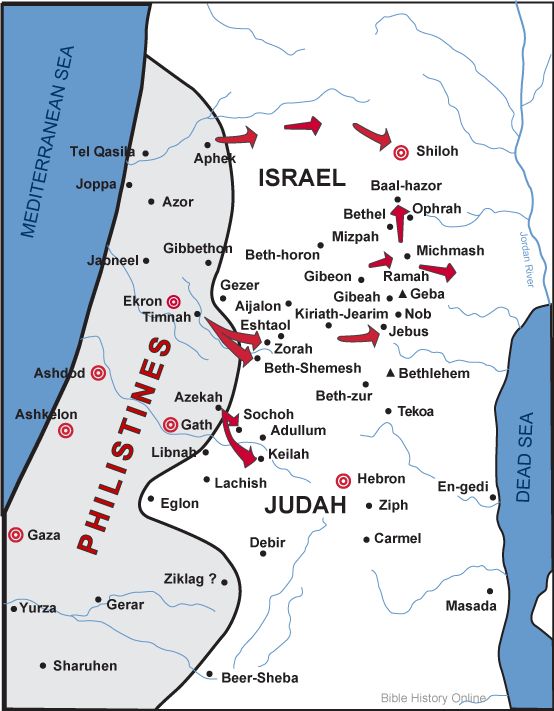
4. On the map below, locate Zorah and Eshtaol (Judges 13:2, 25), where Samson and his family were from, in relation to Timnah and Ashkelon where the action in today’s passage takes place (disregard the arrows). Describe how Samson’s actions in chapter 14 functioned as sort of a stealth, small-scale invasion of Philistia and sheds light on our earlier examination of 14:4. How does the “one man invasion” strategy we see God using here with Samson compare to the “small army” strategy He used with Gideon (see lesson 7 – link above). Consider the actions of the 3000 men in 15:13-15 as you answer.

5. Read 15:1-20. Describe the cowardice of the men of Israel in 13-15. Think about all of the places in Scripture where God tells His people to stand firm, fear not, cry out to Him for help, and trust Him. What should these 3000 men have done instead? Compare their fear of the enemy to Gideon’s fear of the enemy (lessons 6&7 – links above), and their response to the enemy to his response to the enemy.

Are there any ways in which 11-13 pre-figures Judas’ betrayal of Jesus, our perfect Judge, and the high priests handing Jesus over to the Roman officials?

How was Samson’s defeat of the enemy (14-16) different from Jesus’ defeat of the enemy at His first coming? How could “You have granted this great salvation by the hand of your servant,” (18) be said of Jesus centuries later?

6. Consider Samson’s motives for each of his attacks on the Philistines in today’s passage, his “hot anger” in 14:19, and his apparent posture of personal vengeance in 15:7. Now compare these to his statement in 15:18: “You have granted this great salvation by the hand of your servant,” and recall what the angel told Manoah and his wife (see lesson 11 – link above) about Samson’s mission and what they probably told Samson about all of that. Is it reasonable to infer that Samson viewed his attacks on the Philistines in today’s passage as consciously carrying out his mission of “he shall begin to save Israel from the hand of the Philistines,” (13:5) or was he just a hot head getting personal revenge?

If someone came to you and said that Samson’s aforementioned motives, anger, and apparent posture of personal vengeance conflict with James 1:20: “the anger of man does not accomplish the righteousness of God,” (because God’s righteous purpose of pushing back the Philistines was accomplished here) and Romans 12:19: “Beloved, never avenge yourselves, but leave it to the wrath of God, for it is written, ‘Vengeance is mine, I will repay, says the Lord,'” how would you answer that person? (Hint: Be sure you’re reading all of these verses and passages in context.)


Homework

  • Recall from lesson 10 (link above) Samson’s parents’ wisdom and godliness, and the wise and godly counsel they gave him in today’s passage. Consider their good counsel in light of these passages. Why is godly counsel important? How can you tell the difference between counsel that is wise and godly and counsel that is unwise, fleshly, or merely pragmatic? Who would you go to for wise, godly counsel if you needed it? What can you do to prepare yourself to give wise, godly counsel to someone who comes to you asking for it?

Suggested Memory Verse