Mailbag, Movies

The Mailbag: Potpourri (Help me understand Scripture… “The King of Kings” reviews… Thoughts on “House of David”)

Welcome to another โ€œpotpourriโ€ edition of The Mailbag, where I give short(er) answers to several questions rather than a long answer to one question.

I like to take the opportunity in these potpourri editions to let new readers know about my comments/e-mail/messages policy. Iโ€™m not able to respond individually to most e-mails and messages, so here are some helpful hints for getting your questions answered more quickly. Remember, the search bar (at the very bottom of each page) can be a helpful tool!

Or maybe I answered your question already? Check out my article The Mailbag: Top 10 FAQs to see if your question has been answered and to get some helpful resources.


This follower responded to a Facebook post of mine encouraging women to avoid Tara Leigh Cobble

I have been reading The Bible Recap and what I have loved was [Tara Leigh Cobble] explaining the Scriptures to me after, which is helpful. I struggle with understanding Scripture and need it broken down for me. Can you recommend something like this for me?

I’m so glad you asked! I can actually recommend something much better! You may have already done some of these, but I want to answer this question for anyone who might happen across this article.

๐Ÿ“– Make sure you have been genuinely born again. Genuine Believers are indwelt by the Holy Spirit who illumines (supernaturally helps us understand) Scripture to us. First Corinthians 2:14 tells us that’s why lost people (even false converts – those who think they’re saved, but aren’t) aren’t able to understand Scripture. Carefully and prayerfully consider the Scriptures and materials at the What Must I Do to Be Saved tab (in the blue menu bar at the top of this page), and make sure you’ve repented and believed the biblical gospel.

But a natural man does not accept the depths of the Spirit of God, for they are foolishness to him, and he cannot understand them, because they are spiritually examined.

1 Corinthians 2:14

๐Ÿ“– Make sure you’re joined to a doctrinally sound local church. (Check out the Searching for a new church? tab if you need help.) Another reason someone might not understand Scripture is that she’s not in a good, solid, Bible believing, Bible teaching church, so she’s not being taught Scripture or how to understand it.

๐Ÿ“– Make sure you have a trustworthy translation of the Bible that’s easy for you to understand. My article The Mailbag: Which Bible Do You Recommend? has some helpful hints for translations to consider, and to avoid.

๐Ÿ“– Get plugged in to your church and attend faithfully (every Sunday morning at a minimum unless you’re sick or otherwise absolutely can’t go; preferably also Sunday night and midweek if your church has services those days). Sit under good preaching from your pastor, and join a Sunday School or Bible study class. Take every opportunity to study and learn Scripture at your church where your pastor and elders can have oversight over the Bible study classes you’re in to make sure they don’t go wonky.

๐Ÿ“– Ask a godly, older woman to disciple you according to Titus 2:3-5. If you don’t know someone like that at your church, ask your pastor for help.

Older women likewise are to be reverent in their behavior, not malicious gossips nor enslaved to much wine, teaching what is good, so that they may instruct the young women in sensibility: to love their husbands, to love their children, to be sensible, pure, workers at home, kind, being subject to their own husbands, so that the word of God will not be slandered.

Titus 2:3-5

๐Ÿ“– Put aside The Bible Recap and any other “canned” studies (Bible study books, workbooks, programs, etc.), you’re using, and study straight from the text of Scripture in a systematic way. If you’ve never done that before, check out some of the studies I’ve written at the Bible Studies tab. My studies are designed to teach you how to study straight from the Bible in a “learn by doing” sort of way. Try a couple (they’re all free), and once you get the hang of it, you won’t have to rely on anyone else’s studies – even mine – any more. Or, you could just pick up your Bible, choose a book, begin with chapter 1, verse 1, and study it through to the end.

๐Ÿ“– Pray before you study. Start your Bible study time by asking God to help you understand His Word, to speak to you from it, to learn what He wants you to learn from it, and to obey its instruction. This is a God who loves you and wants you to know Him. He has told you that you can ask for wisdom and understanding and He promises to give it to you. Asking God to help you understand His Word is a prayer He delights to answer.

๐Ÿ“– As you’re studying your Bible, listening to the sermons at church, and learning in your Bible study classes, if you have a question about something, ask your pastor, elders, Bible study teacher, or the woman who’s discipling you.

The reason all of these things are better than a “canned” Bible study alternative to The Bible Recap is that all of these things I’ve outlined above are God’s plan for us to learn His Word. God’s plan is for us to learn His Word through the local church, not from strangers on the internet, in books, and so on. It’s fine to occasionally supplement what you’re learning in church and your personal Bible study time with a good book, podcast, or sermon (see the Recommended Bible Teachers, Authors, etc. tab for some suggestions), but your primary source of Bible teaching should be your local church.


Have you seen the movie King of Kings? Are you going to write a review of it?

Haven’t seen it. Not planning to see it or write a review of it unless God picks me up by the hair and plunks me down into a theater that’s showing it (for free – I’m not going to financially support it by buying a ticket).

However, if you’re looking for a trustworthy review, I would highly recommend this one from my friend, Pastor Gabriel Hughes…

or the TLDL version – his two minute WWUTT video review (sorry, can’t redact what some of y’all will consider a 2CV {second Commandment violation} on this one)…

…or this two part commentary and review from Wretched:

Photo courtesy of IMDb

However, I did watch season 1 of the Amazon Prime series, House of David, because these “Bible” shows are just train wrecks I can’t seem to look away from. Here’s my mini-review (because I’m not writing a real review). Spoilers follow:

So far (that’s the focal phrase in this sentence) – although there are definitely some biblical issues with the content of the episodes (I didn’t look into any of the actors or any behind the scenes stuff. I just watched the show. And not super carefully. I needed something to watch while folding laundry.) – so far, it seems more biblically accurate than The Chosen. And, yeah, I realize that’s not saying much. And no, I don’t hold out any hope that it won’t get worse. And no, I don’t think they’re going to get the theology surrounding David as a type of Christ – or any other theological points – right.

The actor playing David is adorable, but by about the third episode (out of eight), I was done with his (or whoever dubbed it) whiny, nasally singing. I’ll be reaching for the mute button on that from here on out.

The general posture of animosity towards David from his brothers and father? I’ve read the biblical account a bunch of times, and I’ve never gotten that impression, have you?

Goliath: Turn the captions on because you’re not going to be able to understand a word he says.

Here’s some info. on the mythology they’re using about David’s mother: Does the Bible mention Davidโ€™s mother?

Samuel: I like him, but what about a hair and beard cut? At least he doesn’t have a man bun. Yet.

Lots of visions in this show (David, Saul, etc.) that are mentioned nowhere in Scripture.

The way they’re portraying Saul’s mental problems (or whatever you want to call them), minus the weird apparitions of Amalek, are about the way I have always pictured them. Some theologians think Saul was bi-polar. I think it was either that or demon possession or oppression. Anyway, it seems true to life.

Goliath threw a spear and injured David before David killed him? Yeah… no. The text doesn’t say that. That’s your “artistic license” coming in to “improve” on a story that’s already perfect.

“What’s my purpose?” “Find your purpose.” Purpose, purpose, purpose. Is Rick Warren getting any royalties off this show? If not, he might want to look into that.

Greg Laurie wrote an accompanying devotional for the show. Miss me with that. I’m going to tell you like we told you with The Chosen devotionals / “Bible” studies: If you want a Bible study on this story, God already wrote it. Pick up your Bible and read it. That way you know you’re getting the truth.

What did I forget? Got specific questions? Comment below.


If you have a question about: a Bible passage, an aspect of theology, a current issue in Christianity, or how to biblically handle a family, life, or church situation, comment below (Iโ€™ll hold all questions in queue {unpublished} for a future edition of The Mailbag) or send me an e-mail or private message. If your question is chosen for publication, your anonymity will be protected.

Bible Study

Bible Book Backgrounds: Why You Need Them and Where to Find Them

It’s time for your daily Bible study. You’ve decided to study Habakkuk or Philippians or Lamentations.

When you pick up a random book of the Bible to study it, how do you know…

…what’s going on in biblical history at the time the book was written
…when the book was written and by whom
…who the intended audience was
…where, geographically, the action takes place
…cultural aspects of the period that will help you better understand allusions and customs?

Unless you’ve done a considerable amount of study in the field of biblical history and the ancient Middle East, the answer is: you probably don’t know all of those things. And, as a result, your study of the book you’ve chosen probably isn’t going to be as fully-orbed as it could be.

Not having done any advanced study in those areas myself, I learned a while back to rely on those who have, and who have taken the time to share their knowledge with the rest of us. When I study, teach, or write a study on a book of the Bible, I always start out by delving into the “story behind the story.” How?

Macro Bible Study 

Reading every book of the Bible is the best way to get a good grip on the meta-narrative of Scripture. Because the books of the Bible aren’t always arranged in order of the events they contain and because many books overlap in their events and timing, I highly recommend a chronological read-through of the Bible at least every few years.

Pay Attention to the Text

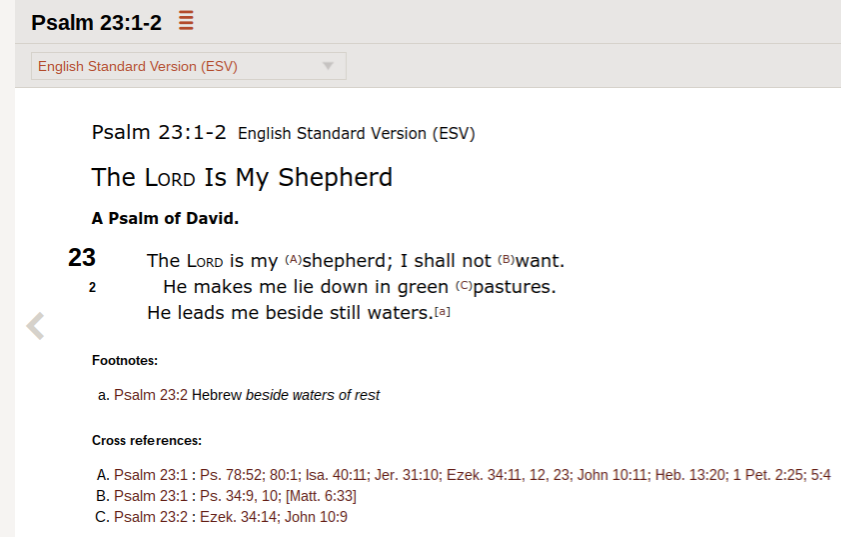
Sometimes the details you’re looking for are in the text itself. Perhaps a certain month and day are mentioned, or “during the reign of King ____.” If the text specifies a certain city or country, look it up on a good Bible map to get your bearings. Sometimes a particular custom or expression is explained as an aside, such as in 1 Samuel 9:9. Some books specify who they’re written to in the first few verses. Also be sure to use your Bible’s footnotes and cross reference notations, and look up any related verses that can bring clarity.

Footnotes explain wording.
Cross references suggest related passages.
(BibleGateway.com)

Study Bibles

There are some fantastic study Bibles out there (and also some duds you’ll want to avoid). Here are a few I highly recommend:

  • The MacArthur Study Bible Great theology, clear explanations. The only thing I would improve if I could is that I wish there were more notes on the Old Testament. (Also see “Bible Introductions” below.)
  • The Faithlife Study Bible app It’s free! Lots of great notes, articles, and diagrams, and because itโ€™s an app, itโ€™s got links, videos, and other great features.
  • The ESV Study Bible Super comprehensive. Itโ€™s like having a set of commentaries and the entire text of Scripture in one book.
  • The ESV Archaeology Study Bible This one is really good for getting a feel for what life, culture, and customs were like in biblical times – food, family, work, neighboring pagan nations, etc. It’s also very helpful with biblical geography.

“Bible Book Backgrounds”

This would be an overview, or survey, to read before you begin the book of Scripture you’ll be studying. I’ve found it’s helpful to use a survey of the book as a foundation and framework for subsequent study of the text.

While some commentaries contain an introduction to each book of the Bible, many do not. But I’ve found several online sites that provide helpful Bible Book Backgrounds:

Bible Introductions at Grace to You- A thorough overview of every book of the Bible, written by John MacArthur. These are the same introductions you’ll find in the MacArthur Study Bible.

Bible Book Overviews at Reformed Answers- Just put the name of the book you’re looking for in the search bar, followed by the word “overview.” You’ll also find overviews of the literary divisions of the Bible, such as an overview of the epistles, wisdom literature, etc.

Bible Surveys at Got Questions- Use the search bar to find the book survey you’re looking for. All surveys except the four gospels are entitled, “Book of ____ – Bible Survey.” You’ll find Matthew, Mark, Luke, and John as, “Gospel of ____.”

Helpful and (mostly) free Greek and Hebrew resources you might not know about at The Cripplegate- Sometimes getting some help with the original languages can also aid in your understanding of the book’s background and setting.

Dig in. Study. Search it out. Doing a “background check” on the book you’re studying is a great way to gain a deeper understanding and appreciation of God’s word.

Bible Study, Mailbag

The Mailbag: We Want Bible Study Answers


Why don’t you provide the answers to the questions you ask in your Bible studies?

If you’ve been around the blog for any length of time you’ve noticed (I hope) that Wednesday is Bible study day. We’ve been through several books, including Jonah, Colossians, Ezra, and our current study of Ruth. We’ve done two topical studies: one on the Ten Commandments (Exodus 20:1-17) and one on assurance (1 John). And there are 66+ (every book of the Bible and then some) one lesson stand-alone studies. If you’re looking for a Bible study for group or personal use, they’re allย here,ย and they’re all free (all I ask is that you don’t plagiarize).

The format I’ve developed for my studies is to present the biblical text, provide several study questions, and finish off with a homework assignment- action you can take to apply one of the truths of the passage to your own life.

But I intentionally refrain from providing a list of answers to the study questions. Why?

Because the purpose of my Bible studies is not for you to get the “right answers.” My goal is to demonstrate for you the kinds of questions you should be asking of any passage of Scripture you approach. The purpose is to teach you (or your small group)ย how to study the Bible on your own so you won’t need to depend on a “canned” study written by somebody else, even me.ย I’m trying to work myself out of a job. You know- teach a woman to fish rather than giving her a fish.

In my own private study time as well as in Sunday School classes and other small group Bible studies, I’ve found that diving into the text and studying it for myself – or with my group – is far more meaningful and memorable than looking at the passage through the eyes of a third party. Approaching Scripture without a “middle man” lends itself to an intimacy with God that just isn’t there otherwise. It’s the difference between a private, behind closed doors, conversation with your husband and a conversation with your husband while out on a double date with friends. You get that “double date conversation” every Sunday when your pastor preaches, but God is a personal God, and you need some time alone with Him during the week.

But I’m afraid that if I study on my own, I’ll get something wrong! What if I misunderstand Scripture and end up believing false doctrine?

Bible study is a skill. And just like every other new skill you learn, you’re probably going to make some mistakes when you’re first starting out. When you first learned to read, you pronounced some words incorrectly. When you were learning to ride a bike, you fell down a few times. But you didn’t let those mistakes stop you. You kept practicing until you learned the skill. Bible study is the same way. You probably will make some mistakes along the way. But God has provided a lot of “training wheels” to help you out:

His Goodness and Trustworthiness
God is a good God. Heย wants you to study His word, get to know Him, and grow in Christ. It would be evil and cruel of God to tell you this, and then lead you – His child, who wants to draw near to Him through the study of His word – into false doctrine. And God is not evil and cruel. He is good, He is a God of truth, and His word is truth. Trust Him as you open His word to study.

What father among you, if his son asks for a fish, will instead of a fish give him a serpent;ย or if he asks for an egg, will give him a scorpion?ย If you then, who are evil, know how to give good gifts to your children, how much more will the heavenly Father give the Holy Spirit to those who ask him!โ€
Luke 11:11-13

The sum of your word is truth, and every one of your righteous rules endures forever.
Psalm 119:160

Sanctify them in the truth; your word is truth.
John 17:17

The Holy Spirit
If you are a genuinely regenerated Believer, you are indwelt by the Holy Spirit, the author of Scripture. Because God does not contradict Himself and He does not lie, the Holy Spirit indwelling you will not lead you to believe what is contrary to the words of Scripture He inspired. Ask Him to give you wisdom and understanding as you study.

And I tell you, ask, and it will be given to you; seek, and you will find; knock, and it will be opened to you. For everyone who asks receives, and the one who seeks finds, and to the one who knocks it will be opened. What father among you, if his son asks for a fish, will instead of a fish give him a serpent; or if he asks for an egg, will give him a scorpion? If you then, who are evil, know how to give good gifts to your children, how much more will the heavenly Father give the Holy Spirit to those who ask him!โ€
Luke 11:9-13

When the Spirit of truth comes, he will guide you into all the truth, for he will not speak on his own authority, but whatever he hears he will speak, and he will declare to you the things that are to come. He will glorify me, for he will take what is mine and declare it to you.
John 16:13-14

Tools
God has blessed us with a number of helps for learning how to study His word, from instructions on handling the text to commentaries, Bible dictionaries, Bible atlases, and the like. Many are online and available for free. I’ve included some of those hereย (be sure to scroll down). And don’t forget your (doctrinally sound) pastor, elders, and Sunday School teachers as invaluable resources. I’ve never met one who wouldn’t be delighted to help someone understand a passage of Scripture.

Easter Eggs
If you’ve worked through any of my studies, you’ve probably noticed that, if you read carefully, Iย doย provide answers to some of the study questions.

Hyperlinks– If you see a hyperlink in a question, try answering the question on your own first. Then, click the link. It will take you either to related Scriptures that will help you answer the question or to an article or resource you can read for more information.

Follow Up Questions– Each study “question” is usually a series of questions. Try to answer them one at a time. But, if you’ll notice, I sometimes provide the answer to one question in a subsequent question. For example (from Ezra, Lesson 11):

What was Israelโ€™s hope? Compare Israelโ€™s hope for Godโ€™s mercy and forgiveness of sin in response to true repentance with 1 John 1:9.

God loves you and wants you to dive into the treasure chest of His word. Trust Him. Use the resources He has provided. And if you fall off your bike in the process, pick yourself up, dust yourself off, and keep practicing.


Additional Resources

Bible Study resource articles

Bible Studies by Michelle Lesley

10 Simple Steps to Plain Vanilla Bible Study

Youโ€™re Not as Dumb as You Think You Are: Five Reasons to Put Down that Devotional and Pick Up the Actual Bible

10 Bookmarkable Biblical Resources for Christian Women

Rightly Dividing: 12 Doโ€™s and Donโ€™ts for Effective Bible Study


If you have a question about: a Bible passage, an aspect of theology, a current issue in Christianity, or how to biblically handle a family, life, or church situation, comment below (Iโ€™ll hold all questions in queue {unpublished} for a future edition of The Mailbag) or send me an e-mail or private message. If your question is chosen for publication, your anonymity will be protected.