Ezekiel Bible Study

Ezekiel ~ Lesson 6


Previous Lessons: 1, 2, 3, 4, 5

Read Ezekiel 11-12

Questions to Consider

1. Review your notes from last week’s lesson and be reminded of the things that lead into, and set the stage for, this week’s passage. How does chapter 11 connect back to chapters 8-10? Recall and describe Israel’s sin from chapter 8-9, and carry that into chapter 11.

2. Read chapter 11.

Who were the people Ezekiel saw in 11:1, and what were they guilty of (11:2-3)? What did God tell Ezekiel to do? (11:4)

How did God execute these princes (11:1) differently than He executed the elders of the temple and the people of the city? (11:6-12) Why was their judgment and execution different? (11:12) Explain the biblical principle that those in positions of authority and power over God’s people bear a greater responsibility before God to know Him, follow Him, and lead His people in His ways. Read 2 Samuel 24:10-14 and compare the elders and the people falling into the hand of God versus the princes falling into the hand of man. Which did David say was better, and why? How does that concept apply to the different executions we see here in Ezekiel?

You may want to go back to Lesson 1 (link above) and refresh your memory about Ezekiel’s situation and residence at this time. Remember, Ezekiel has already been taken captive, and is writing, during and after the second wave of the exile, and prior to the third and final wave. He looks back from exile in Babylon to all of the people still in Jerusalem whom God is putting to death (or soon will) and who does Ezekiel think is the “remnant” of God’s people in 11:13? How does God answer Ezekiel’s question in 11:13, correcting him and reassuring him? (11:14-21) Who does God say is really the remnant of His people? Is there any comparison here to the “exiled” or “scattered” (11:16-17) church – genuinely regenerated Christians, not just people who call themselves Christians and places that call themselves churches – today? When will God finally gather the remnant of His people back together?

How does 11:14-21 illustrate both the human action of repentance and God’s actions in our repentance?

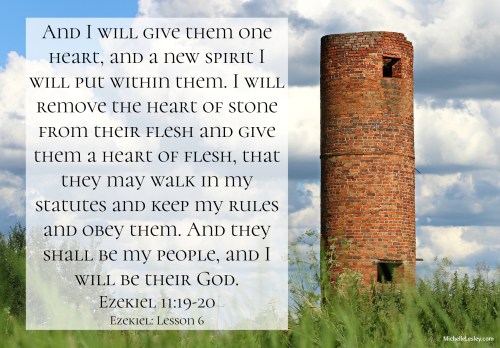
In what ways do 11:19-20 sound similar to our new birth in Christ? Can you think of any “likeminded” New Testament verses? Any verses similar to 11:21 in the New Testament?

Compare the movement of the glory of the Lord in 11:22-23 to its movement in previous chapters. Why does God’s glory keep moving around? Is it getting closer to or farther from the people in Jerusalem?

3. Read chapter 12.

Describe the little drama God has Ezekiel play out for his fellow exiles in 12:1-7. What was the message God was trying to get across to the people? (12:8-16) Why did God again have Ezekiel act out this scenario for the people instead of telling them in words? Did they get it? (12:9)

Describe the little drama God has Ezekiel play out for his fellow exiles in 12:17-20. What was the message God was trying to get across to the people? (12:19-20)

Explain in your own words what God is saying in 12:21-28. Compare 12:22 to 2 Peter 3:4. What did the people mean when they repeated this cliche or proverb? Why was it important to God that these Israelites, already in exile, know that He was about to virtually destroy Jerusalem, and soon?

In Old Testament times, the common understanding of gods – throughout the nations – was that certain gods were attached to a certain people group or “resided” within the borders of a certain nation. This idea may have entered Israel’s thinking as well about their own God, and might partly explain why they didn’t want to believe the things Ezekiel was saying about Jerusalem – God’s “dwelling place”. Explain how Ezekiel’s prophecies to the exiles in chapter 12 should have helped the people to remember that God is limitless, that He is God over all the universe and all people everywhere, and that His power can’t be contained by national borders, indeed, not even by the highest heaven.


Homework

• Did you make your “And you/they shall know that I am the Lord” list from lesson 3’s homework? Add the incidences of this phrase from this week’s lesson (11:10, 12, 12:15, 16, 20), and write down who will know that He is the Lord, what will cause them to know He is the Lord, and why God wants them to know He is the Lord.


Suggested Memory Verse
Idolatry, Old Testament, Salvation, Sunday School

The King and I(srael) ~ Sunday School Lesson ~ 4-13-14

sunday school

These are my notes from my ladies’ Sunday School class this morning. I’ll be posting the notes from my class here each week. Click here for last week’s lesson.

Through the Bible in 2014 ~ Week 14 ~ Apr. 6-12
Judges 19 – 1 Samuel 17
The King and I(srael)

Up until now, Israel has been under the leadership of Moses, Joshua, and a string of judges, including current prophet/judge, Samuel. But some of the elders have decided it’s time for a king. Why? Let’s take a look.

1 Samuel 8; 10:17-24

Why did Israel demand a king?

The cycle of the judges:
Israel was in a cycle in which: they would have a judge for several years and everything would go smoothly for them. throne1God would give them victory in battle (or peace), their harvests would be bountiful, etc. Then, the judge would die, Israel would get into idolatry again, things would go badly for several years, they would cry out to the Lord, the Lord would raise up another judge, and the cycle would start all over again.

Israel likely thought it was the lack of succession from one judge to another that was the cause of all the turmoil, and that if they had a kingship (with built in succession) the chaotic years would cease, and things would go smoothly from there on out. What they failed to realize was that it was their obedience to God that brought peace during the lives of the judges, not a seamless changing of the guard.

The appearance of strength:
Another reason Israel may have wanted a king was that it gave the appearance of strength to other nations. Without a king, neighboring nations probably viewed Israel as weak and vulnerable, leading to more attacks. Of course, this would lead Israel to depend more on the Lord, and that’s exactly what He wanted.

“Everybody else is doing it”:
Finally (8:5), they wanted a king “like all the nations.” Whether this was because they admired the other nations’ structure of government, economy, large armies, etc., or, because Israel wanted to look more prestigious (or stronger- see above) in the eyes of other nations, they were blind to the fact that they would have had things so much better under God’s Kingship.


Why didn’t God want Israel to have a king?

God was already their king.
Israel didn’t need a human king. God was far more capable than any human king of winning battles, providing for them, ensuring a good economy, establishing and enforcing law and order, etc.

God wanted Israel to look to Him for everything.
We tend to look to the President and Congress for worshipgovernance, the grocery store for food, our jobs for paychecks, our doctors for healthcare. God wanted Israel to look to Him for every aspect of their lives: government, provision, health, food, everything. Because He is sovereign over all that happens on earth and in heaven, He wants us to recognize that we should be looking to Him for these things as well. He wants us to realize that we are completely dependent on Him.

Israel’s desire for a king was another rejection of God, which brought Israel ever closer to severe judgment. (Isaiah 28:21, Ezekiel 18:23,32, 2 Peter 3:9)
Even though Israel deserved judgment for her many rebellions against God, judgment is a last, undesirable resort for Him. Isaiah tells us that judgment is God’s “strange work”. Ezekiel reminds us that God takes no pleasure in the death of the wicked. Peter writes that God is not willing that any should perish but that all should come to repentance.

Small rebellions can lead to bigger rebellions. A loving parent knows this and tries to keep this from happening by disciplining his child. With a small rebellion, we might start out with a small discipline, such as taking away dessert. As the rebellions get bigger or more frequent, bigger discipline, stock_scales_justice2such as spanking or grounding might be appropriate.

Most children learn to control their behavior through these moderate forms of discipline, but a few may eventually become so destructive, addicted, or abusive that parents have to go to the extreme end of “tough love” by throwing them out of the house or turning them over to the authorities. It’s all done in love and all in an effort to bring the child home. This is exactly what was happening with the Israelites.

This is why God did everything necessary to keep Israel from His severe judgment. He carefully and specifically laid out the Law, promised them blessings for obedience and described the consequences for disobedience in gory detail, made examples out of people who disobeyed, offered forgiveness for repentance, gave them (initially) good and godly leaders (Moses, Joshua, the judges), and performed miracles to help them believe in Him. All this in an effort to stop their slide into total rejection of Him and the consequence of final judgment.


One last chance (8:10-18)

Israel could never say she hadn’t been warned. In these verses God told them directly and specifically exactly what their new king would be like, how he would treat them, and the consequences that would follow: confiscation of private property, slavery, God turning a deaf ear to their pleas for help. But still they demanded a king. This king God had just described. They were at the point of no return, and they plunged ahead despite the warning. Why?


Hearts of Stone (Ezekiel 11:19, Romans 1:22-25)
Just as a small rebellion can lead to bigger and bigger rebellions, a small hardening of the heart can eventually lead to a complete hardening of the heart.

In the movie Frozen, Elsa (the snow queen), accidentally frozen-anna-elsashoots an icicle ray (or whatever you call it) at her sister’s (Anna) heart, which causes Anna’s heart to slowly begin freezing bit by bit. If Anna doesn’t receive “an act of true love” before her heart completely freezes, she will turn into an ice statue forever.

This is similar to what was happening with Israel. Their continual rebellion was hardening their hearts against God bit by bit, until they would eventually be completely hardened against Him. Romans tells us that when people persist in ungodliness despite the many opportunities for mercy, grace, and salvation God has offered them, He eventually “gives them over” to a hardened heart. He gives them what they want: life without Him.


What does all this have to do with me? (Isaiah 55:9)

Everything. We are just like Israel in so many ways. We’re born into this world having already been shot through the heart with Satan’s “icicle” of sin, the sin nature we inherited from Adam and Eve. We spend our lives rebelling against God, our hearts slowly hardening, bit by bit, looking for another king (usually ourselves), so we can be just like everybody else, because what the world has to offer looks desirable to us.

But God doesn’t want us to have another king, because He’s already THE King, and He’s far better and more capable than any other king we could put on the throne of our lives. He wants us to look to Him for salvation, provision, comfort, strength, everything. So, God extends grace and mercy to us in a variety of ways, some pleasant, some not, to turn us towards the cross and Christ for salvation. He does this so that we can repent and turn to Him instead of facing the final judgment of hell in eternity.

Sometimes, we also see a similarity to Israel’s demand for a king in our prayer lives. We can ask, beg, and plead with God for things He doesn’t want us to have, and even get mad at Him when He doesn’t give us what we want. We must always keep in mind that His ways are higher than our ways and that what He wants for us is always better than what we want. Let us never get to the point in our prayer lives where our will is more important to us than God’s will. Israel’s way was, “No! But there shall be a king over us!” Jesus’ way was, “Nevertheless, not my will, but yours, be done.” Let’s take our example, not from Israel, but from the the King of Israel, King Jesus.