Christmas, Random Ramblings Ruminations Resources

Random Ramblings, Ruminations, and Resources

A couple of months ago, I “beta tested” a new feature here at the blog, which I alliteratively titled Random Ramblings, Ruminations, and Resources. People seemed to like it … or … at least the majority of readers didn’t seem to hate it too much. So I decided to bring it back every once in a while when I’m feelin’ it.

I’m feelin’ it today. So here’s the Christmas/New Year’s edition of Random Ramblings, Ruminations, and Resources.

Christmas Cards

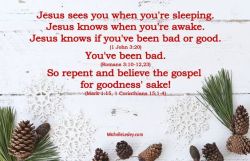
If you don’t follow me on Facebook, Twitter, or Pinterest you might have been missing the Christmas-themed memes I’ve been posting since Thanksgiving. Here are a few:

Need Gift Ideas?

I was going to do a whole article on this, but I felt like with this article and this one, readers might be getting tired of articles on Christmas shopping. So, let me just recommend three items I’ve personally gotten my hands on recently that would make great gifts for your pastor or the theology nerd in your family.

Herman Who?– This is an awesome little DVD series from Wretched that will teach you all the ins and outs of biblical hermeneutics (the science of interpreting Scripture) in a four- or twelve-week course. Teacher and student guides are included, and right now, they’re also throwing in a copy of It’s Not Greek to Me (an introduction to biblical Greek) for free.
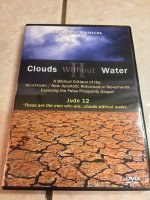
 

Clouds Without Water II– If you’ve never had the privilege of attending a Justin Peters lecture on the New Apostolic Reformation, this DVD set (revised and updated from the original) is the next best thing. You’ll get the history of the NAR, key figures in the movement, an explanation of NAR “theology” and much more. Helpful for any Christian, but, I’m telling you, your pastor needs this in his personal library. And while you’re over there at his online store, pick him up a copy of Do Not Hinder Them, too, especially if you’re Southern Baptist. (Be sure to scroll all the way down the page. Justin has some special deals on combo packages.)
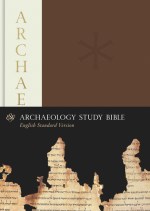
 

ESV Archaeology Study Bible– I got this the other day as an early Christmas present, and I already love it. Tons of articles, study notes, photos, maps, and diagrams pairing the biblical text with what’s been dug up that relates to that text. It’s just fascinating. You can order directly from Crossway, but they’re offering a special deal through ChristianBook.com right now where you can get the hardcover edition for only $24.99! (Word to the wise- go ahead and get a Bible cover for it now if this is going to be someone’s “walking around” Bible.)

Mary Was the First One to Carry the Gospel

(Ugh, that song skeeves me out.)

But Joseph was a close second. Matthew 1:18-20,24-25 tells us:

Now the birth of Jesus Christ took place in this way. When his mother Mary had been betrothed to Joseph, before they came together she was found to be with child from the Holy Spirit. And her husband Joseph, being a just man and unwilling to put her to shame, resolved to divorce her quietly. But as he considered these things, behold, an angel of the Lord appeared to him in a dream, saying, “Joseph, son of David, do not fear to take Mary as your wife, for that which is conceived in her is from the Holy Spirit…When Joseph woke from sleep, he did as the angel of the Lord commanded him: he took his wife, but knew her not until she had given birth to a son. And he called his name Jesus.

In Joseph and Mary’s day, a pregnancy outside of wedlock was much scarier than it is today. Old Testament law called for the death penalty for adultery. If Mary had really committed adultery, Joseph would have been well within his rights to haul her out into the public square and cast the first stone.

But notice that verse 19 says Joseph was both “just” and “unwilling to put her to shame.” He had an obligation to the law, but he loved Mary and wanted to show her mercy so that she might live. Joseph’s dilemma shows us, albeit through a glass darkly, where God stands in relation to sinful mankind.

Though Mary only appeared to have sinned, we really have sinned. And the penalty for our sin is death. But God loves us and wants to show us mercy. And just as an innocent Joseph stepped between Mary and the wrath of the Law that might have been carried out against her, taking her as his wife and bearing her shame and scorn upon his own strong shoulders, God sent the sinless Christ to bear our punishment and our shame, taking us as His bride, so that we might live. But it wasn’t a dilemma for God. He had it all planned out from eternity past.
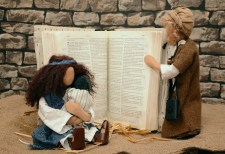
Mary might have been the first one to carry the gospel, but maybe Joseph was the first one to carry it out.

(I can’t take all the credit for this one. My pastor mentioned the idea of Joseph portraying the gospel in his treatment of Mary in his sermon last week and he said he got it from Herschel Hobbs. I can’t find where Dr. Hobbs shared this idea {if you know, fill me in} to cite it or quote him, so I’ve taken his original thought and used it as a springboard for my own observations.)

Reindeer Games

Need a fun game to play at your Christmas party? Give this one from ornamentshop.com a try!

Here are the answers. No cheating or it’s lumps of coal in your stocking this year!

A 2019 Canon Cleanse

My philosophy of Bible study is pretty simple: Christian women need to study the Bible. Not a steady diet of secondhand accounts of what somebody else has studied (or, heaven forbid, what somebody “heard” God say to her) in “canned” studies, but the Bible itself.
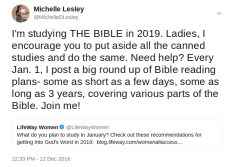
The other day, LifeWay Women tweeted out suggestions of canned studies (you guessed it – most of them authored by false teachers) to kick off the New Year with.

I’d like to challenge you to do something different.

Take this next year to set aside all the pre-fab books, workbooks, DVDs, etc. – even those you consider doctrinally sound – and cleanse your heart, mind, and spirit with the washing of the water of the Word. Just you, your Bible, and, if you’re so inclined, some paper to take notes on.

If you’re not sure how to get started, mark your calendar to check in here on January 1. It’s become my New Year’s Day tradition to post an annual round up of scads of Bible reading plans. Some of them are as short as a few days in length, others, as long as a few years. Some will take you through a biblical topic, some, through a certain part or book of the Bible, some through the whole Bible.

Tune out the noise of other people’s thoughts, ideas, and observations, and hear God speak directly to you through His written Word. Don’t watch someone else mine for gold. Grab your pick and your shovel and discover the joy that only comes from finding that gold for yourself!

Who’s up for the challenge?

Christmas

7 “Stocking Stuffers”

I’m filling the stockings early, but no lumps of coal for my awesome readers! Here are some great little miscellaneous Christian goodies I’ve come across recently. Enjoy!

Crossway has a Bible reading challenge for the holiday season called Simply Read. It will take you through the books of Luke and Acts in 8 days.

Is your church perfect and problem-free? No? Then be sure to give this article a read. Maybe even print it out and stick it on the fridge or in your Bible. The Cripplegate’s When Your Church Disappoints by Eric Davis offers godly counsel on how to biblically think about and approach problems at your church. It was very helpful for me, and I hope it will be for you, too.

The Gospel Project wants to give you a Christmas present! A FREE e-book! “A Christmas Question is Charles Spurgeon’s famous Christmas-day sermon from Exeter Hall in 1859.”

Another FREEBIE? Why not? Beautiful Eulogy is offering their album Worthy for you to download at no cost. Rap isn’t really your thing? Mine either. Check out tracks 5 (a lovely instrumental), 9 (a fantastic devotional from Art Azurdia), and 11 (a slower paced spoken word piece).

Can Christian parents do Santa Claus with their children? My answer in yesterday’s edition of The Mailbag was, yes, as long as Santa keeps his sleigh parked inside biblical parameters. Pastor Josh Buice made a different decision for his children and explains Why My Family Doesn’t Do Santa.

Want to send Christmas cards with an eternal impact? “Each Gideon Christmas card you send this Christmas will provide a New Testament for someone in the world. At the same time, your card will share a message of faith, hope, and joy in Jesus with friends and loved ones.”

Bible Study

10 Simple Steps to Plain Vanilla Bible Study

I’m working on a project I’ve got to get done this week (prayer appreciated!), so I’ll be re-running a few favorite articles from the archives in lieu of new content.

I sincerely apologize to those who were waiting for the last lesson of The Ten this week. Couldn’t be helped. We’ll have to do it next week. I hope you’ll enjoy this article from April 22, 2016 on studying your Bible.

plain vanilla

Baskin Robbins is one of my favorite places to get ice cream. Not only is their ice cream good, but they boast a plethora of flavors to choose from. I love to start at one end of the counter and work my way through all their offerings, getting a little “taste spoon” here and there if a particular flavor piques my interest.

Flavor_Enlarged_Peanutbutter'nChocolate2
Photo courtesy of BaskinRobbins.com.

Having a myriad of options is great when it comes to ice cream, but when it comes to studying the Bible, the tsunami of materials, methods, and other choices out there can be overwhelming. Where do I start? How do I know if a certain Bible study book or teacher is doctrinally sound? Is the study method I’m using in line with good hermeneutics?

It can be enough to make you throw your hands up in the air and head for your local Thirty One Flavors to drown your sorrows in Peanut Butter ‘N Chocolate.

Sometimes it can help to get back to plain old, simple, vanilla Bible study. I’ve been saying for a while now that Christian women should, for the most part, put all the “canned” Bible study books, workbooks, and DVDs aside and simply pick up their Bibles and study them in a systematic way. After all, up until somewhere near the latter half of the 20th century, that’s generally how people studied the Bible. And it worked. People grew in their faith to godly maturity just fine. So, why can’t it work today?

It can. It does. It will.

Unfortunately, the blessing of lots of options, methods, resources, and information, and the marketing of that blessing by celebrity Christians and Christian retailing, has bred a generation of Christian women who are fearful that they aren’t as smart or as capable of reading and understanding God’s word as all the “experts” out there. They look at the simplicity of picking up their Bibles and studying them like calves looking worriedly at a new gate.

“What does that mean?”

“How do I do that?”

“I’m scared I’ll get it wrong!”

It absolutely breaks my heart to hear this angst from women who, I’m certain, genuinely want to study God’s word correctly so that they can know Him better and grow in their faith. And it makes me livid at the churches who haven’t trained them properly, the plantation-style women’s “Bible study” marketing that has kept them ignorant and dependent slaves to Christian retailers, and whatever other forces have conspired to keep these precious ladies away from the pure milk of the word.

So let’s reboot, get back to basics, and get as many women digging into the Word as possible.

First, it’s important to start out with a biblical perspective:

1. God is kind, and He loves you.

Yeah, I know, that’s pretty basic. But it’s worth bringing to the forefront for this discussion. This is a God who loves you and wants you to know Him. He has revealed Himself to you through creation, through Christ, and through His written word. He has indwelt you as a believer with the Holy Spirit to help you understand Scripture. He has told you that you can ask for wisdom and promises to provide it. In His kindness God has bent over backwards to provide you with ways to know Him. He is not some mean ogre sitting up there just waiting for you to get something wrong so He can chastise you. He wants you to understand His word.

2. The Perspicuity of Scripture

There’s this really great, comforting, reassuring doctrine called the perspicuity of Scripture. The gist of it is that Scripture is, for the most part, clear and understandable, especially for believers, because of the aforementioned indwelling of the Holy Spirit. But even lost people tend to understand a lot of what Scripture says (that’s why you hear so many of them arguing against it – they couldn’t do that if they didn’t at least partially understand it).

So, by and large, if you’re reading the Bible in an orderly way you should be able to understand it fairly well. You don’t have to have a seminary degree or be an “expert.” There are dirt farmers and country preachers out there who have a better grasp of Scripture than some celebrity pastors in multi-million dollar churches with thousands of congregants, and a string of seminary degrees behind their names.

OK, now that we have a biblical perspective on studying the Bible, how do we do it in a systematic or orderly way?

3. Pray

Don’t see this as childish or unimportant and skip it. Start your Bible study time by asking God to help you understand His word, to learn what He wants you to learn from it, and to obey its instruction. Even if you’re pretty well versed in the Scriptures, praying like this before opening God’s word will remind you of its holiness and your proper place of humility and submission to it.

bible-1089968_12804. Read the Bible the way you would any other book.

When you pick up a novel, do you read one sentence out of the middle of chapter 4, followed, the next day, by a paragraph from chapter 37, and, the next day, a couple of lines from chapter 1? Of course not. You wouldn’t know what was going on and what the characters meant by what they were saying. If you wouldn’t read something as inconsequential as a novel this way, why would you read the Bible in such a haphazard manner? Yet this is precisely the way people often approach daily Bible study.

My pastor said something awesome about this in his sermon the other day:

The Bible isn’t Google for self-help.

And he’s so right. We don’t just parachute in to a random passage, hoping to glean a nugget of truth. Pick a book of the Bible (maybe Genesis or one of the gospels if you’re new to all this), start at the beginning, and read a little each day until you reach the end. It’s really that simple.

5. Context, context, context

It’s important to read and understand Scripture in its context: how a verse fits with the verses immediately surrounding it, within its chapter, within its book, and within the overarching narrative of the Bible. This is really the biggest key to comprehending Scripture. Fortunately, the main way to do this is by reading the Bible in an orderly way (see #4- You did already read #4, right?)

Another invaluable practice is to make use of the cross-references and footnotes in your Bible. Cross-references will help you get a better idea of how the passage you’re reading fits together with other, related passages. Footnotes are there to add a touch of clarity to particular words and passages.

6. Get a plan, Fran.

If structure helps you, choose a good Bible reading plan. For the beginner, start off with one of the shorter plans so you won’t get overwhelmed. When you’re ready, I highly recommend the chronological plan. It is extremely helpful for learning the big picture of Scripture.

If you decide to choose a reading plan, though, hold its schedule loosely and don’t be beholden to its time frame. Work through the readings at your own pace. Take the time to let the Scriptures sink in and spend as long as you need to on any given section. God doesn’t give gold stars for finishing the Bible in a year.

7. Understand the background and setting.

There are some passages in Scripture that are a little more difficult to understand if you don’t know the customs of the time or what was going on historically and politically. In these cases a good study Bible, commentary, and other resources can be beneficial. I’ve touched on the specifics of some of these resources here. Many of these helpful materials can be found on-line for free.

8. Take notes on the text.

Hmm…an orderly method of reading…footnotes…extra resources…taking notes…this is starting to sound like…well…studying! Yep, that’s the idea. Isn’t it interesting that we often take a more serious and scholarly approach to studying for a class or a test than we do to studying our Bibles?

If you were a better student than I was in high school and college, you probably took notes on your text books as you read them. You wrote down things you wanted to remember, things that seemed important, things you didn’t understand and wanted to work on more later, things that were especially meaningful, even questions that occurred to you. Those are all good things to write down as you study your Bible, as well.

presenter-1206345_12809. Listen to good preaching.

As a Christian, you should already be doing this at least weekly at the church you’re a member of. But try to sneak in some extra listening – to your own pastor or another doctrinally sound pastor – as often as you can during the week. Listening to someone rightly handle and explain God’s word helps you to understand it and trains you to rightly handle it yourself as you study.

I once read that children who read a lot are better spellers. Not because they study spelling more, but because they’re exposed to more words and have the correct spelling of words constantly in front of their eyes. They sort of soak up good spelling by osmosis, and when it’s time for the spelling test, they simply write down what they’ve absorbed. Listening to good, expository preaching can have the same kind of helpful impact on your Bible study skills.

10. Practice makes perfect.

Studying the Bible is just like any other skill. You’ll probably fumble around a good bit when you’re first getting started, but if you stick to it, you’ll find that it gets easier and you get better at it as time goes by. Don’t be afraid to start. Jump right in there and try. Nothing ventured, nothing gained, right?


Ladies, simply picking up the Bible and studying it each day is such a joy. I have been doing it for years, and I love it. The excitement of “digging for buried treasure” in God’s word and uncovering the truths of Scripture for myself has been far more meaningful to me and has grown me so much more than any workbook or curriculum I’ve ever used. I hope you’ll put aside your book studies and devotionals, and give it a try yourself!

Bible Study

10 Simple Steps to Plain Vanilla Bible Study

plain vanilla

Baskin Robbins is one of my favorite places to get ice cream. Not only is their ice cream good, but they boast a plethora of flavors to choose from. I love to start at one end of the counter and work my way through all their offerings, getting a little “taste spoon” here and there if a particular flavor piques my interest.

Flavor_Enlarged_Peanutbutter'nChocolate2
Photo courtesy of BaskinRobbins.com.

Having a myriad of options is great when it comes to ice cream, but when it comes to studying the Bible, the tsunami of materials, methods, and other choices out there can be overwhelming. Where do I start? How do I know if a certain Bible study book or teacher is doctrinally sound? Is the study method I’m using in line with good hermeneutics?

It can be enough to make you throw your hands up in the air and head for your local Thirty One Flavors to drown your sorrows in Peanut Butter ‘N Chocolate.

Sometimes it can help to get back to plain old, simple, vanilla Bible study. I’ve been saying for a while now that Christian women should, for the most part, put all the “canned” Bible study books, workbooks, and DVDs aside and simply pick up their Bibles and study them in a systematic way. After all, up until somewhere near the latter half of the 20th century, that’s generally how people studied the Bible. And it worked. People grew in their faith to godly maturity just fine. So, why can’t it work today?

It can. It does. It will.

Unfortunately, the blessing of lots of options, methods, resources, and information, and the marketing of that blessing by celebrity Christians and Christian retailing, has bred a generation of Christian women who are fearful that they aren’t as smart or as capable of reading and understanding God’s word as all the “experts” out there. They look at the simplicity of picking up their Bibles and studying them like calves looking worriedly at a new gate.

“What does that mean?”

“How do I do that?”

“I’m scared I’ll get it wrong!”

It absolutely breaks my heart to hear this angst from women who, I’m certain, genuinely want to study God’s word correctly so that they can know Him better and grow in their faith. And it makes me livid at the churches who haven’t trained them properly, the plantation-style women’s “Bible study” marketing that has kept them ignorant and dependent slaves to Christian retailers, and whatever other forces have conspired to keep these precious ladies away from the pure milk of the word.

So let’s reboot, get back to basics, and get as many women digging into the Word as possible.

First, it’s important to start out with a biblical perspective:

1. God is kind, and He loves you.

Yeah, I know, that’s pretty basic. But it’s worth bringing to the forefront for this discussion. This is a God who loves you and wants you to know Him. He has revealed Himself to you through creation, through Christ, and through His written word. He has indwelt you as a believer with the Holy Spirit to help you understand Scripture. He has told you that you can ask for wisdom and promises to provide it. In His kindness God has bent over backwards to provide you with ways to know Him. He is not some mean ogre sitting up there just waiting for you to get something wrong so He can chastise you. He wants you to understand His word.

2. The Perspicuity of Scripture

There’s this really great, comforting, reassuring doctrine called the perspicuity of Scripture. The gist of it is that Scripture is, for the most part, clear and understandable, especially for believers, because of the aforementioned indwelling of the Holy Spirit. But even lost people tend to understand a lot of what Scripture says (that’s why you hear so many of them arguing against it – they couldn’t do that if they didn’t at least partially understand it).

So, by and large, if you’re reading the Bible in an orderly way you should be able to understand it fairly well. You don’t have to have a seminary degree or be an “expert.” There are dirt farmers and country preachers out there who have a better grasp of Scripture than some celebrity pastors in multi-million dollar churches with thousands of congregants, and a string of seminary degrees behind their names.

OK, now that we have a biblical perspective on studying the Bible, how do we do it in a systematic or orderly way?

3. Pray

Don’t see this as childish or unimportant and skip it. Start your Bible study time by asking God to help you understand His word, to learn what He wants you to learn from it, and to obey its instruction. Even if you’re pretty well versed in the Scriptures, praying like this before opening God’s word will remind you of its holiness and your proper place of humility and submission to it.

bible-1089968_12804. Read the Bible the way you would any other book.

When you pick up a novel, do you read one sentence out of the middle of chapter 4, followed, the next day, by a paragraph from chapter 37, and, the next day, a couple of lines from chapter 1? Of course not. You wouldn’t know what was going on and what the characters meant by what they were saying. If you wouldn’t read something as inconsequential as a novel this way, why would you read the Bible in such a haphazard manner? Yet this is precisely the way people often approach daily Bible study.

My pastor said something awesome about this in his sermon the other day:

The Bible isn’t Google for self-help.

And he’s so right. We don’t just parachute in to a random passage, hoping to glean a nugget of truth. Pick a book of the Bible (maybe Genesis or one of the gospels if you’re new to all this), start at the beginning, and read a little each day until you reach the end. It’s really that simple.

5. Context, context, context

It’s important to read and understand Scripture in its context: how a verse fits with the verses immediately surrounding it, within its chapter, within its book, and within the overarching narrative of the Bible. This is really the biggest key to comprehending Scripture. Fortunately, the main way to do this is by reading the Bible in an orderly way (see #4- You did already read #4, right?)

Another invaluable practice is to make use of the cross-references and footnotes in your Bible. Cross-references will help you get a better idea of how the passage you’re reading fits together with other, related passages. Footnotes are there to add a touch of clarity to particular words and passages.

6. Get a plan, Fran.

If structure helps you, choose a good Bible reading plan. For the beginner, start off with one of the shorter plans so you won’t get overwhelmed. When you’re ready, I highly recommend the chronological plan. It is extremely helpful for learning the big picture of Scripture.

If you decide to choose a reading plan, though, hold its schedule loosely and don’t be beholden to its time frame. Work through the readings at your own pace. Take the time to let the Scriptures sink in and spend as long as you need to on any given section. God doesn’t give gold stars for finishing the Bible in a year.

7. Understand the background and setting.

There are some passages in Scripture that are a little more difficult to understand if you don’t know the customs of the time or what was going on historically and politically. In these cases a good study Bible, commentary, and other resources can be beneficial. I’ve touched on the specifics of some of these resources here. Many of these helpful materials can be found on-line for free.

8. Take notes on the text.

Hmm…an orderly method of reading…footnotes…extra resources…taking notes…this is starting to sound like…well…studying! Yep, that’s the idea. Isn’t it interesting that we often take a more serious and scholarly approach to studying for a class or a test than we do to studying our Bibles?

If you were a better student than I was in high school and college, you probably took notes on your text books as you read them. You wrote down things you wanted to remember, things that seemed important, things you didn’t understand and wanted to work on more later, things that were especially meaningful, even questions that occurred to you. Those are all good things to write down as you study your Bible, as well.

presenter-1206345_12809. Listen to good preaching.

As a Christian, you should already be doing this at least weekly at the church you’re a member of. But try to sneak in some extra listening – to your own pastor or another doctrinally sound pastor – as often as you can during the week. Listening to someone rightly handle and explain God’s word helps you to understand it and trains you to rightly handle it yourself as you study.

I once read that children who read a lot are better spellers. Not because they study spelling more, but because they’re exposed to more words and have the correct spelling of words constantly in front of their eyes. They sort of soak up good spelling by osmosis, and when it’s time for the spelling test, they simply write down what they’ve absorbed. Listening to good, expository preaching can have the same kind of helpful impact on your Bible study skills.

10. Practice makes perfect.

Studying the Bible is just like any other skill. You’ll probably fumble around a good bit when you’re first getting started, but if you stick to it, you’ll find that it gets easier and you get better at it as time goes by. Don’t be afraid to start. Jump right in there and try. Nothing ventured, nothing gained, right?


Ladies, simply picking up the Bible and studying it each day is such a joy. I have been doing it for years, and I love it. The excitement of “digging for buried treasure” in God’s word and uncovering the truths of Scripture for myself has been far more meaningful to me and has grown me so much more than any workbook or curriculum I’ve ever used. I hope you’ll put aside your book studies and devotionals, and give it a try yourself!